Best mid-century modern console tables in 2026
Sohnne Design Studio
November 27, 2026
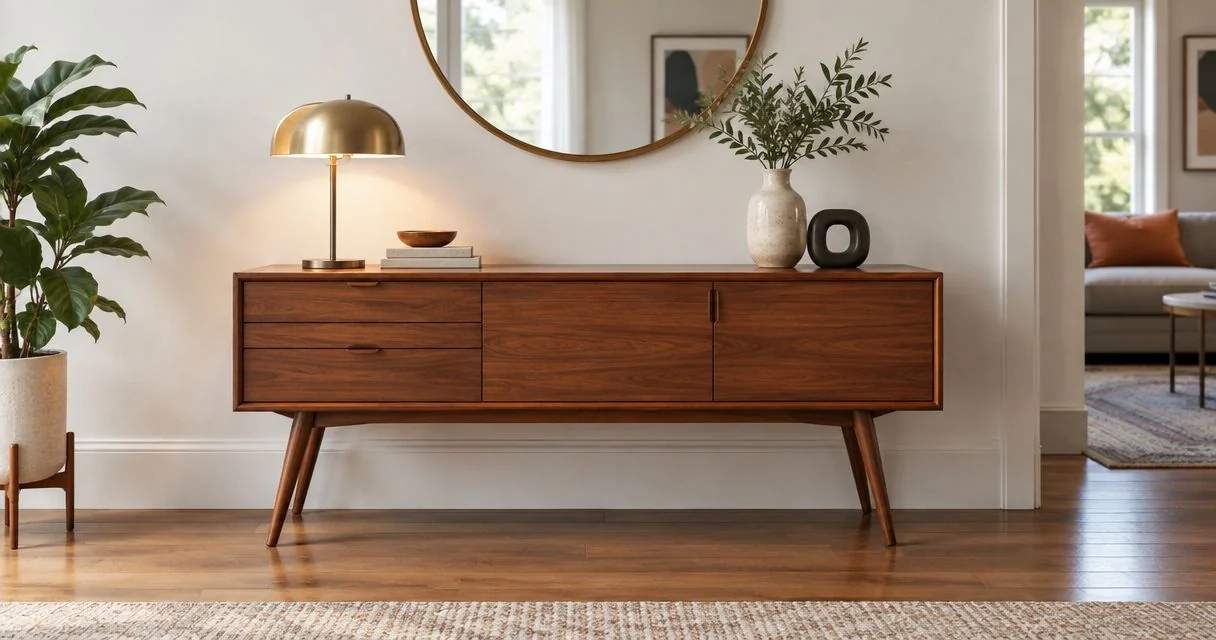
Best overall: a shallow-drawer wood console. Best for a narrow hallway: an open-frame console. Best for concealed storage: a sliding-door console. This 2026 guide from Sohnne compares six mid century modern console table configurations by room fit, storage, and everyday use—not by named products.
TL;DR- The best mid century modern console table for an everyday entryway pairs shallow drawers with a raised base.
- Choose an open-frame console for a narrow hallway; measure its full footprint, including projecting legs.
- Choose sliding doors when you need concealed storage without hinged doors opening into the walkway.
- Sohnne recommends choosing console depth and storage before wood tone or decorative details.
Why this matters
A console sits where furniture and movement meet: beside the front door, behind a sofa, or along a dining-room wall. A handsome cabinet becomes an obstacle when its corners, handles, or open drawers interrupt that route.
For your 2026 shortlist, start with the job rather than the finish. Keys need a different home from serving dishes, and a display surface needs less enclosed space than a household drop zone. The right console solves a specific daily problem without creating a circulation problem.
What makes the best mid-century modern console table?
Use these criteria before comparing silhouettes. Tapered legs and warm wood establish a visual direction; they do not tell you whether a table fits your room.
- Usable depth: Measure from the wall to the furthest projecting edge, including handles, feet, and any gap required behind the furniture.
- Storage access: Check whether drawers, hinged doors, or sliding panels work comfortably in the intended position.
- Material disclosure: Look for separate descriptions of the top, frame, drawer boxes, and back panel. A wood-tone finish does not identify the underlying material.
- Construction details: Examine leg attachments, drawer operation, hardware, and assembly instructions rather than judging strength from photographs.
- Visual balance: Consider the relationship between the top, cabinet body, and legs. A raised base exposes more floor; a substantial cabinet gives the wall more visual weight.
- Care and stability: Read the finish-care instructions, stated load limits, and any anchoring requirements before deciding what to place on top.
Console tables at a glance
These are configuration recommendations, not claims about particular models. Each option wins a different room assignment.
| Rank and configuration | Best for | Standout feature | Key limitation |
|---|---|---|---|
| 1. Shallow-drawer wood console | Everyday entryway organization | Small items stay concealed near the door | Limited space for bulky belongings |
| 2. Open-frame console | Narrow hallways | Uninterrupted space beneath the top | No concealed storage |
| 3. Sliding-door console | Shared household storage | Doors move within the cabinet frontage | Part of the interior stays covered during access |
| 4. Lower-shelf console | Baskets and accessible storage | A second surface below the top | Stored items remain visible |
| 5. Rounded-edge console | An exposed position behind a sofa | Curved corners soften the outline | Curves do not reduce the full footprint |
| 6. Glass-top wood-frame console | A display-focused living-room wall | Transparent top reveals the base | Smudges and objects below remain visible |
1. Shallow-drawer wood console: best for everyday entryways
A shallow-drawer wood console is the strongest default when your front door opens directly into a living space. Drawers give keys, mail, and other small belongings a defined place while leaving the top available for a lamp or bowl.
Choose a restrained cabinet body with enough leg clearance to suit your cleaning routine. Warm wood and a simple drawer front establish the mid-century direction without requiring an elaborate room scheme.
Shallow-drawer wood console pros:
- Conceals small everyday belongings.
- Keeps frequently used items near the entrance.
- Leaves the lower area visually open when built on raised legs.
Shallow-drawer wood console cons:
- Shallow drawers do not accommodate large bags or tall objects.
- Drawers need clear space in front when open.
Best for: An entryway that needs organization rather than substantial household storage.
For your 2026 choice, inspect the internal drawer measurements—not just the table's outside dimensions. Test the footprint with the drawer extension included. Verdict: Buy this configuration if small-item clutter is your main problem.
2. Open-frame console: best for narrow hallways
An open-frame console consists of a top supported by legs or a simple frame, without an enclosed cabinet below. The exposed wall and floor keep the arrangement visually light.
That openness does not guarantee a shallow table. Read the full depth and examine whether angled legs extend beyond the top, especially where the hallway turns or meets a doorway.
Open-frame console pros:
- Leaves the space beneath the top unobstructed by cabinetry.
- Provides a simple surface for a lamp or catchall.
- Makes the wall behind the table part of the composition.
Open-frame console cons:
- Offers no concealed storage.
- Exposes lamp cords unless you plan their route.
Best for: A passage that needs a landing surface but not another storage cabinet.
Keep the arrangement spare. A table covered in baskets and stacked objects loses the visual clarity that made this configuration useful. Verdict: Buy for a narrow passage after confirming the complete footprint.
3. Sliding-door console: best for shared household storage
A sliding-door console conceals belongings behind panels that move across the cabinet front. Unlike hinged doors, those panels do not swing outward into the room.
Choose this configuration when the console must hold more than pocket-sized objects. Check shelf depth, usable opening width, and whether the interior accommodates what you intend to store.
Sliding-door console pros:
- Conceals mixed household belongings.
- Avoids an outward door swing.
- Provides a continuous cabinet surface for a quieter arrangement.
Sliding-door console cons:
- Overlapping panels prevent access to the whole interior at once.
- Tracks add an area to inspect and clean.
Best for: A shared entryway or dining-room wall with a defined concealed-storage task.
For a 2026 purchase, request an interior view before choosing a cabinet solely from its closed appearance. A clean frontage tells you little about shelf placement. Verdict: Buy when concealed storage matters more than an open base.
4. Lower-shelf console: best for baskets and accessible storage
A lower-shelf console adds an exposed storage surface beneath the tabletop. Use it when you want belongings within reach and are comfortable making them part of the room's appearance.
The shelf works best with a planned purpose. Measure your baskets, books, or other intended contents before choosing the table, including the vertical clearance between shelf and top.
Lower-shelf console pros:
- Adds storage without enclosed cabinetry.
- Keeps frequently used objects accessible.
- Separates decorative objects above from storage below.
Lower-shelf console cons:
- Does not hide mismatched belongings.
- Adds another horizontal surface to dust.
Best for: A household that uses baskets consistently or wants accessible book storage.
Do not assume baskets solve every storage problem. If they project beyond the shelf, their handles or edges become part of the walkway footprint. Verdict: Buy if you already know what belongs on the lower shelf.
5. Rounded-edge console: best behind a sofa
A rounded-edge console softens the outline of furniture placed where its ends remain exposed. Behind a sofa, its curved corners offer a different visual rhythm from the long, straight back of the upholstery.
Check the console from the side as well as the front. A table that looks balanced against a wall needs a finished back when it sits in an open-plan room.
Rounded-edge console pros:
- Gives exposed ends a softer outline.
- Contrasts with rectangular sofas and rugs.
- Works as a surface for lighting behind seating.
Rounded-edge console cons:
- Curved ends reduce usable surface at the corners.
- Rounded edges do not establish stability or child safety.
Best for: An exposed sofa-back position where the console is visible from several directions.
Compare the tabletop with the sofa back and check the location of outlets. A lamp is only useful there when its cord has a sensible route. Verdict: Buy for an exposed placement after checking the back finish.
6. Glass-top wood-frame console: best for a display wall
A glass-top wood-frame console makes the support structure visible through the surface. It suits an arrangement where the frame, wall finish, and objects are intended to be seen together.
Treat the glass specification as a buying question, not an assumption. Confirm the glass type, edge treatment, support method, and care instructions for the exact table.
Glass-top wood-frame console pros:
- Keeps the supporting frame visible.
- Provides a clear surface for a restrained display.
- Pairs transparent material with the texture of wood.
Glass-top wood-frame console cons:
- Fingerprints and smudges remain visible.
- Offers no visual concealment for objects or cords underneath.
Best for: A display-focused wall rather than a busy household drop zone.
Keep the surface selective and inspect how the top is secured. Transparency is an aesthetic choice, not evidence of strength. Verdict: Buy for display; skip when hidden storage is essential.
Measure the placement before choosing the finish
Record the available width, maximum depth, and intended height. Then mark the proposed footprint on the floor with removable tape and walk past it carrying the things you normally bring through that space.
Check the surrounding movement too: the front door opening, a nearby drawer extending, and the route around a sofa. Measure against the baseboard rather than assuming the furniture can sit flush with the wall.
Use this sequence:
- Mark the footprint: Include projecting legs and handles.
- Check access: Allow for doors, drawers, and nearby furniture.
- Place daily objects: Test the actual lamp, basket, or tray you intend to use.
- Review stability: Follow the manufacturer's load and anchoring instructions.
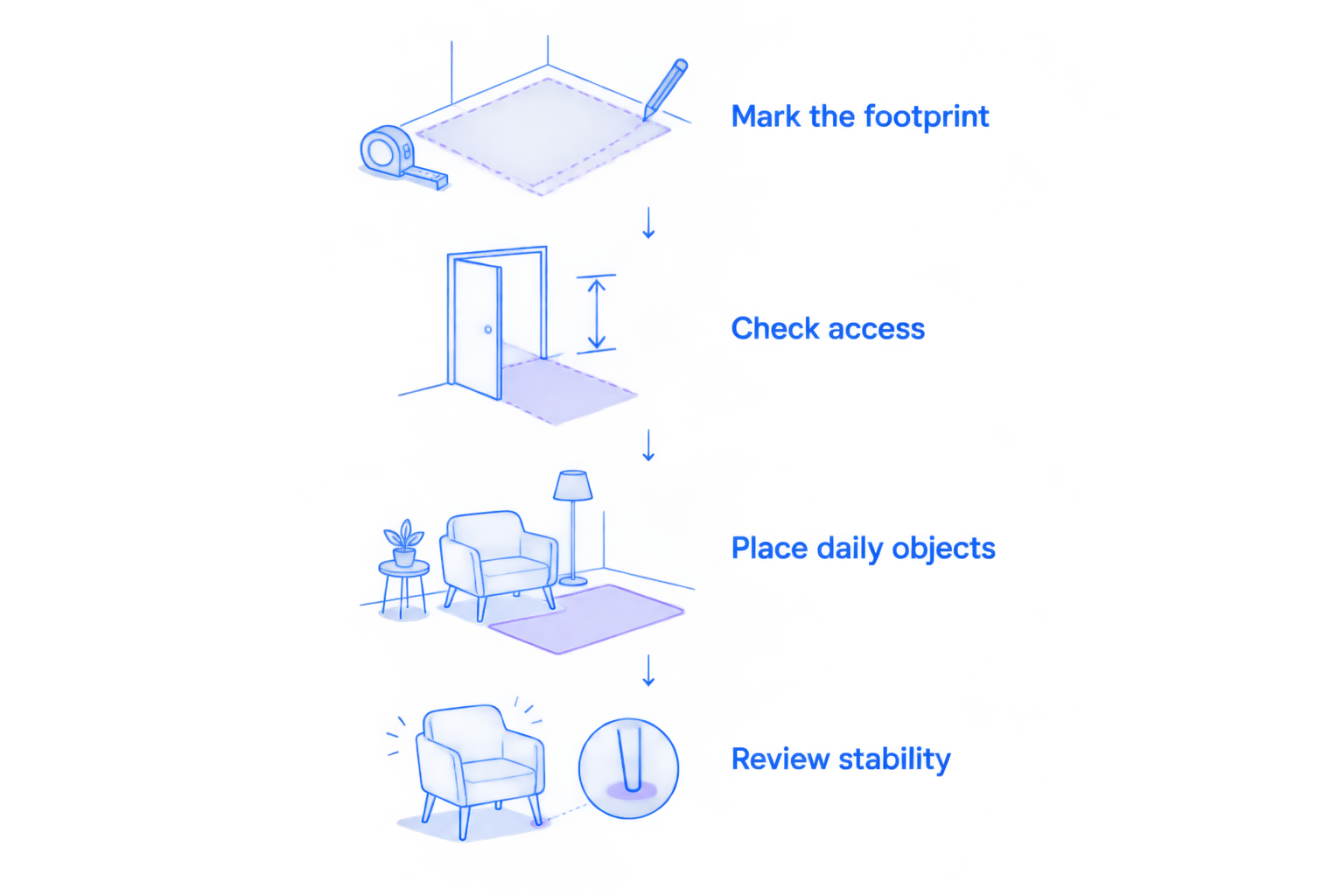 Check the console in use, not only as a closed rectangle against the wall.
A floor outline reveals the table's footprint, but not its height or visual weight. Hold a piece of cardboard at the proposed top height to judge its relationship with nearby seating, switches, and wall art.
How these console configurations rank
Sohnne's mid century modern console table ranking puts daily function before decorative detail. The shallow-drawer configuration leads because it gives an everyday entryway concealed small-item storage without requiring a full storage cabinet.
The remaining configurations each solve a narrower problem. This 2026 guide ranks those uses against the same criteria: footprint, access, material disclosure, construction details, visual balance, and care. Individual models still need those checks; a configuration alone does not establish quality.
Which console table should you choose?
Choose the shallow-drawer wood console if you are undecided. It gives an everyday entryway a clear place for small belongings while keeping the top available for light and a simple display.
Choose an open frame when the passage takes priority, sliding doors when storage takes priority, or rounded edges when the console stands behind a sofa. For a 2026 room plan, decide the position and contents first. Let the wood tone follow.
FAQ
What’s the best mid century modern console table for an entryway?
A shallow-drawer wood console is the best default for an entryway that needs small-item organization. Check internal drawer dimensions and make sure open drawers do not block the route through the room.
Which console table works best in a narrow hallway?
An open-frame console suits a narrow hallway when its full depth fits the passage. Measure projecting feet and handles as well as the tabletop, and keep the surface free of objects that extend beyond its edges.
Are sliding doors better than drawers on a console?
Sliding doors are better when you need cabinet storage without an outward door swing. Drawers are better suited to separating small objects; the right choice depends on what the console must hold.
Can I put a console table behind my sofa?
Yes, provided the console fits the space and leaves the surrounding route clear. Check its height against the sofa back, confirm that the rear surface is finished, and plan any lamp cords.
Is a glass-top console practical for everyday use?
A glass-top console suits display-focused use when you accept visible fingerprints and regular cleaning. Confirm the exact glass specification, support method, and manufacturer’s care instructions before choosing it.
How do I tell whether a wood console is well made?
Assess the stated materials and construction details rather than relying on the wood color. Inspect leg connections, drawer operation, hardware, and assembly requirements, and request close-up images when those details are unclear.
Does my console table need to match my other furniture?
Your console does not need to match every other piece. Choose a deliberate relationship through wood tone, shape, or finish, while checking that its size and storage suit the room.
One last thing
Before ordering, put everything intended for the console on a surface you already own. Separate what belongs on display from what needs to disappear into storage. That small exercise is more useful than choosing between nearly identical wood finishes.
Sohnne's recommendation is simple: buy the console for what happens around it, not just how it looks against an empty wall.
Related guides
- Best mid-century modern pendant lights
- How to choose furniture scale for a room with high ceilings
- How to add texture to a neutral living room with furniture
- Is it worth buying a full matching furniture set?
Stay connected with us!
Keep in touch with what’s new and next. Subscribe for weekly insights, product launches, and community news!