Best bouclé accent chairs in 2026
Sohnne Design Studio
November 27, 2026
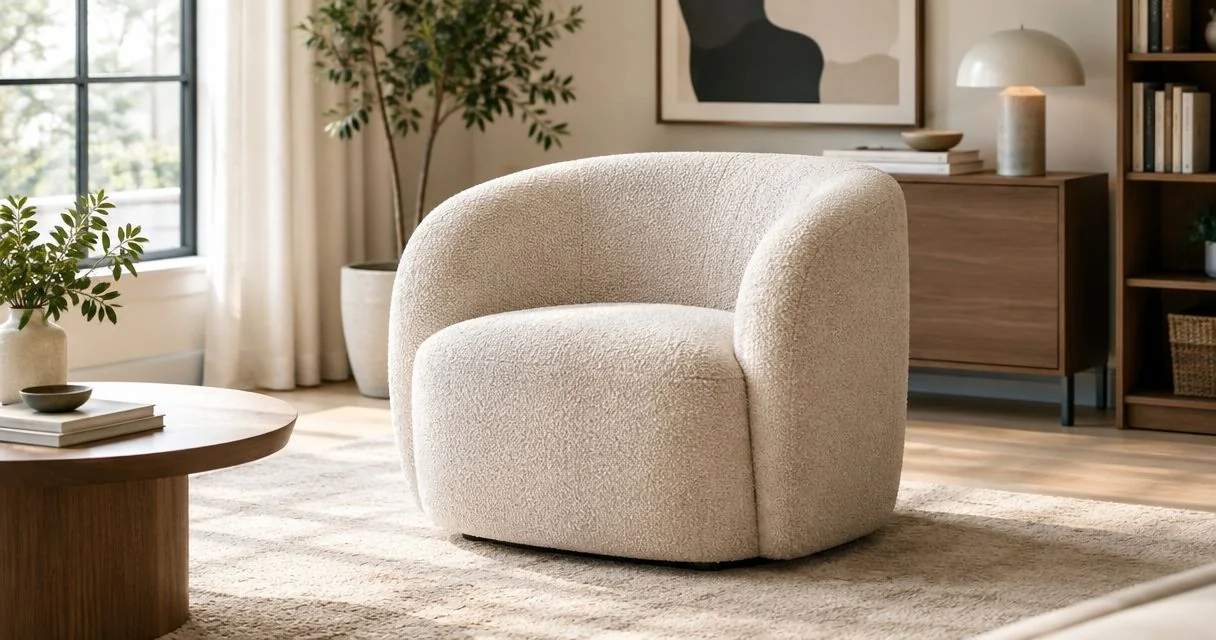
Best overall: a fixed-base barrel chair. Best for open-plan rooms: a swivel chair. Best for small spaces: an exposed-leg chair. This 2026 boucle accent chair guide compares five chair shapes by how they support sitting, fit the room, and work with everyday life.
TL;DR- Sohnne’s boucle accent chair guide favors a fixed-base barrel chair for everyday conversation seating.
- Choose a swivel accent chair when your seating needs to face different parts of an open-plan room.
- Choose an exposed-leg chair for visual lightness, but judge small-space fit by actual dimensions.
- Bouclé describes texture, not fiber content, stain resistance, or guaranteed durability.
Why this matters
A bouclé chair brings texture into a room without adding a strong pattern. Its looped surface catches light differently across the seat, arms, and back, giving a quiet interior more depth.
But upholstery cannot correct the wrong proportions. A beautiful chair becomes occasional seating when its seat is too deep for your legs or its arms make getting up awkward. Choose the chair’s shape and sitting position before choosing its color.
For readers exploring Sohnne, this guide separates furniture decisions from fabric decisions. The 2026 shortlist ranks chair configurations rather than treating a textured finish as evidence of comfort or construction quality.
What makes the best bouclé accent chair?
- Seat fit: Your feet should rest comfortably while the back supports your preferred sitting position. Check usable seat dimensions, not only overall dimensions.
- Back and arm support: Match the support to the task. Conversation, reading, and putting on shoes ask different things of a chair.
- Room footprint: Include the widest part of the chair, space for your legs, and any movement around its base.
- Upholstery information: Look for stated fiber content, cleaning instructions, and fabric-specific performance information. Texture alone answers none of these questions.
- Construction clarity: Examine the stated frame, suspension, cushion materials, and assembly requirements. Ask for details rather than filling gaps from photographs.
- Maintenance access: Consider seams, crevices, the area beneath the chair, and whether cushions or covers are removable. Confirm each feature for the actual chair.
Best bouclé accent chairs at a glance
These five configurations occupy different use-case slots. The ranking is a starting point for your 2026 shortlist, not a claim that every chair within a category performs identically.
| Rank and chair type | Best for | Standout feature | Key limitation |
|---|---|---|---|
| 1. Fixed-base barrel chair | Everyday conversation | Curved back and arms form an enclosing seat | Broad arms can reduce usable seat width |
| 2. Swivel chair | Open-plan living | Changes direction without repositioning the base | Needs clearance throughout its turning path |
| 3. Exposed-leg chair | Visually light small rooms | Open space beneath the seat | Visible legs do not guarantee compact dimensions |
| 4. High-back armchair | Upright reading | Taller back offers a larger support surface | Height creates a stronger visual presence |
| 5. Armless slipper chair | Bedroom dressing corners | Open sides allow an unobstructed approach | No armrests for resting elbows or pushing up |
1. Fixed-base barrel chair: best for everyday conversation
A fixed-base barrel chair wraps a curved back around the sitter, often continuing into the arms. The shape gives a seating group a defined place to sit without requiring a tall back.
Choose a version that lets you sit comfortably with your back supported. A rounded exterior can conceal a narrow interior, so compare usable seat width with the chair you already find comfortable.
Fixed-base barrel chair pros:
- Curved arms provide places to rest your forearms.
- The enclosing shape defines an individual seat.
- A fixed base keeps the chair facing its intended conversation area.
Fixed-base barrel chair cons:
- Thick arms take up space without adding sitting width.
- A low back is unsuitable when you need upper-back or head support.
- Deep seats require careful checking for shorter sitters.
Best for: A living-room conversation group where guests sit facing one another.
Verdict: Buy a fixed-base barrel chair when its interior dimensions fit you. It is the default choice in this guide because its enclosed shape suits a clearly defined conversation seat.
2. Swivel chair: best for open-plan living
A swivel chair rotates on its base, allowing you to turn between a sofa, a window, and another part of the room. That movement is the reason to choose it; the upholstery is secondary.
Check the full turning path before committing. The back and arms need room to move past nearby walls, tables, and curtains, even when the base itself looks compact.
Swivel chair pros:
- Changes your viewing direction without dragging the chair.
- Serves seating areas with more than one focal point.
- Lets you turn toward conversation while remaining seated.
Swivel chair cons:
- The turning path adds to its effective footprint.
- A moving seat is unsuitable if you need a stationary surface when sitting down.
- Mechanism details require checking separately from upholstery details.
Best for: An open-plan room connecting conversation seating with another activity area.
Verdict: Buy a swivel chair when you genuinely need directional flexibility. Skip the mechanism when the chair will always face the same place.
3. Exposed-leg chair: best for a visually light small room
An exposed-leg chair leaves visible floor beneath the seat. That open area helps preserve sightlines in a compact room, particularly beside a sofa with a heavy, floor-reaching base.
The effect is visual, not dimensional. A chair with slender legs can still have wide arms or a deeply angled back, so measure its entire outline rather than judging its size from the base.
Exposed-leg chair pros:
- Keeps part of the floor visible beneath the seat.
- Introduces a contrasting wood or metal element.
- Allows access beneath the seat when the clearance suits your cleaning tools.
Exposed-leg chair cons:
- Narrow-looking legs do not reduce the chair’s overall width.
- Floor protection needs checking for the leg and flooring combination.
- Exposed structure adds another finish to coordinate.
Best for: A small living room that needs seating without another visually solid block.
Verdict: Buy an exposed-leg chair for visual openness, then confirm its actual footprint. Skip any model that fits the photograph better than the floor plan.
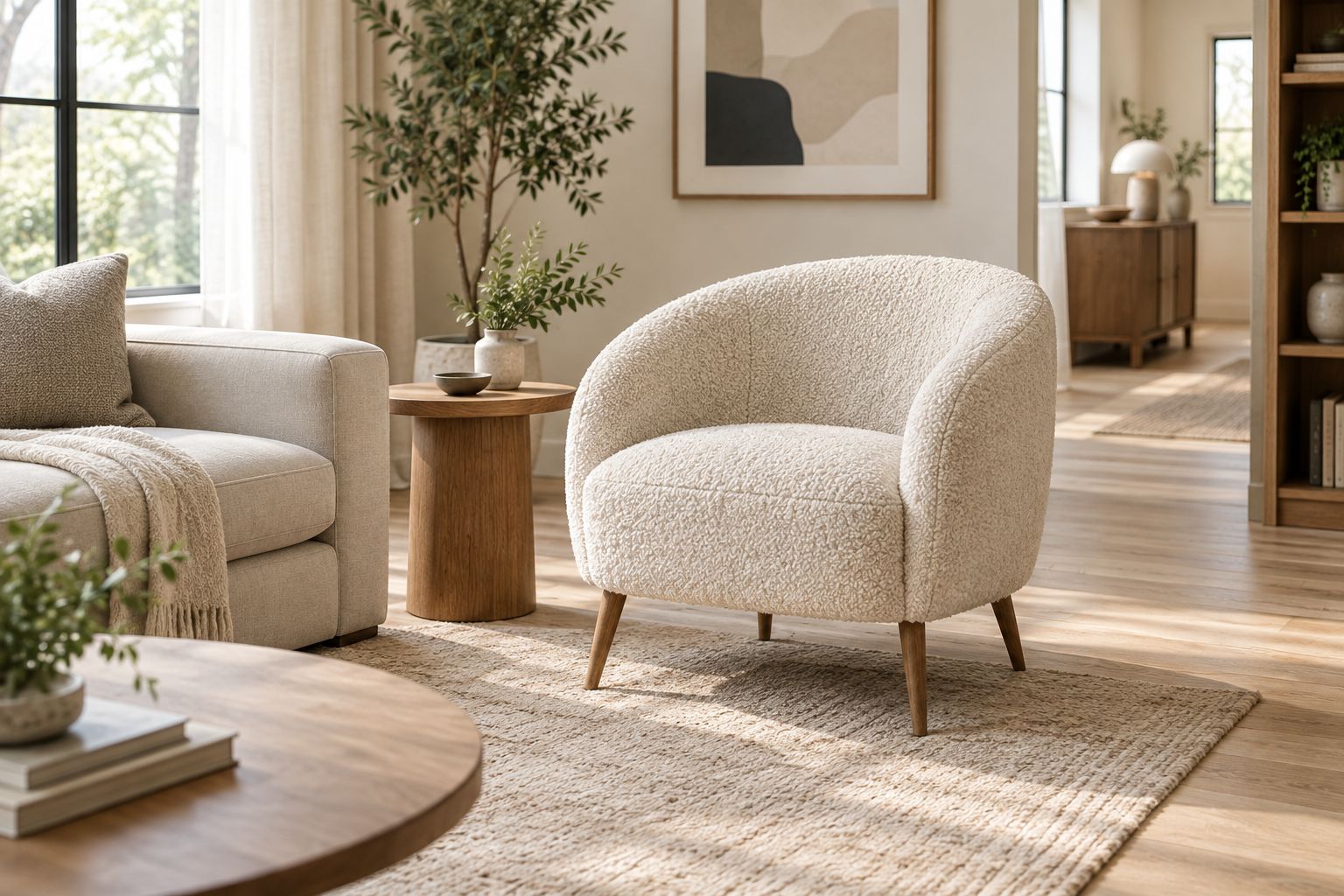 Exposed legs preserve a view of the floor, but overall dimensions still determine fit.
4. High-back armchair: best for upright reading
A high-back armchair provides a taller surface behind your torso than a low accent chair. Choose it for reading when its back angle, seat depth, and arm position support the way you hold a book.
Back height alone does not establish head support. Sit in the chair, or compare its dimensions with a familiar seat, before assuming the top edge will meet your shoulders or neck correctly.
High-back armchair pros:
- Provides a larger back-support surface.
- Armrests give your elbows a resting place while reading.
- A tall outline gives a reading corner a distinct presence.
High-back armchair cons:
- Its height interrupts more of the view behind it.
- A poorly positioned back contour remains uncomfortable despite its height.
- Large arms can restrict your preferred reading posture.
Best for: A dedicated reading corner where upright support matters more than a low silhouette.
Verdict: Buy a high-back armchair after checking your seated posture. Wait if the choice rests entirely on back height rather than how the whole chair fits.
5. Armless slipper chair: best for a bedroom dressing corner
A slipper chair removes the arms, leaving the seat open at both sides. It suits brief sitting tasks where an easy approach matters more than elbow support.
Check seat height especially carefully. An armless chair gives you no armrests to push against, so the seat must work for the person who will use it.
Armless slipper chair pros:
- Open sides leave the seat accessible.
- No arms compete with a nearby dresser or bedside furniture visually.
- The simple outline keeps attention on the upholstery texture.
Armless slipper chair cons:
- There is nowhere to rest your elbows.
- It lacks armrests to assist with standing.
- A low or deep version can be awkward for dressing tasks.
Best for: A bedroom corner used for putting on shoes or laying out clothes.
Verdict: Buy a slipper chair for short, purposeful sitting. Skip it as your default reading seat when you rely on arm support.
Check the fabric before choosing the color
For a 2026 purchase, ask what the upholstery is made from rather than accepting bouclé as the complete material description. Bouclé refers to looped yarn and the resulting textured surface; it does not identify a single fiber.
Wool, synthetic fibers, and blends require different care decisions. Follow the instructions for the specific upholstery, and do not assume that a removable cover is machine washable.
Use these checks before deciding:
- Fiber content: Confirm the composition of the actual upholstery option.
- Cleaning method: Read the manufacturer’s instructions before applying water or a cleaning product.
- Surface texture: Examine how pronounced and open the loops are.
- Household contact: Consider claws, jewelry, clothing fasteners, and other objects that can catch on loops.
Do not treat a pale textured chair as maintenance-free. A fabric sample lets you assess the surface in your own light; it does not prove stain resistance. Keep bouclé furniture care part of the buying decision, not something to investigate after a spill.
Measure the seat, the room, and the route
Start with 3 seat measurements: usable width, usable depth, and height from the floor. Record them in inches so you can compare candidates consistently. Overall chair dimensions answer a different question: whether the object fits the room.
Next, mark the chair’s outline on the floor with removable tape. Sit beside the marked area, open nearby drawers, and walk the route you use daily. For a swivel chair, check its moving outline as well as its resting position.
Finally, measure the delivery route. Door openings, hallway turns, stairs, and packaging dimensions all belong in the check. Do not assume removable legs or a detachable back unless the chair’s assembly information confirms them.
This 2026 buying checklist has a simple order: fit your body, fit the room, then confirm access. A chair that fails any of these checks does not belong on your shortlist.
How to make bouclé sit comfortably in the room
Let the upholstery provide texture while nearby materials provide contrast. A smooth wooden table, a plain woven rug, or a metal lamp gives the looped surface something distinct to sit beside.
Avoid choosing every upholstered piece from the same photograph. Compare samples against your existing sofa in daylight and under evening lighting, because the surrounding colors and light affect how you perceive the fabric.
Position the chair for its task before finishing the arrangement. A reading chair needs light placed around the reader; a conversation chair needs a useful relationship with the other seats. Add cushions only after checking whether the chair needs them for comfort.
How we ranked these chair types
Sohnne’s bouclé accent chair ranking puts seat fit, support, room footprint, upholstery information, construction clarity, and maintenance access ahead of appearance alone. Each configuration earns a different recommendation because it solves a different seating problem.
The 2026 verdict favors a fixed-base barrel chair for ordinary conversation seating. A swivel, exposed-leg, high-back, or armless design becomes the better choice when movement, visual openness, reading support, or dressing access is the priority.
Which bouclé accent chair should you choose?
Choose a fixed-base barrel chair if you need one dependable starting point for living-room conversation seating. Move away from that default only when your room or sitting habits give you a clear reason.
Sohnne’s bouclé accent chair guide favors fit over silhouette: choose the chair you can sit in comfortably, not merely the one that completes a picture. Keep your final shortlist focused on the configuration that serves your main activity.
FAQ
What’s the best boucle accent chair for most living rooms?
A fixed-base barrel chair is this guide’s default for living-room conversation seating. Its curved back and arms define an individual seat, but usable seat dimensions still need to fit the sitter.
Is a swivel bouclé chair better than a fixed chair?
A swivel bouclé chair is better when you need to face different parts of a room. Choose a fixed chair when a stationary seat and a consistent orientation better suit your routine.
What bouclé accent chair works best in a small room?
An exposed-leg chair is the visual-lightness choice for a small room. Confirm overall width and depth, because visible floor beneath a chair does not make its footprint smaller.
Is bouclé a good upholstery choice for homes with cats?
Bouclé is not the default choice when snag resistance is your priority. Its loops can catch on claws, so examine the specific fabric and your cat’s behavior before choosing it.
Can you wash bouclé chair upholstery?
Wash bouclé upholstery only when the manufacturer’s care instructions permit it. A removable cover is not proof that the fabric is machine washable.
Is a high-back bouclé chair good for reading?
A high-back bouclé chair suits reading when its back angle, seat depth, and arm position fit your posture. Back height alone does not establish comfortable neck or head support.
What should you measure before buying a bouclé chair online?
Measure usable seat width, seat depth, seat height, and the chair’s overall footprint. Also check the delivery route and the full turning path for a swivel design.
One last thing
Photograph your taped chair outline from the doorway, not only from directly in front of it. That view reveals what the chair will block and how it relates to the rest of the room.
Then remove the photograph from the decision for a moment. Walk through the space. The best chair belongs in the route of your day without getting in its way.
Related guides
- How to style a bouclé lounge chair in a bedroom
- How long bouclé fabric stays looking new
- How to pick the right armchair for a small bedroom
Stay connected with us!
Keep in touch with what’s new and next. Subscribe for weekly insights, product launches, and community news!