Best mid-century modern dining tables in 2026
Sohnne Design Studio
November 26, 2026
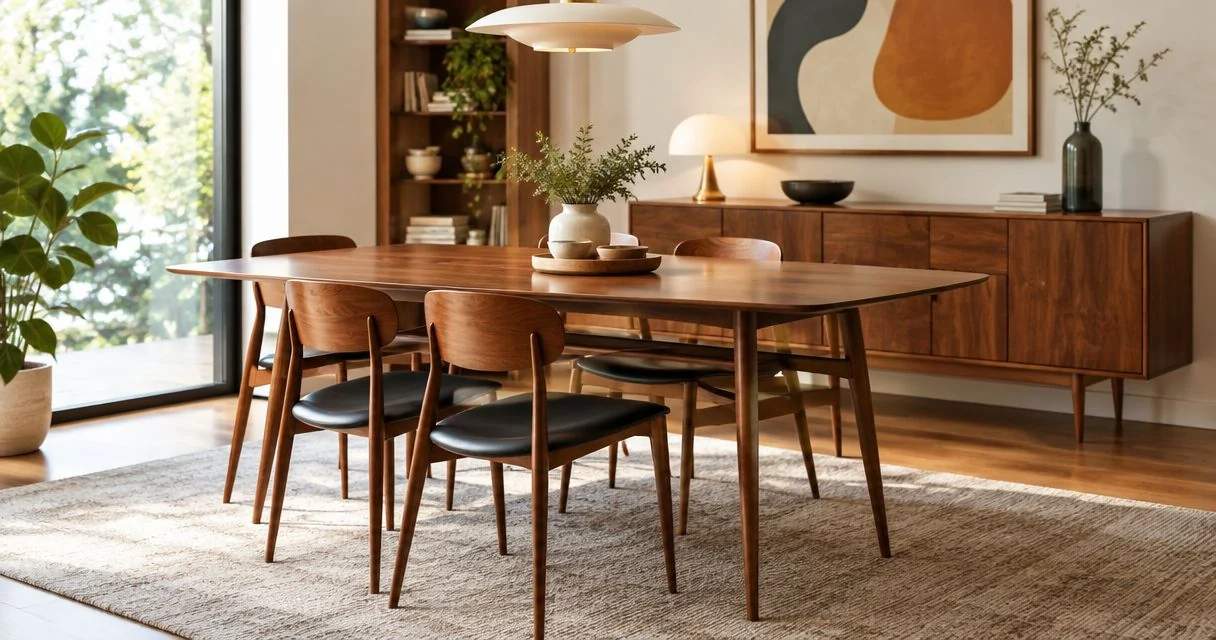
Best overall: a rectangular wood dining table. Best for a compact dining nook: a round wood table. Best for occasional hosting: an extendable wood table. This 2026 guide compares five mid century modern dining table configurations by room fit, seating comfort, construction, and everyday use.
TL;DR- Sohnne’s mid century modern dining table guide recommends rectangular wood tables for dedicated dining rooms.
- Round dining tables suit compact nooks; check the base position before choosing chairs.
- Extendable dining tables suit occasional hosting only when the room accommodates the open configuration.
- Judge usable seating by leg placement and chair clearance, not tabletop dimensions alone.
Why this matters
A dining table occupies more space than its top suggests. Chairs need room to move, people need a route behind them, and nearby storage still needs to open. A beautiful silhouette does not resolve a crowded layout.
For your 2026 shortlist, start with the room rather than the finish. At Sohnne, apply the same rule to mid-century modern furniture: choose the footprint first, then assess the material, edge, and base. A warm wood surface belongs in the conversation only after everyone can sit comfortably.
What makes the best mid-century modern dining table?
- Room fit: The table must leave usable space for chairs, circulation, and storage access.
- Seating geometry: Legs, rails, and supports should not occupy the places where diners need their knees.
- Material clarity: Look for an explicit description of the top, core, finish, and base—not a wood color alone.
- Daily care: Choose a surface whose cleaning instructions match how you eat, work, and entertain.
- Visual balance: A restrained edge and open base keep the dining area from feeling crowded.
- Adaptability: An extension mechanism earns its place when you genuinely need different seating arrangements.
The best table is the one that fits with the chairs pulled out, not just pushed in. Use that distinction to eliminate unsuitable options before comparing decorative details.
The 2026 shortlist at a glance
These are table configurations, not individual product models. Each occupies a different use-case slot; the order favors straightforward daily dining before more specialized layouts.
| Table configuration | Best for | Standout feature | Key limitation |
|---|---|---|---|
| Rectangular wood | Dedicated dining rooms | Straight sides organize seating clearly | Corner legs can restrict end seats |
| Round wood | Compact dining nooks | Curved perimeter removes projecting corners | A large diameter makes the center harder to reach |
| Oval wood | Open-plan dining areas | Long seating edges with rounded ends | Curved ends provide less usable surface than rectangular corners |
| Extendable wood | Occasional hosting | Changes length between everyday and guest use | Needs space for the fully extended arrangement |
| Compact square wood | Two-person dining | Simple footprint for a small household | Offers limited flexibility for larger gatherings |
1. Rectangular wood: best for a dedicated dining room
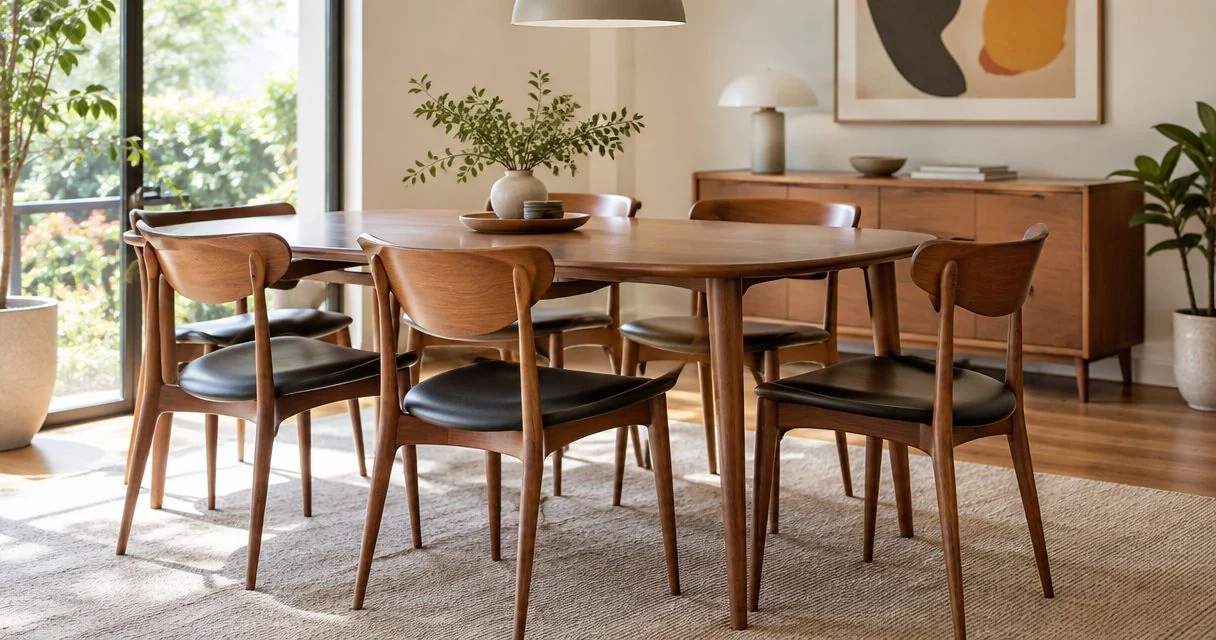
A rectangular wood table is the default choice when your dining area has a clear boundary. Its long sides make chair placement easy to understand, while the straight footprint works naturally alongside a wall or sideboard. Choose it for predictable daily seating rather than sculptural impact alone.
Look closely beneath the top. A substantial apron—the rail below the tabletop—can reduce thigh clearance even when the overall height looks suitable. Likewise, widely splayed legs can occupy the space where an end chair needs to sit.
Rectangular wood table pros:
- Straight sides make place settings and chair positions easy to organize.
- The long surface accommodates shared dishes along its center.
- The footprint aligns neatly with a rectangular room.
Rectangular wood table cons:
- Projecting corners require attention near busy walking routes.
- Legs near the corners can reduce usable seating at the ends.
Best for: A household with a dedicated dining room and a consistent daily seating arrangement.
Verdict: Buy a rectangular wood table if straightforward room fit is your priority.
2. Round wood: best for a compact dining nook
A round wood table softens a small dining area without relying on decorative detail. Everyone faces toward the center, and the perimeter has no corners projecting into nearby routes. Its success still depends on diameter and base placement.
Do not assume that a circular top guarantees generous legroom. Several legs clustered beneath a small top can conflict with chair positions. Check the footprint of the supports against the actual chairs you intend to use.
Round wood table pros:
- A continuous curved edge removes projecting tabletop corners.
- The seating arrangement supports face-to-face conversation.
- The shape creates a distinct dining zone within a nook.
Round wood table cons:
- Increasing the diameter also increases the distance to the center.
- A round top does not sit flush against a wall.
Best for: A compact dining nook where a curved edge suits the walking route.
Verdict: Buy a round wood table when the complete chair arrangement fits comfortably.
3. Oval wood: best for open-plan dining
An oval wood table combines a long dining surface with rounded ends. It suits an open-plan room where people pass around the dining area on their way elsewhere. The elongated shape establishes direction without placing a sharp tabletop corner beside that route.
Compare the usable surface, not just the maximum length and width. The curved ends remove some area that a rectangular top would retain. End seats also need a base arrangement that leaves feet and knees free.
Oval wood table pros:
- Rounded ends remove corners beside circulation routes.
- Long sides support an organized dining arrangement.
- The outline provides a softer transition between dining and living areas.
Oval wood table cons:
- Curved ends leave less surface for place settings and serving dishes.
- A long top still requires a substantial overall footprint.
Best for: An open-plan dining area with regular movement around the table ends.
Verdict: Buy an oval wood table when circulation matters more than maximum tabletop area.
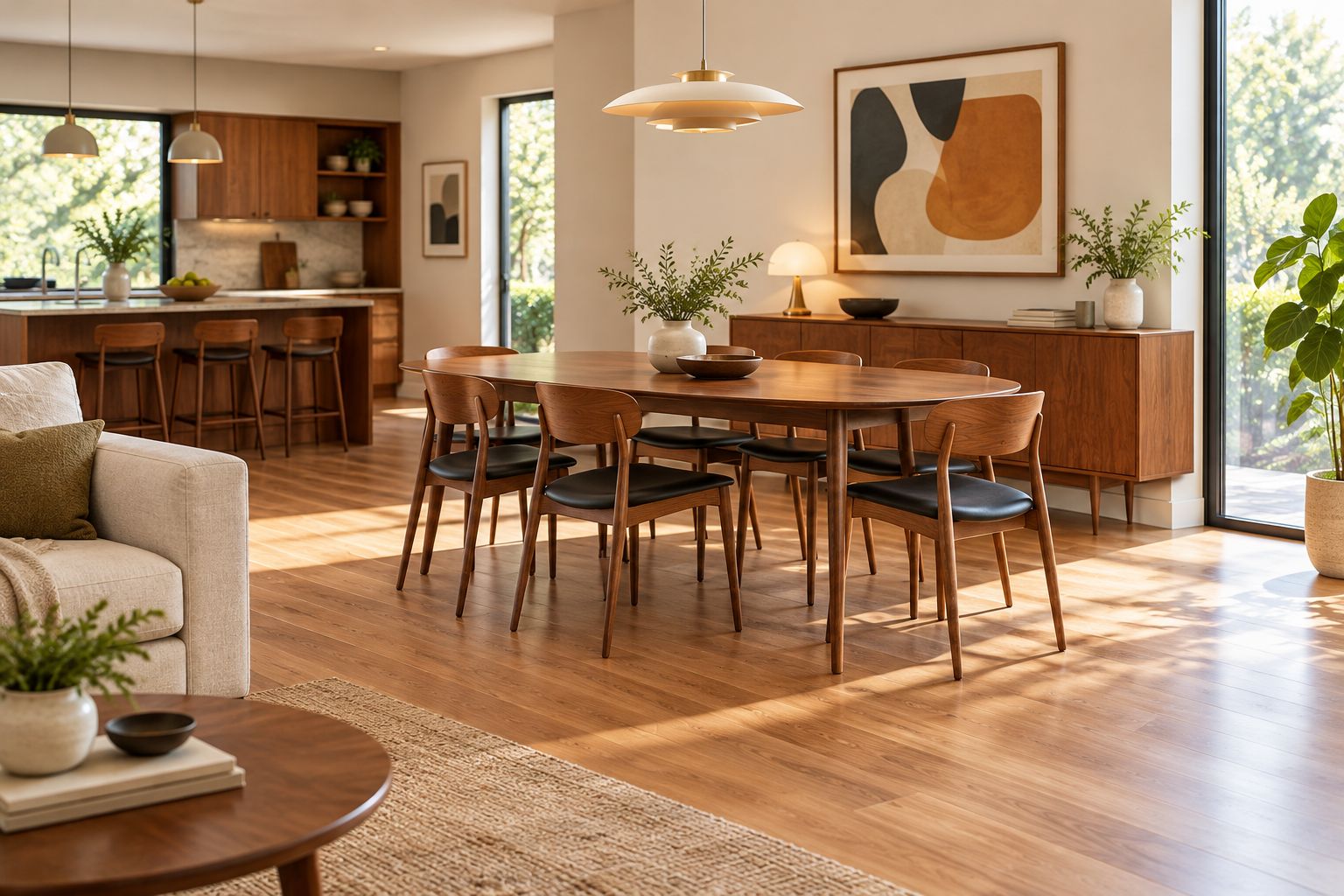 Rounded ends remove projecting corners, but the chairs still need their own space.
4. Extendable wood: best for occasional hosting
An extendable wood table changes length when your seating needs change. It suits a household that wants a smaller everyday arrangement and a larger surface for planned gatherings. The mechanism matters as much as the closed silhouette.
Check how the top opens, where additional sections are stored, and whether the supports move with the extension. Ask for instructions before deciding. A table that expands into a doorway does not solve a hosting problem.
Extendable wood table pros:
- Offers different lengths for everyday meals and gatherings.
- Keeps the daily footprint smaller than the fully open arrangement.
- Adapts the dining surface without replacing the table.
Extendable wood table cons:
- Moving parts and tabletop joins add inspection and care points.
- Separate extension sections need suitable storage when not in use.
Best for: A household that hosts occasionally and has room for the open configuration.
Verdict: Buy an extendable wood table only after checking both layouts.
5. Compact square wood: best for two-person dining
A compact square wood table creates a defined place for everyday meals without introducing a long dining surface. It suits a two-person household that values a permanent dining spot. Keep the surrounding chairs visually simple so the arrangement remains clear.
Square does not automatically mean space-saving. The top, legs, and occupied chairs still form a larger footprint, particularly when every side is used. Choose this configuration for your normal routine rather than an occasional gathering.
Compact square wood table pros:
- Provides straight edges for simple place-setting layouts.
- Establishes a dining area without a long tabletop.
- Works with a restrained pair of everyday dining chairs.
Compact square wood table cons:
- Offers limited flexibility when several guests join you.
- Corners remain present beside nearby walking routes.
Best for: A two-person household with a small, clearly defined dining area.
Verdict: Buy a compact square wood table for everyday meals; skip it for regular group hosting.
Check the fit before choosing the finish
Treat these measurements as planning guidelines, not product specifications. Around 30 inches high is a common dining-table reference; allow approximately 24 inches of tabletop edge per diner and start with 36 inches between the table edge and a wall or cabinet. A route behind occupied chairs needs more space than chair movement alone.
Use your actual furniture to refine those starting points. Broad chairs, thick upholstery, arms, and deep seats change the fit. Your 2026 room plan should include these details before you settle on a tabletop size.
- Mark the top. Use removable tape to outline the proposed tabletop on the floor.
- Place the chairs. Position your existing chairs around that outline and sit down.
- Walk the route. Move behind an occupied chair and open nearby doors and drawers.
- Check the base. Compare the proposed leg positions with your knees, feet, and chair legs.
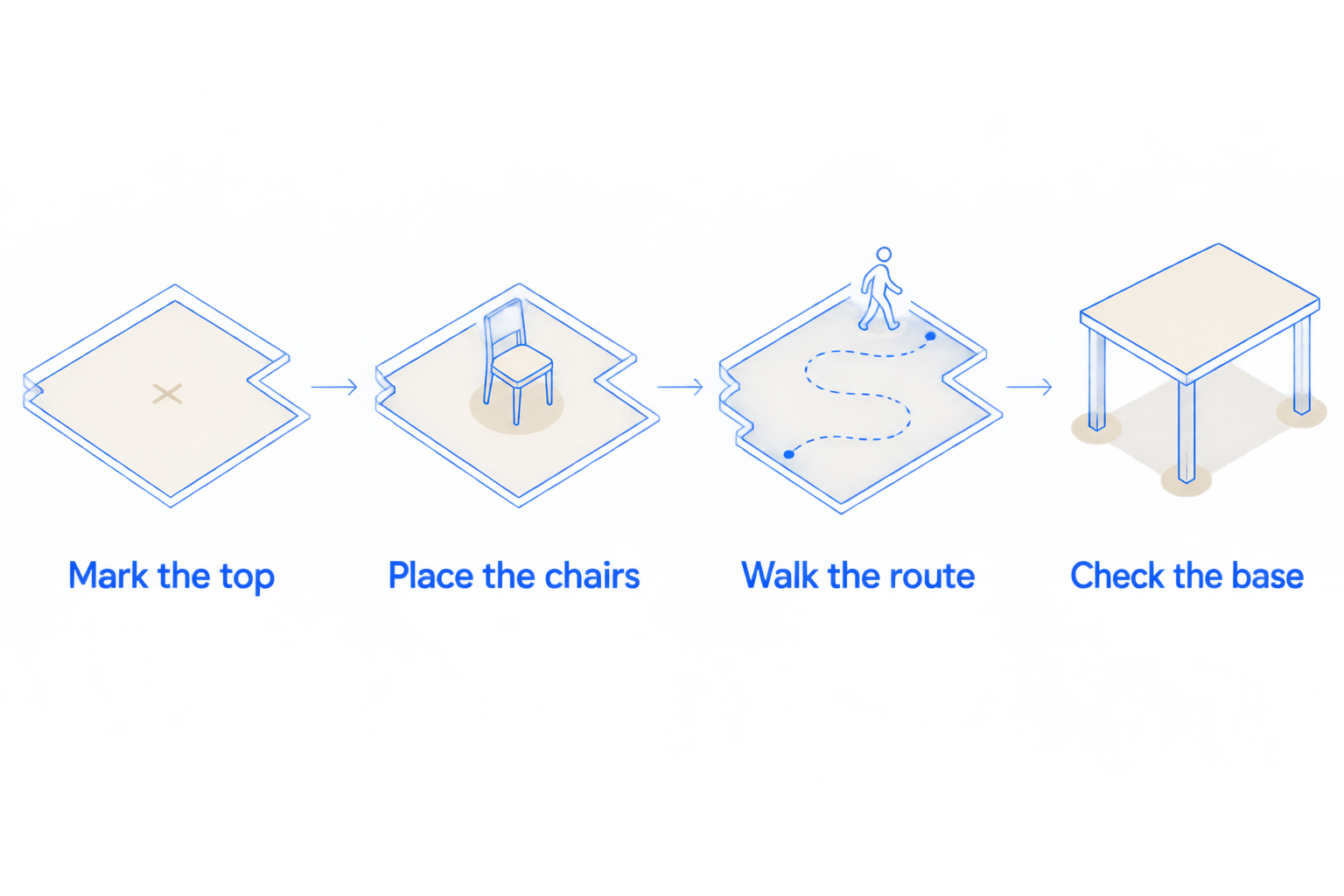 Test the occupied dining area before judging its appearance.
A cardboard outline can help you judge an oval or round top more accurately than its maximum dimensions alone. Keep it in place during an ordinary evening so you experience the walking route, not just a staged arrangement.
Balance the table with storage and lighting
A dining room is not an isolated table surrounded by empty space. Storage, lighting, and chair movement share the same footprint. When planning around mid-century sideboards, account for cabinet doors and drawers as well as the space diners occupy; a closed cabinet conceals part of its working footprint.
Choose which piece leads visually. A strongly figured wood tabletop benefits from quieter storage, while a restrained table leaves room for a more expressive cabinet. The wood tones do not need to match exactly, but repeating an undertone helps the combination feel deliberate.
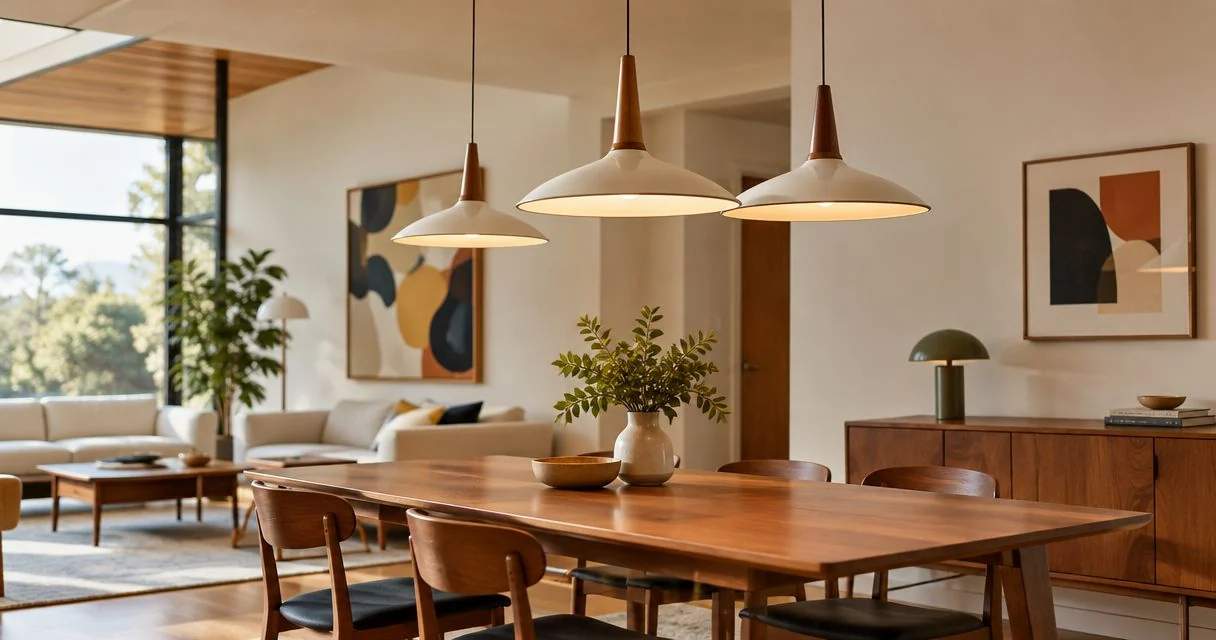
Center the dining light over the table’s intended position rather than automatically using the room’s center. With an extendable table, consider both arrangements before fixing that position. Keep the centerpiece low enough for seated conversation.
Read the material description closely
A wood species name does not describe the entire table. Separate the surface material from the core, edge, base, and protective finish. A walnut-colored finish, for example, does not establish that the top is solid walnut.
Solid wood and wood veneer are construction choices, not complete quality verdicts. Solid wood responds to changes in humidity; veneer places a thin wood surface over a supporting core. For either construction, inspect how the edges are finished and follow the stated care instructions.
Before ordering, confirm:
- The material used for the top, its core, and its edges.
- Whether the base attaches securely and has leveling provisions.
- The recommended cleaning method and protection from heat and moisture.
- The assembly sequence and access needed to tighten fasteners.
Ask Sohnne about any construction detail that remains unclear. Request a written answer tied to the specific table rather than assuming that a collection-wide description applies to every piece.
How the configurations rank
The 2026 order prioritizes room fit, usable seating, material clarity, care, visual balance, and adaptability. Rectangular wood leads because it provides a straightforward default for a dedicated dining room; the remaining configurations answer different layout needs.
This is a configuration ranking, not a product-testing claim. A well-built table in the right shape remains a better choice than a higher-ranked shape that obstructs your room.
Which mid-century modern dining table should you choose?
Choose a rectangular wood table unless your layout gives you a clear reason not to. Pick round for a compact nook, oval for circulation around the ends, extendable for occasional hosting, and compact square for a two-person routine.
Sohnne’s mid century modern dining table recommendation for 2026 is simple: resolve the occupied footprint before choosing the finish. That order protects everyday comfort from an attractive but unsuitable purchase.
FAQ
What’s the best mid century modern dining table shape?
A rectangular wood dining table is the best default for a dedicated dining room. Choose round for a compact nook or oval when people regularly walk around the table ends.
Is a round dining table better for a small room?
A round dining table suits a small room when its curved perimeter improves the walking route. Check the occupied chairs and base footprint before deciding; a round shape alone does not guarantee a smaller arrangement.
How much space should I leave around a dining table?
Start with approximately 36 inches between the table edge and a wall or cabinet as a planning guideline. Leave more room where people must pass behind occupied chairs, and include space for storage doors to open.
How much tabletop space does each person need?
Allow approximately 24 inches of tabletop edge per diner as a starting guideline. Broad chairs and table legs near seating positions require a closer fit check.
Is solid wood always better than wood veneer?
Solid wood is not automatically better than wood veneer. Assess the complete construction, edge treatment, supporting structure, finish, and care requirements rather than treating either material label as a quality guarantee.
Should I choose an extendable dining table?
Choose an extendable dining table when your household needs different everyday and hosting layouts. Confirm the open dimensions, support positions, operating instructions, and storage requirements before ordering.
Do dining chairs need to match the table?
Dining chairs do not need to match the table exactly. Prioritize seat comfort, arm clearance, and compatible proportions, then connect the pieces through wood undertones or another repeated material.
One last thing
Measure the underside, not just the tabletop height. A deep apron can stop chair arms from sliding beneath an otherwise suitable table. Before you commit, compare the lowest underside clearance with the highest point of your chairs—and check that clearance where the chairs actually sit.
Related guides
- Best mid-century modern dining chairs
- Mid-century modern dining chairs ranked by durability
- Best mid-century modern pendant lights
Stay connected with us!
Keep in touch with what’s new and next. Subscribe for weekly insights, product launches, and community news!