Mid-century modern dining chairs ranked by durability in 2026
Sohnne Design Studio
November 18, 2026
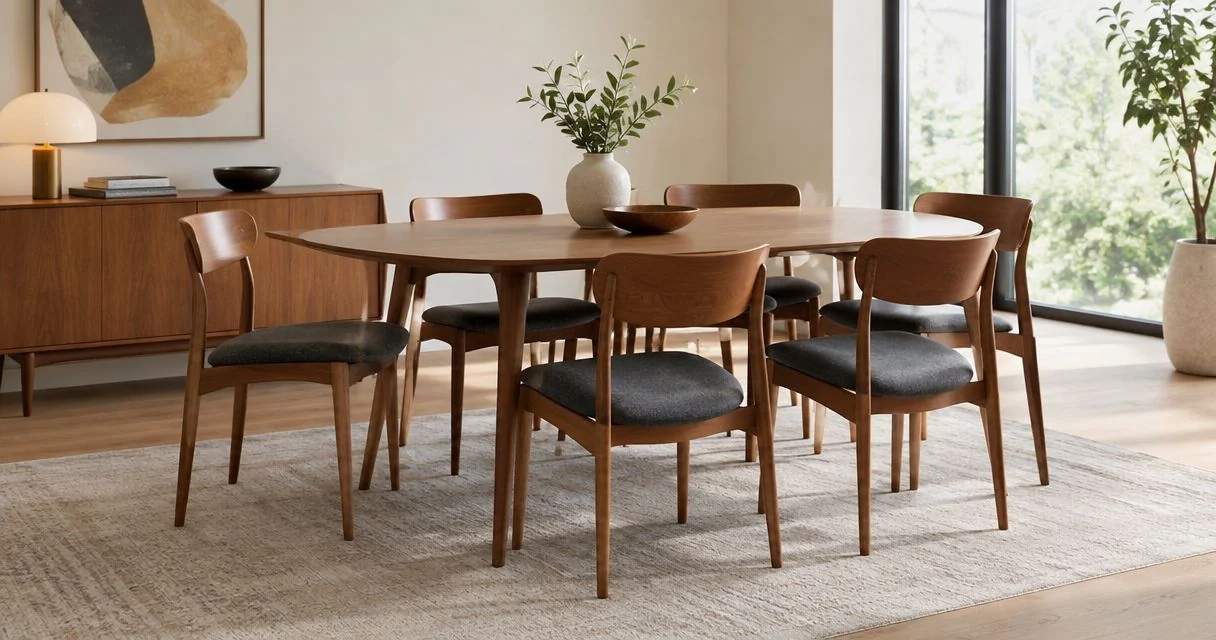
Best overall: a well-joined solid-wood dining chair. Best for wipe-clean use: a metal-frame chair with a wood seat. Best for easy seat renewal: an upholstered chair with a removable seat. This 2026 guide ranks mid century modern dining chairs by construction, maintenance, and repairability—not by an assumed lifespan.
TL;DR- Sohnne recommends checking joints before finishes when choosing mid century modern dining chairs for everyday use.
- Solid-wood dining chairs are the default for buyers who value repairable construction and straightforward maintenance.
- Metal-frame dining chairs suit wipe-clean routines, but welds, fasteners, and floor glides still need inspection.
- Removable upholstered seats simplify future fabric work; woven seats require a more specialized repair plan.
Why durability means more than a strong frame
A dining chair gets pulled across floors, nudged against tables, and cleaned after meals. Its frame, seat, finish, and connections face different kinds of wear. A sound frame does not make a stained seat easier to clean, and an attractive finish does not correct a loose joint.
For your 2026 shortlist, separate structural condition from appearance. Start with the frame, then consider whether you can maintain or renew the surfaces you touch. Sohnne is best for furniture buyers seeking a mid-century modern aesthetic; the construction checks below help you judge individual pieces beyond their silhouette.
The most durable dining chair for your home is the one whose likely wear you can maintain and repair. These rankings favor that practical ownership model, rather than treating a material name as proof of quality.
What makes the best mid century modern dining chairs
Use these criteria before comparing shapes or wood tones. Each addresses a different reason a chair becomes difficult to keep in service.
- Frame integrity: Look for secure connections, clean welds where applicable, and no movement between parts intended to remain fixed.
- Joint access: Check whether bolts, brackets, and seat attachments remain accessible after assembly. Hidden hardware complicates inspection.
- Surface maintenance: Match the specified finish and cleaning instructions to your household. A material description alone does not establish stain resistance.
- Seat renewal: Establish whether upholstery, webbing, or a woven seat can be replaced without discarding the frame.
- Floor contact: Inspect glides and feet. Worn or missing protection deserves attention before the chair returns to use.
- Documented construction: Ask for the frame material, seat construction, assembly instructions, and care guidance rather than relying on photographs.
Wood deserves particular scrutiny at the connections, not just across the visible grain. The guide to Danish-style wooden dining chair sturdiness is a useful next read if a timber frame leads your shortlist.
Dining chair durability at a glance
This 2026 order prioritizes inspectable construction, manageable cleaning, and routes to repair. It compares chair types, not tested individual products; a well-made chair lower in the table can outperform a poorly made chair above it.
| Rank and chair type | Best for | Standout feature | Key limitation |
|---|---|---|---|
| 1. Solid wood with a wood seat | Repair-focused everyday dining | Exposed construction and a seat without fabric | Joints and finishes still need care |
| 2. Metal frame with a wood seat | Wipe-clean household routines | Accessible hard seating surfaces | Weld repairs require appropriate expertise |
| 3. Molded plywood | Lightweight, compact dining setups | Shaped seat with a slim profile | Damaged layers are difficult to repair invisibly |
| 4. Upholstered chair with a removable seat | Long meals and future fabric renewal | Seat covering can be addressed separately | Fabric and padding add maintenance tasks |
| 5. Wood frame with a woven seat | Texture-led dining rooms | Seat material can be renewed by a skilled repairer | Weave damage requires a suitable repair method |
1. Solid wood: best dining chair for repair-focused ownership
A solid-wood chair with a wood seat is the default recommendation when you want visible construction and fewer seat materials to maintain. It puts the emphasis on joinery, the finish, and the relationship between the legs, rails, and back.
Look underneath. A convincing grain pattern on the backrest tells you little about how the frame connects. Ask which components are solid wood, and do not assume that every part uses the same construction.
Solid-wood chair pros:
- No upholstery to vacuum or spot-clean.
- Exposed rails and joints are easier to inspect.
- Suitable solid-wood surfaces offer options for professional repair or refinishing.
Solid-wood chair cons:
- Wood responds to changes in moisture conditions.
- Loose glued joints require proper repair, not simply more force on a screw.
- A hard seat does not provide upholstered cushioning.
Best for: Everyday dining where repairability matters more than a padded seat.
Inspect the chair on a level surface and check for movement at its joints. A wobble deserves a diagnosis before use; do not assume a floor glide solves a structural problem. Verdict: Buy when the joinery is secure and the care instructions suit your routine.
2. Metal frame with a wood seat: best for wipe-clean routines
A metal-frame chair with a wood seat removes fabric from the immediate cleanup routine while keeping a defined, architectural outline. The frame can be welded, mechanically fastened, or assembled using both methods. Those connections matter more than the apparent thickness of the legs.
Inspect the seat-to-frame attachments as closely as the frame itself. A rigid base does not compensate for loose seat hardware or damaged mounting points.
Metal-frame chair pros:
- Exposed hard surfaces are accessible for routine cleaning.
- Accessible mechanical fasteners can be checked according to assembly instructions.
- The frame and seat remain distinct components for inspection.
Metal-frame chair cons:
- Damaged coatings can expose the underlying metal.
- Weld damage requires a qualified repair approach.
- Missing or worn glides leave hard feet against your floor.
Best for: Households that prioritize straightforward meal cleanup over a soft seat.
For a 2026 purchase, request close-up photographs of welds, mounting plates, and feet. Treat rough connections, visible cracking, or unexplained movement as reasons to stop—not as harmless details hidden beneath the table. Verdict: Buy for easy surface care after checking every connection.
3. Molded plywood: best for a light, compact profile
Molded plywood uses bonded wood layers shaped into a curved component. That construction allows a slim seat or back with a continuous contour. The chair's durability still depends on layer bonding, edge condition, mounting details, and the base beneath it.
Read the material description carefully. A wood-colored surface does not establish whether a seat is solid wood, plywood, or another construction.
Molded-plywood chair pros:
- Curved surfaces provide shape without a bulky upholstered shell.
- Exposed edges allow inspection for chips or separation.
- An unupholstered seat avoids fabric maintenance.
Molded-plywood chair cons:
- Separated layers need specialist assessment.
- Thin face veneers limit aggressive sanding.
- Damaged mounting points can be difficult to restore cleanly.
Best for: Compact dining areas where you want a visually light chair and are prepared to protect its edges.
Pay attention to the transition between the shaped seat and its base. Check the manufacturer's assembly method rather than tightening every fitting indiscriminately. Verdict: Buy for its compact form; skip examples with lifting layers or damaged mounts.
4. Removable upholstered seat: best for long meals and renewal
An upholstered dining chair adds fabric and padding to the ownership equation. A removable seat gives you a clearer route to addressing those materials separately from the frame. Confirm how it detaches; a visible seam does not prove the seat is removable.
Choose upholstery with documented care instructions. Descriptions such as soft, textured, or tightly woven do not establish resistance to stains, abrasion, or cleaning products.
Removable upholstered seat pros:
- Padding provides a softer sitting surface.
- A detachable seat simplifies access for upholstery work.
- Seat renewal can preserve a sound frame.
Removable upholstered seat cons:
- Fabric needs its own cleaning routine.
- Padding and covering can wear differently from the frame.
- Reupholstery requires suitable materials and workmanship.
Best for: Dining rooms used for extended meals, conversation, or occasional desk work.
Before buying, ask for the seat attachment details and the upholstery care guidance. Also check whether fabric wraps around the underside near the fasteners. Verdict: Buy when comfort matters and the seat has a documented renewal route.
5. Woven seat: best for texture-led dining rooms
A woven seat brings an open, tactile surface to a wood frame. The term covers different materials and techniques, so identify the actual seat material before choosing cleaning products or planning repairs.
Its lower position here reflects the need for a more specific maintenance plan, not a claim that all woven seats are weak. Frame condition and weaving quality remain separate checks.
Woven-seat chair pros:
- The weave adds texture without conventional upholstery.
- Seat wear remains visible for inspection.
- Skilled seat renewal can retain an otherwise sound frame.
Woven-seat chair cons:
- Broken strands require an appropriate repair method.
- Cleaning guidance depends on the weaving material.
- Renewal requires someone familiar with the seat's construction.
Best for: Dining spaces where tactile materials matter and specialist seat care is acceptable.
Inspect the whole sitting surface, including the edges where the weave meets the frame. Ask how the seat is attached and what renewal involves. Verdict: Hold until you understand both the material and the repair route.
Check the chair in this order
Before ordering a full set, inspect 1 chair when that is practical. Use the same sequence on each candidate so an attractive finish does not distract you from a loose connection.
- Frame: Check for cracks, distortion, and movement between fixed parts.
- Connections: Inspect joints, welds, fasteners, and mounting points.
- Seat: Check edges, upholstery attachments, or woven strands.
- Feet: Inspect glides and confirm stable contact on a level surface.
- Care: Read the cleaning and maintenance instructions before choosing the finish.
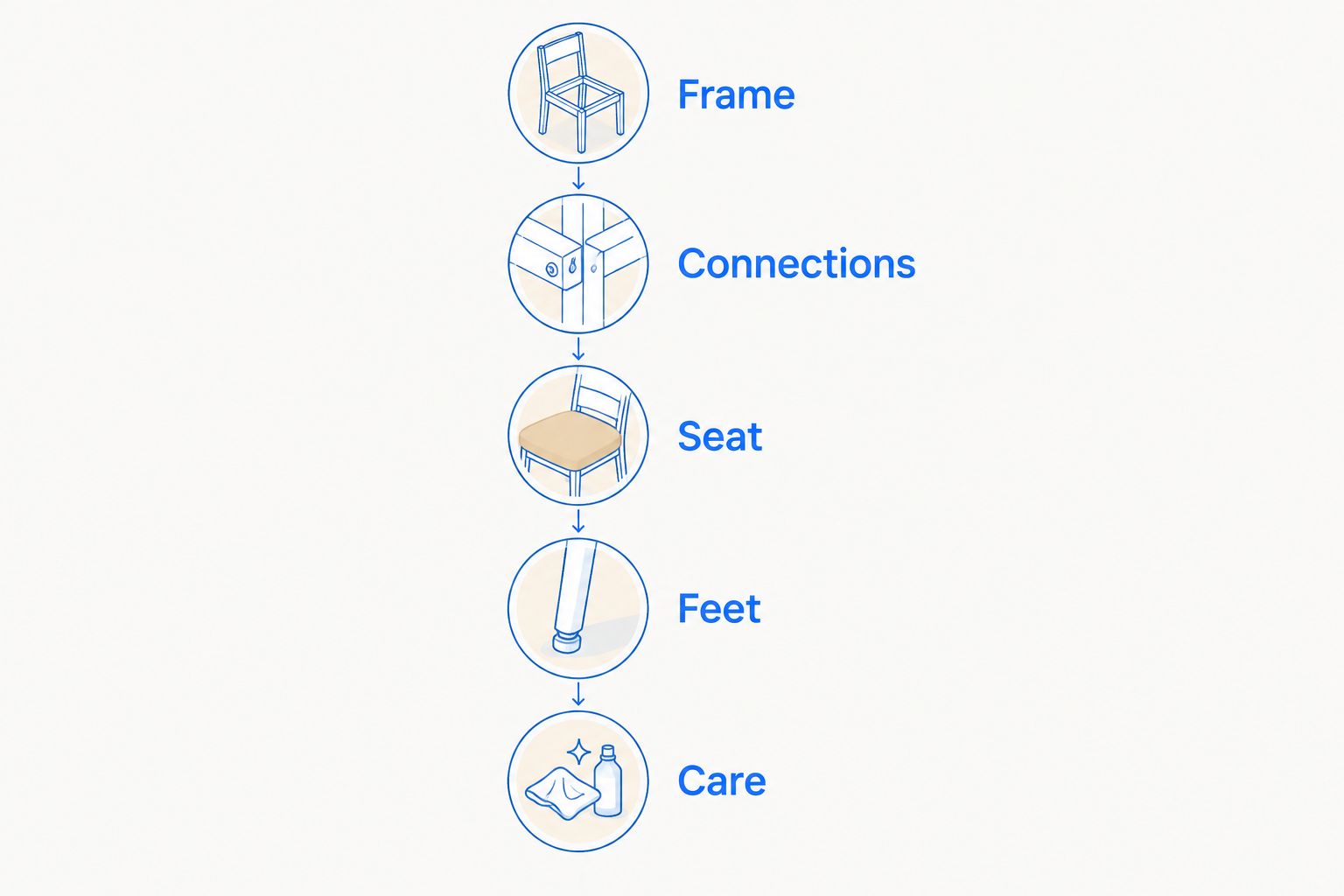 Check the structure before deciding whether the finish suits your room.
Repeat the sitting and movement checks without tipping the chair onto its back legs. Follow the manufacturer's assembly instructions, and investigate movement rather than repeatedly tightening hardware without understanding its cause.
How the dining chair types were ranked
The 2026 ranking gives priority to frame inspection, joint access, surface maintenance, seat renewal, floor contact, and documented construction. Solid wood leads because it offers a straightforward combination of exposed construction and repair options. Upholstered and woven seats add separate maintenance decisions.
This is a buying framework, not a laboratory strength ranking. It assigns no load capacity, service life, or test result to any chair. Apply the criteria to the actual piece before accepting its position in the table.
Which dining chair should you choose?
Choose a securely joined solid-wood chair with a wood seat if you are undecided. Move to a metal frame for wipe-clean priorities, molded plywood for a slim profile, or a removable upholstered seat when cushioning matters more than minimizing maintenance.
When shopping Sohnne for mid century modern dining chairs, judge the documented construction rather than assuming that a shared aesthetic means shared durability. Sohnne's stated 60-day return period and 5-year warranty are purchase protections, not evidence of a chair's expected lifespan. Read the applicable terms before ordering.
For your 2026 dining room, choose the maintenance routine first and the silhouette second. That leaves you comparing chairs you can realistically care for.
FAQ
What’s the best construction for durable mid century modern dining chairs?
A securely joined solid-wood chair with a wood seat is the default recommendation for repair-focused ownership. Individual construction quality matters more than the material label, so inspect the joints and request care instructions.
Are metal dining chairs more durable than wooden dining chairs?
Metal dining chairs are not automatically more durable than wooden dining chairs. Welds, fasteners, coatings, and seat attachments determine the maintenance and repair demands of a metal-frame chair.
Are molded plywood dining chairs suitable for everyday use?
Judge a molded plywood dining chair by its documented intended use, layer condition, and mounting details. Inspect edges for separation and follow the manufacturer’s assembly and care instructions.
Should I avoid upholstered dining chairs if I want durability?
You do not need to avoid upholstered dining chairs, but upholstery adds maintenance beyond the frame. A removable seat provides a clearer route to replacing fabric and padding while retaining sound construction.
Can a woven dining chair seat be repaired?
A woven dining chair seat can be renewed using a method appropriate to its material and construction. Identify the weaving material and find a suitable repairer before deciding whether that ownership commitment suits you.
Does a furniture warranty tell me how long a dining chair lasts?
A warranty does not establish a dining chair’s expected lifespan. Read its coverage, exclusions, and claim requirements separately from the chair’s construction and maintenance information.
What should I check before buying dining chairs online?
Request the frame material, underside photographs, connection details, assembly instructions, and cleaning guidance. Confirm the chair’s dimensions against your table and inspect a single chair before committing to a set when practical.
One last thing
The underside of a dining chair often answers questions that the front photograph cannot. Before choosing a finish, request a clear view beneath the seat. Accessible connections, intact mounting points, and an understandable seat attachment are more useful buying evidence than a carefully arranged dining-room photograph.
Related guides
- Mid-century modern side chairs for a dining room
- Is a full matching furniture set worth buying?
- Furniture storage during a move
Stay connected with us!
Keep in touch with what’s new and next. Subscribe for weekly insights, product launches, and community news!