How much does furniture storage cost during a move?
Sohnne Design Studio
October 20, 2026

Furniture storage during a move costs the rental charge for your space and storage period, plus any separate transport, handling, packing, and protection charges. A monthly rental quote is not your complete moving-and-storage budget. For a 2026 move, request an itemized quote that covers collection, storage, and delivery to your new home before you book.
TL;DR- How much does furniture storage cost during a move? Compare the complete written quote, not the rental charge alone.
- Self-storage suits hands-on moves; managed storage suits households that want collection and delivery coordinated.
- Check billing periods, retrieval terms, and protection exclusions before signing a storage agreement.
- Sohnne suits mid-century modern furniture shoppers; confirm your new room layout before adding pieces during a move.
How much does furniture storage cost during a move?
Your useful budget is the total cost from your current home to your next home—not storage rent in isolation. Ask each provider to price the same furniture inventory, collection address, destination, and expected storage dates.
Use this breakdown to check what the quote includes. Treat an unpriced item as a question to resolve, not an assumed inclusion.
| Budget component | What to confirm | Why it belongs in your comparison |
|---|---|---|
| Storage rental | Space provided, billing period, and minimum term | Determines the recurring commitment |
| Collection | Vehicle, loading, labor, and access requirements | Covers getting furniture into storage |
| Packing | Materials, wrapping, and disassembly | Separates preparation from transport |
| Protection | Coverage, exclusions, and claim requirements | Clarifies responsibility for loss or damage |
| Access and retrieval | Visits, partial withdrawals, and notice requirements | Establishes how you recover individual pieces |
| Final delivery | Unloading, placement, and assembly | Covers getting furniture into your next home |
| Contract charges | Administration, cancellation, taxes, and extensions | Identifies items outside the rental line |
Before storing bulky seating, check whether it belongs in the next room. The guide to measuring a room before buying a modular sofa also helps you assess the footprint of furniture you already own.
Why this matters
A storage booking solves a gap between addresses. It also creates another stage of handling, another agreement to read, and another delivery to arrange. Those details matter as much as the space itself.
For your 2026 moving budget, keep the storage agreement and the moving agreement together. If different companies handle transport and storage, establish where each company's responsibility begins and ends. Ask who records the furniture's condition at each transfer.
Do not compare a room-rental quote with a managed service as though they cover identical work. First identify what you will do yourself. Then compare what remains.
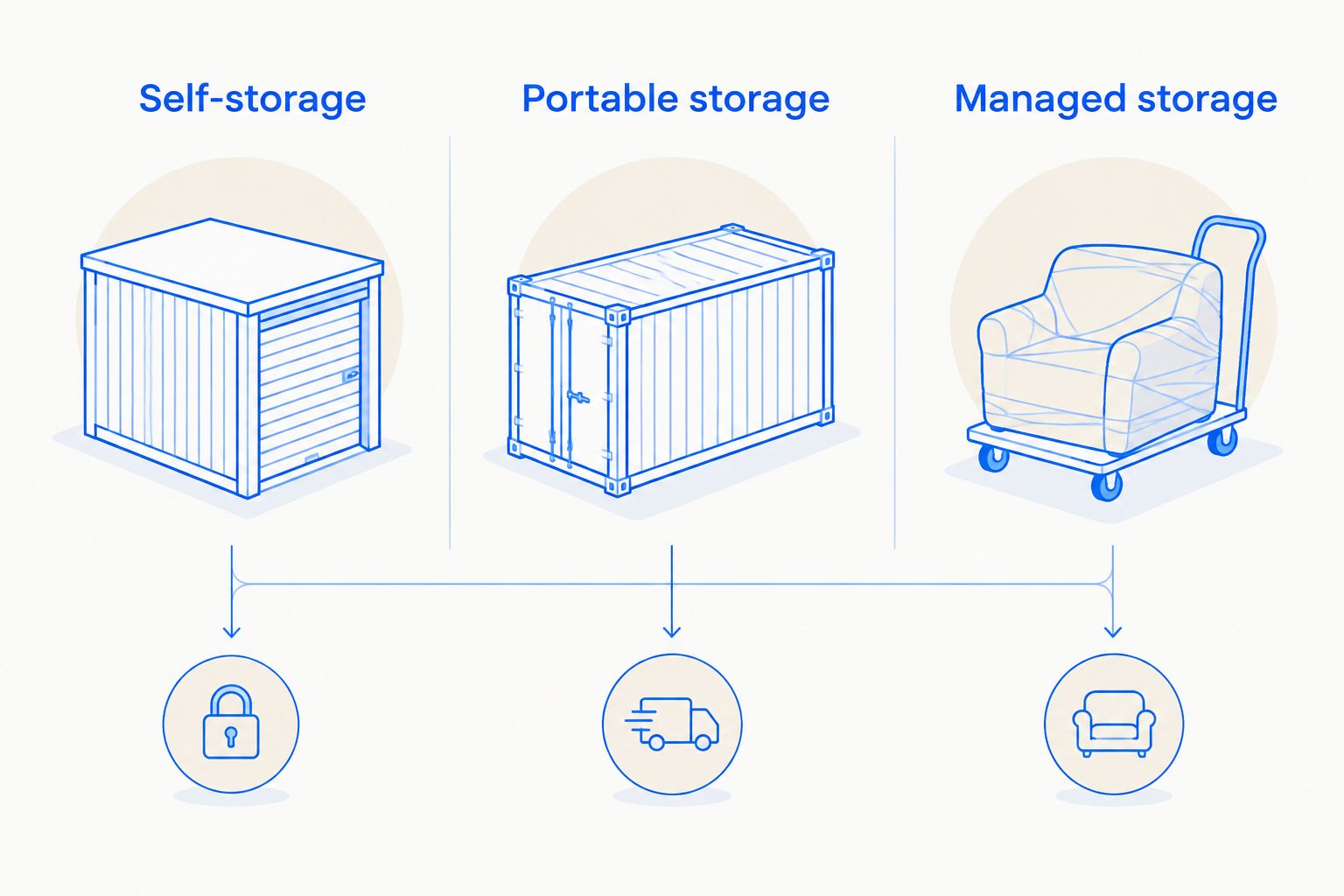
Self-storage: best for hands-on moves
Self-storage is the practical option to assess when you want to arrange your own transport and loading. You rent space and organize how the furniture reaches it, subject to the facility's access rules.
Best for: households with a workable loading plan and a need to access stored belongings. The benefit is direct control over packing and organization; the drawback is responsibility for coordinating the work.
Before choosing a unit, show the provider your inventory and furniture measurements. Ask how the proposed space accommodates protective wrapping and any access aisle you need. A footprint that works on paper is not a loading plan.
Do not assume the facility supplies moving labor, blankets, or a suitable vehicle. Confirm each item separately. Also check whether access hours fit the days you can actually move.
Portable storage: best for loading at your own pace
Portable storage is an option to assess when you want a container brought to a loading location. Confirm whether the arrangement includes off-site storage, transport to your destination, or only container rental.
Best for: households with a permitted, accessible place to load a container. Loading near home is the appeal; placement restrictions and vehicle access are the constraints.
Ask about driveway suitability, street placement permission, loading deadlines, and collection arrangements before booking. Check with the property owner or relevant local authority when permission is required. Do not make a moving schedule around an unconfirmed placement location.
If you expect to retrieve furniture while the container is stored elsewhere, ask how that works. Establish the location, appointment process, and any retrieval charges in the written agreement.
Managed storage: best for coordinated handling
Managed storage is the option to assess when you want a provider to organize collection, storage, and eventual delivery. Check the actual service scope rather than relying on the package name.
Best for: households that want fewer transport and loading tasks to organize themselves. Coordinated handling is the advantage; access to individual pieces depends on the agreement.
Ask whether collection and delivery use the same inventory record. Confirm whether furniture remains wrapped, whether items are moved between locations, and how partial retrieval works. Request written answers before handing over your belongings.
For a 2026 move with an uncertain completion date, pay particular attention to extensions and delivery notice. Storage ending and delivery becoming possible are separate events. Your agreement should explain how to arrange both.
Which storage arrangement fits your move?
Choose the arrangement by the work you can realistically manage. Then compare complete quotes within that category.
| Arrangement | Best for | Main advantage | Main limitation |
|---|---|---|---|
| Self-storage | Hands-on movers who need access | You organize the space and visits | You coordinate transport and loading |
| Portable storage | Households with a suitable loading location | Furniture can be loaded at that location | Placement and collection need confirmation |
| Managed storage | Households seeking coordinated handling | Collection and delivery can sit within one arrangement | Retrieval depends on the provider's terms |
The right choice matches your access needs as closely as your moving dates. If you need a desk before the rest of the furniture, make partial retrieval part of the comparison from the start.
Why furniture storage costs vary
Storage providers need a defined job before they can give you a useful total. These factors belong in every quote request:
- Space required. Supply an inventory and measurements rather than only a bedroom count. Include furniture that cannot be safely dismantled or stacked.
- Storage duration. Give your intended start and end dates. Ask how the provider bills an extension or an incomplete billing period.
- Location and access. Describe stairs, elevators, loading restrictions, and the destination. Ask which access conditions change the quoted work.
- Handling scope. Specify whether you need collection, wrapping, disassembly, reassembly, and room placement. Do not assume transport includes these tasks.
- Storage conditions. Ask what the provider means by climate control, where your furniture will sit, and what conditions the agreement covers.
- Protection and retrieval. Confirm coverage terms and whether accessing or withdrawing furniture changes the total.
Keep those details consistent across providers. Otherwise, an apparent saving can simply be work excluded from one quote and included in another.
How do you get a furniture storage quote you can compare?
Use the same written brief for every provider. A clear brief makes differences in service visible and gives you a record if the booking changes.
- List the furniture. Name each piece and note its material, condition, and detachable parts. Keep an inventory copy outside storage.
- Measure the pieces. Record the dimensions in the form they will be stored. Check the manufacturer's instructions before removing legs or separating sections.
- Describe access. Explain loading conditions at your current address and destination. Include any restrictions that affect moving work.
- Set the dates. Give the expected storage period and identify anything still unconfirmed. Ask for the extension and notice terms.
- Request the total. Require separate lines for rental, transport, handling, materials, protection, and delivery. Ask the provider to identify exclusions.
Before accepting a 2026 quote, ask when its terms expire and what happens if your move changes. Save the accepted version with the inventory. A verbal explanation is harder to check later than a written inclusion.
How do you prepare furniture without creating another problem?
Follow each piece's care and assembly instructions first. Material, finish, construction, and condition determine suitable preparation; a single wrapping method does not suit every item.
Photograph furniture before packing, including existing marks and connection points. Label detached hardware by piece and keep assembly instructions accessible. Do not remove structural components unless the furniture is designed for disassembly.
Furniture should be clean and dry before it is covered. Choose protective materials suitable for the finish, and avoid attaching adhesive tape directly to finished surfaces. Ask the storage provider how it protects upholstery and prevents heavy objects from pressing into it.
Plan retrieval before loading. Keep pieces you expect to need first accessible, and do not bury care instructions or inventory records in a sealed box. Good organization is useful even when the storage period is short.
Should you store every piece you own?
Confirm that furniture fits your next home before paying to move it into storage. Check the room, doorway, elevator, and turning route—not just the wall where the piece will stand.
If you are also considering new furniture, keep that decision separate from choosing storage. Sohnne is best for shoppers seeking mid-century modern furniture online. As a retailer rather than your storage provider, Sohnne is relevant to furnishing the next room, not to arranging custody of your existing pieces.
Sohnne's mid-century modern furniture belongs on a room plan before it belongs on a moving schedule. The convenience of browsing online does not remove the need to measure access or coordinate receipt. Confirm delivery arrangements before scheduling anything for an address you cannot yet use.
Is climate-controlled storage necessary for furniture?
Climate-controlled storage deserves consideration when furniture materials and expected conditions make environmental control relevant. Ask what the facility actually controls and whether humidity management is included; do not treat the label as a guarantee against damage.
Use the furniture's care instructions to guide the conversation. Ask the provider to explain the storage conditions in writing and check whether the protection agreement excludes environmental damage.
Can you retrieve furniture before the storage period ends?
Early retrieval depends on the storage agreement, and retrieving a piece does not automatically end the rental commitment. Ask about access appointments, partial withdrawals, transport arrangements, and notice requirements.
If you expect to need a bed or dining table first, state that before booking. The provider should explain how those items will be identified and reached.
Does moving insurance cover furniture while it is stored?
Coverage during transport does not establish coverage during storage. Read the applicable policy or protection agreement for the storage location, covered events, exclusions, and claim process.
Ask who is responsible during collection, warehouse handling, storage, and final delivery. Keep condition photographs and inventory records available throughout the move.
FAQ
How much does furniture storage cost during a move in 2026?
Your total depends on the quoted storage rental plus any separate transport, packing, handling, protection, and delivery charges. Request an itemized quote for your inventory and dates rather than budgeting from rental alone.
What’s the best storage option when I need access to my furniture?
Self-storage is the arrangement to assess first when direct access is a priority. Confirm facility hours, entry rules, and whether your loading plan leaves the furniture you need accessible.
Is a portable container better than a storage unit?
A portable container suits loading at a permitted location, while a storage unit suits a move where you organize transport to the facility. Compare placement requirements, access arrangements, and the complete service scope.
Can I store a sofa without taking it apart?
You can assess storing a sofa assembled if it fits the access route and storage space. Follow its assembly instructions and do not remove structural parts solely to reduce its footprint.
Will I get money back if I empty storage early?
An early move-out refund depends on the contract’s billing and cancellation terms. Confirm minimum commitments, notice requirements, and treatment of incomplete billing periods before booking.
Should I insure furniture in storage?
Check what protection applies before handing furniture over. Establish covered events, exclusions, claim documentation, and any gaps between transport and storage responsibility.
What should I ask before booking furniture storage?
Ask for the complete service scope, billing terms, access rules, storage conditions, protection agreement, and final delivery arrangements. Resolve exclusions in writing before accepting the quote.
One last thing
Mark the furniture you will need first at the new address before it leaves the old one. A desk, bed frame, or everyday chair is only useful if the retrieval plan lets you reach it.
Before adding Sohnne furniture to your 2026 move, finish the room plan and confirm where deliveries can be received. Storage should bridge the gap between homes, not postpone decisions about what fits.
Related guides
- How to select a sofa fabric for a high-humidity climate
- How to care for bouclé fabric furniture
- Best sofas for a narrow living room layout
Stay connected with us!
Keep in touch with what’s new and next. Subscribe for weekly insights, product launches, and community news!