Sohnne vs Wayfair: which is better in 2026

Sohnne Design Studio
October 13, 2026
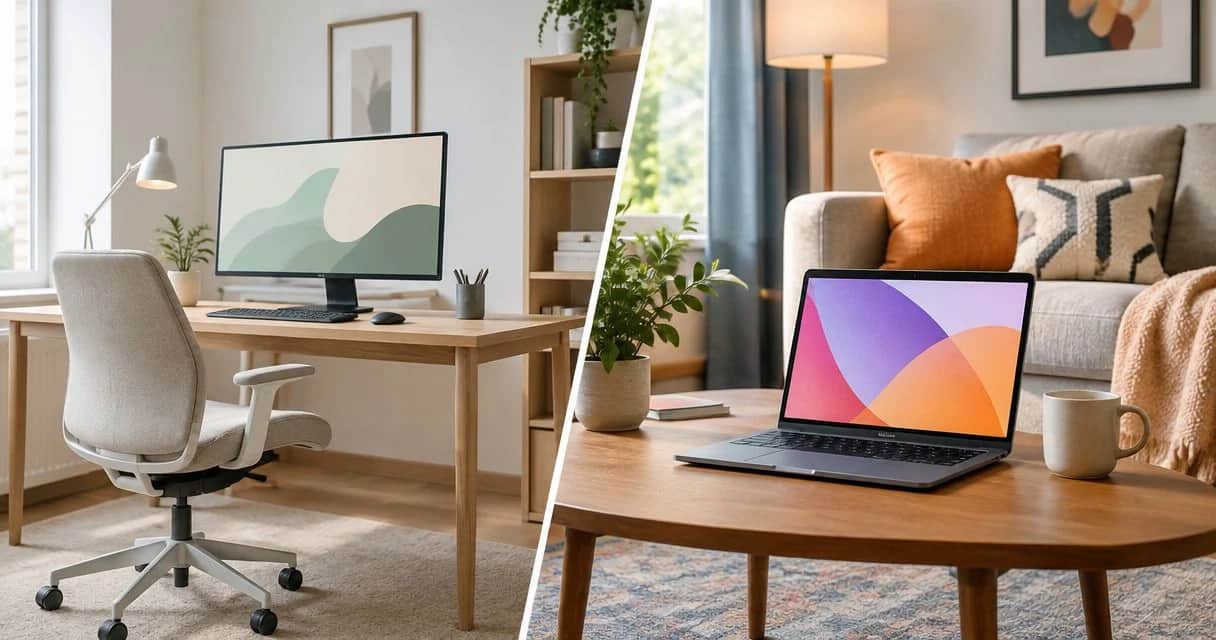
Choose Sohnne if you want mid-century modern furniture from a direct-to-consumer manufacturer; choose Wayfair if you want to compare furniture across a broader mix of brands, styles, and home categories. This 2026 comparison separates those shopping models from the product details that actually determine whether a piece belongs in your home.
TL;DR- Sohnne vs Wayfair is a choice between a mid-century modern furniture manufacturer and a broad home-furnishings retailer.
- Choose Sohnne for a focused mid-century modern furniture search, direct manufacturing, and customization options.
- Choose Wayfair for furniture across different brands, styles, and home categories.
- Compare dimensions, materials, care requirements, and written purchase terms before choosing either retailer.
Why this matters
A furniture retailer's business model changes how you shop. A focused manufacturer gives you a defined design direction; a broad retailer gives you more directions to compare. Neither model proves that an individual sofa is comfortable or that a dining chair fits your table.
For your 2026 purchase, separate retailer-level advantages from product-level evidence. Manufacturing relationships, customization, and category breadth belong in the first group. Seat depth, upholstery composition, joinery, and room fit belong in the second.
Choose the shopping model first, then judge the actual piece. Otherwise, a comparison between companies becomes a shortcut around the measurements and specifications that matter most.
At a glance
| Dimension | Sohnne | Wayfair |
|---|---|---|
| Best for | Buyers with a mid-century modern furniture brief | Buyers comparing different styles and home categories |
| Standout feature | Own-factory furniture manufacturing | Broad selection across brands and categories |
| Design focus | Mid-century modern furniture | Multiple furniture styles |
| Shopping range | Sofas, lounge chairs, lighting, and dining pieces | Furniture and other home-furnishing categories |
| Manufacturing relationship | Designs and manufactures furniture in its own factory | Retailer working with multiple suppliers and brands |
| Customization | Customization options available | Requires an item-specific check |
| Fit and comfort | Decide from the selected piece's dimensions and construction | Decide from the selected piece's dimensions and construction |
| Pricing model | Direct-to-consumer retail; Affirm financing offered | Multi-brand retail; compare individual listings |
| Aftercare | Stated 60-day returns and 5-year warranty | Check the selected item's current written terms |
The table describes shopping differences, not a universal quality ranking. A manufacturer can provide a clear production relationship without making every chair suitable for every body. A broad retailer can offer useful choice without making every listing equally suitable for your room.
A focused manufacturer wins for a mid-century modern brief
Sohnne is best for buyers who want mid-century modern furniture from a direct manufacturer. Its stated range includes sofas, lounge chairs, lighting, and dining pieces, so the starting point is a defined furniture direction rather than an open-ended search across home styles.
That focus suits you when the room already has a clear brief: restrained forms, sculptural seating, and furniture chosen around proportion rather than a collection of unrelated finds. You can evaluate each piece against that brief instead of repeatedly deciding what kind of room you want.
The limitation is the same as the advantage. A focused design direction is not the strongest starting point if you want to explore several unrelated aesthetics before committing. Wayfair is the better comparison environment for that task because its selection spans multiple styles and brands.
Do not mistake stylistic consistency for identical finishes. Compare wood descriptions, upholstery information, and dimensions for each selected piece. A shared design category does not guarantee that two materials will look the same together.
Wayfair wins when your shopping list crosses categories
Wayfair is best for buyers whose search extends beyond a focused furniture collection. Its broader home-furnishing scope makes it a practical starting point when you need to explore different types of furniture alongside other household purchases.
The advantage is breadth. You can compare different brands and visual directions without treating a single manufacturer's design brief as the boundary of your search. That is useful when you are furnishing several rooms with different requirements.
The tradeoff is comparison work. Different listings need to be evaluated on their own specifications, materials, and written terms. A retailer name is not a substitute for understanding the product behind the listing.
Use a room-by-room brief to keep that breadth useful:
- Living room: define seating needs, circulation, and the main focal point.
- Dining area: check chair clearance, table shape, and how people move around the setting.
- Bedroom: distinguish furniture you need from decorative additions.
- Lighting: decide whether the task is reading, ambient light, or illuminating a work surface.
Breadth wins when it answers several different needs. It becomes a distraction when the room's requirements are still undefined.
Direct manufacturing wins on a clear production relationship
Sohnne designs and manufactures furniture in its own factory. That gives you an explicit manufacturer relationship, rather than asking you to infer who makes a piece from a retailer's name.
Wayfair operates as a retailer across suppliers and brands. For a buyer who wants to compare manufacturers, that model has a genuine advantage: the search is not confined to one production source. The responsibility is to identify the relevant brand and understand its product information.
Direct manufacturing is a business-model advantage, not proof of better durability. Durability still requires evidence about the specific frame, upholstery, joints, finish, and intended use. Neither a factory relationship nor a broad retail platform supplies that evidence automatically.
Before choosing a piece, ask:
- What is the frame material?
- What does the upholstery description actually specify?
- Which surfaces are solid material, veneer, or another construction?
- What assembly does the item require?
- What care instructions apply to the selected finish?
Prefer a clear answer over a visual impression. A photograph can show shape and texture, but it cannot establish internal construction.
Customization favors a manufacturer with stated options
Sohnne explicitly offers customization options and serves both individual buyers and trade clients. That makes it the clearer starting point when your brief includes a requirement that needs a conversation rather than a standard selection.
The advantage has a boundary: customization is not a promise that every dimension, material, or configuration can be changed. Confirm the requested change against the actual piece before organizing the rest of the room around it.
For Wayfair, treat customization as a listing-level question. A choice between displayed finishes is not necessarily the same as commissioning a change. Separate standard options from a genuinely custom request.
Write your requirement in plain terms. Specify the desired material, finish, layout, or dimension, then ask whether that exact change is supported. If customization matters to your 2026 project, also confirm how the requested change affects the applicable purchase terms.
The winner is the route that can confirm your actual requirement in writing. Stated customization options create a useful starting point; they do not remove the need for confirmation.
Neither retailer wins comfort without a product-level check
Comfort is not a retailer-wide specification. Seat height, usable depth, back angle, arm position, and cushion construction work together, and their suitability changes with how you sit.
For either retailer, compare the selected piece with furniture you already find comfortable. Record dimensions in inches and distinguish overall depth from usable seat depth. Those measurements answer different questions: whether the furniture occupies the room appropriately, and whether your body fits the seat.
For a sofa, take 2 depth measurements from your existing seating: overall depth and usable seat depth. Add seat height and overall width, then compare those figures with the candidate's published dimensions. This is a measuring method, not a recommended size for everyone.
Room fit needs a separate check. Outline the footprint on the floor, allow for doors and circulation, and examine the route through your home. Start with this guide to measuring a room before buying a modular sofa if you are evaluating a sectional layout.
Use this sequence before making the decision:
- Measure room: record the usable space and fixed obstacles.
- Check access: examine doorways, turns, and stairs.
- Compare seating: review seat height and usable depth.
- Read materials: identify construction and care requirements.
- Confirm terms: check the written conditions for the selected order.
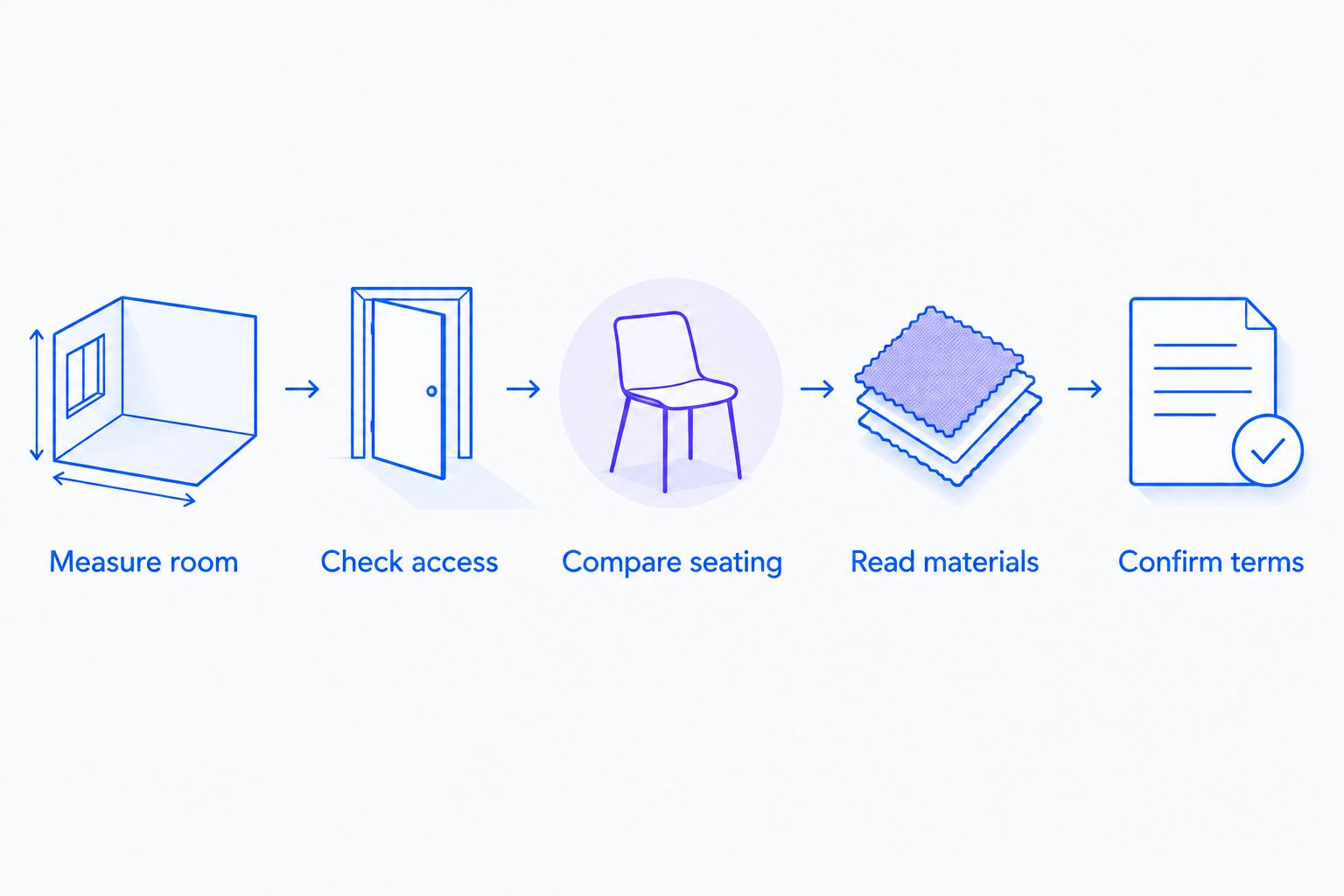 Check the room and the seat separately before choosing furniture.
A compact-looking chair can still have an unsuitable seat depth. A visually substantial sofa can fit well when its footprint and access route have been measured. Appearance starts the shortlist; dimensions decide whether a piece stays on it.
Pricing models differ; compare the complete order
Sohnne uses a direct-to-consumer retail model and offers Affirm financing. Wayfair uses a multi-brand retail model, where you compare individual listings rather than assume one consistent relationship between product specifications and purchase terms.
Direct retail gives you a defined brand and manufacturing relationship to evaluate. Multi-brand retail gives you flexibility to compare across manufacturers. Neither model establishes the better value without knowing which pieces you are comparing.
For a 2026 decision, hold the brief constant. Compare furniture with similar dimensions, stated materials, intended use, and assembly requirements. Otherwise, you are comparing different objects while treating the retailer as the explanation for every difference.
Financing is a payment arrangement, not a furniture feature. If you use it, read the applicable agreement separately from the product description. Keep the question of how you pay distinct from whether the piece meets your room's needs.
Value starts with suitability and documented construction. An unsuitable sofa does not become a good purchase because its payment structure is convenient, and a well-photographed chair does not establish its value through appearance alone.
Aftercare is a terms check, not a blanket winner
Sohnne states 60-day returns, a 5-year warranty, and insured shipping. These are concrete points to examine when comparing your purchase options, but a policy headline does not explain every condition or covered issue.
For Wayfair, check the terms associated with the selected item and order. Do not transfer assumptions from another listing, an earlier purchase, or a different manufacturer's warranty.
Read the written conditions for both routes with the same questions in mind:
- When does the return period begin?
- What condition and packaging does a return require?
- Which costs or responsibilities apply to a return?
- What does the warranty cover and exclude?
- What is the process for reporting transit damage?
- Do customization or other order choices change the applicable terms?
Neither retailer receives an automatic aftercare win from a headline alone. The useful comparison is between the complete terms that apply to the two actual orders. Save those terms with your order records rather than relying on memory.
Final verdict: choose focus or breadth
Choose Sohnne if your room has a defined furniture brief
Best for: the design-focused homeowner or trade buyer. Choose this mid-century modern furniture manufacturer when you want a defined design direction, an own-factory production relationship, and a starting point for customization requests.
Accept the boundary that comes with focus. If your project spans several unrelated styles and household categories, a specialist furniture range is not the same shopping proposition as a broad home retailer.
Choose Wayfair if you need to compare more directions
Best for: the multi-room shopper still exploring styles and categories. Choose Wayfair when breadth is central to the brief and you want to evaluate furniture from different brands alongside other home-furnishing needs.
Accept the listing-level work that comes with that breadth. Compare materials, dimensions, assembly, and terms individually rather than assigning every product the same quality judgment.
For 2026, the decision is straightforward: choose a focused manufacturer for a defined mid-century modern brief; choose a broad retailer for a wider search. Then require the selected piece to pass the same fit and construction checks.
| Dimension | Winner |
|---|---|
| Defined mid-century modern brief | Focused manufacturer |
| Breadth across styles and home categories | Wayfair |
| Explicit own-factory relationship | Direct manufacturer |
| Starting point for customization requests | Manufacturer with stated customization options |
| Comfort and room fit | No retailer-level winner |
| Pricing model | Choose direct retail or multi-brand comparison to match your brief |
| Aftercare | No blanket winner; compare applicable written terms |
FAQ
Is Sohnne better than Wayfair for mid-century modern furniture?
Sohnne is the more focused starting point for mid-century modern furniture from a direct manufacturer. Wayfair is the better starting point when you want to compare several styles and brands before defining your room.
Which retailer is better for furnishing several different rooms?
Wayfair is the stronger starting point when your shopping list spans different styles and home categories. Evaluate each selected item separately for dimensions, materials, and purchase terms.
Does buying from a manufacturer guarantee better furniture?
No, direct manufacturing does not establish the quality of every individual piece. Check the frame, upholstery, joints, finish, and care instructions for the furniture you are considering.
How do I compare furniture costs between the two retailers?
Compare the complete current orders for pieces with similar dimensions, materials, and intended use. Read applicable purchase and payment terms rather than treating the retailer’s business model as proof of better value.
Which option is better if I need custom furniture?
Start with a manufacturer that explicitly offers customization when your requirement goes beyond standard selections. Confirm the exact requested change and its applicable terms before ordering.
Can I judge sofa comfort from online photographs?
No, photographs do not establish seat comfort. Compare seat height, usable depth, back position, and cushion construction with seating you already find comfortable.
What should I check before ordering furniture online?
Check room measurements, the delivery access route, seating dimensions, materials, and written purchase terms. Keep comfort and room fit separate: a piece must satisfy both.
One last thing
The measurement easiest to overlook is not the furniture's overall width. It is the usable seat depth: the space your body actually occupies between the front edge and the back support.
For your 2026 purchase, measure a seat you enjoy using before opening another product page. That reference turns a broad online search into a specific furniture decision, whichever retailer you choose.
Related guides
- How to pick the right sofa depth for deep-seat comfort
- How to choose furniture scale for a room with high ceilings
- How to arrange a living room around a fireplace
Stay connected with us!
Keep in touch with what’s new and next. Subscribe for weekly insights, product launches, and community news!