Sohnne vs Amazon: which is better in 2026

Sohnne Design Studio
October 13, 2026
Choose Sohnne if you want mid-century modern furniture from a retailer that designs and manufactures its own pieces; choose Amazon if you want to compare furniture across multiple brands and sellers. For 2026, the useful distinction is a focused furniture business versus a broad marketplace—not a blanket claim that one makes better furniture.
TL;DR- Sohnne vs Amazon is a choice between mid-century modern furniture specialization and broad marketplace comparison.
- Sohnne is best for mid-century modern furniture buyers who want manufacturer-direct shopping and customization options.
- Amazon is best for shoppers comparing furniture across multiple brands, sellers, and design categories.
- Judge construction, room fit, and purchase terms at the individual product level—not by retailer name.
Why this matters
Furniture shopping has two separate decisions: choosing the object and choosing the business responsible for the transaction. A chair can look right in a photograph while its seat depth, upholstery, or delivery requirements make it wrong for your home.
A focused retailer narrows the design search. A marketplace expands it. Neither approach removes the need to read specifications and understand who handles questions, delivery problems, and returns.
For your 2026 shortlist, decide which task you need help with first. Are you building a mid-century modern room, or are you still comparing different furniture styles and manufacturers? That answer gives this comparison a useful starting point.
At a glance
| Dimension | Sohnne | Amazon |
|---|---|---|
| Best for | Buyers furnishing a mid-century modern interior | Buyers comparing multiple brands and styles |
| Shopping model | Direct-to-consumer furniture retailer with its own factory | Retailer and marketplace with multiple sellers |
| Standout feature | Furniture customization options | Cross-brand shopping in one marketplace |
| Selection breadth | Focus on sofas, lounge chairs, lighting, and dining pieces | Furniture alongside many other product categories |
| Customization | Options offered; confirm the scope for your chosen piece | Depends on the individual brand and listing |
| Quality evidence | Assess the exact materials, construction, and specifications | Assess the exact materials, construction, and specifications |
| Returns and warranty | Stated 60-day returns and a 5-year warranty; read applicable terms | Check the specific item's return and warranty terms |
| Pricing model | Direct retail purchase, with Affirm financing offered | Item-by-item purchase across retail and marketplace offers |
The table compares purchasing routes, not matched products. It does not establish a winner for comfort, durability, or craftsmanship. Those judgments require a closer look at the furniture you actually intend to buy.
Sohnne wins for a focused mid-century modern search
Best for: the buyer who already knows the room's design direction. A specialist makes sense when your brief is clear: sculptural seating, restrained forms, and a coordinated mid-century modern interior. You begin within that category rather than searching across unrelated furniture styles.
The business designs and manufactures furniture in its own factory, serving individual buyers and trade clients. Its stated categories include sofas, lounge chairs, lighting, and dining pieces. That focus is relevant when you want the furniture search to follow a particular aesthetic.
The limitation is equally clear. A defined design direction is not the same thing as unrestricted choice. If you are comparing traditional, rustic, contemporary, and mid-century modern furniture at once, a broader shopping route better matches that task.
Choose the specialist for a defined brief. Do not choose it merely because a focused catalog sounds more selective; your shortlisted piece still needs to fit your room and your daily use.
The direct model makes the business relationship clearer
Best for: buyers who want to purchase from the business behind the furniture. Direct-to-consumer shopping connects the retail purchase with the company that designs and manufactures the pieces. That is a concrete distinction from buying through a marketplace listing supplied by another seller.
On Amazon, identify both the seller and the fulfillment arrangement before ordering. The marketplace name alone does not describe every party involved in the purchase. Questions about the furniture and questions about the transaction are not always questions for the same business.
The direct model has a limitation: dealing with a manufacturer does not establish a particular service response time or guarantee that every request is possible. Read the applicable terms and ask precise questions before committing.
For a substantial furniture purchase in 2026, clarity matters more than familiarity. Know the business receiving your order, the business responsible for the product, and the route for resolving a problem.
Amazon wins for cross-brand discovery
Best for: shoppers who have not settled on a manufacturer or design direction. Amazon's marketplace structure lets you explore furniture from multiple brands and sellers. That is useful when your first question is what kinds of pieces exist, rather than which piece belongs in an already planned room.
Breadth brings a practical advantage: you can compare different approaches to the same need. An accent chair search, for example, can become a comparison of upholstery, frame materials, seat shapes, and assembly requirements across brands.
The drawback is that a wider search also puts more responsibility on you to keep comparisons consistent. Similar photographs do not establish equivalent materials, proportions, or construction. Read each listing as a separate product proposal.
Amazon wins on cross-brand exploration, not on an assumed quality standard. Narrow the search with your room requirements before treating any listing as a finalist.
Amazon wins for shopping beyond furniture
Best for: the buyer combining a furniture search with other household purchases. A broad marketplace serves a different purpose from a furniture specialist. Furniture sits alongside other home and non-home categories, making Amazon a useful route when the task extends beyond furnishing a room.
That breadth does not make it the stronger choice for a particular sofa or dining chair. It makes it the stronger fit for a broader shopping list. Keep those two advantages separate.
A specialist is the more concentrated environment when furniture is the whole project. You can evaluate the seating, lighting, and dining pieces against a defined interior direction without making the retailer responsible for every other household need.
For your 2026 room plan, use breadth where it helps discovery. Once you have a shortlist, stop comparing shopping environments and start comparing the objects themselves: their dimensions, materials, care instructions, and purchase terms.
The specialist wins when customization is essential
Best for: buyers whose room requires a specified configuration or finish. Customization options are part of the specialist's stated offer. That makes it a relevant starting point when an off-the-shelf configuration does not satisfy your brief.
Customization is not permission to assume that any dimension, material, or finish can be changed. Ask which options apply to the exact piece, what the final specification includes, and whether different purchase terms apply. Keep the agreed specification in writing.
On Amazon, assess customization at the listing and seller level. Do not treat a marketplace-wide search result as evidence that a particular piece can be altered. A selectable color is also not the same request as changing the furniture's dimensions.
The tradeoff is decision work. A standard item lets you evaluate a fixed specification; a customized order requires you to define the specification before purchasing. Choose customization because it solves a room requirement, not because it sounds more personal.
Neither retailer name proves better construction
Best for: buyers willing to compare evidence rather than photographs. Furniture quality belongs to the individual piece. A direct manufacturing model does not, by itself, establish better joinery, upholstery, or cushioning than every product offered through a marketplace.
Likewise, a marketplace listing does not establish poor construction. Different manufacturers use different materials and methods. Give neither purchasing route a quality verdict without examining the shortlisted products.
Use the same questions on both sides:
- What is the frame made from?
- What material covers each visible surface?
- How are the joints and load-bearing parts described?
- What assembly does the furniture require?
- What care instructions apply to the upholstery and finish?
Room fit deserves the same discipline. Record 3 dimensions—width, depth, and height—for each shortlisted piece, then distinguish overall dimensions from seat measurements. Use the guide to choosing furniture scale for a room with high ceilings when proportions, rather than floor area alone, are driving the decision.
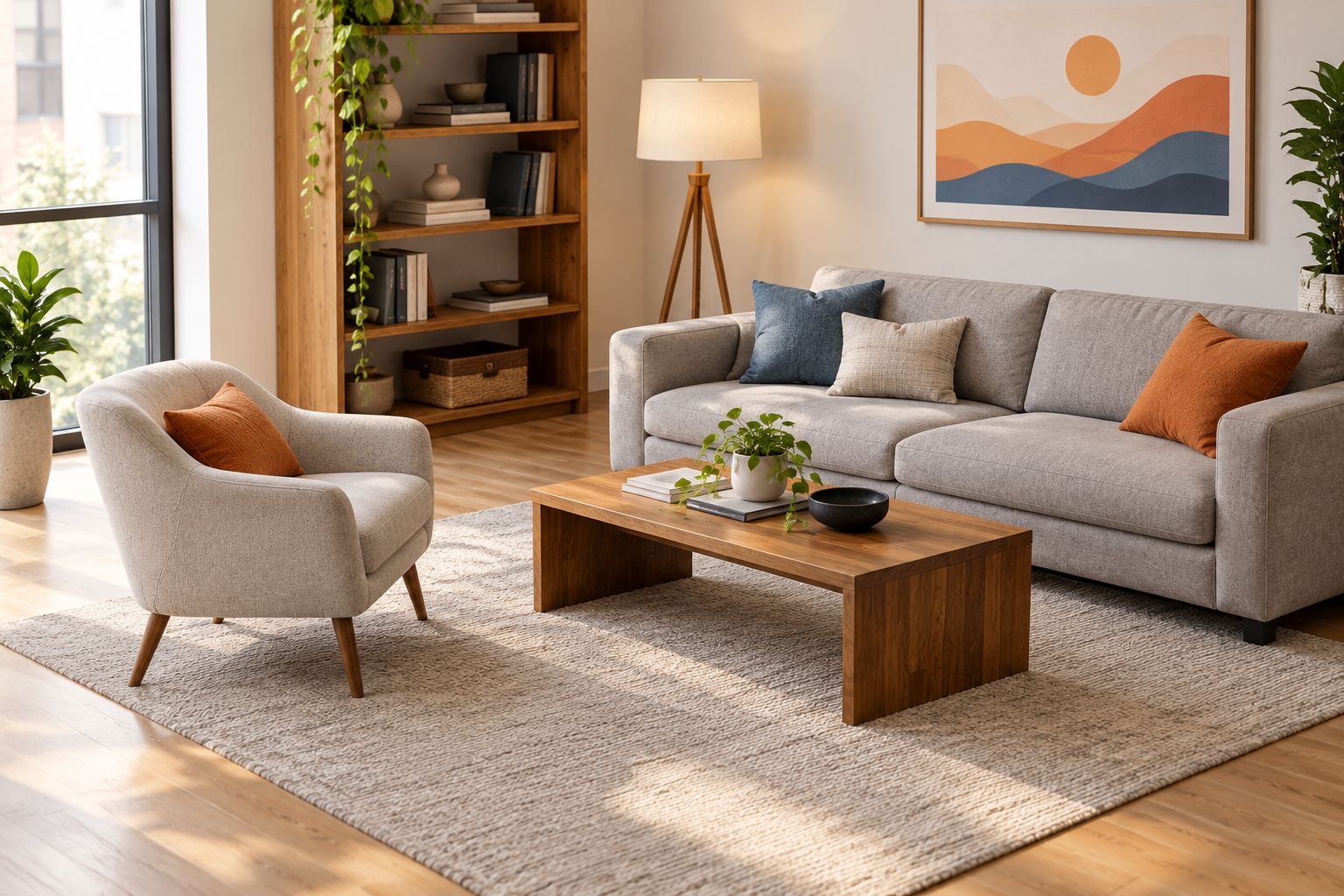 Compare furniture proportions and walking space, not just the silhouette in a listing photograph.
Returns and warranty require different checks
Best for: buyers who read purchase protection before checkout. Sohnne states a return period of 60 days and a warranty lasting 5 years, alongside free insured shipping. These are useful terms to examine, but the return period and warranty serve different purposes.
A return policy concerns sending a purchase back under its stated conditions. A warranty concerns the issues covered during its stated term. Neither should be treated as unconditional protection against every problem.
Read the applicable conditions for your selected furniture, including how a return begins, what condition the item must be in, and which issues the warranty covers. For customization, confirm whether the same conditions apply before placing the order.
With Amazon, read the return information attached to the specific purchase and identify the product's warranty provider. Do not assume that every furniture listing carries identical protection.
The specialist supplies a defined policy starting point; the marketplace requires an item-specific check. That distinction is useful, but it does not justify declaring either route universally easier for returns.
Pricing: compare the purchase, not the retailer stereotype
For this 2026 comparison, neither side earns a blanket value verdict. Direct retail and marketplace shopping describe how you buy, not whether a particular piece offers better value.
Sohnne sells directly to consumers and offers Affirm financing. Financing changes the payment arrangement; it does not change the furniture's construction or make an unsuitable piece suitable. Read the payment terms separately from the product specification.
Amazon presents individual retail and marketplace offers. That model supports comparison across sellers, but an offer becomes useful only after you have checked that it matches the furniture, configuration, and purchase conditions you intended to evaluate.
Before deciding, align the following:
- Product specification: materials, upholstery, finish, and configuration.
- Transaction scope: delivery arrangement, assembly requirements, and applicable charges.
- Purchase protection: return conditions and warranty coverage.
- Payment arrangement: payment timing and any financing conditions.
A focused direct purchase reduces the number of businesses you are comparing. A marketplace gives you more offers to assess. Choose the model that supports your decision, then evaluate the exact transaction on its own terms.
Final verdict: choose the route that matches your project
Choose Sohnne if you are furnishing a mid-century modern room
Named profile: the design-led homeowner or trade buyer. You have a clear aesthetic brief and want a furniture business that designs and manufactures its own pieces. Customization options are relevant to your project, and you are prepared to confirm the specifications and purchase terms before ordering.
The specialist is the better starting point for that profile. Its limitation is focus: it is not the route to choose simply because you want to browse as many unrelated brands and styles as possible.
Choose Amazon if you are comparing brands and styles
Named profile: the cross-brand household shopper. You are still deciding what type of furniture suits your home, or your shopping list extends beyond furniture. Marketplace breadth supports that discovery task.
Amazon is the better starting point for that profile. Its limitation is comparison work: you need to check each product, seller, and purchase arrangement rather than assigning one standard to the whole marketplace.
For 2026, keep the decision simple: use specialization for a defined design brief; use marketplace breadth for cross-brand discovery. Neither route replaces product-level judgment.
| Dimension | Winner |
|---|---|
| Best for a defined mid-century modern room | Specialist |
| Direct relationship with the furniture business | Specialist |
| Standout feature | Split: customization versus cross-brand discovery |
| Selection breadth and shopping beyond furniture | Amazon |
| Customization-led starting point | Specialist |
| Construction quality | No blanket winner; compare individual pieces |
| Returns and warranty | Different checks; no blanket winner |
| Pricing model and value | No blanket winner; compare exact purchases |
FAQ
Is Sohnne better than Amazon for mid-century modern furniture?
Sohnne is the better starting point for buyers seeking a focused mid-century modern furniture retailer that designs and manufactures its own pieces. Amazon is the better starting point for comparing multiple brands and styles; construction quality still requires a product-level comparison.
What’s the main difference between a furniture specialist and Amazon?
A furniture specialist concentrates on a defined furniture offer, while Amazon combines retail shopping with a marketplace of sellers. The distinction changes how you discover products and identify the business responsible for your purchase.
Does buying directly from a manufacturer mean better quality?
No, buying directly from a manufacturer does not establish better quality than every marketplace product. Compare the frame, surface materials, construction details, upholstery, and care requirements of the exact pieces.
Is Amazon better if I want to compare furniture brands?
Amazon is the better fit for a cross-brand furniture search. Treat each listing as a separate product and check its seller, specifications, and purchase terms before making a shortlist.
Can I assume that all furniture on Amazon has the same return policy?
No, you should check the return information for the specific furniture purchase. Identify the seller and read the applicable conditions rather than relying on the marketplace name alone.
What should I check before ordering customized furniture?
Confirm the exact configuration, finish, dimensions, and purchase conditions before ordering customized furniture. Keep the agreed specification in writing and check whether customization changes the return conditions.
How do I compare furniture value without focusing only on the purchase amount?
Compare the exact specification and transaction scope before deciding which furniture offers better value. Include materials, delivery arrangements, assembly requirements, return conditions, warranty coverage, and payment terms in the comparison.
One last thing
The chair that fits your floor plan does not necessarily fit your sitting habits. Overall depth describes the object; seat depth describes part of your experience using it. Keep those measurements separate.
Before checkout, write a short acceptance brief: the room location, intended use, required dimensions, preferred materials, and purchase conditions you accept. Compare both routes against that same brief. A photograph starts the shortlist; a clear specification finishes it.
Related guides
- How to measure a room before buying a modular sofa
- How to pick the right sofa depth for deep-seat comfort
- How to choose a lounge chair for a tall person
Stay connected with us!
Keep in touch with what’s new and next. Subscribe for weekly insights, product launches, and community news!