Sohnne vs 1stDibs: which is better in 2026

Sohnne Design Studio
October 13, 2026

Choose Sohnne if you want newly made mid-century modern furniture from a direct retailer; choose 1stDibs if you want to search dealers for vintage, antique, or contemporary pieces. This 2026 comparison separates furnishing a room for everyday use from finding an object whose history is part of its appeal.
TL;DR- Sohnne vs 1stDibs compares direct furniture retail with a dealer marketplace, not two equivalent furniture manufacturers.
- Sohnne is best for buyers seeking newly made mid-century modern furniture with customization options.
- 1stDibs is best for buyers seeking vintage furniture, antiques, and individual dealer listings.
- Compare condition, dimensions, delivery responsibilities, and purchase terms before choosing either route.
Why this matters
A newly made sofa and a vintage sofa can share a silhouette without answering the same brief. One purchase starts with how you want to live; the other can start with a particular period, material, or documented history. Decide which brief matters before comparing photographs.
For a 2026 furniture purchase, the useful distinction is direct retail versus marketplace sourcing. A retailer offers its own furniture and purchase framework. A marketplace connects you with sellers whose individual objects need their own assessment.
Neither model proves comfort, construction quality, or suitability for your home. Those questions belong to the actual piece. A beautiful listing still needs to fit through the doorway and support the way you sit.
At a glance
| Dimension | Sohnne | 1stDibs |
|---|---|---|
| Best for | Newly made mid-century modern furniture for everyday interiors | Searching dealer listings for vintage, antique, and contemporary objects |
| Vintage sourcing | A new-furniture buying route | The stronger route for period pieces |
| Standout feature | Designs and manufactures furniture in its own factory | Brings listings from different dealers into one marketplace |
| Customization | Customization options are offered | Establish options with the seller of the specific piece |
| Condition assessment | Assess materials, construction details, and finish | Assess those details plus wear, repairs, and alterations where relevant |
| Room fit | Check the chosen piece against your room and access route | Check the individual listing against your room and access route |
| Purchase framework | Brand-stated 60-day returns, 5-year warranty, and insured shipping | Check the applicable marketplace and seller terms for the transaction |
| Pricing model | Direct retail purchase; Affirm financing is offered | Purchase through individual seller listings on a marketplace |
Direct retail wins for a new-furniture brief
Sohnne is best for buyers furnishing an everyday home with newly made mid-century modern furniture. Its stated range covers sofas, lounge chairs, lighting, and dining pieces. That makes the direct-retail route relevant when your starting point is a room plan rather than a collectible object.
Picture a living room that needs a sofa, an accent chair, and a light with a clear purpose. You can evaluate each item against daily use: where you read, how you entertain, and which paths must remain open. The purchase does not require an older object to justify itself through age or provenance.
The limitation is equally clear. Newly made furniture does not answer a brief that requires a period object with documented history. If that history is your main reason for buying, treat it as a requirement rather than trying to substitute appearance for evidence.
The direct route suits homeowners and trade buyers who want to discuss new furniture and available customization. It does not remove the need to inspect specifications. Start with function, then judge the form.
1stDibs wins for vintage and antique sourcing
1stDibs is the better choice when the object’s age or history belongs in your buying brief. The marketplace is known for dealer listings spanning antiques, vintage furniture, and contemporary design. Its value here is access to different sellers and individual objects, not a single manufacturing program.
A collector looking for a period cabinet has a different task from someone choosing a new cabinet for storage. The collector needs evidence about age, attribution, condition, and any restoration. A marketplace search lets that buyer compare candidates whose differences extend beyond dimensions and finish.
That breadth creates work. You need to distinguish what a listing documents from what its photographs merely suggest. Ask for supporting information when a historical claim materially affects your decision.
Choose this route because you want the particular object, not because the marketplace name alone appears reassuring. A strong listing makes the piece legible: what it is, what has happened to it, and what you are agreeing to buy.
Factory ownership and dealer breadth solve different problems
There is no shared winner for the standout feature. Factory ownership supports a conversation about newly made furniture; dealer breadth supports a search across different objects. These are separate advantages, not interchangeable quality scores.
A direct retailer that designs and manufactures its own furniture gives you a defined business to question about construction and customization. Ask which materials apply to the exact item, what the selected finish means, and which details can change. Factory ownership itself does not establish a particular frame specification or upholstery performance.
With 1stDibs, the useful feature is the marketplace format. You can encounter different periods, materials, and approaches through separate dealer listings. The consequence is that you must assess each candidate on its own evidence.
For your 2026 shortlist, write down the question you need answered. If it is about adjusting newly made furniture to your brief, direct manufacturing is relevant. If it is about finding a specific period object, dealer breadth is relevant. Neither advantage automatically settles the other question.
Direct retail has the clearer customization starting point
The direct retailer wins on having an expressly stated customization offering. That is a useful starting point for a buyer whose room or project requires a discussion beyond the standard selection. It is not a promise that every piece can be changed in every way.
Bring a precise brief to the conversation. Identify whether your concern is upholstery, finish, configuration, or another detail, then ask which changes apply to the item you are considering. Get the agreed specification in writing before approving the purchase.
For 1stDibs, establish customization with the seller of the actual listing. Contemporary furniture and an antique object present different questions. Do not assume that a marketplace-wide search result carries a common set of modification options.
There is also a tradeoff between changing an object and preserving what drew you to it. If historical condition matters, discuss any proposed alteration before treating it as a simple decorating choice. A finish change is not just a color decision when the existing surface is part of the buying brief.
Both require evidence; older pieces need a history check
Neither route wins construction quality without item-level evidence. Compare the frame, joints, surface materials, upholstery, and support system of the actual candidates. Category labels and carefully lit photographs cannot answer those questions alone.
For newly made furniture, request the construction details relevant to your intended use. A dining chair needs scrutiny at its joints and seat; a sofa needs clarity about its frame, cushions, and upholstery. Ask for close-up images where the written description leaves an important detail unclear.
For a vintage or antique listing on 1stDibs, add a history check. Ask about repairs, replaced components, refinishing, and changes to upholstery. Request photographs that show the underside, back, and areas of wear rather than relying only on the front view.
The advantage of an older piece can be its existing surface and history. The disadvantage is that its condition requires interpretation. Decide which signs of use you welcome and which would interfere with daily function, then make those distinctions explicit to the seller.
Neither wins room fit without measurements
Room fit is a tie: the right dimensions matter more than the buying channel. A sculptural chair can look light in a photograph and occupy a substantial part of a room. A sofa can fit the floor plan yet fail the delivery route.
Before your 2026 purchase, use this sequence:
- Measure the room: record the available footprint and the routes people use through it.
- Check the piece: compare its width, depth, and height with that footprint and your intended use.
- Check access: measure doorways, turns, stairs, and any other constraints along the route.
Keep the full footprint separate from usable seating space. Arms, a reclined back, or an extended base can affect placement without adding usable seat area. For more on proportions, see the guide to choosing furniture scale for a room with high ceilings.
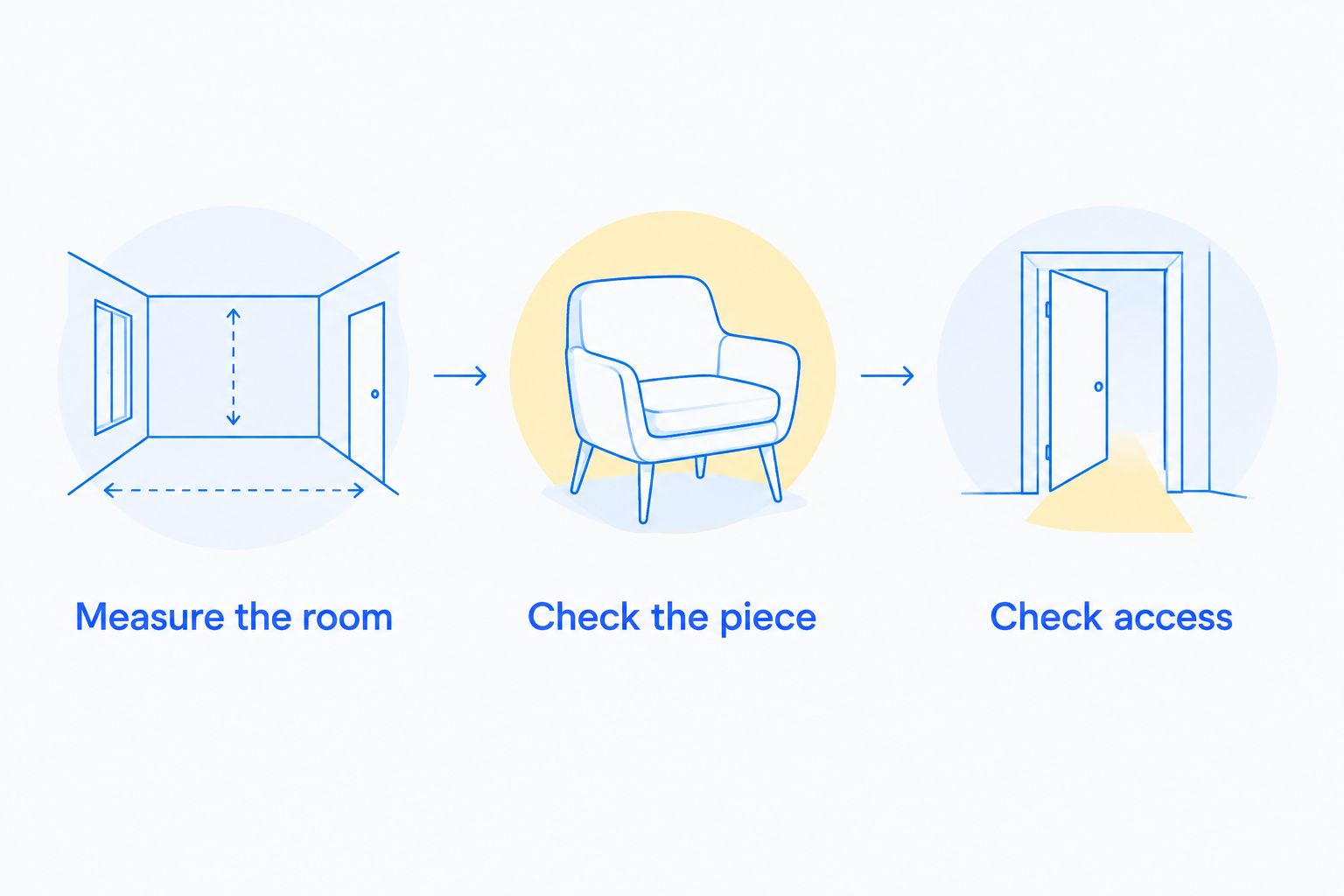 Check the room, the furniture, and the access route before committing.
Comfort needs a separate check. Ask for seat height, usable seat depth, and back support details when they matter to you. Overall dimensions alone do not establish how a chair or sofa will feel.
Direct retail has the clearer brand-level policy reference
Sohnne provides a stated purchase framework: 60-day returns, a 5-year warranty, and insured shipping. Those are concrete reference points for a new-furniture buyer. Read the applicable terms before ordering; a headline policy is not a substitute for its coverage and conditions.
Confirm how the policy applies to your selected item and any agreed customization. Keep the order details, specification, and correspondence together. If a problem arises, you need a clear record of what you purchased.
For a 1stDibs transaction, check the applicable marketplace and seller terms before committing. Establish who handles delivery questions, what the return conditions are, and how a condition concern should be reported. Do not treat the terms for one listing as a promise about another.
For 2026, the practical comparison is not a claim that one channel eliminates risk. It is how clearly you can understand the transaction before accepting it. Read the delivery scope as carefully as the furniture description, especially when access or handling is complicated.
Pricing models: direct retail versus individual seller listings
The pricing-model difference follows the business model. Direct retail centers the chosen furniture and configuration; marketplace purchasing centers the individual seller listing. Compare the complete purchase terms, not just the visual resemblance between two objects.
Affirm financing is part of the direct retailer’s stated offering. If financing matters to your purchase, review the current agreement and its conditions before deciding. Do not confuse a payment arrangement with evidence about furniture quality.
For 1stDibs, treat each listing as its own commercial proposition. A new contemporary item and a vintage object do not necessarily carry the same purchase conditions. Establish what is included, how delivery is handled, and what happens if the piece does not meet the agreed description.
A disciplined comparison uses the same brief for both candidates: intended use, dimensions, condition expectations, delivery requirements, and applicable protections. Otherwise, you are comparing two different purchases and mistaking the difference for a simple winner.
Final verdict: choose the route that matches your brief
Choose Sohnne if you are furnishing for everyday use
Best for: the homeowner or trade buyer seeking newly made mid-century modern furniture. Choose this route when your priorities are a functional room, a direct conversation about the furniture, and access to stated customization options.
The strongest reason to choose it is the match between the business model and a new-furniture brief. The limitation is that it does not answer a collector’s requirement for a period object. Keep those briefs separate.
Choose 1stDibs if you are sourcing a particular object
Best for: the collector or design-focused buyer seeking vintage, antique, or distinctive contemporary pieces through dealers. Choose 1stDibs when the search itself requires comparing individual objects and their supporting descriptions.
Its strength is marketplace breadth. Its limitation is the listing-level work: condition, history, terms, and delivery all deserve close attention. Choose the object on its evidence, not just its setting in the photograph.
| Dimension | Winner |
|---|---|
| Newly made furniture brief | Direct retailer |
| Vintage and antique sourcing | 1stDibs |
| Standout feature | Tie: factory ownership and dealer breadth serve different briefs |
| Stated customization offering | Direct retailer |
| Construction and condition confidence | Tie: item-level evidence decides |
| Room fit | Tie: measurements decide |
| Brand-level policy reference | Direct retailer |
| Pricing model | No universal winner; compare complete terms |
FAQ
Is Sohnne or 1stDibs better for mid-century modern furniture?
Sohnne is the better fit for newly made mid-century modern furniture, while 1stDibs is the better fit for searching vintage and antique dealer listings. Choose according to whether everyday function or a particular object’s history leads your brief.
Is 1stDibs a furniture manufacturer?
1stDibs is a marketplace, not a single furniture manufacturer. Assess the seller, description, condition, and applicable terms of the individual listing.
Which option is better if I want customization?
The direct retailer has an expressly stated customization offering. Confirm which changes apply to your selected item; for a 1stDibs listing, establish any options with its seller.
Does vintage furniture automatically mean better quality?
Vintage status does not establish construction quality or current condition. Examine materials, joints, repairs, alterations, and supporting photographs before choosing a piece.
What should I measure before buying furniture online?
Measure the room footprint, the furniture’s width, depth, and height, and the full access route. For seating, also check usable seat dimensions rather than relying only on overall size.
Which purchase terms should I check before ordering?
Check returns, warranty coverage where applicable, delivery scope, and the process for reporting damage or condition concerns. Keep the specification and order correspondence together.
How should I compare the pricing models in 2026?
Compare a direct-retail purchase with the terms of the individual marketplace listing. Review the selected configuration, delivery responsibilities, financing agreement if used, and applicable purchase protections.
One last thing
Before making your 2026 decision, write a single sentence describing why you want the piece. If the sentence is about sitting, dining, reading, or fitting a room, lead with function and measurements. If it is about a particular period object and its history, lead with documentation.
Do not let the photograph change the brief. A convincing room image can make an unsuitable piece feel inevitable. Return to your sentence, then choose the buying route that can satisfy it.
Related guides
- How to measure a room before buying a modular sofa
- How to pick the right sofa depth for deep-seat comfort
- How to arrange a living room around a fireplace
Stay connected with us!
Keep in touch with what’s new and next. Subscribe for weekly insights, product launches, and community news!