Is a Camaleonda-style sofa worth it in 2026?
Sohnne Design Studio
November 24, 2026
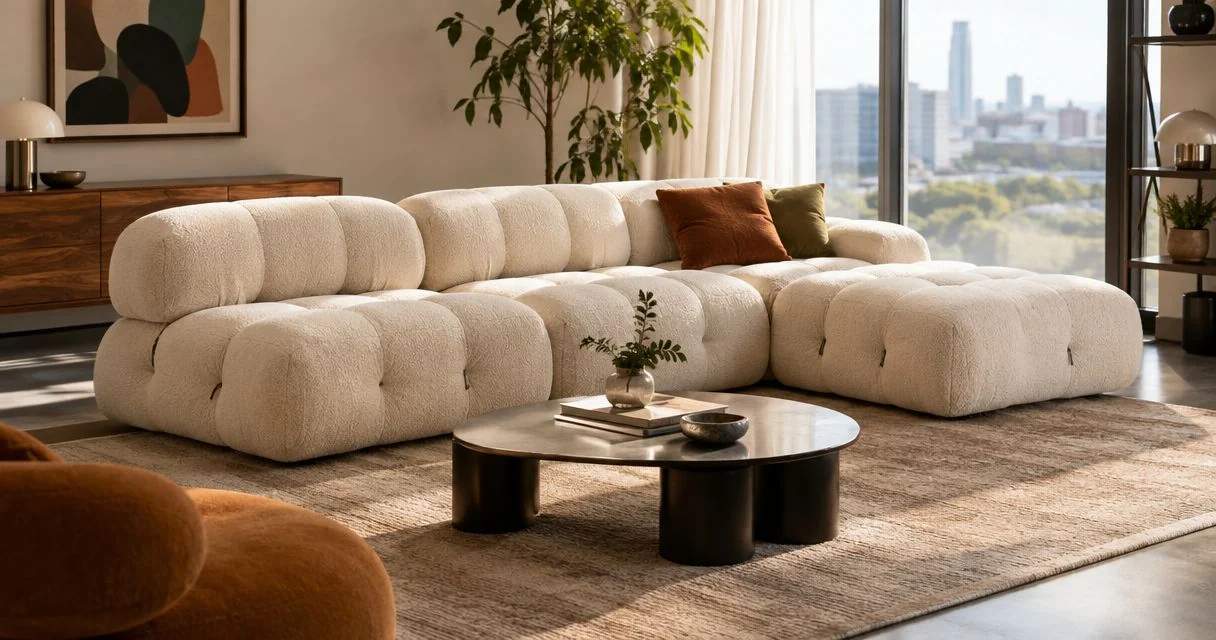
A Camaleonda-style sofa is worth it in 2026 if you want sculptural, relaxed seating and the exact configuration fits your room, posture, and cleaning routine. Skip it if you need firm upright support, easy standing, or a compact footprint more than you want its rounded, deeply upholstered shape.
TL;DR- Is a Camaleonda style sofa worth it? Yes, when relaxed seating and room fit outweigh upright support.
- Compare usable seat depth, module connections, upholstery care, and delivery access before choosing a modular sofa.
- A sculptural silhouette does not establish cushion quality, comfort, or durability.
- Sohnne suits U.S. buyers shopping online for mid-century modern furniture; assess each sofa’s specifications separately.
Is a Camaleonda-style sofa worth it in 2026?
Buy for the way you sit, not just the way the sofa photographs. The rounded profile and segmented upholstery create a strong visual anchor, but appearance cannot tell you whether your feet reach the floor or your back feels supported.
Start by measuring your room before buying a modular sofa. Use the dimensions of the exact configuration under consideration, including arms, backs, and any projecting sections. A layout that fits against a wall can still obstruct the route through the room.
| Seating approach | Best for | Main advantage | Main drawback | Decision |
|---|---|---|---|---|
| Rounded, deeply upholstered modular sofa | Relaxed lounging and a sculptural focal point | Creates a generous-looking seating area with configuration choices where supported | Deep seats and low backs do not suit every posture | Choose after checking seat fit and connections |
| Upright, fixed-frame sofa | Conversation and feet-on-floor sitting | A shallower seat can suit an upright posture | Fixed dimensions limit rearrangement | Choose when everyday support takes priority |
| Sofa with separate accent seating | Rooms serving different sitting preferences | Lets you select different seat heights and depths | Requires planning around several furniture footprints | Choose when household needs differ |
These are seating approaches, not promises about a particular product. A modular label does not establish which sections disconnect, whether arms move, or whether additional components will remain compatible.
Why this matters
A sofa shapes how you use the room every day. If its depth pushes you into a position you dislike, an attractive silhouette does not solve the problem; if its footprint blocks a doorway, rearranging the cushions changes nothing.
For a 2026 purchase, separate visual preference from practical acceptance. You can love the shape and still reject a particular version because its seat dimensions, upholstery instructions, or access requirements do not work for your home.
The right sofa should support your routine without requiring you to reorganize that routine around its limitations. Decide what that means before comparing finishes.
Comfort: test the seat, not the silhouette
A deep seat works differently when you curl up than when you sit upright. Assess both positions if both belong in your day. Your preferred posture matters more than a room photograph showing neatly arranged cushions.
Check usable depth rather than relying only on overall depth. The distance from the front edge to the back support determines where you actually sit; the space occupied by the back cushions is not usable seating.
For an upright fit, check whether your feet rest comfortably and your back reaches support without sliding forward. Then try standing without pulling yourself up on nearby furniture. If you need substantial effort, reject that seat geometry for your needs.
For lounging, check whether the seat supports your preferred position without forcing your head forward or leaving your lower back unsupported. Do not assume that a soft appearance means a soft feel, or that softness guarantees comfort.
If you cannot try the sofa, compare the published measurements with a seat you already know. A guide to choosing sofa depth helps you distinguish a generous outer footprint from the space your body actually uses.
Modularity: worthwhile only when the layouts work
Rearrangement has value when you will use it. Before treating modularity as a reason to buy, draw 2 layouts: your everyday arrangement and a genuinely useful second arrangement. A second layout that blocks a door is not flexibility.
Ask how the sections connect and what happens at exposed ends. Some arrangements require particular arms, backs, or finished sides. Obtain confirmation for the exact configuration rather than assuming every section works independently.
Use this sequence to evaluate the layout:
- Map the room. Mark doors, windows, fixed features, and the routes you use.
- Outline the sofa. Transfer the full configuration footprint onto the floor with removable tape.
- Check movement. Walk through the room and open nearby doors and drawers.
- Test alternatives. Outline the second arrangement and confirm the necessary components.
The taped outline reveals circulation, not comfort. Use it alongside seat measurements, never as a substitute for checking posture.
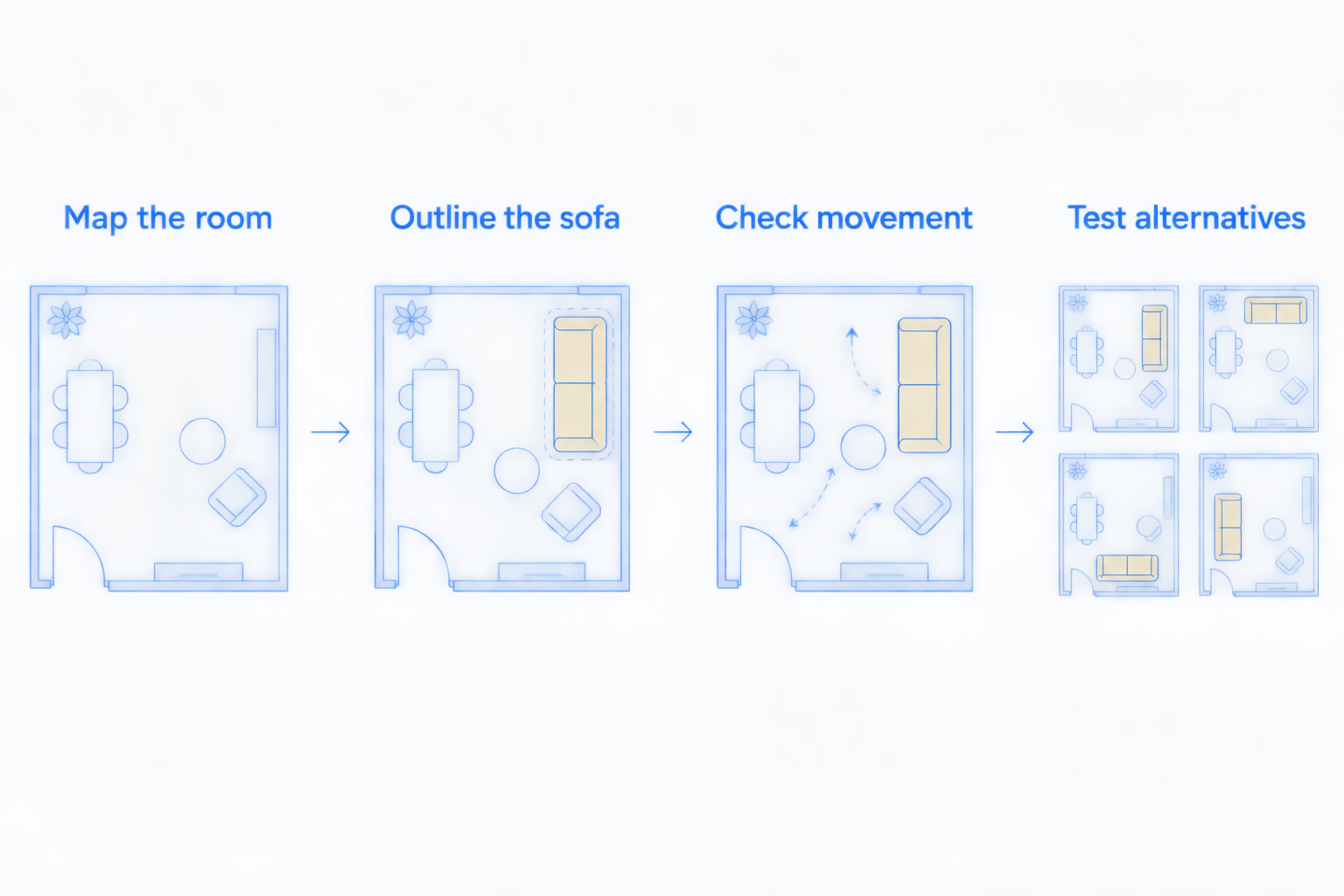 A second arrangement adds value only when it works with your room and the sofa’s components.
Why a Camaleonda-style sofa’s value varies
The visual category does not provide a shared construction standard. Evaluate the exact sofa through the details that affect sitting, maintenance, and room use.
- Seat geometry: Overall depth, usable depth, seat height, and back position shape how you sit and stand.
- Cushion construction: Ask what provides support and whether any cushions need routine reshaping. Do not infer the filling from photographs.
- Module connections: Confirm how sections attach, how they separate, and which layouts the connection system supports.
- Upholstery care: Obtain cleaning instructions for the exact covering. A removable cover is not automatically washable.
- Room and delivery fit: Check both the assembled footprint and the dimensions of the pieces that must pass through your home.
- Documented terms: Read the conditions for delivery, returns, and warranty coverage before deciding whether the purchase suits your circumstances.
A missing answer is a reason to ask another question, not a reason to fill the gap with assumptions. A clear specification is more useful than an unqualified claim of quality.
Upholstery: choose for contact, cleaning, and texture
Start with what touches the sofa. Consider clothing, throws, pets, food, and direct sunlight, then compare those conditions with the covering’s documented care requirements. No fabric name alone tells you how a finished sofa will perform in your household.
Request a sample where offered. View it beside your flooring and existing upholstery, then examine its texture at close range. A small sample cannot establish whole-sofa comfort, but it helps you judge color and surface feel without relying entirely on a screen.
Look closely at the channels and seams. Deep upholstery details create the sofa’s rounded rhythm, but they also create areas you must reach during cleaning. Decide whether that care routine suits you before treating the shape as an advantage.
Avoid applying a generic cleaner because it worked on another sofa. Follow the instructions for the specific covering, including any directions for testing a concealed area. If the instructions require specialist care, include that obligation in your decision.
Choose an upholstery specification you can maintain, not one you hope will tolerate your routine. That distinction matters more than whether a color is fashionable in 2026.
Delivery access: check the pieces, not just the room
A sofa can fit its intended position and still fail at the entrance. Modular construction does not establish that every piece will pass through a narrow doorway, turn inside a corridor, or enter an elevator.
Record 3 measurements for each delivery piece: width, depth, and height. Obtain packaged dimensions too, then compare them with the narrowest points along the actual route. Include stair turns, landings, elevator openings, and fixed obstacles.
Ask which components arrive attached and which can be removed using the manufacturer’s approved method. Do not plan around removing an arm or back unless that procedure is confirmed for the exact sofa.
Also distinguish delivery access from placement. Confirm what the delivery service includes rather than assuming the pieces will be carried to the final room, connected, and cleared of packaging. Written confirmation keeps the decision tied to the service you are actually arranging.
What should you ask Sohnne before choosing a sofa?
Sohnne suits U.S. buyers shopping online for mid-century modern furniture. Online selection still requires product-level checks: a retailer’s category focus does not establish whether a specific seat fits your body or a specific configuration fits your room.
Ask Sohnne for the exact information your decision depends on: configuration dimensions, usable seat depth, covering care, connection details, and delivery-piece measurements. Keep those answers beside your room plan rather than comparing products from photographs alone.
The advantage of this approach is a furniture search centered on your preferred aesthetic. The limitation is that online images cannot confirm personal comfort. Treat an unanswered fit question as unresolved, even when the sofa looks right.
Is a Camaleonda-style sofa comfortable for everyday use?
A Camaleonda-style sofa is comfortable for everyday use only when its actual seat dimensions and support match how you sit. The shape alone does not establish comfort, and different versions need separate assessment.
Test 1 seat in your usual position before judging the arrangement as a whole. If you need extra cushions simply to reach the back comfortably, decide whether you accept that setup as your everyday solution.
Does a Camaleonda-style sofa work in a small living room?
A Camaleonda-style sofa works in a small living room when its full footprint leaves your necessary routes and furniture functions clear. A low back does not compensate for excessive depth.
Tape the outline before choosing a configuration. If the room works only after removing a table you use or squeezing past the sofa, select a smaller arrangement or a different seat profile.
Is a modular sofa worth it if you rarely rearrange furniture?
A modular sofa is worth considering without frequent rearrangement if the current configuration already meets your needs. Do not assign value to hypothetical layouts that your room cannot accommodate.
Confirm the sofa works as purchased. Future expansion should remain a possibility to verify, not a promise you assume from the word modular.
FAQ
Is a Camaleonda-style sofa worth buying in 2026?
A Camaleonda-style sofa is worth buying in 2026 when you want relaxed, sculptural seating and the exact sofa passes your comfort, room-fit, and care checks. Choose a different seat profile if upright support or easy standing matters more.
How can I check sofa comfort when shopping online?
Compare the sofa’s usable seat depth, seat height, and back position with seating you already find comfortable. Photographs and overall dimensions cannot establish your personal fit.
Will a low sofa make my living room feel bigger?
A low back leaves more of the wall visible, but the sofa still needs enough floor space for its full footprint. Check depth and circulation rather than choosing by back height alone.
Can every modular sofa section be rearranged independently?
No, independent rearrangement depends on the sofa’s connections, backs, arms, and finished sides. Confirm each intended layout for the exact configuration before buying.
Are removable sofa covers machine washable?
Removable sofa covers are machine washable only when the covering’s care instructions explicitly allow it. Removability alone does not establish a safe cleaning method.
What should I ask Sohnne about a sofa before ordering?
Ask Sohnne for the exact sofa’s seat measurements, configuration footprint, upholstery care instructions, connection details, and delivery-piece dimensions. Review the applicable delivery, return, and warranty terms as part of the same decision.
Should I buy a deep sofa if I prefer sitting upright?
Choose a deep sofa only if you can sit upright with comfortable back support and foot placement. If the seat forces you to slide forward, a shallower profile better matches that preference.
One last thing
Before committing to a sofa in 2026, remove the styling from your decision. Imagine the piece without the art, rug, generous room proportions, or carefully placed cushions in its photographs. Then ask whether you still want to sit in that exact seat every evening.
An extra module is not an improvement if it takes away the space that makes the room comfortable. Choose the smallest configuration that supports your real routine, then let the sculptural form provide the visual presence.
Related guides
- How to arrange a modular sofa in an L-shaped room
- Can a low-profile modular sofa fit through a narrow hallway?
- How to pick a sofa finish for a high-traffic household
Stay connected with us!
Keep in touch with what’s new and next. Subscribe for weekly insights, product launches, and community news!