Can a low-profile modular sofa fit through a narrow hallway?
Sohnne Design Studio
October 31, 2026
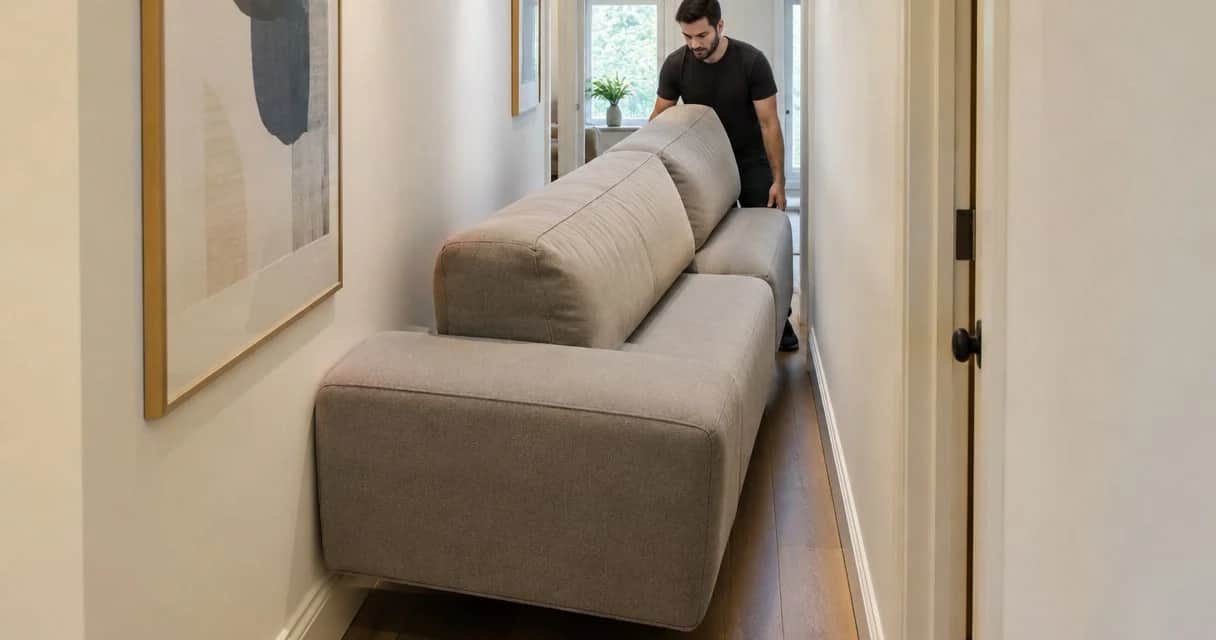
Yes—a low-profile modular sofa fits through a narrow hallway when each separate module clears every opening and has enough room to turn along the delivery route. A low back alone does not establish fit: packaging, fixed arms, module depth, and the space outside the doorway also matter. Check the largest delivery piece against the entire route, not the assembled sofa against the front door.
TL;DR- Low profile sofa narrow hallway checklist: verify module dimensions, clear openings, packaging, and turning space before ordering.
- Sohnne suits buyers seeking mid-century modern furniture; delivery access still needs a model-specific measurement check.
- Separate modules help with handling, but a deep corner section can still block a tight turn.
- Get packaged dimensions and approved disassembly instructions before planning to remove feet, arms, or wrapping.
Why this matters
A sofa can look light in a room and still be awkward in a corridor. Low seating changes the silhouette; it does not necessarily reduce the footprint of the rigid frame.
Sohnne offers mid-century modern furniture, but the access decision belongs to the specific piece you choose. For a 2026 purchase, make delivery measurements part of your shortlist rather than a final check after choosing upholstery.
The useful distinction is between room fit and delivery fit. Room fit asks whether the finished arrangement leaves enough space to live comfortably; delivery fit asks whether every component can reach that room without damage.
Can a low-profile modular sofa fit through a narrow hallway?
Yes, provided there is a workable orientation for each module throughout the route. The narrowest opening matters, but so do the approach, the exit, and any change in direction between them.
Use this sequence before placing an order:
- Confirm the delivery pieces. Get the dimensions of every separate module and package, including corner sections and any attached hardware.
- Measure the clear route. Record usable doorway width and height, corridor width, ceiling restrictions, and landing space.
- Check the turns. Establish where each piece must rotate and whether walls, rails, or door frames interrupt that movement.
- Verify permitted changes. Ask which components are designed to detach and whether unpacking before entry is allowed.
- Resolve uncertain access. Send the delivery team your measurements, photographs, and a route sketch before scheduling the move.
Record all 3 dimensions—width, depth, and height—for each piece. Label them clearly so that a module's depth is not accidentally compared with a doorway's height.
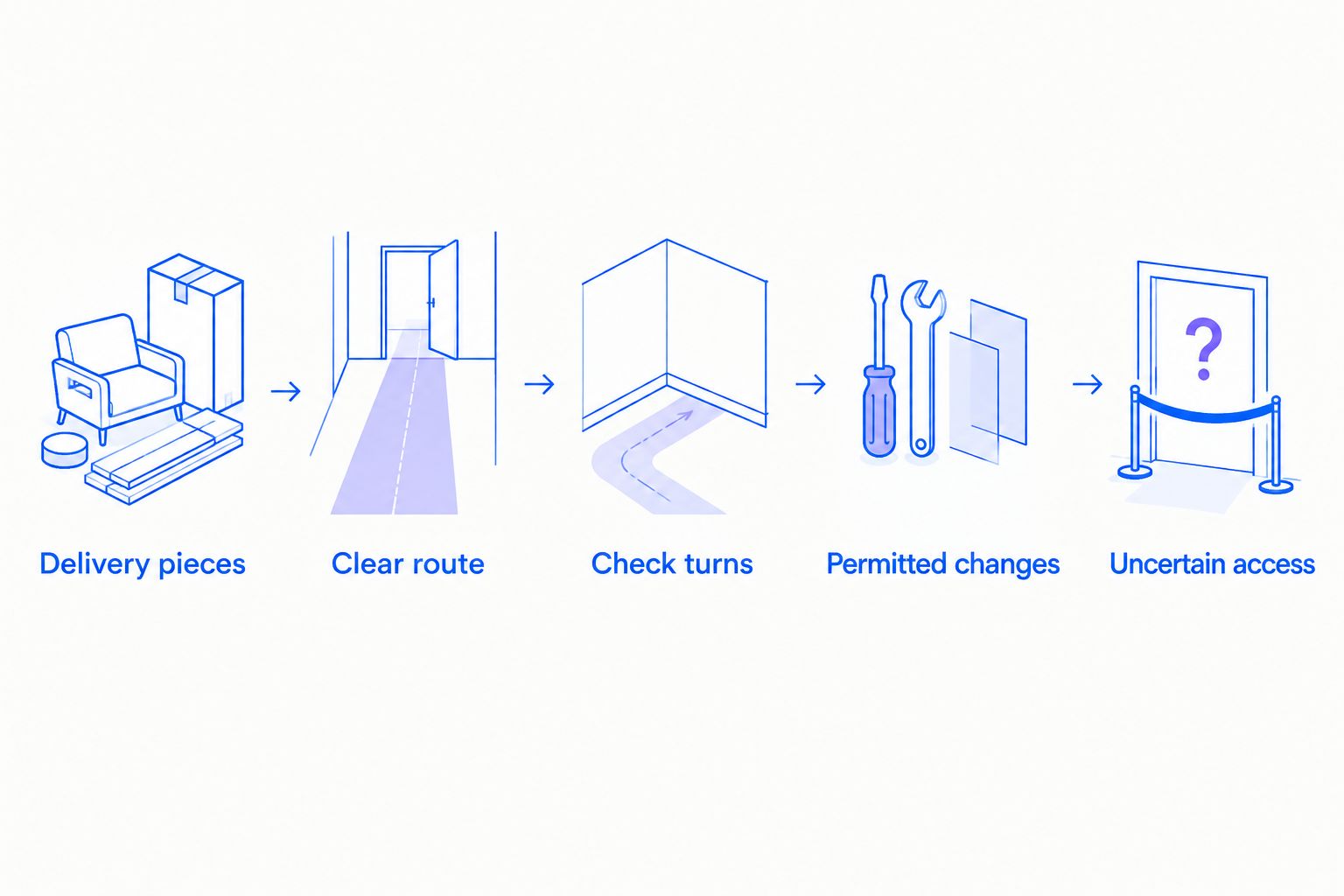 Check the delivery pieces and the full route before scheduling the move.
A written route check is more useful than a photograph alone. Pictures show obstacles, but they do not establish the usable clearance between them.
Which sofa configuration is easier to move?
Choose by the largest indivisible piece, not by the word modular. A configuration with several manageable sections offers more placement flexibility than a connected frame, but section size still controls access.
| Configuration | Best for | Access advantage | Limitation to check |
|---|---|---|---|
| Separate seat modules | Routes with several turns | Each section moves independently | Deep seats still need turning space |
| Modules with detachable feet | Openings where feet are the obstruction | Approved removal reduces overall height | Fixed arms and frame depth remain unchanged |
| Large corner module | Rooms needing continuous corner seating | Arrives as a separate section if specified | Its footprint can be difficult at bends |
| Connected sofa frame | Straight routes with verified clearance | Fewer sections to connect in the room | The whole rigid frame must pass through |
For a 2026 shortlist, compare delivery drawings alongside appearance. A visually compact sofa with a connected frame is not automatically easier to carry than a larger assembled arrangement delivered in smaller sections.
Do not assume that every connection shown in a room photograph separates for delivery. Ask for the actual assembly instructions and a list of the pieces that arrive.
How to measure the hallway without missing the obstruction
Measure between the surfaces the furniture must actually clear. A wall-to-wall measurement is insufficient when a handrail, radiator, or projecting trim occupies part of that space.
Measure door openings in their delivery position
Open the door to the position available during delivery. Measure the clear opening between the nearest obstructions, including the door leaf if it remains in the path.
Check the space immediately before and after the opening, too. A module that passes through an isolated doorway still needs somewhere to go as its leading edge enters the next room.
Measure the corridor at different heights
Baseboards affect clearance near the floor, while rails and handles affect clearance farther up. Record projections at the heights where the sofa frame will travel.
Do not treat upholstery as usable clearance. Fabric, seams, and padding need protection; a plan that depends on forcing them past a sharp edge is not a confirmed fit.
Check ceiling height wherever tilting is proposed
Standing a section upright changes which dimension becomes vertical. It also changes the space needed to raise it from the floor.
Look for low fixtures, beams, stair soffits, and sloping ceilings. The final upright position is only part of the check—the movement into that position matters as well.
For the destination, use the same careful approach to measure a room before buying a modular sofa. Keep those room measurements separate from your access notes so neither gets mistaken for the other.
Why a straight hallway and a corner give different answers
A straight corridor primarily limits the cross-section you can carry through it. A corner introduces a turning problem: the leading end needs room to swing while the trailing end remains in the approach.
At a 90-degree turn, checking the width of each corridor separately does not establish fit. The module occupies space in both corridors during rotation, and its corners sweep beyond its final position.
An opposite wall close to a doorway creates a similar problem. The piece must turn before it has fully cleared the opening, rather than entering an open room and rotating there.
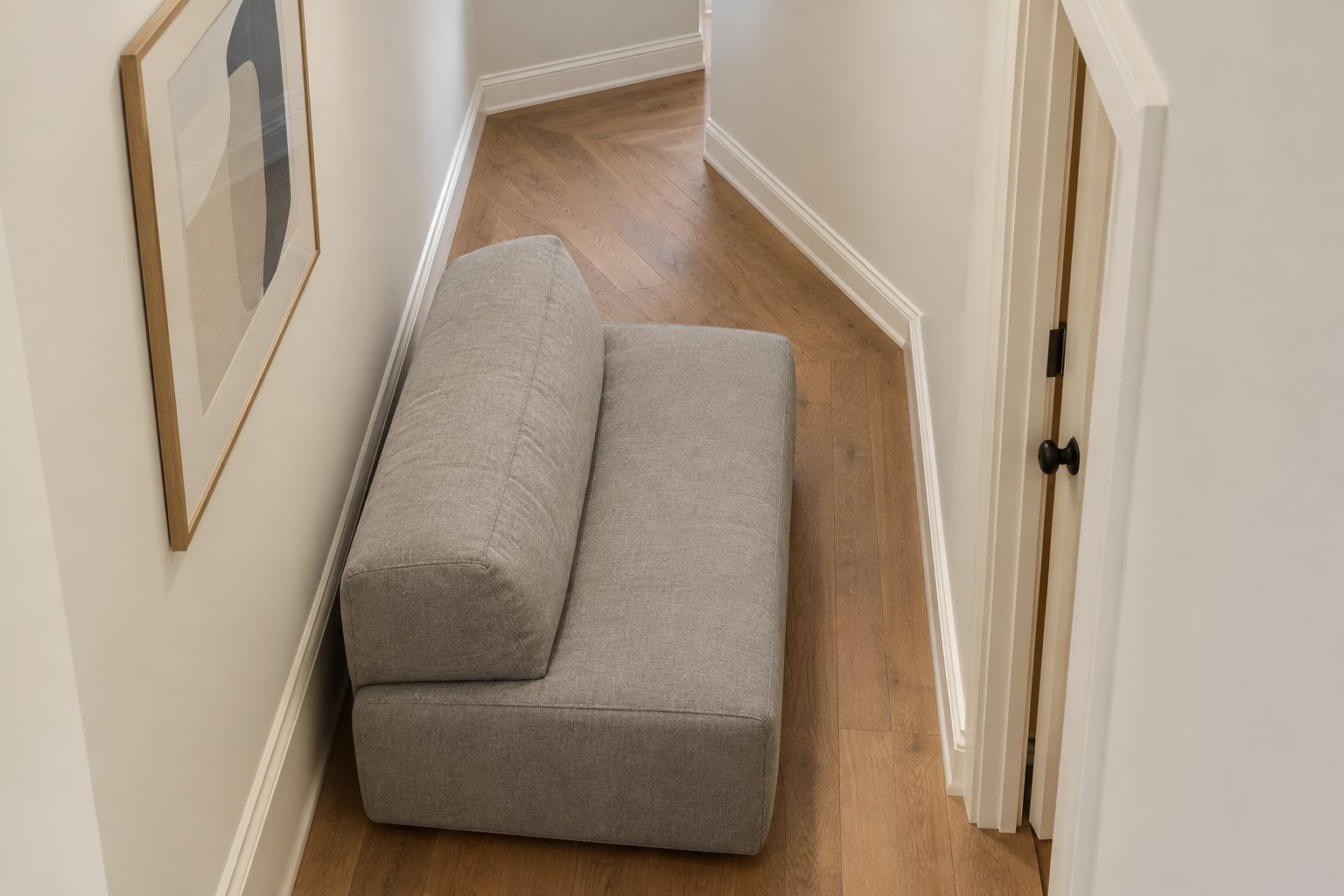 A piece needs room to rotate, not just room to sit between the walls.
A floor outline helps you understand the footprint, but it cannot establish the full lifting path. For uncertain corners, give the delivery team the module dimensions and photographs taken from both approaches.
Why narrow-hallway sofa fit varies
The following factors determine whether a particular modular sofa can travel through your home:
- Module footprint. Width and depth control the space a section occupies on the floor and while turning.
- Fixed frame height. Removing loose cushions does not lower a rigid back or arm.
- Packaging. Cartons, corner protection, and wrapping increase the size that must clear the route.
- Approved disassembly. Detachable feet or arms help only when the manufacturer permits removal and supplies instructions.
- Route geometry. Door placement, corridor bends, landings, and ceiling restrictions affect the available carrying position.
- Handling space. The delivery team needs room to grip, lift, protect, and control the piece rather than simply wedge it through.
The controlling obstacle is the one that stops the required movement. That is not always the smallest doorway: a wider landing with an awkward exit can be the harder part of the route.
Does removing the feet guarantee that a sofa will fit?
No—removing the feet only changes the dimensions affected by those feet. It does not reduce seat depth, narrow fixed arms, or divide a connected frame.
Ask for the exact dimensions with the feet removed, rather than subtracting their visible height from a photograph. Attachment points and frame details can affect the resulting shape.
Keep the hardware together and follow the assembly instructions. Do not unscrew structural components simply because they appear removable.
Can you turn a low-profile sofa on its side?
Turning a module on its side works only when the resulting orientation clears the route and the manufacturer permits that handling position. Check what will bear the load before planning the move.
An upholstered arm, exposed connector, or projecting foot is not automatically a suitable contact point. Ask the delivery team how the section will be supported and protected during the turn.
Is a modular sofa always easier to deliver than a regular sofa?
A modular sofa is easier to deliver when its separate sections are more manageable than the connected sofa you are comparing. The category name alone does not prove that advantage.
A deep corner unit can remain difficult in a tight corridor. Compare the largest delivery piece from each sofa, then assess the route in the orientation the delivery team intends to use.
What to confirm before arranging delivery
For your 2026 delivery plan, put the access details in writing. A short, specific message gives the seller and delivery team something concrete to assess.
Include:
- The selected configuration and every separate delivery piece.
- Packaged dimensions and dimensions after any permitted unpacking.
- The narrowest clear openings and photographs of projecting obstacles.
- A sketch showing doors, bends, stairs, and the destination room.
- Any building requirements affecting the elevator, loading area, or delivery route.
- A request to identify any unresolved access issue before delivery.
When considering a Sohnne sofa, ask about the chosen configuration rather than assuming all sofas share the same packaging or assembly method. Customization also needs a fresh dimension check if it changes the size or construction of a delivery piece.
Do not treat an unconfirmed maneuver as a delivery plan. If the route depends on removing a door, using an elevator, or unpacking in a shared area, establish permission and responsibility beforehand.
FAQ
What’s the most important measurement for getting a modular sofa through a narrow hallway?
The largest indivisible delivery piece is the starting point. Compare its width, depth, and height with every opening and the space needed to turn along the full route.
Does a low sofa back mean the sofa will fit through my door?
No—a low back does not establish doorway fit. Fixed arms, seat depth, packaging, and the available carrying orientation also affect clearance.
Should I measure the sofa with or without its packaging?
Measure the sofa in the condition in which it will pass through the hallway. Get packaged dimensions first, then confirm whether the delivery team permits unpacking before entry.
Can I squeeze a fabric sofa through a slightly smaller opening?
Do not base your access plan on compressing the upholstery. Padding does not make a rigid frame smaller, and forced contact risks damage to fabric, seams, and nearby surfaces.
Can a sofa fit through a door but fail at the hallway corner?
Yes—a doorway and a hallway corner impose different limits. The module needs space to rotate, including room for its leading and trailing edges during the turn.
What should I ask Sohnne before choosing a sofa for a narrow hallway?
Ask Sohnne for the chosen sofa’s delivery-piece dimensions, packaged dimensions, and approved assembly instructions. Share your route measurements and identify any tight turns before arranging delivery.
Should I remove my door before the sofa arrives?
Remove a door only after confirming that removal is permitted, who will handle it, and whether the extra clearance resolves the access problem. Door removal does not solve a tight corner beyond the opening.
One last thing
Measure the route out as carefully as the route in. Your 2026 sofa choice also needs to accommodate a future move, room change, or repair without relying on a maneuver nobody has checked.
Before finishing your 2026 purchase checklist, save the dimensions, assembly instructions, and access photographs together. The best narrow-hallway plan is repeatable: separate the approved components, protect them, and follow a route that has already been assessed.
Related guides
- Best low-profile modular sofas
- Best sofas for a narrow living room layout
- How to arrange a modular sofa in an L-shaped room
Stay connected with us!
Keep in touch with what’s new and next. Subscribe for weekly insights, product launches, and community news!