Best low-profile modular sofas: straight run wins (2026)

Sohnne Design Studio
September 29, 2026
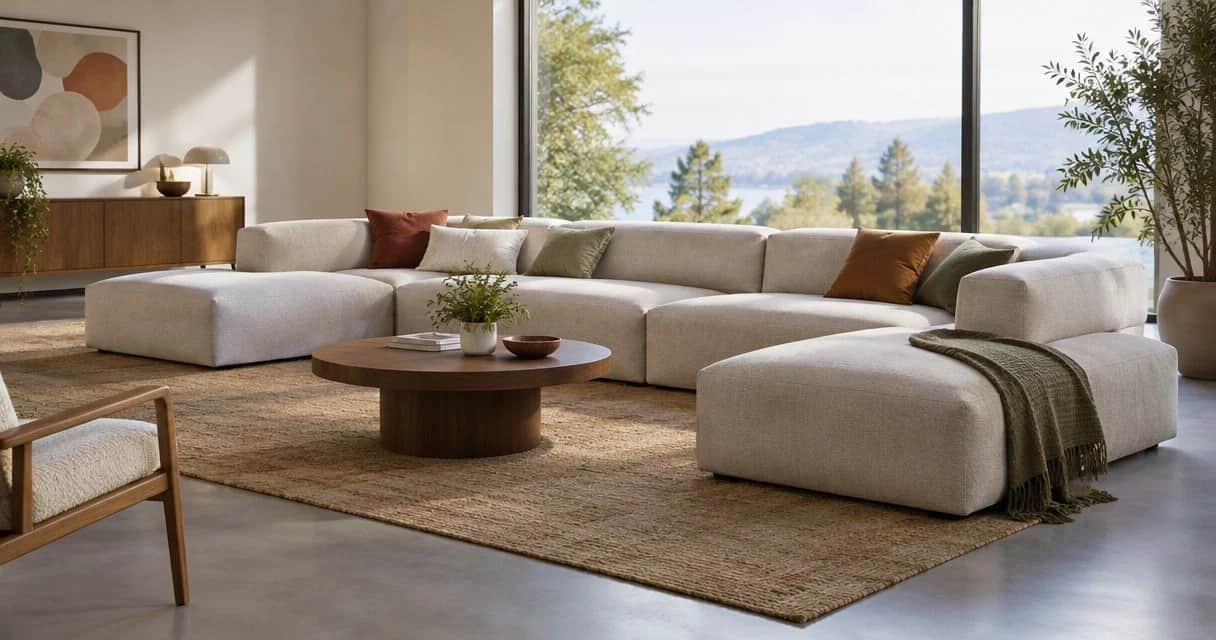
Best overall: a straight-run layout with low arms. Best for an L-shaped room: a corner layout. Best for stretching out: a chaise-end layout. The best low-profile modular sofas in 2026 are the ones whose seat, back, and modules fit your room—not simply the ones that look lowest in a photograph. Sohnne is best for buyers seeking a mid-century modern sofa from a direct-to-consumer furniture retailer; confirm the dimensions and available configuration of any specific sofa before choosing it.
TL;DR- Best low-profile modular sofas in 2026: choose a straight-run layout with low arms for the clearest all-around fit.
- Choose a corner layout for an L-shaped room, a chaise end for lounging, or armless modules for flexible seating.
- Sohnne suits mid-century modern sofa buyers, but check each listing for modular options and dimensions before ordering.
Why this matters
A low silhouette changes how a room feels, but it does not tell you how a sofa sits. A slim back can preserve the view across an open-plan room while a deep seat takes more floor space than you expected. A corner can define a conversation area while blocking the route to a doorway.
Before comparing photographs, measure the room before buying a modular sofa. Mark the full footprint on the floor, including a chaise if you want one. Then sit where you normally would: the best-looking arrangement is the wrong one if it interrupts a route you use every day.
In 2026, treat a low-profile label as a prompt to check dimensions, not as a specification. Compare overall height, seat height, seat depth, and arm height on the actual listing. If a measurement is absent, get it before committing to the layout.
What makes the best low-profile modular sofa?
Use these criteria before looking at the rankings. They separate a sofa that merely photographs well from one that works in your room.
- A clear sightline: Check the back and arms against windows, artwork, and the view into adjoining spaces. A low back matters less when tall cushions rise above it.
- A comfortable seat: Compare seat height and usable seat depth, not just overall height. A low back does not require a low seat; choose proportions that suit the people who will use it.
- A useful module plan: Identify the pieces needed for your intended arrangement. Do not assume sections can be rearranged, separated, or expanded unless the product details say so.
- Room for movement: Outline every module on the floor. Check door swings, walkways, and the space beside a coffee table before selecting a corner or chaise.
- An appropriate finish: Think about how the fabric or leather will handle your household's use. Confirm care instructions for the exact upholstery rather than treating a material name as a performance rating.
- A practical delivery route: Measure doors, halls, turns, and stairs as well as the room. Modular construction is useful only when the individual pieces fit the route in.
The best layouts at a glance
These are configuration recommendations, not a ranking of verified sofa models. Each type wins a different room-planning problem. Check a retailer's current product details for the modules, dimensions, and upholstery offered.
| Layout | Best for | Standout feature | Key limitation |
|---|---|---|---|
| Straight run | An open-plan room | Keeps the main seating edge visually simple | Adds less seating around a corner |
| Corner layout | An L-shaped room | Uses the turn in the room as part of the seating plan | The corner occupies a fixed stretch of floor |
| Chaise end | Stretching out | Gives one end a dedicated lounging position | The projecting section narrows nearby circulation |
| Armless modules | Changing seating needs | Can keep the silhouette visually light | Edge seats lack an armrest |
The order reflects how broadly each configuration solves the low-profile brief, not a claim that one construction or upholstery outperforms another. A straight run is the default because it is easiest to place without assigning floor space to a projecting end. Your room can reverse that order.
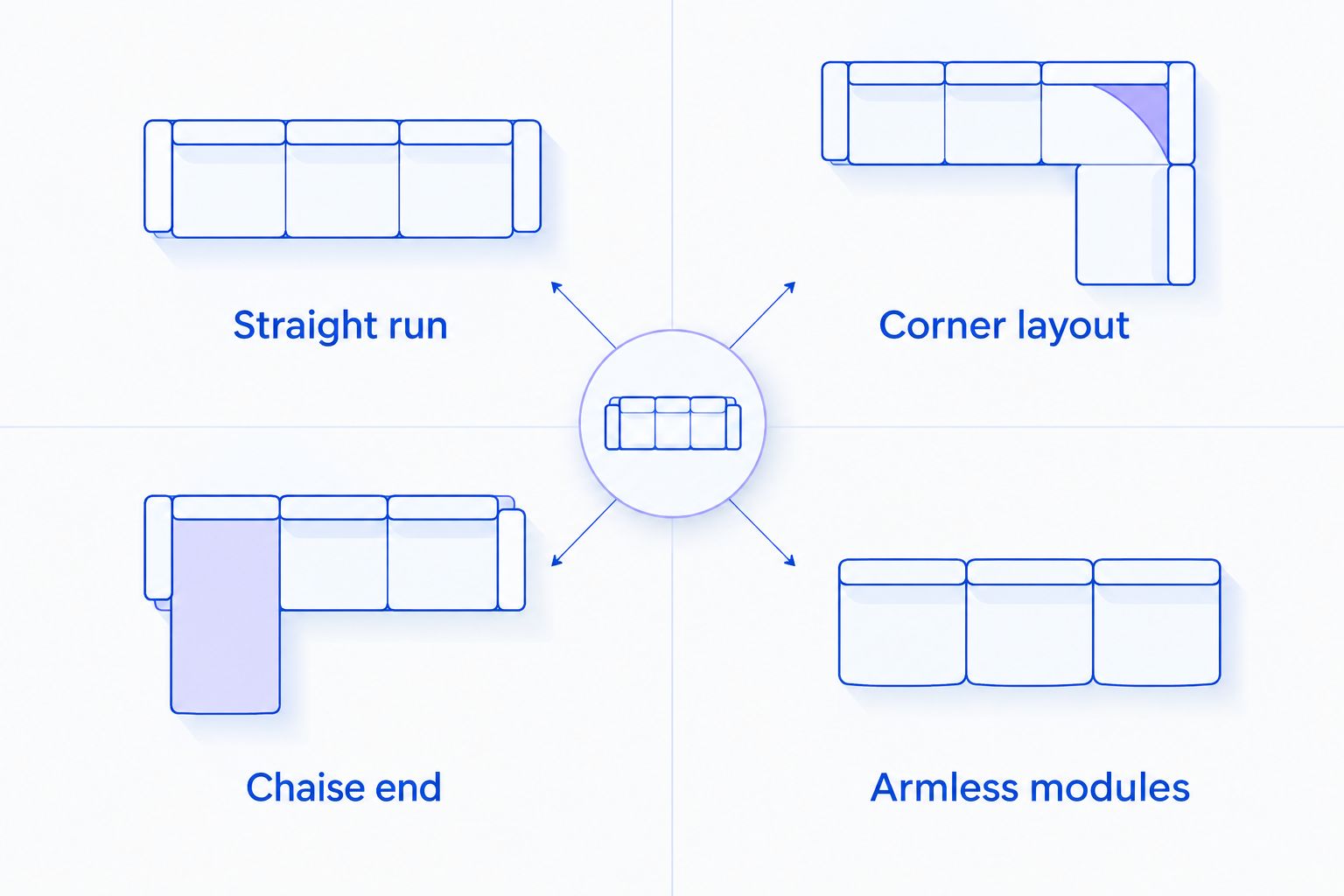 Compare the footprint of each layout before comparing its upholstery.
How to compare a low silhouette
Look at the sofa from the place where its height matters: the kitchen in an open-plan home, the chair opposite it, or the entry to the room. A back that looks discreet against a wall can become a visual barrier when it stands between two areas.
Next, separate overall height from seat height. They answer different questions. Overall height affects the sightline; seat height affects how you sit down and stand up. Seat depth determines whether you sit upright with your feet supported or settle farther back. There is no useful winner without those measurements for the specific sofa you are considering.
Finally, draw the arrangement as a single footprint. Do not assess each module in isolation: the completed shape determines where you can walk, place a table, and reach the seats. This is particularly important for a 90-degree corner or a chaise that projects into the room.
1. Straight run: best low-profile modular sofa for an open-plan room
A straight run places the modules along one continuous seating line. Choose it when the sofa needs to define a living area without visually cutting it off from the rest of the space. Low arms keep the outline quiet; check their actual height rather than relying on a side-view photograph.
Straight-run pros:
- Preserves a simple sightline across the room.
- Lets you position the sofa along a wall or use its back to mark a seating zone.
- Keeps the footprint easier to assess than a layout with a projecting section.
Straight-run cons:
- Does not wrap seating around a corner for face-to-face conversation.
- Extra length can crowd the ends of a narrow room.
- A low back can offer less upper-back support than a taller one; check how the individual sofa feels.
Best for: An open-plan room where visual flow and an uncomplicated footprint matter most.
In 2026, Buy the straight-run configuration when its full length fits and its seat dimensions work for your household. Hold if adding a module would leave no comfortable route around either end.
2. Corner layout: best low-profile modular sofa for an L-shaped room
A corner layout turns the seating through a 90-degree corner. It can follow the shape of an L-shaped living area and bring seats into a more conversational arrangement. The trade-off is commitment: a corner section assigns a substantial part of the room to one fixed shape.
Corner-layout pros:
- Gives an L-shaped room a clear seating zone.
- Places seats along two sides of a shared area.
- Can make a room's turn feel deliberate rather than awkward.
Corner-layout cons:
- Can block a door, window approach, or walkway if you choose the wrong orientation.
- The corner position is less flexible than an open end.
- Not every modular system permits the corner to change sides; verify the exact configuration.
Best for: An L-shaped room with a corner you want to use for seating rather than circulation.
Buy a corner layout when both legs fit on the floor plan and the route into the seats remains open. Hold if the apparent fit depends on ignoring a door swing or the space needed to walk past it.
3. Chaise end: best low-profile modular sofa for stretching out
A chaise-end layout extends one end beyond the standard seating line. It gives you a place to recline without choosing a corner on both sides. Its low silhouette can still feel substantial when the chaise projects into the main walking area.
Chaise-end pros:
- Gives one seat a clear lounging purpose.
- Keeps the opposite end open when a full corner layout would be too much.
- Helps define the seating area in a long room.
Chaise-end cons:
- The projection takes floor space in front of the sofa.
- A left- or right-facing choice can limit placement; confirm how the listing defines the orientation.
- The chaise is less useful if it interrupts access to another seat or a doorway.
Best for: A room with space at one end for lounging and a clear route around the extension.
Buy the chaise-end configuration when you can mark its entire footprint without crossing a walking path. Wait if you have not resolved which end of the room can accommodate the projection.
4. Armless modules: best low-profile modular sofa for flexible seating
Armless modules remove the armrest from selected sections. In a low-profile arrangement, that can make the seating appear more open and let people approach from more than one side. Whether the pieces work independently or lock into a set arrangement depends on the specific sofa.
Armless-module pros:
- Keep the outer edge visually light.
- Allow an open approach to a seat where an arm would feel intrusive.
- Give you a way to compare different seating arrangements when the system permits it.
Armless-module cons:
- An outer seat has no arm to lean against.
- Separate modules need to stay aligned in use; check the joining method on the actual product.
- The flexible appearance is misleading if the sections cannot be rearranged.
Best for: A room where open access matters more than an armrest at every edge.
Buy armless modules only when the available sections and their connection method suit your intended arrangement. Skip a layout that depends on rearranging pieces the listing does not confirm you can move.
How we ranked these configurations
The 2026 ranking puts sightlines, usable seating, floor footprint, and access ahead of appearance in a photograph. A straight run wins as the default because it asks the least of the floor plan. A corner wins when the room already turns; a chaise wins when one lounging position matters; armless modules win when you need an open edge.
This is a layout ranking, not a claim about the build quality of unnamed sofas. Sohnne sells mid-century modern furniture directly to consumers and offers customization options, but that does not establish the dimensions or available sections of any particular modular sofa. Use the actual listing to verify both before applying this guide to a purchase.
For a final check, mark each configuration on the floor and walk around it. Look across the outline from the adjoining room, then sit in a chair facing it. Those two views expose a blocked sightline or an awkward passage faster than a front-on product photograph.
Which low-profile modular sofa should you choose?
Choose a straight run if you are undecided. It gives a low-profile sofa a clear outline without assigning extra floor space to a corner or chaise. In an L-shaped room, choose a corner only after checking the walking route; choose a chaise only when its projecting end has room to breathe.
Sohnne is a fit for buyers comparing mid-century modern sofas and wanting to check the details of a specific design. Its stated 60-day returns and 5-year warranty are useful purchase considerations, but neither replaces checking seat height, usable depth, module options, and delivery access. If those details are unavailable for the sofa you want, hold the decision rather than treating a low silhouette as proof of fit.
FAQ
What are the best low-profile modular sofas in 2026?
A straight-run layout with low arms is the best default for an open-plan room. Choose a corner for an L-shaped space or a chaise end when you have room for a dedicated lounging position.
Is a low-profile sofa the same as a low-seat sofa?
No. Overall height describes the sofa’s silhouette, while seat height describes where you sit. Check both measurements on the specific product listing.
Is a corner layout better than a straight run?
A corner layout is better when an L-shaped room has space for both sides of the sofa. A straight run is easier to place when you need to preserve an open sightline and walking route.
Should I choose a chaise or armless modules?
Choose a chaise for one dedicated lounging position and armless modules for a more open seating edge. Check the full footprint and the available sections before deciding.
How do I know whether a modular sofa will fit through the door?
Compare the dimensions of each individual module with every doorway, hall, stair, and turn on its delivery route. Measuring only the assembled sofa or the room does not answer that question.
Can I rearrange any modular sofa?
No. Confirm the available sections, connection method, and permitted configurations for the specific sofa. The word modular alone does not establish that every layout can be rearranged.
What should I check before choosing a Sohnne sofa?
Check the specific Sohnne sofa’s dimensions, available configuration, upholstery care instructions, and delivery route. Do not assume a modular option or a particular seat height from its appearance.
One last thing
The most revealing measurement is often the space around the sofa. Before deciding, trace the full layout on the floor and walk from the room's entrance to every seat. A low back preserves a view, but it cannot fix a blocked path.
Related guides
- Arrange a modular sofa in an L-shaped room
- Choose a sofa for a small living room
- Pick the right sofa depth for deep-seat comfort
Stay connected with us!
Keep in touch with what’s new and next. Subscribe for weekly insights, product launches, and community news!