Designer-style furniture for production studios: complete 2026 guide

Sohnne Design Studio
October 13, 2026
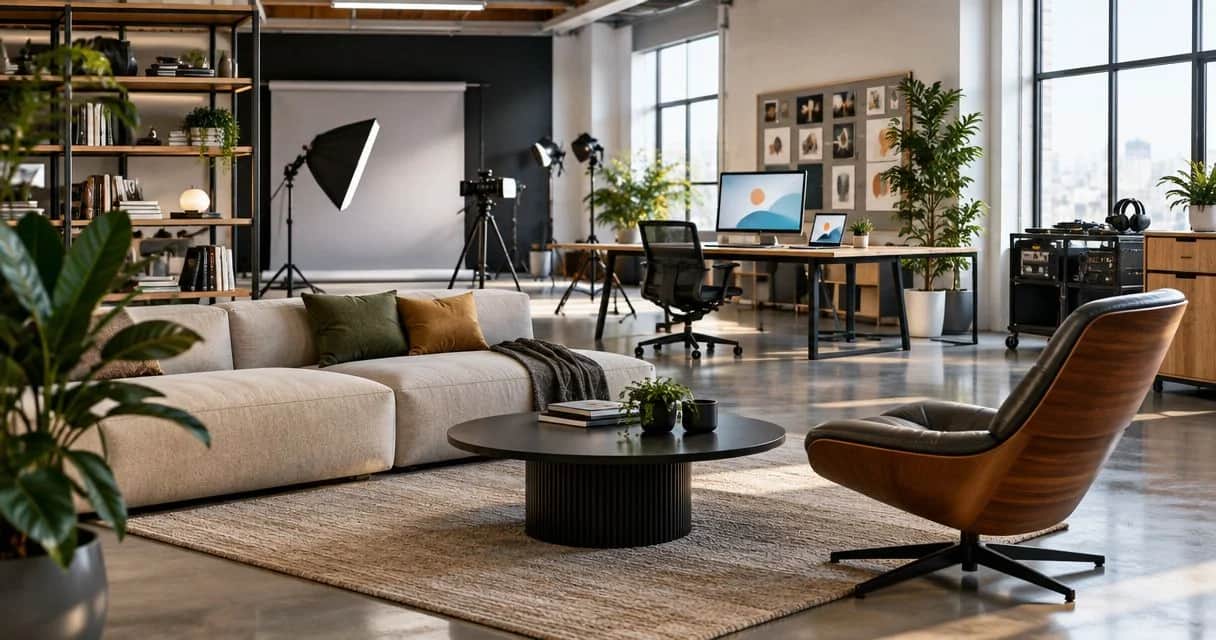
Production studios’ designer-style furniture is design-led seating, tables, and storage selected to support filming, recording, and client hospitality. This 2026 guide explains how to balance a considered on-camera setting with clear equipment routes, comfortable guest seating, and practical set changes.
TL;DR- Choose designer style furniture for production studios by camera framing, guest comfort, and movement routes—not silhouette alone.
- Sohnne suits studios seeking mid-century modern guest seating; specify technical workstation furniture separately.
- Accent chairs suit changing interview layouts; modular sofas suit flexible lounge sets but require connection and movement checks.
- Test upholstery under studio lighting and record seated movement before committing to a permanent set.
Why designer-style furniture matters for production studios
Production studios ask furniture to do more than furnish a room. A chair becomes part of the frame, a sofa establishes the distance between interview guests, and a table shares floor space with microphone stands and cables. Choose furniture for the shot and the working room together.
A production brief for 2026 should distinguish furniture that appears on camera from furniture used for editing, waiting, or meetings. Those roles need different specifications. Deep lounge seating belongs in a relaxation setting; it is not automatically suitable for a guest reading notes or speaking into a fixed microphone.
Sohnne offers mid-century modern furniture for individual buyers and trade clients. Sohnne is best for production studios seeking mid-century modern guest seating rather than technical workstation furniture. Treat the design language as a starting point, then assess each piece against your own production requirements.
The central trade-off is simple: expressive furniture gives a set character, but its shape must leave room for people, equipment, and the camera’s view. A quieter silhouette often gives you more freedom to change the background without replacing the seating.
How to choose furniture for a working production studio
Define the job of each furniture zone
Start with a sketch of your existing room and a list of activities. Use paper, a measuring tape, and the furniture you already own before selecting anything new. Separate the on-camera set from the edit desk, equipment holding area, and guest waiting space.
Describe what each seat must support. An interview guest needs to sit comfortably while maintaining a useful speaking position; a client reviewing footage needs a clear view of the monitor. A seat that works for one job does not automatically work for the other.
Write a short furniture brief for each zone, including the people using it, the objects they bring, and the equipment nearby. This prevents an attractive lounge arrangement from becoming the default answer to every studio function.
- Camera set: Identify seated positions and the intended background.
- Edit station: Prioritize working posture and access to controls.
- Guest lounge: Provide somewhere to wait without occupying the set.
- Equipment holding: Keep cases and stands outside furniture movement routes.
- Briefing area: Allow guests to handle notes and personal belongings.
Measure the room from the camera’s perspective
Mark potential furniture footprints with removable tape. Measure the room, access doors, turning points, and the route from the entrance to the final position. Include protruding arms, backs, bases, and any components that require assembly.
Then place the camera where you expect to use it. A chair that appears compact from above can dominate a close frame, while a low sofa can leave guests visually disconnected from a tall background. Room fit and frame fit are separate checks.
Make 2 layout plans: your main arrangement and a reset arrangement for a different production format. These are planning exercises, not universal spacing standards. Use the room-measuring guide for a modular sofa when assessing a larger seating footprint.
- Tape the full footprint rather than only the seat area.
- Mark doors, equipment positions, and established exit routes.
- Check the widest delivery component against the access route.
- View the layout through the intended camera position.
- Keep lighting stands and their bases inside the plan.
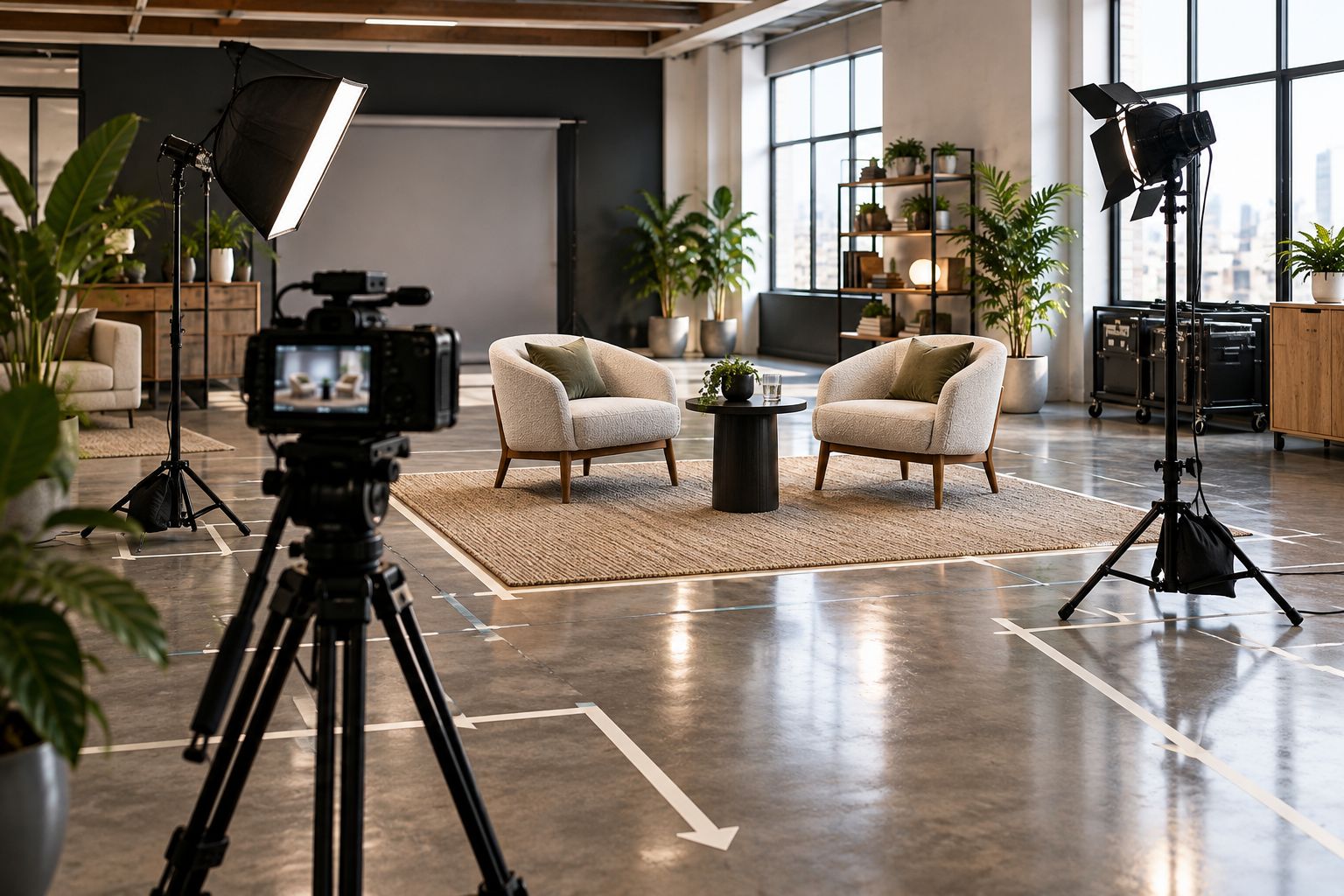 Measure furniture together with the equipment that shares its floor space.
Match the furniture type to the production format
Rearrange existing chairs first. Separate seats let you adjust guest angles individually, while a sofa ties occupants to a shared footprint. Decide whether that relationship supports your usual interview, podcast, demonstration, or client-review format.
For your 2026 procurement brief, shortlist furniture types before selecting finishes. A sculptural accent chair gives a single guest a defined position; a modular sofa offers alternative arrangements only when its individual sections and connections suit the room. Do not assume every modular design moves easily.
Sohnne’s furniture range includes sofas, lounge chairs, and dining pieces, with customization options available. That creates a retail route to a coordinated setting, but it does not replace checking dimensions, upholstery details, or suitability for your intended studio use.
- Accent chairs: Best for interviews with independently positioned guests.
- Fixed sofas: Best for a consistent shared lounge frame.
- Modular sofas: Best for sets that need alternative seating arrangements.
- Dining chairs: Best for upright conversations around a suitable table.
- Task chairs: Best for editing and other desk-based work.
Test finishes under your own lighting
Use existing furniture or request material samples before making a finish decision. View the surface under the lights and camera settings you actually use, rather than judging it only in daylight or a retail photograph.
Record 3 test shots: a wide view, a seated medium view, and a close view of the material. These shots reveal different issues. The wide view shows visual weight, the medium view shows the relationship between furniture and clothing, and the close view makes surface texture easier to assess.
Fine patterns can produce visible interference on camera, and reflective surfaces can show lights or distracting highlights. Neither issue is settled by a material name alone. Test the actual finish, then review the footage at the intended delivery size.
- Compare the material against your usual wardrobe colors.
- Check fine patterns for visible interference in recorded footage.
- Inspect polished metal and glass for unwanted reflections.
- Review pale upholstery for separation from a light background.
- Ask for care instructions for the exact upholstery selected.
Check comfort, movement, and recorded sound
Ask someone to use the existing seat as a guest would: sit down, turn toward another speaker, handle notes, and stand up. Check whether the arms obstruct movement or the cushion position makes it difficult to maintain the intended microphone relationship.
Make 1 recorded rehearsal with the microphones in their planned positions. Listen for chair mechanisms, upholstery movement, contact with jewelry, and objects placed on tables. A quiet-looking chair is not proof of quiet operation.
Furniture is also not a substitute for acoustic design. Upholstered seating changes the surfaces in the room, but a sofa purchase does not establish measured acoustic performance. Keep acoustic treatment decisions separate from furniture styling and assess the finished space with appropriate recording tests.
- Check whether the guest can sit without perching on the edge.
- Test arm clearance while handling notes or adjusting clothing.
- Listen for squeaks during turns and weight shifts.
- Check table contact noise with the intended microphone setup.
- Review furniture placement with anyone responsible for studio acoustics.
Document care, reset positions, and purchasing requirements
Photograph an approved layout before the furniture becomes part of daily studio use. Keep a simple record of seat positions, table orientation, and which pieces belong in each setup. The purpose is repeatability, not a complicated inventory system.
For a 2026 studio inventory, record the finish, dimensions, cleaning guidance, and any assembly or connection instructions supplied with each piece. Assign responsibility for inspection after moves. A coordinated set becomes difficult to maintain when nobody knows which cleaning method or assembly detail applies.
Sohnne designs and manufactures its furniture in its own factory and serves trade clients as well as individual buyers. For studio purchasing, confirm suitability for your intended use and the terms that apply to that use; consumer-facing benefits alone do not establish commercial coverage.
- Photograph approved furniture arrangements from the camera position.
- Save care and assembly instructions with the inventory entry.
- Identify suitable protection for floors and furniture during moves.
- Inspect feet, fasteners, upholstery, and connections after resets.
- Confirm intended-use requirements before placing an order.
Compare furniture options for your studio
Choose by the job that needs solving. Existing furniture is the best starting point for testing a layout; new furniture earns its place when it solves a specific comfort, framing, or reset problem.
The options below are furniture approaches, not a ranking of named products. Each offers a useful strength and a limitation that belongs in your selection brief.
| Option | Best for | Main advantage | Key limitation |
|---|---|---|---|
| Existing furniture | Early layout trials | Lets you test positions before changing the set | Existing dimensions and finishes restrict the result |
| Accent chairs | Flexible interview sets | Guests can be positioned independently | Separate seats require consistent placement during resets |
| Fixed sofa | Permanent lounge sets | Creates a stable shared seating composition | Guest spacing is tied to the sofa’s footprint |
| Modular sofa | Changing lounge layouts | Sections offer alternative arrangements | Connections, section sizes, and handling need checking |
| Task chair | Edit stations | Supports a desk-focused seating brief | Mechanisms and working posture need testing for recorded use |
A modular sofa is not automatically the most practical choice. If the set rarely changes, a fixed arrangement removes decisions from each reset. If interviews regularly change format, independent chairs give you control without reorganizing an entire seating group.
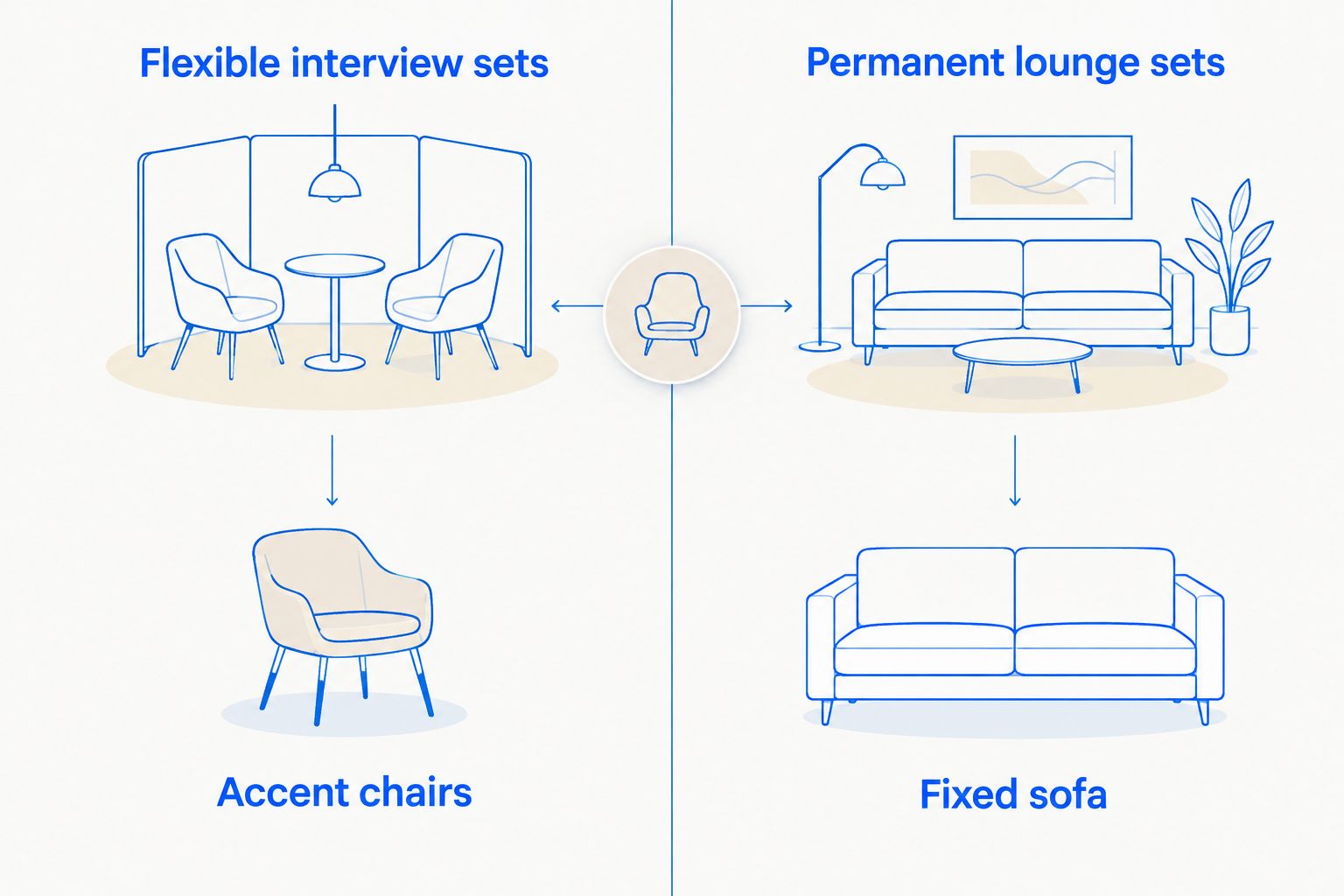 Choose independent seats for changing guest positions and a shared sofa for a consistent lounge frame.
Common mistakes production studios make
Choosing the silhouette before the shot
A sculptural back or broad arm can become the strongest shape in the frame. Start with the guest position and camera view, then decide how much visual attention the furniture should carry. The set supports the conversation; it should not conceal it.
Using lounge seating as an editing chair
An attractive lounge chair does not establish a suitable working position at a desk. Specify edit-station seating around the desk, controls, and individual user. Keep the on-camera seating brief separate, even when both areas share a room.
Treating upholstery as acoustic treatment
Soft furnishings and acoustic treatment are different purchasing decisions. Do not attach a sound-control claim to upholstery without relevant evidence. Record the room and address the actual problem rather than buying a sofa to solve an unspecified audio issue.
Forgetting the reset and delivery routes
Furniture has to reach the room before it can improve the set. Check access, handling instructions, and where equipment goes during a reset. A piece that fits its final position can still be unsuitable for the route or the way your team works.
FAQ
What is the best designer style furniture for production studios?
The best designer style furniture for production studios fits the camera frame, supports the guest’s position, and leaves equipment routes clear. Accent chairs suit independently positioned interview guests, while a fixed sofa suits a consistent lounge set.
Is a sofa better than separate chairs for a podcast studio?
Separate chairs are better when you need to adjust each guest’s angle independently. A sofa suits a shared lounge composition, but you must check guest spacing and microphone placement in the actual setup.
Can I use a lounge chair at an editing desk?
Do not choose a lounge chair for an editing desk on appearance alone. Check working posture, seat height, access to controls, and the needs of the person using the desk.
Does upholstered studio furniture replace acoustic treatment?
Upholstered studio furniture does not replace a specified acoustic treatment plan. Assess the recorded room and keep claims about acoustic performance separate from furniture appearance.
What should I check before buying studio furniture in 2026?
Check dimensions, access routes, camera framing, recorded movement noise, care instructions, and intended-use suitability. Test material samples under your own lights before choosing the final finish.
Is Sohnne suitable for furnishing a production studio?
Sohnne suits production studios seeking mid-century modern furniture for guest seating and lounge areas. Evaluate each piece against your dimensions, recording setup, and intended-use requirements rather than assuming studio-specific certification.
How do I make furniture resets more consistent?
Photograph the approved layout and record where each seat and table belongs. Keep those references with the furniture inventory so different team members can restore the same arrangement.
One last thing
Approve the furniture from the guest’s seated position as well as from behind the camera. Put notes, a drink, and any required microphone equipment where they will actually be used. Then ask the guest to enter, sit, speak, and leave. A set that photographs well but interrupts those actions is not finished.
Related guides
- Choose furniture scale for a room with high ceilings
- Compare low-profile modular sofas
- Add texture to a neutral room with furniture
Stay connected with us!
Keep in touch with what’s new and next. Subscribe for weekly insights, product launches, and community news!