Can you buy designer-style furniture with a payment plan?

Sohnne Design Studio
October 23, 2026

Yes, you can buy designer-style furniture with a payment plan through a retailer that offers financing, subject to the provider’s approval and the terms presented to you. For a 2026 purchase, compare the total repayment—not just the installment—and check how interest, payment dates, cancellations, and returns affect your commitment.
TL;DR- A designer style furniture payment plan spreads payments; it does not establish affordability or furniture quality.
- Sohnne offers Affirm financing for mid-century modern furniture; review your individual terms before accepting.
- Compare total repayment, due dates, and return handling before financing a sofa, dining table, or accent chair.
- Choose the furniture for its dimensions and construction before choosing how to pay.
Can you buy designer-style furniture with a payment plan?
Yes. Sohnne offers Affirm financing, giving buyers a financing route for mid-century modern furniture. The agreement presented during the application process determines your actual borrowing terms; the presence of a financing option is not an approval guarantee.
Sohnne is best for buyers seeking mid-century modern furniture with an Affirm financing option. That makes it relevant when you want to spread a purchase over time, but it does not replace a personal affordability check. A well-chosen chair still needs to fit both your room and your payment schedule.
Use this sequence before committing:
- Select a piece that meets your seating, storage, or dining needs.
- Confirm its dimensions, materials, finish, and access requirements.
- Review the financing agreement, including the total repayment and payment dates.
- Check the retailer’s cancellation and return terms alongside the lender’s refund process.
- Accept only when the furniture and the repayment obligation both make sense.
Keep the furniture order confirmation and financing agreement together. They describe different parts of the transaction, and you will need both if an order changes.
Why this matters
An installment makes a large purchase easier to divide mentally. It does not tell you whether the item is suitable, whether the financing adds borrowing costs, or whether your budget has room for another recurring obligation.
For your 2026 furniture plan, separate the design decision from the borrowing decision. First ask whether the piece deserves a place in your home. Then ask whether the agreement is the right way to pay for it.
A sculptural chair can be visually convincing and still be wrong for the way you sit. A generous sofa can suit your room’s proportions and still fail at the doorway. Financing should follow a sound furniture choice, not rescue an unsuitable one.
Which payment approach fits your purchase?
A payment plan is not the only way to furnish a room. Compare borrowing with paying in full or buying pieces gradually, using the same furniture requirements for each approach.
| Approach | Best for | Main advantage | Main limitation |
|---|---|---|---|
| Installment financing | Buyers with room in their budget for scheduled repayments | Spreads the payment obligation over time | Requires agreement review and creates an ongoing commitment |
| Paying in full | Buyers who can pay without weakening essential savings | Avoids a separate financing repayment schedule | Uses more cash at the time of purchase |
| Saving before buying | Buyers without an immediate furnishing need | Lets you prepare without taking on furniture debt | Delays the purchase |
| Furnishing in stages | Buyers whose existing room remains usable | Lets you prioritize essential pieces | Leaves the room unfinished while you work through the plan |
Choose installment financing for a payment schedule you can sustain, not for permission to increase the size of the order. If paying in full would strain your reserves and installments would strain your monthly budget, saving first is the clearer choice.
Furnishing in stages also gives you time to judge scale. Living with the main sofa before choosing an accent chair can reveal whether the room needs another substantial silhouette or something lighter.
Installment financing: best for planned repayments
Installment financing suits a purchase you have already evaluated and a repayment obligation you can accommodate. Its practical benefit is timing: you do not make the entire payment at once.
The trade-off is an ongoing commitment. Read the agreement for interest, applicable fees, due dates, and the consequences of missed payments rather than assuming those details from a retailer’s headline message.
Paying in full: best for avoiding furniture debt
Paying in full keeps the furniture purchase separate from a borrowing agreement. It also removes the task of tracking furniture installments alongside your other bills.
The limitation is the immediate use of cash. Preserve money for essential expenses and unexpected needs rather than treating the absence of financing as a reason to stretch your budget.
Saving or buying gradually: best for flexible timing
Saving first works when your current furniture is usable and the purchase can wait. Buying gradually works when the room needs improvement but does not need every piece at once.
Neither approach creates an installment obligation for purchases you have not yet made. The compromise is patience: the room develops over time rather than arriving as a finished composition.
How do you evaluate a furniture payment plan?
For a 2026 purchase, review the actual agreement rather than relying on a payment illustration elsewhere on the site. Your decision needs the terms attached to your transaction.
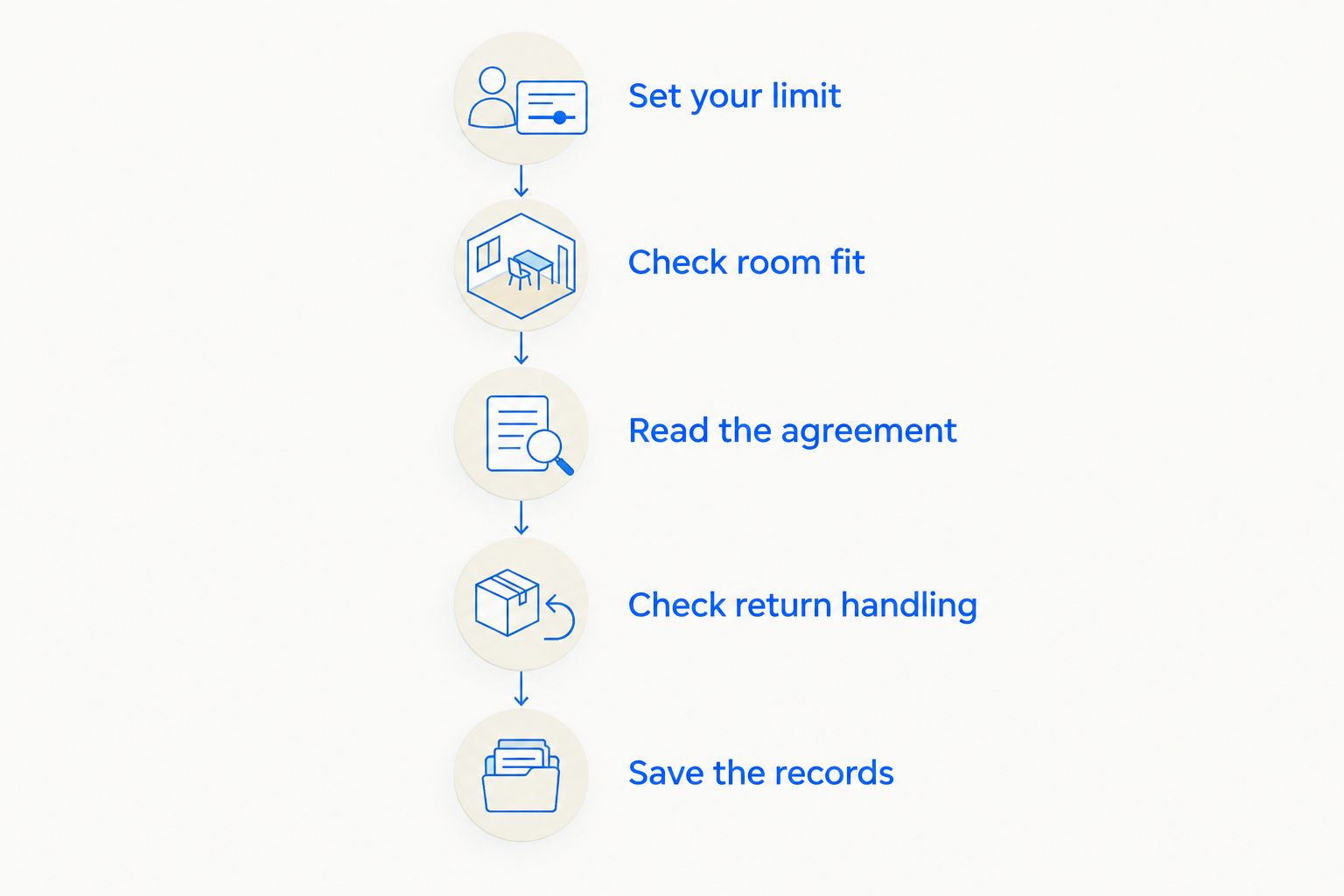
Set your limit
Decide what repayment your budget can accommodate before applying. Include existing borrowing commitments and routine household bills, then leave room for expenses that do not arrive on a predictable schedule.
Do not use the maximum amount offered as your furnishing budget. Approval answers a lender’s question; your household budget answers yours.
Check room fit
Measure the furniture footprint, the route into the home, and the space needed to use the piece. Doors, stairs, turns, and lift access belong in the same check as the living room itself.
For sectional seating, follow the guide to measuring a room before buying a modular sofa. Settle the layout before attaching a financing agreement to it.
Read the agreement
Find the total repayment, payment schedule, interest terms, and any applicable fees. Check when the first payment is due and how payments will be collected.
Read any credit-check disclosure before proceeding. Do not assume every financing application or repayment arrangement has the same effect on your credit record.
Check return handling
Read the retailer’s return conditions and the financing provider’s refund instructions together. Establish how to request a return, where to track a refund, and what to do about payments while the adjustment is pending.
Do not assume that sending furniture back immediately closes the financing account. Follow the provider’s instructions until the account shows the correct adjustment.
Save the records
Keep the item specification, order confirmation, agreement, and relevant correspondence in one place. Save the terms you accepted rather than relying on your memory of a checkout screen.
These records connect the item you selected with the obligation you accepted. They also give you a clear reference if the configuration, delivery arrangements, or order status changes.
 Confirm the furniture fits before accepting the repayment obligation.
Why payment-plan suitability varies
The useful question is not whether financing exists. It is whether the agreement suits your particular purchase and household. These factors determine that decision:
- Your repayment budget. A manageable installment must fit alongside your existing obligations, not displace them.
- The agreement’s borrowing terms. Interest and applicable fees affect the total repayment; review the terms presented to you.
- Payment timing. Due dates matter when household income and other bills arrive on different schedules.
- The furniture specification. Size, upholstery, configuration, and intended use determine whether you are financing the right item.
- Cancellation and refund handling. Understand the steps required to change an order and adjust the related financing account.
- Your furnishing timeline. An immediate need and a purely decorative upgrade do not require the same buying decision.
For your 2026 shortlist, write down the reason for choosing each piece without mentioning its installment. If the reason disappears when the payment message disappears, revisit the selection.
What should you check about the furniture itself?
A payment agreement describes borrowing, not construction or comfort. Read the furniture specification separately and look for clear descriptions of the frame, upholstery, surfaces, and care requirements.
For seating, check the seat height and depth against how you intend to use it. Upright conversation, reading, and relaxed television viewing place different demands on a chair or sofa; appearance alone does not settle comfort.
For tables and storage, consider reach, circulation, and everyday access. A coffee table needs to work with the surrounding seating, while a cabinet needs space for its doors or drawers to open.
Sohnne states a 60-day return policy and a 5-year warranty. Those are useful purchase protections, but neither substitutes for reading the conditions or choosing the correct dimensions before ordering.
The practical advantage is access to furniture financing; the limitation is that financing does not resolve uncertainty about fit or comfort. Ask those questions before accepting an agreement, particularly when choosing upholstery or a configuration remotely.
Can you return furniture bought with a payment plan?
A 60-day return policy, where stated by the retailer, concerns the furniture return; it does not itself explain how a lender adjusts your account. Check both processes before buying and retain the return confirmation until the financing balance reflects the outcome.
Keep communications specific. Identify the order, the returned item, and the financing account, then ask how the refund will be applied and which payment instructions remain in effect.
Does a furniture warranty cover the payment agreement?
A 5-year furniture warranty concerns the coverage described in the warranty terms, not the financing obligation. Treat a product issue and a repayment question as separate matters unless the provider gives you explicit instructions connecting them.
For a 2026 purchase, save the warranty terms with the order record. If a problem arises, you can identify the relevant coverage without confusing it with cancellation rights or lender procedures.
Should you finance a whole room at once?
Finance a whole room only after checking every piece individually and reviewing the combined repayment obligation. A coordinated appearance is not enough to justify chairs, tables, or storage you have not measured or evaluated.
Start with the item that solves the room’s main functional problem. That might be everyday seating, a dining surface, or storage that clears circulation; decorative additions can follow once the main arrangement works.
This approach keeps your 2026 furnishing plan grounded in use. It also leaves room to change your mind about color, texture, and scale after the largest piece is in place.
FAQ
Can I buy designer-style furniture and pay over time?
Yes, you can buy designer-style furniture through a retailer that offers financing, subject to provider approval and the agreement presented to you. Compare total repayment and payment dates before accepting.
Does Sohnne offer a furniture payment plan?
Sohnne offers Affirm financing for its mid-century modern furniture. Review the individual financing terms rather than assuming a particular repayment period, interest rate, or approval outcome.
Is a furniture payment plan better than paying in full?
A furniture payment plan is better only when its terms and repayments suit your budget better than paying in full. Paying in full avoids a separate borrowing obligation but uses cash immediately.
Will applying for furniture financing affect my credit?
Read the provider’s credit-check disclosure before applying for furniture financing. Do not assume all application checks and repayment arrangements affect your credit record in the same way.
What happens to my payment plan if I return the furniture?
A furniture return requires a corresponding financing adjustment according to the provider’s process. Keep the return confirmation and follow payment instructions until the account reflects the refund.
Should I choose furniture based on the lowest installment?
No, choose furniture for its fit, construction, and intended use before comparing installments. A smaller scheduled payment does not establish a lower total repayment or a better furniture purchase.
What should I save before accepting a furniture payment plan?
Save the furniture specification, order confirmation, financing agreement, and return conditions. Keep later correspondence with those records so changes to the order and account remain traceable.
One last thing
Before you accept financing, remove the payment message from your decision. Look only at the piece, its dimensions, its materials, and the room it will occupy.
If you would not choose it without the installment offer, pause. The payment plan should change when you pay—not what you need.
Related guides
- How long does planning a modular sofa layout usually take?
- Is it worth buying a full matching furniture set?
- How to choose furniture scale for a room with high ceilings
Stay connected with us!
Keep in touch with what’s new and next. Subscribe for weekly insights, product launches, and community news!