Can you machine wash a boucle sofa cover?
Sohnne Design Studio
November 12, 2026
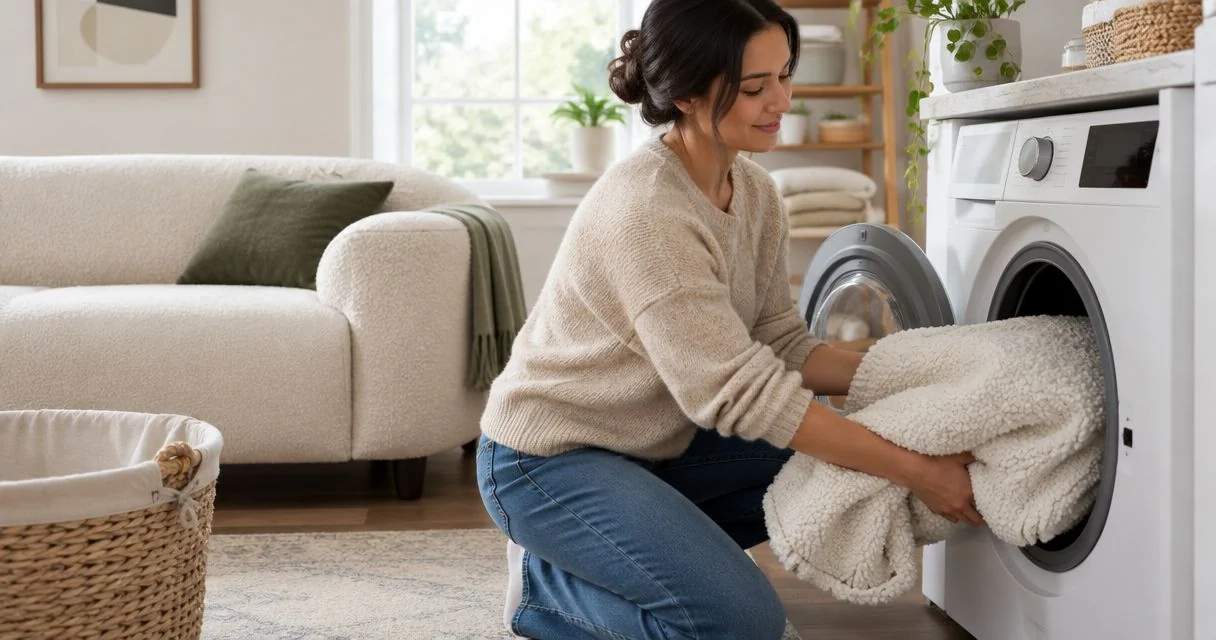
You can machine wash a bouclé sofa cover only when the manufacturer explicitly permits machine washing for that exact cover. A removable cover, a zipper, or a water-safe upholstery code does not establish that permission. In 2026, the safest rule remains simple: follow the cover’s washing and drying instructions, not general advice for textured fabric.
TL;DR- Can you machine wash a boucle sofa cover? Only if its manufacturer explicitly permits machine washing.
- A zipper means access, not washability; upholstery cleaning codes do not authorize a laundry cycle.
- Sohnne furniture owners should confirm the exact cover’s care instructions before removing it.
- Machine-washing permission does not automatically include tumble drying; check both instructions separately.
Can you machine wash a boucle sofa cover?
Yes, if the exact cover is labeled machine washable; otherwise, do not put it in the washer. Check the sewn-in label and the sofa’s care documentation together. Instructions for a scatter cushion, fabric sample, or different upholstery option do not establish how to clean your seat cover.
For routine maintenance between deeper cleans, Sohnne’s guide to caring for bouclé fabric furniture covers the broader care question. Whole-cover washing requires a more specific decision.
Use this sequence before removing anything:
- Find the label. Look for care information on the cover and in the furniture documentation.
- Confirm permission. Find an explicit machine-washing instruction, not simply a statement that the fabric tolerates water.
- Check drying. Read the drying instructions before starting a wash.
- Inspect construction. Identify linings, backing, seams, and fastenings that need special handling.
- Resolve uncertainty. Ask the seller or manufacturer if the instructions are missing or contradictory.
A care instruction must apply to the complete cover, not just its visible fabric. The outer textile can tolerate a treatment that damages its backing or changes the way the cover fits.
Why this matters
Bouclé’s raised loops give a sofa its soft, irregular surface. Those same loops need protection from snagging and excessive friction. Washing also exposes seams, zipper tape, backing, and any lining to moisture and movement.
The consequence is not always an obvious tear. A cover can look clean yet no longer sit correctly around a cushion, with twisted seams or a zipper under tension. Protecting the fit matters as much as removing the stain.
This 2026 care guide separates permission to wash from the process of washing. The first decision comes from the manufacturer; the second follows the instructions attached to that permission.
Which cleaning method fits your cover?
Choose a method according to the care instructions and the problem you need to solve. Routine dust, a fresh spill, and widespread soiling are different jobs.
| Method | Best for | Main benefit | Main limitation |
|---|---|---|---|
| Gentle vacuuming | Loose dust and surface debris | Cleans without wetting the cover | Does not remove absorbed spills |
| Approved spot cleaning | A localized mark on compatible upholstery | Treats the affected area without washing everything | The wrong product or excess moisture can leave marks |
| Machine washing | Covers explicitly labeled machine washable | Cleans the removable cover as a whole | Incorrect washing or drying can alter texture and fit |
| Professional upholstery cleaning | Non-washable upholstery or difficult stains | Allows assessment of the fabric and construction | Requires a suitable method; professional cleaning is not automatically wet cleaning |
Machine washing is not the next step merely because spot cleaning failed. If a stain remains, reassess the method rather than increasing heat, detergent, or scrubbing pressure.
Machine-washable covers: follow the complete instruction
An explicit machine-washable label is permission with conditions. The allowed temperature, cycle, detergent restrictions, and drying method work together; selecting a delicate cycle does not cancel the other requirements.
Read any qualifying language carefully. Instructions to wash separately, avoid bleach, or reshape during drying are part of the care procedure, not optional finishing details.
A washable cover still needs gentle handling. Keep its loops away from exposed hooks, rough fastenings, and other items that can catch the surface. Check the washer’s instructions too: a large cover needs room to move without being forced into the drum.
Best for: owners whose exact covers carry clear machine-washing instructions. The advantage is whole-cover cleaning; the limitation is that every stage, including drying, must remain within the stated conditions.
Removable covers: a zipper is not washing permission
A zipper can allow a manufacturer to insert filling or assemble upholstery. It does not prove that you should routinely remove the cover, and it says nothing about how the fabric behaves in a washer.
Before unzipping a tightly fitted cushion, check whether the care instructions authorize removal for cleaning. If they do, photograph the seam positions and cushion orientation so you can return everything to its original arrangement.
Do not pull on the bouclé loops to free a cover. Support the cushion, ease the material around the corners, and stop if removal strains the seams or fastening.
Best for: covers whose documentation confirms removal for the intended cleaning method. Removability provides access, but it is not evidence of washability.
Upholstery cleaning codes: what they do and do not mean
Common upholstery codes describe permitted cleaning approaches. They are not laundry instructions, and their meaning must be read alongside the furniture manufacturer’s guidance.
- W: permits water-based upholstery cleaning products as directed. It does not mean the cover can go in a washing machine.
- S: calls for suitable solvent-based upholstery cleaning, not water-based washing.
- W/S or S/W: permits appropriate water-based or solvent-based upholstery cleaners, subject to the care directions.
- X: generally limits cleaning to vacuuming or light brushing; do not apply water or solvent cleaners yourself.
A laundry wash symbol provides different information. Under the GINETEX care-symbol system, a wash tub marked 30°C, 40°C, or 60°C states the maximum temperature for the indicated washing treatment. These are examples of label limits, not recommended temperatures for bouclé.
Bars beneath a wash symbol indicate a gentler treatment. A crossed-out wash tub means do not wash. In 2026, an upholstery code and a laundry symbol still answer different questions: one concerns cleaning products and methods, while the other specifies washing treatment.
How do you wash a cover that is explicitly machine washable?
Use this process only after confirming that the cover is machine washable. If any step conflicts with the manufacturer’s directions, the manufacturer’s directions take priority.
Find the label
Read the washing and drying instructions before you remove the cover. Photograph the label so you can refer to it while the cover is in the machine, and check whether separate components have different instructions.
Do not assume that every cushion on the same sofa uses the same construction. A decorative cushion cover and a fitted seat cover can require different care.
Prepare the cover
Remove loose debris with an upholstery attachment, using suction that does not pull aggressively at the loops. Inspect the seams and zipper for damage before washing; laundering is not a repair for an opening seam.
Remove only the components intended to come out. Follow any directions for fastening zippers or turning the cover inside out, rather than applying a generic laundry rule.
Set the washer
Select the temperature and cycle specified on the label. Use a detergent compatible with those instructions and follow its dosing directions; extra detergent does not make an unsuitable wash safe.
Do not add bleach, fabric softener, stain remover, or other additives unless the care guidance permits them. Avoid washing textured covers with items that have exposed hooks or abrasive surfaces.
Dry as directed
Check the drying symbol or written instruction separately from the washing instruction. Permission to machine wash does not establish permission to tumble dry.
If air drying is specified, support the cover as directed so its wet weight does not pull it out of shape. Keep it away from direct heat unless the care instructions expressly allow that treatment.
Check the fit
Follow the manufacturer’s directions on when to refit the cover. Do not automatically refit it damp: that advice is not suitable for every fabric, backing, or cushion construction.
Align the corners and seams before closing the zipper. If the fastening needs force, stop rather than stretching the cover or compressing the cushion to make it close.
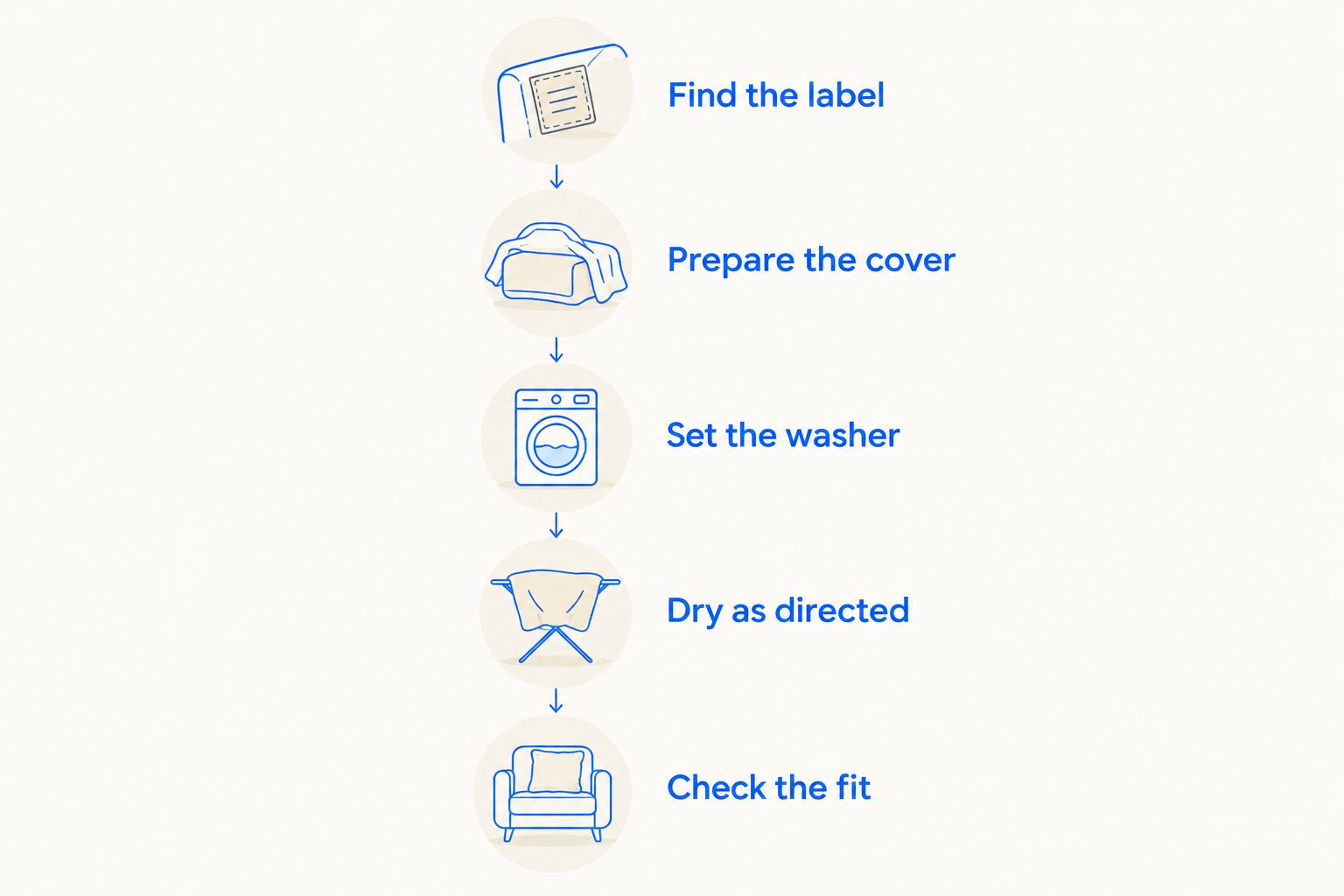 Check drying instructions before starting the wash, not after the cycle finishes.
Why bouclé cover washability varies
There is no universal bouclé washing setting. These construction differences explain why care instructions vary:
- Fiber composition: wool, cotton, polyester, and blends do not all respond identically to moisture, heat, and agitation.
- Yarn construction: the looped surface needs protection from catching and friction.
- Backing and lining: materials behind the face fabric can impose different care restrictions.
- Cover construction: seams, piping, fastenings, and attached components affect the complete item’s care requirements.
- Fit: a closely tailored cover has less tolerance for dimensional change than a loose covering.
- Finishes: applied treatments can require particular cleaning products or methods.
When comparing mid-century modern furniture in 2026, ask for care instructions alongside dimensions and upholstery information. An attractive fabric description does not establish how practical the cover will be in your household.
Sohnne serves buyers seeking mid-century modern furniture; cover washability remains a model-specific care question. If you own a piece from the retailer, contact Sohnne with the product details and a photograph of the care label before choosing a cleaning method.
What should you do if the care label is missing?
Do not machine wash an unidentified cover. Find the order information, upholstery selection, and any care paperwork, then ask the manufacturer to confirm the instructions for that exact item.
While you wait, limit maintenance to gentle removal of loose debris where the fabric condition permits it. Avoid testing a succession of household cleaners: each application complicates assessment of the original mark.
If the spill needs urgent treatment, ask an upholstery-cleaning professional to assess it. Explain what spilled and what, if anything, you have already applied.
Can you put a bouclé sofa cover in the dryer?
Only use a dryer if the cover’s instructions explicitly permit tumble drying. A machine-washable label does not automatically permit dryer heat, and a low-heat setting does not make a prohibited treatment acceptable.
Check for written restrictions and drying symbols before washing. When drying instructions are unclear, ask the manufacturer instead of choosing a setting by trial and error.
What if the cover shrinks or the texture changes?
Stop before forcing the cover back onto the cushion. Check whether the material is fully dry as required, whether its orientation is correct, and whether the seams line up with their original positions.
Do not use steam, stretching, or another wash as an improvised correction. Photograph the change and ask the manufacturer or an upholstery professional to assess the next step. Some washing damage is irreversible.
FAQ
Can you machine wash a boucle sofa cover on a delicate cycle?
Only if the manufacturer explicitly permits machine washing for that exact cover. A delicate cycle does not override a do-not-wash instruction or make an unidentified cover washable.
Does a removable bouclé cushion cover mean it is washable?
No, a removable cover is not necessarily washable. A zipper can provide assembly access without authorizing removal or laundering by the owner.
Does a W cleaning code mean I can wash the cover in a machine?
No, a W code permits appropriate water-based upholstery cleaning as directed, not machine washing. Look for separate washing instructions for the complete cover.
What temperature should I use to wash a bouclé sofa cover?
Use only the temperature specified for the machine-washable cover. Bouclé has no universal washing temperature because fiber composition, backing, and construction differ.
Can I tumble dry a machine-washable bouclé cover?
Only if the drying instructions permit tumble drying. Washing permission and drying permission are separate, so check both before starting.
Should I put the cover back on while it is damp?
Refit a damp cover only if the manufacturer specifically instructs you to do so. Do not assume damp refitting is suitable for every fabric or cushion construction.
What should I do if my bouclé cover has no care label?
Do not machine wash a cover without confirmed care instructions. Send the manufacturer the product details and photographs, and request guidance for the exact upholstery.
One last thing
Before your next deep clean in 2026, take a clear photograph of the care label and save it with the sofa’s order details. The most useful cleaning tool is the instruction you can still find when a spill happens. A fabric name tells you how the surface looks; the complete care instruction tells you what treatment it can take.
Related guides
- How long does bouclé fabric stay looking new?
- How to select a sofa fabric for a high-humidity climate
Stay connected with us!
Keep in touch with what’s new and next. Subscribe for weekly insights, product launches, and community news!