Blog content to affiliate commission: complete 2026 workflow

Sohnne Design Studio
October 16, 2026

Instead of manually matching blog posts, referral links, and payment records, build a furniture affiliate program blog income workflow that connects each recommendation to a verified tracking link and a reconciled payment. For your 2026 plan, confirm merchant eligibility first, then publish useful buying guidance, test attribution, and separate pending commissions from money received.
TL;DR- Furniture affiliate program blog income requires verified merchant terms, useful content, working attribution, and confirmed payments.
- Sohnne suits mid-century modern furniture audiences; affiliate eligibility depends on confirmed merchant terms.
- Disclose affiliate relationships before readers encounter referral links.
- Track approved commissions separately from pending transactions and payments received.
Why this matters
A furniture article can attract readers without producing attributable sales. A tracked sale can also remain unpaid while the merchant reviews it. Treat publishing, attribution, approval, and payment as separate stages. Each stage needs its own evidence.
For a retailer such as Sohnne, editorial fit starts with the audience: people considering mid-century modern furniture. Useful content explains room fit, materials, and everyday use rather than adding commercial links to unrelated posts.
Sohnne suits mid-century modern furniture audiences; affiliate eligibility depends on confirmed merchant terms. A relevant retailer is an editorial candidate, not proof of an affiliate relationship. Confirm that relationship before presenting any link as commission-earning.
Your 2026 publishing plan should therefore start with a small, traceable workflow. Expand only after you can explain how a reader moves from an article to a merchant referral and, eventually, a payment.
Before you start
- Secure merchant approval and current terms. Confirm permitted publishing channels, eligible transactions, attribution rules, review conditions, and payment requirements. Do not assume Sohnne or any other retailer accepts your website without written confirmation.
- Prepare your publishing access and records. You need permission to edit your blog, access to your approved affiliate account, and a spreadsheet for article, link, transaction, and payment records. Use images you own or have permission to publish.
- Check the tracking gotcha before editing links. Redirects, link-shortening tools, and added parameters can interfere with tracking or breach merchant rules. Use merchant-issued links unchanged unless the program explicitly permits modification; never place a test order without permission.
Keep a dated copy of the terms you accept. During your 2026 review, record the date you checked them rather than treating an old screenshot as current guidance.
Article brief and tracking register
Start with 1 article that resolves a specific furniture decision. That limit is a setup recommendation, not an earnings benchmark: a single article makes link testing and transaction reconciliation easier to inspect.
Create the article record
- Create a spreadsheet row for the article. Add your own columns named Article, Reader need, Merchant, Destination, Tracking link, Disclosure checked, and Last checked. These are fields you create, not merchant dashboard labels.
- Write the decision your reader needs to make under Reader need. For example, explain how to assess a sofa footprint before choosing a configuration. Keep the question narrow enough to answer with measurements, photographs, and documented specifications.
- Record the approved merchant and intended destination. Keep an editorial source separate from the commercial destination so a research link never gets mistaken for a referral link.
- Add a notes column for evidence. Record where each material, dimension, care instruction, or compatibility claim comes from. Remove claims you cannot verify.
Expected result: You can identify what the article helps someone decide, which merchant relationship supports monetization, and which destination needs testing.
Choose the content format
Choose the format around the reader's question, not the number of links you can insert. These options serve different purposes and carry different editorial costs.
| Content format | Best for | Advantage | Limitation |
|---|---|---|---|
| Measurement guide | Readers checking room fit | Answers a concrete question with a repeatable process | Needs accurate dimensions and clear diagrams |
| Material guide | Readers comparing everyday care | Explains practical differences before a purchase | Requires documented care guidance for specific items |
| Room-layout guide | Readers planning furniture placement | Connects individual pieces to a usable space | Layout advice does not establish product suitability |
| Hands-on review | Readers assessing a specific item | Supports observations with direct experience | Requires genuine access and clear limits on conclusions |
Begin with a measurement guide when you can document the process. Do not label a research-based article a hands-on review. A strong limitation is more useful than an unsupported endorsement.
For a practical content brief, use the room-measurement guide for a modular sofa as a related subject. Build your own article around an original question, measurements, and evidence rather than copying another page's wording.
Referral links and publishing checks
The publishing stage connects your article to an approved commercial relationship. It does not establish that a commission has been earned.
Prepare the referral destination
- Obtain the referral link through your approved merchant account or program contact. Follow the program's actual interface and instructions; do not construct tracking parameters yourself.
- Paste the issued link into Tracking link. Record its intended landing page under Destination so you can distinguish a successful redirect from a redirect to the wrong page.
- Use a placement identifier only if the program supports one. Keep identifiers consistent and descriptive. Never insert reader names, email addresses, or other personal information into tracking links.
- Open the link and inspect the destination. Confirm that the page matches the recommendation, then follow the merchant's permitted method for checking whether the referral registered.
Expected result: Your register contains an issued referral link, its intended destination, and a documented test. A page opening successfully confirms destination access—not attribution.
Publish the recommendation and disclosure
- Explain the furniture decision before asking readers to leave the article. State who the recommendation suits, what evidence supports it, and what limitation matters.
- Place a clear affiliate disclosure before readers encounter referral links. Explain that you can earn a commission from qualifying purchases. Avoid vague language that hides the commercial relationship.
- Add referral links where they support the decision. For an initial audit, inspect 3 placements: the first commercial recommendation, any comparison table, and the closing action. This is a checking routine, not a required link quota.
- Mark compensated links with the
rel="sponsored"attribute. If your editor provides a supported control for this attribute, use it; otherwise ask the person responsible for your site to implement it. - Review the published page on mobile and desktop. Check disclosure visibility, anchor wording, destination accuracy, and image permissions. Record completion under Disclosure checked and date Last checked.
Expected result: Readers understand the commercial relationship, each link has a clear purpose, and the live page passes your editorial and destination checks.
For your 2026 content audit, check the published version rather than relying on an editor preview. A template, redirect, or formatting change can affect what readers actually encounter.
The sequence below keeps editorial work and financial confirmation distinct. Return to the relevant stage whenever a link, recommendation, or merchant term changes.
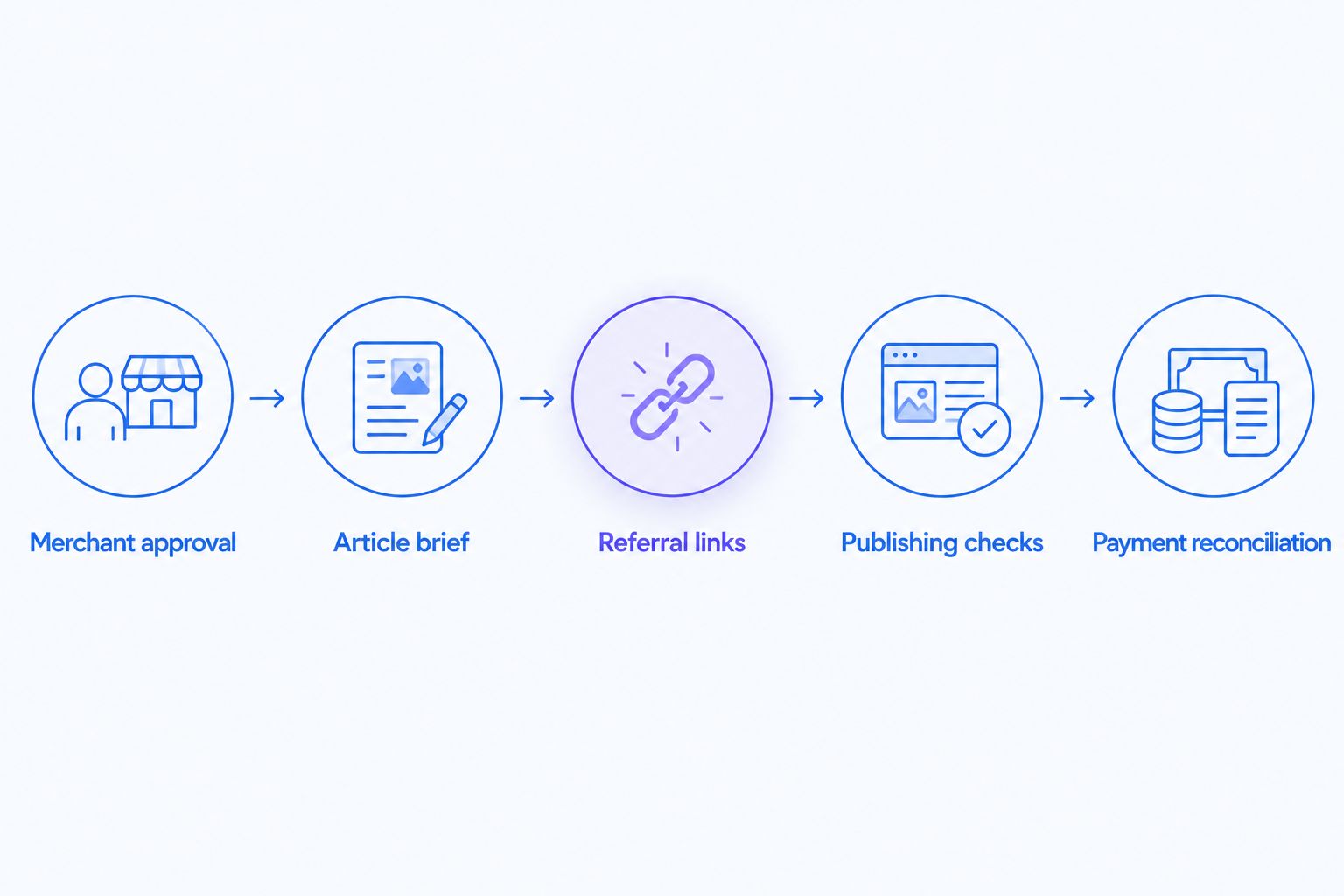 Publishing a referral link and receiving a payment are separate stages.
Payment reconciliation
Build your income record around merchant-reported transactions and actual payments. Your blog analytics cannot establish whether a sale qualified under the affiliate agreement.
Match transactions to payments
- Create a transaction sheet with your own columns named Transaction reference, Article identifier, Reported status, Approved commission, Payment reference, and Payment date. Preserve the merchant's original status wording under Reported status.
- Import or enter records using the reporting method your program provides. Associate transactions with articles only when supported tracking identifiers establish that connection. Leave unattributed records unattributed.
- Separate pending transactions from approved commissions. Record adjustments as adjustments instead of silently overwriting earlier entries. This preserves the explanation for a changed total.
- Match merchant payment records to money received. Group transactions under a payment reference only when the program provides enough detail to support that match.
- Schedule a 30-day reconciliation review as an internal routine. Follow the merchant's actual reporting and payment schedule when deciding whether a record needs investigation.
Expected result: You can distinguish activity awaiting review, approved earnings, and received payments without counting the same commission twice.
Use received payments for your cash-income view and approved commissions for your approved-earnings view. Keep both labels visible. If you need accounting or tax treatment, use professional guidance rather than treating an editorial spreadsheet as your accounting policy.
For your 2026 income review, compare like with like. A report filtered by transaction date and a bank record organized by payment date describe different events; matching their totals without reconciliation produces misleading conclusions.
Run the workflow whenever an article changes
An existing article needs another check when you change the recommended furniture, move a referral link, or revise the reader's intended use. A wording edit alone does not justify replacing a working tracking link.
- Record the reason for the revision and preserve the article's existing tracking record.
- Recheck the source evidence, merchant terms, destination, and disclosure placement.
- Replace the referral link only when the destination or program instructions require it. Record the replacement date so later reporting remains understandable.
- Test the live page again and keep subsequent transaction records connected to the correct identifier when reporting supports that distinction.
Expected result: Your revised article remains traceable without erasing the history needed to understand earlier transactions.
Apply the same review discipline to a second format, such as a material-care guide. Keep separate article identifiers even when both pages discuss the same furniture category. Otherwise, you lose the distinction between a useful topic and an effective referral placement.
Troubleshooting
The link opens, but no referral appears
Confirm that you used the issued link without unsupported changes. Check the program's stated reporting delay and permitted testing procedure before diagnosing a failure. If the record remains absent, send the program contact the link, test time, and redirect details—without sharing visitor personal information.
Blog clicks and merchant clicks disagree
Check date ranges, time zones, and metric definitions first. Your site can record an outbound click without the merchant recording the same event under its reporting rules. Preserve both figures with their original labels rather than forcing them to match.
A transaction is pending or reversed
Read the transaction status against the program's terms. Investigate the specific reference through the merchant's support process. Do not count a pending transaction as approved income or assume a reversal has a particular cause without confirmation.
Approved earnings do not match the payment
Compare payment references, reporting periods, documented adjustments, and payment conditions. Keep unmatched entries open until the records explain them. A total that looks close is not sufficient evidence of reconciliation.
Readers cannot see the disclosure before a link
Inspect the live page on a narrow screen. Move the disclosure into the article body before the first referral recommendation, then check that formatting has not made it difficult to read. A separate policy page does not replace a clear disclosure alongside the recommendation.
Customize your workflow
Expand by reader need, not by adding commercial destinations. Build a measurement guide, then a layout guide that helps the same audience apply those measurements. Each article should answer a distinct question and explain its own limitations.
Sohnne's mid-century modern furniture category gives design-focused publishers a relevant editorial subject. It does not remove the need to verify each product claim, disclose any compensated relationship, or confirm program eligibility.
Keep automation downstream of accurate records. A scheduled reminder or spreadsheet calculation can reduce repetitive work; neither can decide whether a recommendation is truthful or whether a transaction qualifies for commission. Review those decisions against source evidence and merchant terms.
FAQ
How do I earn blog income through a furniture affiliate program?
Join a program that approves your publishing channel, publish useful furniture guidance, and use its issued referral links. Income depends on qualifying transactions and the program’s approval and payment terms, not traffic alone.
Does Sohnne have an affiliate program I can join?
Confirm current affiliate enrollment directly with Sohnne before planning commission-based links. A retailer’s relevance to your audience does not establish program access or eligibility.
What should my first furniture affiliate article cover?
Start with a specific decision you can explain with evidence, such as measuring a room for a sofa. A narrow guide makes the recommendation, destination, and tracking record easier to check.
Do I need an affiliate disclosure on a furniture blog?
Yes, clearly disclose a compensated affiliate relationship before readers encounter referral links. Explain the relationship in ordinary language rather than relying on an unfamiliar label.
Can I add tracking parameters to my affiliate links?
Only modify affiliate links when the program explicitly permits it. Use supported placement identifiers and avoid placing personal information in URLs.
When should I count an affiliate commission as income?
Keep pending transactions, approved commissions, and received payments in separate views. Use professional advice for accounting and tax treatment rather than assuming a dashboard status settles those questions.
Can I test an affiliate link by buying through it?
Do not place a test order unless the program expressly permits that method. Follow the merchant’s approved tracking test and confirm any restrictions before purchasing.
One last thing
A working destination is not proof of working attribution. Keep those checks separate in every article record. That distinction prevents a polished furniture guide from becoming an untraceable commercial asset—and keeps your 2026 reporting grounded in records rather than assumptions.
Related guides
- Video review to confident furniture purchase
- How to pick the right sofa depth for deep-seat comfort
- How to arrange a living room around a fireplace
Stay connected with us!
Keep in touch with what’s new and next. Subscribe for weekly insights, product launches, and community news!