Sohnne vs Houzz: which is better in 2026

Sohnne Design Studio
October 13, 2026

Choose Sohnne if you already want mid-century modern furniture and prefer buying directly from the company that makes it; choose Houzz if you need room inspiration or a local design professional before choosing furniture. This 2026 comparison separates a furniture retailer from a home-design platform, so you can choose the right starting point rather than compare unlike services.
TL;DR- Sohnne vs Houzz compares direct furniture buying with home-design research, not two equivalent furniture stores.
- Sohnne is best for buyers with a clear mid-century modern furniture brief.
- Houzz is best for room inspiration and finding home-design professionals.
- Room measurements and material checks matter whichever route you choose.
Why this matters
A room photograph and a furniture specification answer different questions. The photograph helps you decide what you like; the specification helps you decide whether a particular piece belongs in your home.
That distinction matters when furnishing a room in 2026. If your layout is settled, more browsing can distract from the practical checks that remain. If the room itself needs work, selecting a sofa does not resolve lighting, circulation, electrical changes, or the need for professional help.
Choose the route that answers your next unresolved question. A direct retailer serves a defined furniture brief. A design platform serves an earlier, broader search.
At a glance
| Dimension | Sohnne | Houzz |
|---|---|---|
| Best for | Buying mid-century modern furniture directly | Exploring rooms and finding design professionals |
| Design focus | A defined mid-century modern furniture offering | Home-design imagery across different aesthetics |
| Room inspiration | Furniture-led research | Room photographs and saved idea collections |
| Professional search | Serves individual buyers and trade clients | Directory of home-design and renovation professionals |
| Customization | Customization options available | Discuss project-specific requirements with a selected professional |
| Buyer protections | Free insured shipping, 60-day returns, 5-year warranty | Check the terms of the specific product transaction or professional agreement |
| Room fit | Check furniture dimensions against your layout | Translate visual references into a measured plan |
| Pricing model | Direct furniture purchase; Affirm financing offered | Separate furniture purchasing from professional project quotes |
| Standout feature | Designs and manufactures furniture in its own factory | Connects visual research with professional discovery |
A defined furniture brief favors the direct retailer
The direct-retail route wins when the design direction is already clear. You want mid-century modern furniture, you know which room you are furnishing, and your remaining decisions concern the object: proportions, upholstery, finish, and how it works beside existing pieces.
Sohnne is best for buyers who already know they want mid-century modern furniture. Its stated offering includes sofas, lounge chairs, lighting, and dining pieces, with manufacturing in its own factory. That gives the shopping process a specific focus.
The advantage is relevance, not a claim that every piece suits every room. A coherent design direction still needs careful selection. A low silhouette can feel calm in one setting and disappear against large architectural features in another.
Houzz is the better starting point when you cannot yet describe the room you want. Exploring different interiors helps you distinguish an attraction to a photograph from a preference you can carry through your own space.
- Direct-retail advantage: a focused search once you know the furniture category and aesthetic.
- Direct-retail limitation: a focused offering is not a substitute for exploring other design directions.
- Platform advantage: a broader visual starting point.
- Platform limitation: more references do not automatically produce a usable furniture brief.
Houzz wins for room inspiration before shopping
Houzz is built around home-design research, including room photographs and saved collections known as ideabooks. Those tools suit the stage when you are still identifying a palette, comparing arrangements, or deciding what needs to change.
Use the photographs analytically. Look at where the seating faces, how daylight reaches the room, and whether the furniture supports conversation or screen viewing. A finish that catches your eye is only part of the composition.
For a 2026 room refresh, save references with a written reason. Note the low-backed seating, the quiet contrast between wood and fabric, or the space left beside a doorway. Those observations are more useful than a collection assembled around a vague mood.
The limitation is translation. A photographed room has its own dimensions, light, and architectural features. Your room needs a separate plan, even when the visual direction feels exactly right.
A retailer is more useful after that translation. Once you know the shape and function you need, product information becomes more valuable than another photograph. Houzz wins at defining the visual brief; direct furniture research belongs after the brief is clear.
Houzz wins when you need a design professional
Houzz provides a directory of home-design and renovation professionals. That makes it the relevant option when your problem extends beyond furniture selection: a changed floor plan, a kitchen project, built-in storage, or a room that needs professional design input.
Search for the expertise your project requires, not merely an appealing portfolio. Interior design, construction, and specialist installation involve different responsibilities. A photograph demonstrates an aesthetic; it does not establish the exact scope of your agreement.
Before appointing someone, discuss:
- The work you expect the professional to handle.
- The decisions and purchases that remain your responsibility.
- The drawings, specifications, or other deliverables included.
- How changes to the brief will be agreed.
- Who coordinates furniture choices with the rest of the project.
The furniture retailer serves a different role. Serving trade clients does not make a retailer a directory of local designers or contractors, and buying furniture does not include a room-design service unless your agreement explicitly says so.
Houzz is the better choice for finding project expertise. Its limitation is that discovery is only the beginning: you still need to assess the professional and agree the work directly.
The direct retailer wins for furniture customization
Sohnne offers customization options, making it relevant when you have a furniture brief that needs discussion rather than a standard selection alone. Ask which changes apply to the specific piece you are considering before treating customization as part of your plan.
Keep the request concrete. Describe the room, the intended use, and the attribute you want to change. A request about upholstery or finish is easier to assess than a general request to make a piece feel more personal.
Customization is an advantage only when the agreed result suits your needs. Confirm the final specification, care requirements, and applicable purchase terms in writing. Do not assume that every material, dimension, or configuration can be changed.
Houzz helps you communicate a visual direction to a professional through references. That is useful for a wider project, but saving an image is not the same as obtaining a customized furniture specification.
The direct retailer wins for discussing the furniture itself; Houzz wins for assembling references around a wider room brief. Neither route removes the need to document what you have agreed.
The retailer provides stated furniture purchase protections
The stated purchase protections are free insured shipping, 60-day returns, and a 5-year warranty. These are concrete considerations when comparing a direct furniture purchase with a research or professional-discovery platform.
Read the applicable terms before ordering. A return period and a warranty address different situations: one concerns returning a purchase, while the other concerns covered issues under the warranty. Do not treat either as an unconditional promise covering every circumstance.
For a direct purchase, establish:
- How the return period applies to your order.
- The process for reporting transit damage.
- What the warranty covers and excludes.
- Whether your selected customization changes the applicable terms.
On Houzz, room photographs and professional profiles do not establish the terms of a separate furniture order or design agreement. Identify the business responsible for the transaction, then assess that business's written commitments.
The direct retailer wins for having stated furniture purchase protections in this comparison. That is not a verdict on an unrelated seller or professional you discover through Houzz; their agreement requires its own assessment.
Neither route wins on room fit without measurements
Room fit is an honest tie. A furniture retailer gives you an object to evaluate; a design platform gives you references to interpret. Neither makes the room larger or changes the route through your doorway.
Start with 3 measurements: overall width, overall depth, and overall height. Then check the dimensions that affect use, such as seat height, seat depth, arm height, and the clearance around nearby furniture. Treat this as a checklist, not a universal sizing formula.
Mark the footprint on the floor before deciding. The empty rectangle reveals whether the piece interrupts movement, crowds a door, or leaves an awkward gap. Check the delivery route separately, including turns and changes in level.
For seating with several components, use the guide to measuring a room before buying a modular sofa. A configuration that looks balanced in a photograph still needs to work in your measured layout.
Comfort also needs its own check. A sculptural profile does not establish how the seat supports you, and a deep-looking cushion does not establish the usable sitting depth. Ask for the relevant specifications rather than reading comfort into the image.
Both routes require the same discipline: measure the room, verify the furniture, and check access.
Pricing: compare the purchase with the project
The direct-retail model centers on buying furniture. Affirm financing is offered, but financing changes the payment arrangement rather than the physical suitability of the piece. Review the current terms separately from your design decision.
Houzz serves a broader research and professional-discovery role. If that research leads you to a designer or renovation professional, the resulting agreement concerns a project scope, not simply a furniture item. Separate professional fees, furniture purchases, and other agreed work when comparing proposals.
For a 2026 comparison, define the outcome before comparing spending. Buying a chair and appointing someone to redesign a living room are different decisions. A useful comparison holds the scope steady instead of treating both as interchangeable ways to obtain the same result.
The tradeoff is a defined product decision versus a broader project decision. Direct purchasing suits a settled brief. Professional work suits a room whose planning questions remain unresolved.
Neither route earns a general affordability verdict here. Compare the current written proposal or purchase terms against the exact result you need, including the responsibilities that remain with you.
Final verdict: choose by the decision you need to make
Choose Sohnne if you are a furniture-ready buyer
You have a settled layout, prefer mid-century modern furniture, and want to discuss the purchase with the company that designs and manufactures the pieces. Your next decision concerns furniture specifications, customization, and the applicable purchase protections.
Winner: Sohnne for a defined direct furniture purchase. The limitation is scope: this route does not replace professional planning when the room needs more than furniture.
Choose Houzz if you are a room-planning homeowner
You are still deciding how the room should look, need references to explain your preferences, or want to find a professional for design or renovation work. Your next decision concerns the room rather than a specific furniture order.
Winner: Houzz for inspiration and professional discovery. The limitation is follow-through: you must turn references into a measured brief and assess any professional agreement separately.
For 2026, the simplest decision sequence is to identify your stage before opening another catalog. Use the visual route to clarify an unresolved room; use the buying route once the furniture brief is ready.
- Room research: identify the atmosphere and function you want.
- Project help: find the expertise needed to resolve the room.
- Furniture purchase: verify specifications against the finished brief.
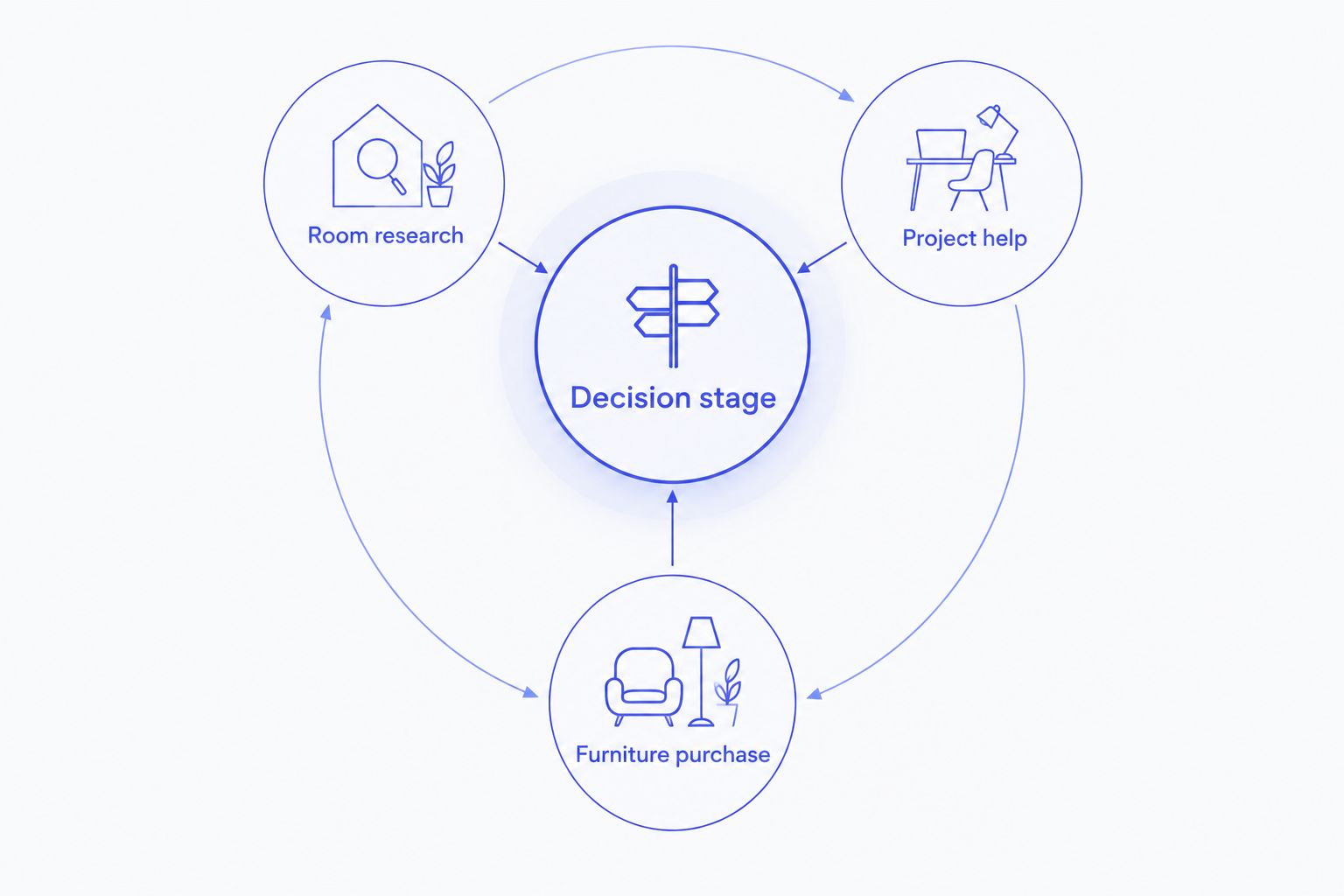 Choose the route that resolves your next decision, not every decision at once.
One-glance scorecard
| Dimension | Winner |
|---|---|
| Defined mid-century modern furniture brief | Direct retailer |
| Room inspiration | Houzz |
| Finding design professionals | Houzz |
| Discussing furniture customization | Direct retailer |
| Stated direct-purchase protections | Direct retailer |
| Verifying room fit | Tie: measurements required |
| Pricing decision | Tie: compare equivalent scopes |
| Standout function | Different roles: purchasing versus discovery |
FAQ
Is Sohnne vs Houzz a comparison between two furniture stores?
No. This comparison places a direct furniture retailer beside a home-design platform. Choose according to whether you need to buy furniture or resolve the room’s design direction.
What’s the better choice if I already know my furniture style?
The direct retailer is the better starting point when your mid-century modern furniture brief is settled. Check the selected piece’s dimensions, materials, and applicable purchase terms before ordering.
Is Houzz better for finding an interior designer?
Houzz is the better option here for finding home-design professionals. Assess the professional’s relevant work and agree the scope directly before appointing anyone.
Can I use Houzz just for decorating ideas?
Yes. Houzz offers room photographs and ideabooks for collecting references. Record what you like about each room so the collection becomes a usable design brief.
Which option is cheaper for furnishing a room?
Compare equivalent purchases or project scopes rather than declaring one route cheaper. A furniture order and a professional room-design agreement cover different work.
Does a furniture warranty replace checking the return policy?
No. A warranty and a return policy serve different purposes. Read both sets of applicable terms, including how they address your specific order.
What should I check before buying furniture online?
Check dimensions, materials, room clearance, delivery access, and the applicable purchase terms. Photographs help you judge appearance but do not establish physical fit or sitting comfort.
One last thing
The most useful reference photograph is not necessarily the most beautiful one. It is the one whose useful details you can name: a clear route past the seating, a lamp placed for reading, or a finish that works with the room's existing wood.
Before shopping, write a short furniture brief that states the piece's job, its required footprint, and the material qualities you need. That brief keeps both visual research and product selection accountable to your actual room.
Related guides
- How to choose furniture scale for a room with high ceilings
- Best sofas for a narrow living room layout
- How to add texture to a neutral living room with furniture
Stay connected with us!
Keep in touch with what’s new and next. Subscribe for weekly insights, product launches, and community news!