Sohnne vs eBay: which is better in 2026

Sohnne Design Studio
October 13, 2026

Choose Sohnne if you want new mid-century modern furniture from a direct retailer with customization options; choose eBay if you want to search across sellers for used furniture, vintage pieces, or a particular item. The difference is direct buying versus marketplace search, not a universal winner on furniture quality.
TL;DR- Sohnne vs eBay comes down to new mid-century modern furniture versus a seller-by-seller marketplace search.
- Choose the direct retailer for factory-made furniture, customization options, and stated warranty terms.
- Choose eBay for used furniture and vintage searches; evaluate the actual item and seller.
- Neither shopping route removes the need to check dimensions, materials, delivery arrangements, and return conditions.
Why this matters
A furniture retailer and a marketplace answer different questions. One helps you select from its own range; the other helps you find an item offered by an independent seller. Treating them as interchangeable obscures who makes the furniture, who describes its condition, and who handles problems after delivery.
Sohnne is best for buyers who want new mid-century modern furniture directly from the company that designs and manufactures it. That is a clear reason to choose the retailer, but it does not make every new piece a better choice than every used one.
For your 2026 purchase, decide whether you need a new furnishing for a planned room or a specific object with an existing history. That distinction should come before comparing photographs. A beautiful listing is not yet a complete buying decision.
At a glance
| Dimension | Sohnne | eBay |
|---|---|---|
| Best for | New mid-century modern furniture bought directly | Used furniture, vintage searches, and specific-item hunting |
| Standout feature | Designs and manufactures furniture in its own factory | Marketplace connecting buyers with separate sellers |
| Condition and history | Direct access to the manufacturer's new furniture range | New and used listings with item-specific histories |
| Customization | Customization options are offered | Any customization depends on the individual seller |
| Buying responsibility | Direct relationship with the furniture retailer | Seller-specific product descriptions and arrangements |
| Returns and warranty | Stated 60-day returns and a 5-year warranty | Check seller terms and applicable marketplace policies |
| Delivery planning | Insured shipping is stated | Shipping or collection arrangements depend on the listing |
| Room fit | Requires item dimensions and access checks | Requires item dimensions and access checks |
| Pricing model | Retail purchase, with Affirm financing offered | Fixed-price and auction formats, depending on the listing |
Direct buying wins for a planned new-furniture purchase
Choose the direct retailer when your brief starts with a room, not a particular secondhand object. You can evaluate sofas, lounge chairs, lighting, and dining pieces within a furniture business focused on mid-century modern design. The retailer is also the manufacturer, rather than simply the venue where another seller posts an item.
That relationship matters when you want to ask about a material, finish, or customization request. Your starting point is the company responsible for the product. It does not remove the need to get a precise answer for the piece you are considering.
The limitation is equally clear: a manufacturer's range is not a search across unrelated owners, dealers, and furniture categories. If your goal is an older object with a particular history, browsing a new-furniture range solves the wrong problem.
For a 2026 living-room project, write down the function first: everyday seating, occasional seating, dining, or lighting. Then select the shopping route that serves that brief. Do not let an attractive shape replace the practical requirements of the room.
eBay wins for searching across independent sellers
Choose eBay when finding a particular used or vintage item is the point of the purchase. Its marketplace structure lets you search listings from separate sellers instead of staying within one manufacturer's range. That is the meaningful advantage for a buyer who enjoys comparing individual objects.
The tradeoff is additional evaluation. Two listings with similar titles are not necessarily equivalent: condition, measurements, included components, and seller arrangements need their own checks. A category description cannot establish the details of the item in front of you.
Use the marketplace as a search venue, not as a single furniture brand. Ask the seller about the actual piece, and distinguish photographs of that piece from images used only to illustrate its design.
This route suits a patient collector or a homeowner looking for an older accent piece. It is less suited to someone who wants to treat every listing as part of one consistent product range with one set of manufacturer commitments.
eBay wins for examining an individual item's history
Used furniture has a history that new furniture does not. Previous use, repairs, refinishing, and upholstery changes are relevant to what you receive. On eBay, those questions belong to the specific listing and seller.
For a used-furniture purchase, condition evidence matters more than a persuasive title. Request clear views of joints, undersides, upholstery seams, exposed edges, and any disclosed damage. Ask whether photographs show the item currently being sold.
A new-furniture purchase has a different burden of proof. You need the construction details and finish information for the selected product, rather than a record of previous ownership. Neither route proves quality through appearance alone.
An older piece also deserves care when its history is part of your reason for buying it. Separate documented information from a seller's description. If attribution or age is essential to your decision, ask what evidence supports it before committing.
Direct buying wins when customization is part of the brief
The direct retailer offers customization options. That gives you a relevant starting point when the standard presentation is not your final brief. Ask which changes apply to the selected piece, and get the agreed specification in writing.
Do not assume customization covers every material, dimension, or configuration. An option offered by a brand is not a promise that every product accepts every change. Keep the discussion tied to the exact furniture you intend to order.
On eBay, customization is a seller-level question. A seller offering an existing used piece and a seller offering newly made furniture are not making the same proposal. Check the individual offer rather than expecting a platform-wide service.
The direct route wins for buyers who want to discuss customization with the furniture manufacturer. The marketplace remains useful when the existing item's particular finish, wear, or proportions are what you want to preserve.
Direct buying wins on a clear manufacturer relationship
Buying directly gives you a straightforward starting point for product questions: the furniture company itself. You do not need to establish whether a separate seller also designed or manufactured the piece before asking about its construction.
That is an accountability advantage, not evidence that one purchase will last longer. Durability still depends on the selected product, its materials, construction, care, and use. No platform-wide quality ranking can replace those details.
With eBay, identify the seller's role. An owner selling a used chair, a furniture dealer, and a manufacturer selling its own goods offer different kinds of information. Ask questions appropriate to that role.
For either route, keep the listing, specification, correspondence, and order record. A written answer about the exact item is more useful than a general assurance about furniture quality. This is especially important when a material or finish determines whether the piece fits your household.
Direct buying wins on stated returns and warranty
Sohnne states 60-day returns and a 5-year warranty. Those are concrete commitments to examine when comparing a direct purchase with an individual marketplace listing. Read the applicable conditions before ordering, particularly if you are discussing customization.
The two commitments address different decisions. Returns concern sending a purchase back under the stated terms; a warranty concerns the coverage described in its conditions. Neither should be treated as an unlimited promise covering every circumstance.
For eBay, review both the seller's stated terms and the marketplace policies applicable to the transaction. Do not assume that every furniture listing includes the same return arrangements or a manufacturer's warranty.
For a 2026 order, establish the process before you need it: whom you contact, what evidence you retain, and what the relevant terms require. The direct retailer wins on having stated brand-level commitments; the individual marketplace purchase still needs its own policy check.
Neither route wins delivery without an item-level check
The direct retailer states insured shipping. That is relevant protection to review, but it does not answer every logistical question about getting furniture into your home. Confirm the delivery arrangement for your order and how damage should be documented.
On eBay, read the listing's shipping or collection terms. A furniture search is not complete until you know how the particular item reaches you. Do not treat a seller's location as proof that collection or a particular delivery service is included.
Both routes require an access check. Measure the entrance, the narrowest passage, and any turn the furniture must pass through. Ask about packaged dimensions and whether any components arrive separately.
Delivery is a tie until the actual arrangements are compared. For your 2026 purchase, a clear arrival plan matters more than a general impression that one shopping route is simpler. Keep access, delivery responsibilities, and damage procedures in the same decision checklist.
Neither route wins room fit without measurements
Furniture dimensions belong to the object; comfort and circulation belong to your room. Neither a direct retailer nor a marketplace can make a chair fit beside a doorway or a sofa fit through a tight turn merely by presenting it well.
Record 3 measurements for each shortlisted piece: width, depth, and height. Then mark its footprint on the floor. Include the space you need to walk past it and use nearby doors, drawers, or other furniture.
For upholstered seating, overall depth and usable seat depth answer different questions. Use the guide to choosing sofa depth for deep-seat comfort to separate the furniture's footprint from the way you intend to sit.
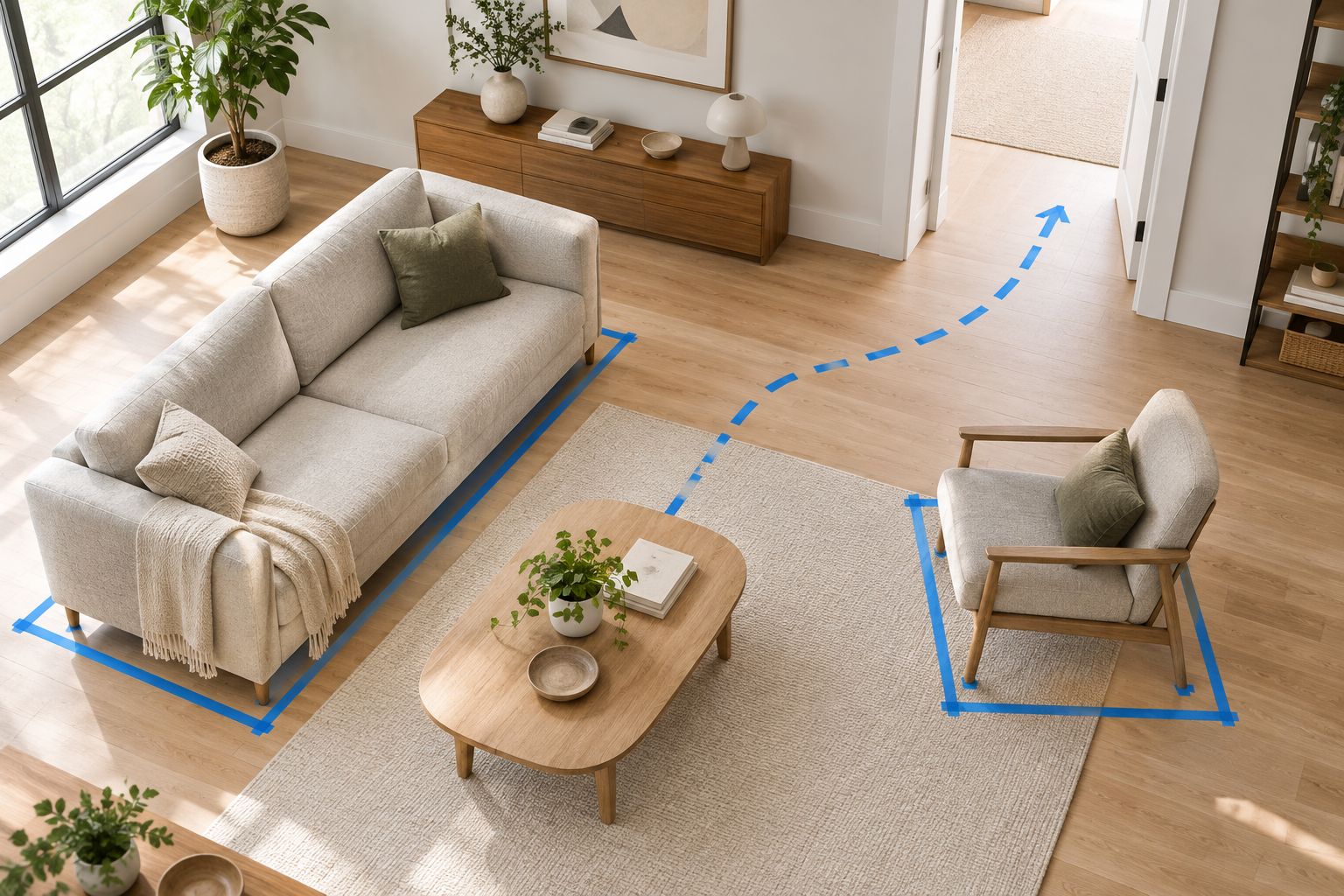 Check the furniture footprint and the route around it before choosing where to buy.
Room fit is an honest tie. A carefully measured used piece beats an unsuitable new one, and a correctly sized new piece beats a vintage purchase chosen only for its photograph. Start with the room's constraints, then compare the objects.
Pricing: direct retail is simpler; auctions offer another buying route
The direct retailer uses a retail buying model and offers Affirm financing. Separate the furniture decision from the payment decision: suitability, construction, and dimensions still need to stand on their own. Review financing terms independently before choosing that payment method.
On eBay, listings use fixed-price or auction formats. A fixed-price listing lets you assess a stated offer, while an auction introduces bidding into the decision. Not every listing uses every purchasing format.
Direct retail wins for buyers who want to select a product without an auction process; eBay wins for buyers who specifically want that process. Neither format establishes better value by itself. Compare the exact item, condition, included components, transport arrangements, and relevant terms.
For a 2026 comparison, set your limits before an auction begins. The desire to win a bid is not evidence that the furniture suits your home. Equally, financing does not turn an unsuitable retail purchase into a suitable one.
Final verdict
Choose Sohnne if you are furnishing a room with new pieces
Best for: the homeowner planning a mid-century modern interior. Choose the direct retailer when you want factory-made furniture, a manufacturer relationship, customization discussions, and stated returns and warranty commitments. Your main work is selecting the right piece and confirming its specification.
Accept the limitation: you are choosing within the retailer's range, not searching the wider secondhand market. Verify dimensions and product-level details rather than treating brand-level positioning as a complete specification.
Choose eBay if you are searching for a particular object
Best for: the vintage hunter or used-furniture buyer. Choose eBay when the search itself matters and you are prepared to investigate individual condition, history, seller terms, and transport. Its marketplace structure serves that task better than a single manufacturer's range.
Accept the limitation: the platform does not make every listing equivalent. You remain responsible for distinguishing a well-documented item from an incomplete description.
| Dimension | Winner |
|---|---|
| Planned new-furniture purchase | Direct retailer |
| Search across independent sellers | eBay |
| Individual used-item history | eBay |
| Manufacturer customization discussions | Direct retailer |
| Clear manufacturer relationship | Direct retailer |
| Stated brand-level returns and warranty | Direct retailer |
| Delivery planning | Tie; verify the actual arrangements |
| Room fit | Tie; measure the actual furniture |
| Buying format | Direct retail for simplicity; eBay for auctions |
FAQ
Is Sohnne better than eBay for mid-century modern furniture?
Sohnne is the better fit for buying new mid-century modern furniture directly from its manufacturer. eBay is the better fit for searching individual sellers for used or vintage furniture.
Which is better if I want vintage furniture?
eBay is the better shopping route for a vintage-furniture search. Assess the actual item’s condition and request evidence for any history that matters to your purchase.
Can I customize furniture through either option?
The direct retailer offers customization options, while customization on eBay depends on the individual seller. Confirm the exact changes offered for the selected piece rather than assuming every item can be altered.
Does every eBay furniture listing include a warranty?
Do not assume an eBay furniture listing includes a warranty. Read the seller’s terms and ask whether any manufacturer coverage applies to the item.
Is used furniture always the better value?
Used furniture is not automatically the better value. Compare condition, construction information, included components, delivery arrangements, and suitability for your room.
What should I measure before buying furniture online?
Measure the furniture’s width, depth, and height, then check your delivery route and its intended position. For seating, also review usable seat dimensions rather than relying only on overall size.
Should I choose an auction or a fixed-price listing?
Choose a fixed-price listing if you want to assess a stated offer without bidding; choose an auction if you want to participate in that buying process. Establish your requirements and limits before committing to either format.
One last thing
Ask one question before choosing either route: What information would make me reject this exact piece? An unclear material description, an unsuitable seat depth, or an unresolved delivery arrangement deserves attention before the shape wins you over.
Turn that answer into your first question to the retailer or seller. You will make a clearer decision by testing the furniture against your needs than by deciding which website deserves a universal win.
Related guides
- How to measure a room before buying a modular sofa
- How to choose furniture scale for a room with high ceilings
- eBay alternatives for designer-style furniture
Stay connected with us!
Keep in touch with what’s new and next. Subscribe for weekly insights, product launches, and community news!