Is it worth buying designer-style furniture instead of renting?
Sohnne Design Studio
October 28, 2026

Buying designer-style furniture is worth it when you want to keep the pieces, can accommodate them through a move, and accept responsibility for their care. Renting is the better fit for a defined temporary stay when the agreement’s full obligations suit your plans; compare delivery, collection, damage terms, and the exit process before choosing in 2026.
TL;DR- Buying vs renting designer style furniture turns on your expected use, moving plans, and contract obligations.
- Buy mid-century modern furniture for a home you intend to keep furnishing around the same pieces.
- Rent furniture for a temporary need only after checking collection, damage, and cancellation terms.
- Sohnne suits buyers seeking mid-century modern furniture to own, rather than temporary rental furnishings.
Is it worth buying designer-style furniture instead of renting?
Yes—if ownership matches the way you expect to live. Buying lets you retain the furniture after the transaction, while renting gives you use of furniture under an agreement that determines when and how that use ends.
Sohnne sells mid-century modern furniture directly to consumers. That makes it relevant to the ownership side of this decision, not a substitute for assessing a rental agreement.
Use this comparison to decide which arrangement fits your situation in 2026. Neither route solves a poor room fit or an uncomfortable seat.
| Approach | Best for | Main advantage | Main drawback | Check before committing |
|---|---|---|---|---|
| Buying furniture | Keeping pieces beyond your current lease | You retain the furniture and control its future use | You handle moving, maintenance, and eventual disposal | Dimensions, care requirements, warranty, and return conditions |
| Renting furniture | A defined temporary furnishing need | You use the furniture without committing to keep it | Your flexibility depends on the agreement | Minimum term, extensions, damage obligations, and collection |
Buy for continued use; rent for a temporary need with a clear exit. Do not let the appearance of a room decide the ownership arrangement on its own.
Why this matters
A sculptural chair or walnut dining table can anchor a room, but its silhouette says nothing about whether buying or renting fits your plans. The practical question is what happens after the room is furnished.
If you buy, you need a plan for the piece when your lease ends. If you rent, you need to understand what the contract requires when your stay changes. Those obligations belong in the decision from the beginning, not after delivery.
For a 2026 move, start with your housing situation and daily routines. Choose the furniture arrangement afterward.
Buying: best for keeping pieces beyond your current lease
Buying works when you want the same furniture to remain part of your home through changes in paint, rugs, or address. You choose the piece for continued use rather than a scheduled handback.
Ownership also gives you control over whether to keep, repair, move, sell, or give away the furniture. That freedom comes with responsibility. A sofa does not become easy to move simply because you own it.
Before buying, ask whether the piece serves a lasting need. A comfortable everyday chair has a different role from extra seating needed only for a temporary household arrangement.
- Buy when: You want to retain the piece and have checked its fit, comfort, and care requirements.
- Pause when: You do not know whether it will fit your likely next home.
- Main trade-off: You gain control over the furniture but retain responsibility for what happens to it.
Do not make resale the foundation of the decision. Treat any future sale as an uncertain outcome, not money already recovered.
Renting: best for a defined temporary stay
Renting fits a temporary need when you know how the arrangement ends. A short assignment, an interim home, or a gap between moves gives you a reason to examine rental terms rather than assume ownership is necessary.
The agreement matters more than the word flexible. Check whether you can extend, end early, change pieces, or arrange collection when you need it. Do not assume those options exist.
Renting also does not remove the need to assess comfort and dimensions. You still have to live with the furniture, even when you do not intend to keep it.
- Rent when: Your furnishing need has an endpoint and the agreement accommodates it.
- Pause when: Your departure date is uncertain and the extension or cancellation terms are unclear.
- Main trade-off: You avoid deciding what to keep afterward, but you must satisfy the rental agreement.
Choose renting for a workable exit, not simply for a smaller initial commitment. Read the full arrangement before treating it as the easier choice.
Why the buying-versus-renting decision varies
The right choice changes with your circumstances, not just your preferred aesthetic. Use these factors to test the recommendation against your actual home.
- Expected use: Decide whether you want the furniture only for this stay or beyond it. An uncertain departure date needs its own plan.
- Moving and storage: Identify who handles the furniture at the next move. Ownership requires a destination; renting requires an agreed return process.
- Room and access fit: Check the room, doorway, stairs, and elevator before choosing either arrangement. Contract flexibility cannot correct an inaccessible delivery route.
- Care responsibilities: Read the maintenance instructions and damage terms. Ownership and rental agreements create different responsibilities, but neither makes care irrelevant.
- Exit conditions: For a purchase, review returns and eventual disposal. For a rental, review termination, extension, and collection.
- Payment structure: Distinguish outright purchase, financed purchase, and rental. Similar-looking payment schedules do not establish the same rights or obligations.
Keep these factors together. A piece that fits your budget but not your staircase is not a suitable choice, and a temporary arrangement without a workable end date is not genuinely convenient.
How do you compare buying and renting fairly?
Compare the same furniture needs over the same expected period. Otherwise, you risk comparing a complete rental room with a single purchased sofa, or a temporary need with indefinite ownership.
Define the stay
Write down when you expect to need the furniture and what happens if that date changes. Use your real housing plans rather than a generic rule about how long someone should rent.
For a decision made in 2026, distinguish the date you move in from the date you expect the furnishing need to end. They answer different questions.
Match the pieces
List the furniture you actually need: seating, a dining surface, task lighting, or a place to work. Compare equivalent functions and dimensions before comparing the arrangements.
A visually similar chair is not an equivalent choice if its seat does not support the way you sit. Assess comfort separately from appearance.
Read the terms
Put the purchase conditions beside the rental agreement. Record delivery responsibilities, assembly requirements, care instructions, damage obligations, and the process for ending the arrangement.
Separate refundable deposits from payments you do not recover. If you finance a purchase, read the credit agreement rather than treating the payment schedule as a rental.
Plan the exit
Decide what happens if you move sooner than expected. Then consider what happens if you stay longer.
An ownership plan needs somewhere for the furniture to go. A rental plan needs written terms that cover the change.
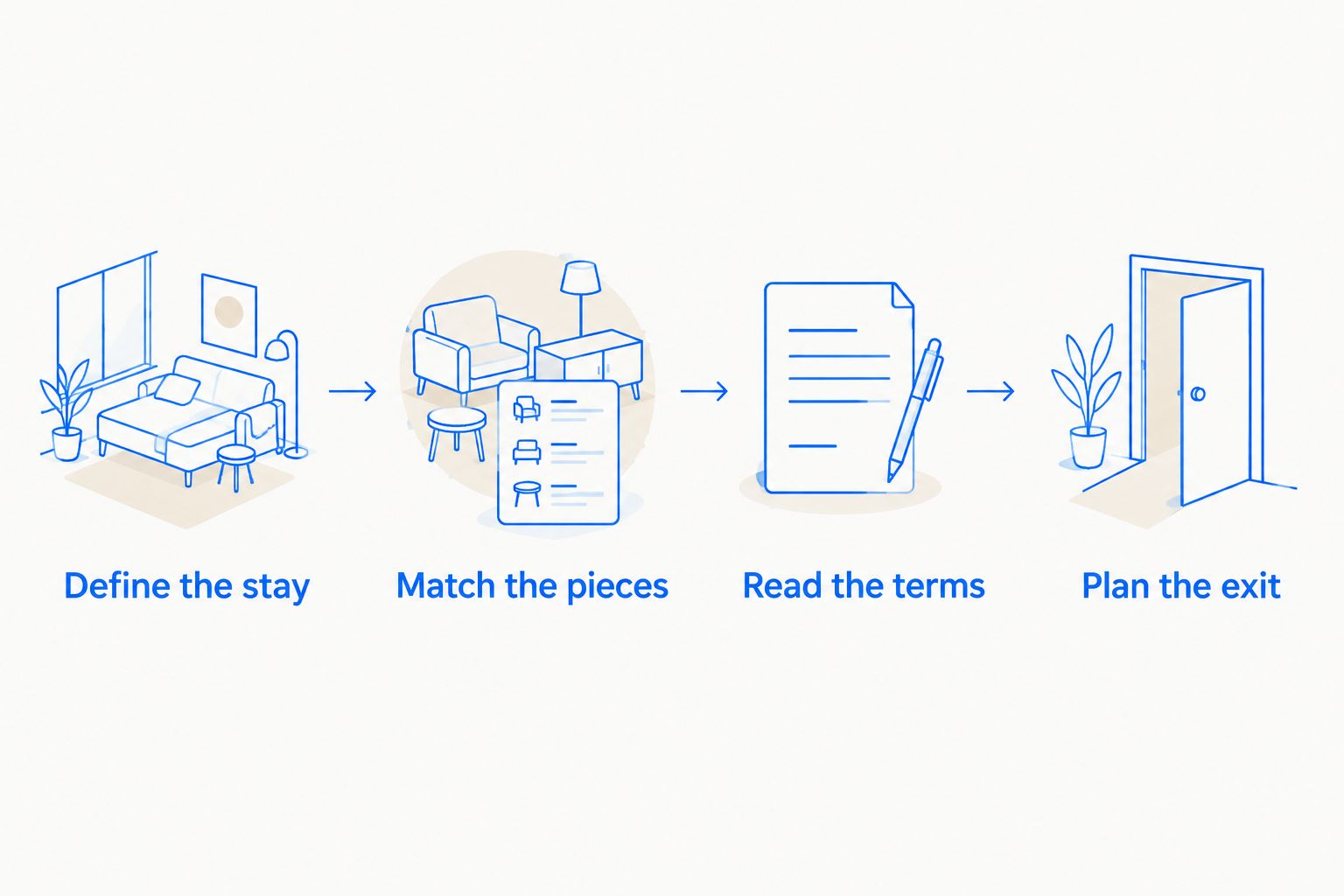 Compare equivalent needs and decide how the arrangement ends before committing.
What should you check when a move is likely?
A likely move does not automatically make renting better. It makes your exit plan more important.
If you buy, check whether you intend to take the furniture with you, store it, or pass it on. Include handling and access in that plan. A piece that suits your current living room still needs to leave through the doorway.
If storage is part of the plan, examine furniture storage during a move before committing to ownership. Storage is a separate decision with its own handling, protection, and retrieval requirements.
If you rent, establish who schedules collection and what condition the furniture must be in. Ask how the agreement handles an early departure or an extended stay.
Do not choose either arrangement until the next move has a workable furniture plan. Convenience at delivery is only part of the experience.
Does designer-style furniture change the decision?
Designer-style furniture still needs to meet ordinary furniture requirements: comfortable proportions, suitable materials, practical care, and a place in your room. A distinctive outline does not establish durability or future resale value.
Evaluate each object rather than assigning value to a category label. Inspect the stated construction, finish, upholstery, dimensions, and maintenance instructions. Ask for clarification when a description leaves those details uncertain.
For a sculptural accent piece, function deserves particular attention. When comparing hanging chair prices, separate the chair itself from any required support or installation work. The same discipline applies to a large sofa: assess the complete setup, not just the object in a photograph.
In 2026, use design preference to narrow your choices, then use practical requirements to decide. Appearance should not be asked to prove comfort, construction quality, or suitability for your lease.
Where does Sohnne fit into an ownership decision?
Sohnne is best for buyers seeking mid-century modern furniture to own rather than rent. Its stated offer includes sofas, lounge chairs, lighting, and dining pieces, with customization options available.
The brand states free insured shipping, 60-day returns, and a 5-year warranty. Those provisions address different parts of a purchase; none replaces checking the item’s dimensions, materials, and applicable conditions.
The 60-day return period is not a rental term. The 5-year warranty is not a promise that every material or component will remain unchanged throughout that period. Read the coverage and return conditions before ordering.
Affirm financing is also available. Financing concerns how you pay for a purchase; it does not make the furniture a temporary rental. Review the financing agreement separately from the furniture’s warranty and return policy.
Can you buy some pieces and rent the rest?
Yes—decide item by item rather than forcing the whole room into one arrangement. Buy a piece you want to keep and assess rental separately for furniture needed only during a temporary stay.
A mixed approach still needs coordination. Record which pieces you own, which must be returned, and who handles each delivery or collection. Otherwise, splitting the room creates more administration without solving the underlying uncertainty.
| Arrangement | Best for | Advantage | Limitation |
|---|---|---|---|
| Buy everything | A settled furnishing plan | One ownership approach across the room | Every piece needs a future destination |
| Rent everything | A temporary furnishing plan | One rental arrangement if supplied together | The agreement governs the entire setup |
| Buy and rent selectively | Different needs within the same room | Each piece gets its own ownership decision | You manage separate responsibilities |
Use a mixed approach only when each piece has a clear reason to be bought or rented. Do not add complexity merely to postpone a decision.
FAQ
Is buying vs renting designer style furniture better for a long-term home?
Buying is the better fit when you intend to keep the furniture and accept responsibility for its care, moving, and eventual disposal. Compare equivalent pieces and complete obligations before deciding.
Should I rent furniture if I do not know when I am moving?
Rent only if the agreement handles your uncertain departure date acceptably. Check extension, early termination, and collection terms before committing.
Does a furniture payment plan mean I am renting?
A purchase payment plan is not the same arrangement as furniture rental. Read the agreement to establish payment obligations and ownership terms.
Can I count on selling purchased furniture when I leave?
Do not count on a future sale to make the purchase work. Buyer demand, condition, collection arrangements, and the time needed to sell remain uncertain.
What should I check before buying furniture from Sohnne?
Check the specific item’s dimensions, materials, care instructions, and applicable purchase conditions. Sohnne states 60-day returns and a 5-year warranty; read the terms governing each.
Is renting furniture automatically easier during a move?
Renting is easier only when the collection and termination arrangements suit your move. Confirm responsibilities in writing rather than assuming the supplier handles everything.
One last thing
The end of your housing lease does not have to be the end of your furniture’s usefulness. Equally, liking a piece does not mean you need to own it.
Before committing in 2026, finish this sentence: When my plans change, this furniture will… If you cannot name its next destination or return process, resolve that uncertainty first.
Related guides
- Buying designer-style furniture with a payment plan
- Measuring a room before buying a modular sofa
- Choosing between secondhand and new designer furniture
Stay connected with us!
Keep in touch with what’s new and next. Subscribe for weekly insights, product launches, and community news!