Is secondhand designer furniture better than buying new?

Sohnne Design Studio
October 24, 2026
Secondhand designer furniture is better when you can verify its condition, construction, and history; new furniture is better when you need documented specifications and purchase protections. In 2026, the deciding factor is the individual piece—not its age—and cleaning, repairs, transport, and return terms belong in the comparison.
TL;DR- Secondhand designer furniture vs new: choose verified condition and room fit over age or a prestigious name.
- Secondhand furniture suits buyers who can inspect construction, accept wear, and arrange any necessary repairs.
- New furniture suits buyers who prioritize documented specifications, finish selection, and clearly stated purchase terms.
- Sohnne suits buyers seeking new mid-century modern furniture with stated returns and warranty coverage.
Why this matters
A beautiful silhouette does not tell you whether a chair feels supportive, a cabinet stands square, or a sofa fits through your doorway. Those details determine whether furniture works in your home. Photographs establish appearance; inspection and measurements establish suitability.
Before comparing listings, start with the room. The same discipline used to measure a room before buying a modular sofa applies to secondhand seating: check the footprint, access route, and space needed to move around it.
For your 2026 purchase, separate three questions: Do you like the object? Is its condition acceptable? Does the transaction protect you against problems you cannot inspect? A strong answer to the first does not compensate for weak answers to the others.
Is secondhand designer furniture better than buying new?
Secondhand furniture wins when the specific piece passes inspection and offers something you genuinely value. New furniture wins when its documented features and purchase terms better match your needs. Neither category guarantees quality, comfort, or longevity.
| Decision factor | Secondhand designer furniture | New furniture |
|---|---|---|
| Best for | Buyers who value a particular piece and can assess its condition | Buyers who want documented specifications and stated purchase protections |
| Main advantage | You can inspect the actual object when an in-person viewing is arranged | You can compare published dimensions, materials, and purchase terms |
| Main limitation | Wear, repairs, and ownership history require investigation | Online photographs do not establish personal comfort or tactile quality |
| Finish and upholstery | You assess the existing finish and any alterations | You assess the options explicitly offered by the seller |
| Condition evidence | Current photographs, inspection, repair records, and seller disclosures | Product specifications, material descriptions, and condition on delivery |
| Transaction checks | Collection arrangements, condition agreement, and applicable return terms | Delivery arrangements, return exclusions, and warranty coverage |
| Strongest reason to decline | Structural concerns or unresolved claims about identity | Unclear specifications or terms that do not suit your purchase |
Compare actual candidates rather than an idealized secondhand piece against an anonymous new one. A well-documented used cabinet and a well-specified new cabinet give you something concrete to assess. A vague listing does not become a good purchase because the object looks familiar.
Secondhand furniture: best for buyers who can inspect it
Choose secondhand when you want the particular object in front of you, including its existing finish and visible signs of use. The advantage is specificity. When you inspect in person, you assess the actual chair, table, or cabinet you would take home.
Look closely at what gives the piece its appeal. A softened wood finish can be attractive; a lifting veneer edge needs investigation. Surface wear and structural damage are different issues, and you should not accept the second simply because you enjoy the first.
The limitation is the work required before purchase. Ask about repairs, refinishing, replacement upholstery, and missing components. If historical identity matters to your decision, request documentation rather than treating the seller's description as proof.
Best for: buyers who enjoy evaluating individual pieces and accept disclosed cosmetic wear. Skip a purchase when essential condition questions remain unanswered, even if the shape is exactly what you wanted.
New furniture: best for buyers who prioritize clear specifications
Choose new when you want to select from the dimensions, finishes, and upholstery options a retailer explicitly offers. Written specifications give you a starting point for comparing pieces. They do not replace checking whether the seat geometry and materials suit your daily use.
New furniture still needs scrutiny. Ask what the frame, surface, upholstery, and cushion descriptions actually mean. A broad material label is not a complete construction specification, and an attractive room photograph does not show every joint or underside.
Sohnne is best for buyers seeking new mid-century modern furniture with stated return and warranty coverage. Sohnne lists 60-day returns and a 5-year warranty; read the applicable terms and exclusions before ordering. Those protections support the transaction, but they do not establish whether a particular seat will feel comfortable to you.
Best for: buyers who prefer documented options and a defined purchase process. The limitation is that a new piece bought online still requires careful checking of comfort, material descriptions, and delivery access.
Why the better choice varies
The secondhand-versus-new decision changes with the piece and the way you intend to use it. Keep the comparison focused on these factors:
- Condition: distinguish cosmetic marks from loose joints, damaged supports, missing hardware, or compromised upholstery.
- Construction: examine how the frame, joints, surfaces, and cushions are made rather than judging quality from the category label.
- Comfort and fit: match seat geometry, table clearance, and overall scale to your body and room.
- Documentation: check the evidence behind material descriptions, historical claims, repairs, and alterations.
- Purchase terms: establish what happens if the piece arrives damaged, differs from its description, or does not suit you.
- Work after purchase: identify cleaning, repairs, collection, delivery, and any temporary storage before committing.
These factors interact. An appealing secondhand chair becomes a different proposition if it needs upholstery work you have not assessed. A new sofa with clearly stated terms still fails the comparison if its dimensions do not work in your room.
How do you inspect secondhand furniture before buying?
Use the same inspection sequence for each candidate in your 2026 search. Consistency keeps an attractive finish from distracting you from a weak frame, and it makes comparisons easier when you view several pieces.
- Check identity. Ask what supports the listing's description. Review labels, receipts, repair records, and other documentation where relevant. Treat undocumented claims as unresolved, not confirmed.
- Check structure. Examine joints, supports, bases, and attachment points. With the seller's permission, test the piece gently on a level surface and note movement, unevenness, or unusual sounds.
- Check surfaces. Look underneath, behind, and inside the furniture. Examine edges, seams, corners, drawer interiors, and concealed areas rather than relying on the most flattering view.
- Check fit. Confirm dimensions, try the furniture where appropriate, and compare it with your room and delivery route. Finish by recording any concerns that need an answer before purchase.
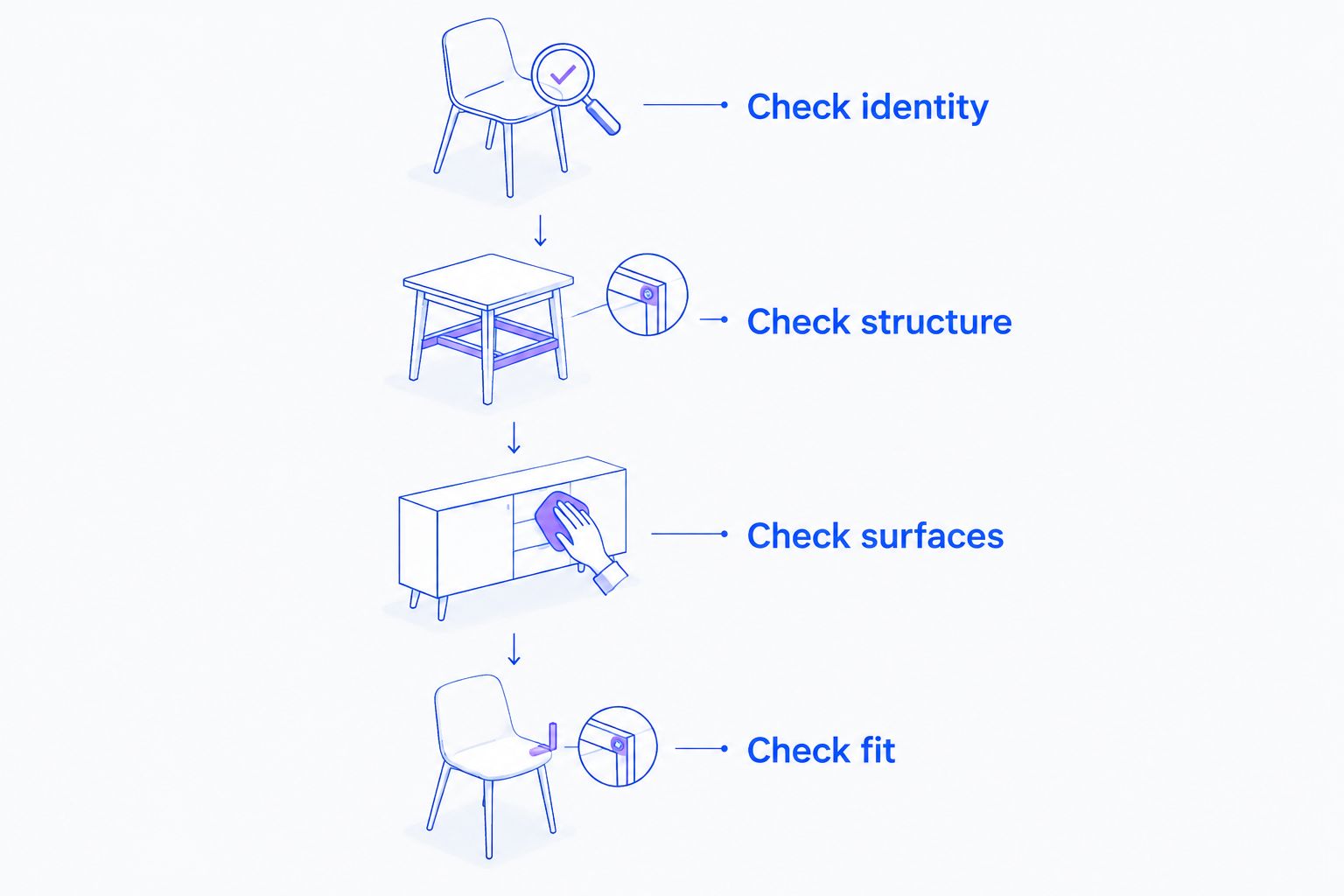 Inspect the actual piece before deciding whether its appearance justifies the purchase.
For upholstered furniture, ask about storage conditions, smoke exposure, pets, spills, and previous cleaning. Inspect accessible seams and undersides for signs that need professional assessment. Do not assume fresh fabric establishes the condition of the frame or everything beneath it.
If you cannot inspect in person, request current photographs of specific areas and a continuous video showing the piece from several angles. Ask the seller to demonstrate drawers, doors, or moving parts. Images help answer targeted questions, but they do not establish smell, comfort, or every concealed condition.
Decline when the evidence does not resolve a problem you are unwilling to inherit. You do not need to diagnose every fault yourself; you need enough information to make a sound decision.
What should you verify when buying new furniture online?
Start with 3 measurements: overall width, depth, and height. Then check the dimensions that affect use, such as seat height and depth for seating or underside clearance for a dining table. Record measurements in a consistent unit so you can compare listings without confusion.
Read material descriptions component by component. Identify what is stated about the frame, visible surface, upholstery, and cushions. Do not convert a finish description into an assumption about the material underneath it.
Next, read delivery and return terms before placing the order. Check who handles an unsuccessful delivery, how damage is reported, what condition a return must meet, and whether any exclusions apply. Keep a copy of the specifications and terms associated with your purchase.
Finally, plan the arrival inspection. Compare the delivered piece with the order, examine accessible surfaces and connections, and document concerns before discarding packaging. New furniture deserves the same attention to condition as secondhand furniture.
Is secondhand upholstered furniture a good choice?
Secondhand upholstered furniture is a good choice when its condition is acceptable and you understand any cleaning or restoration work it needs. Upholstery adds questions beyond visible fabric wear: cushion support, internal condition, odor, and the frame all matter.
Sit in different positions if the seller permits it. Notice whether support feels even, whether you can rise comfortably, and whether the arms and back suit how you sit. A generous-looking seat is not automatically a comfortable seat.
If you already know the covering needs replacement, seek an assessment before buying. New upholstery changes the surface; it does not automatically address a damaged frame, weak supports, or other underlying problems.
Is secondhand furniture always the more sustainable choice?
Secondhand furniture keeps an existing object in use, but that fact alone does not establish the complete environmental impact of a particular purchase. Transport, repairs, replacement materials, and how long you keep the piece also belong in the assessment.
For a practical 2026 decision, ask whether the furniture fits your home well enough to remain useful. An unsuitable piece that you quickly replace does not serve the same purpose as one you maintain and use. Apply that question to new furniture too.
Buy for continued use, not for the environmental label alone. Choose maintainable materials, understand care requirements, and avoid a purchase that already depends on changes you have not investigated.
Can you combine secondhand and new furniture?
Combining secondhand and new furniture lets you choose each piece on its own merits. You do not need a room-wide allegiance to either category. Start with the furniture that carries the most daily use, then assess supporting pieces individually.
Repeat a few visual relationships to give the room coherence: wood tone, metal finish, upholstery texture, or the weight of a silhouette. The pieces do not need identical origins. They need compatible proportions and enough space to function together.
Keep practical requirements ahead of the composition. A sculptural side chair should still suit its intended task, and a coffee table should work with the surrounding seating. A mixed room succeeds when the furniture is useful as well as visually connected.
FAQ
What’s better for everyday use: secondhand designer furniture or new?
The better everyday choice is the piece with suitable comfort, sound construction, and acceptable condition. Compare actual furniture rather than assuming age or a design label establishes quality.
Can I trust a secondhand furniture listing without seeing it?
A listing alone does not verify condition, comfort, or historical identity. Request current detailed photographs, documentation, a video demonstration, and written answers to condition questions before deciding.
Does new furniture always last longer than secondhand furniture?
New furniture does not automatically last longer than secondhand furniture. Construction, existing condition, use, care, and repairability determine which individual piece better suits your plans.
Should I buy a used sofa if I plan to change the fabric?
Buy a used sofa for reupholstery only after assessing the frame, supports, cushions, and scope of work. Replacing the covering does not automatically fix underlying damage or uncomfortable proportions.
What purchase protections does Sohnne list?
Sohnne lists 60-day returns and a 5-year warranty. Read the applicable terms, exclusions, and requirements before ordering; purchase protections do not replace checking dimensions and materials.
Is secondhand furniture guaranteed to hold its value?
Secondhand furniture is not guaranteed to hold its value. Buy for condition, suitability, and your intended use rather than depending on a future resale outcome.
What should I ask a secondhand furniture seller before collecting?
Ask about dimensions, condition, repairs, alterations, and collection access before collecting secondhand furniture. Confirm what is included and record any agreed disclosures in writing.
One last thing
Before either purchase, write down what would make you reject the piece: an uncomfortable seat, an unresolved structural issue, a difficult access route, or terms you cannot accept. Make that decision before you become attached to the photograph.
For your 2026 furniture search, let the least glamorous evidence settle the choice: measurements, underside photographs, construction details, and written terms. The strongest purchase is the piece that still makes sense after those checks.
Related guides
- Is it cheaper to buy a new sofa or reupholster an old one?
- How to choose furniture scale for a room with high ceilings
- How to care for bouclé fabric furniture
Stay connected with us!
Keep in touch with what’s new and next. Subscribe for weekly insights, product launches, and community news!