Is it cheaper to buy a new sofa or reupholster an old one?

Sohnne Design Studio
October 22, 2026

Neither buying a new sofa nor reupholstering an old one is automatically cheaper: compare the complete replacement total with a written upholstery quote for the work your sofa actually needs. Fabric alone does not cover a restoration; padding, support repairs, labor, and transport belong in the comparison. Keep a sofa that still fits and supports you well; consider replacement when you need different proportions or extensive structural work.
TL;DR- To buy new sofa or reupholster, compare complete project totals—not fabric against a finished sofa.
- Reupholstery suits a sofa whose frame, proportions, and comfort you want to preserve.
- A new sofa suits a room that needs different dimensions, seating, or access requirements.
- Sohnne sells new mid-century modern furniture; assess replacement options against a written upholstery scope.
Is it cheaper to buy a new sofa or reupholster an old one?
The cheaper option is the one with the lower complete total for an acceptable result. Before requesting quotes, start by measuring your room before choosing a sofa: restoring the wrong-sized piece does not solve a layout problem.
For a useful 2026 comparison, put these items side by side. Ask each provider to distinguish included work from optional work rather than treating an initial estimate as a finished total.
| Decision point | Reupholster your sofa | Buy a new sofa |
|---|---|---|
| Best for | Keeping proportions and a frame you want to retain | Changing size, layout, or seating characteristics |
| Main advantage | Preserves the existing piece while changing upholstery and specified internal components | Lets you select a different overall design and construction |
| Main drawback | New fabric does not correct every underlying problem | You must evaluate an unfamiliar sofa and arrange removal of the old one |
| Include in the comparison | Fabric, labor, padding, support repairs, collection, and return transport | Sofa, applicable delivery or assembly charges, and old-sofa removal |
| Confirm before committing | Repair scope, fabric quantity, exclusions, and approval process | Dimensions, materials, access requirements, and written policies |
Do not compare a fabric-only estimate with a complete new sofa. Equally, do not compare a fully rebuilt sofa with a replacement whose construction and comfort you have not assessed.
Why this matters
A sofa has several layers of value: its frame, suspension, cushions, covering, and usefulness in your room. Worn fabric tells you about the surface, not necessarily the condition underneath.
Separate appearance from function before you decide. If you like the shape but dislike the upholstery, investigate restoration; if you dislike sitting on it or walking around it, identify those problems before paying to preserve the same form.
Sentimental value belongs in the decision, too. It can justify keeping a piece without making restoration the cheaper choice. Treat that as a separate reason, not evidence that one quote represents better financial value.
When reupholstering makes sense
Best for: a sofa whose shape, scale, and underlying structure you want to keep. Reupholstery is a targeted decision when the covering is the problem and the rest of the piece still serves you.
Start with what already works. Do your feet reach the floor comfortably? Does the back support your preferred sitting position? Can everyone use the sofa without squeezing past another piece of furniture? Write down the qualities you want the upholsterer to preserve.
Then ask for an inspection. A professional needs to distinguish worn upholstery from loose joints, damaged support, or deteriorated cushioning. Photographs help explain visible damage, but they do not reveal every internal condition.
What reupholstery can change
Specify the changes rather than requesting a general refresh. Discuss fabric, cushion filling, seams, trim, and any identified repairs as separate parts of the job.
An upholsterer can assess whether your requested changes suit the existing construction. Do not assume that replacing the covering includes new cushions, repaired springs, or a rebuilt frame.
What reupholstery does not automatically solve
Reupholstery does not automatically change the sofa's footprint, arm height, or basic seating geometry. Alterations require a separate discussion about feasibility and scope.
The main drawback is uncertainty about concealed work. Ask how the workshop handles damage discovered after removing the covering, and require approval before additional work proceeds. An attractive fabric choice is not a substitute for a clear repair agreement.
When buying a new sofa makes sense
Best for: a household that needs different dimensions, seating characteristics, or a different layout. Replacement lets you reconsider the whole object instead of preserving its existing boundaries.
A sofa that blocks circulation or overwhelms the room needs a fit assessment before an upholstery consultation. The same applies when the seat is fundamentally too deep, too low, or otherwise unsuitable for the people using it.
Replacement also deserves consideration when an inspection identifies extensive work. Ask the upholsterer to explain what needs rebuilding, then compare that complete project with a new sofa that meets your requirements.
What a new sofa changes
You can choose a different footprint, back profile, arm shape, and seating arrangement. Those decisions affect how the room works as well as how it looks.
The drawback is that you must establish comfort and quality anew. Product photography cannot tell you everything about seat support, cushion feel, or how easily you can stand up. Check the written specifications and evaluation options before committing.
What to do with the old sofa
Arrange its next destination before the replacement arrives. Donation, resale, removal, and disposal each require confirmation with the organization or service involved.
Do not assume delivery includes taking the old piece away. Keep that task visible in your comparison, even when someone else is handling the move.
Why the comparison varies
Your sofa's condition and the scope of work determine what belongs in an upholstery quote. On the replacement side, construction, materials, and services determine what you are comparing.
- Frame condition: Ask whether joints or structural members require repair before new upholstery is fitted.
- Seat support: Distinguish cushion wear from problems in the support beneath the cushions.
- Fabric selection: Confirm the chosen material, required quantity, pattern matching, and suitability for the application.
- Upholstery detail: Ask how tufting, piping, fitted cushions, and other sewing details affect the work involved.
- Transport and access: Confirm collection, delivery, stairs, doorways, and any assembly requirements.
- Changes after inspection: Establish how newly discovered repairs are documented and approved.
For your 2026 decision, request a scope that names these items rather than a single unexplained total. That makes differences between quotes easier to understand without assuming the lowest initial figure covers the same result.
How do you compare the options fairly?
Use the same brief for both routes. Describe how you use the sofa, what must change, and what you refuse to compromise on; then compare the proposals against that brief.
- Inspect the sofa. Record visible wear, movement, sagging, and any comfort problems. Ask an upholsterer to assess the underlying condition.
- Define the result. Decide whether you want a new covering, different cushioning, structural repairs, or a different seating shape.
- Request written scope. Separate materials, labor, repairs, transport, and exclusions. Ask what happens if concealed damage appears.
- Check replacement fit. Compare dimensions, seating characteristics, construction information, and delivery access.
- Compare complete totals. Include the work and services required to get each sofa into use, not just the headline item.
- Choose the acceptable result. Reject an option that leaves your main problem unresolved, even if its initial total is lower.
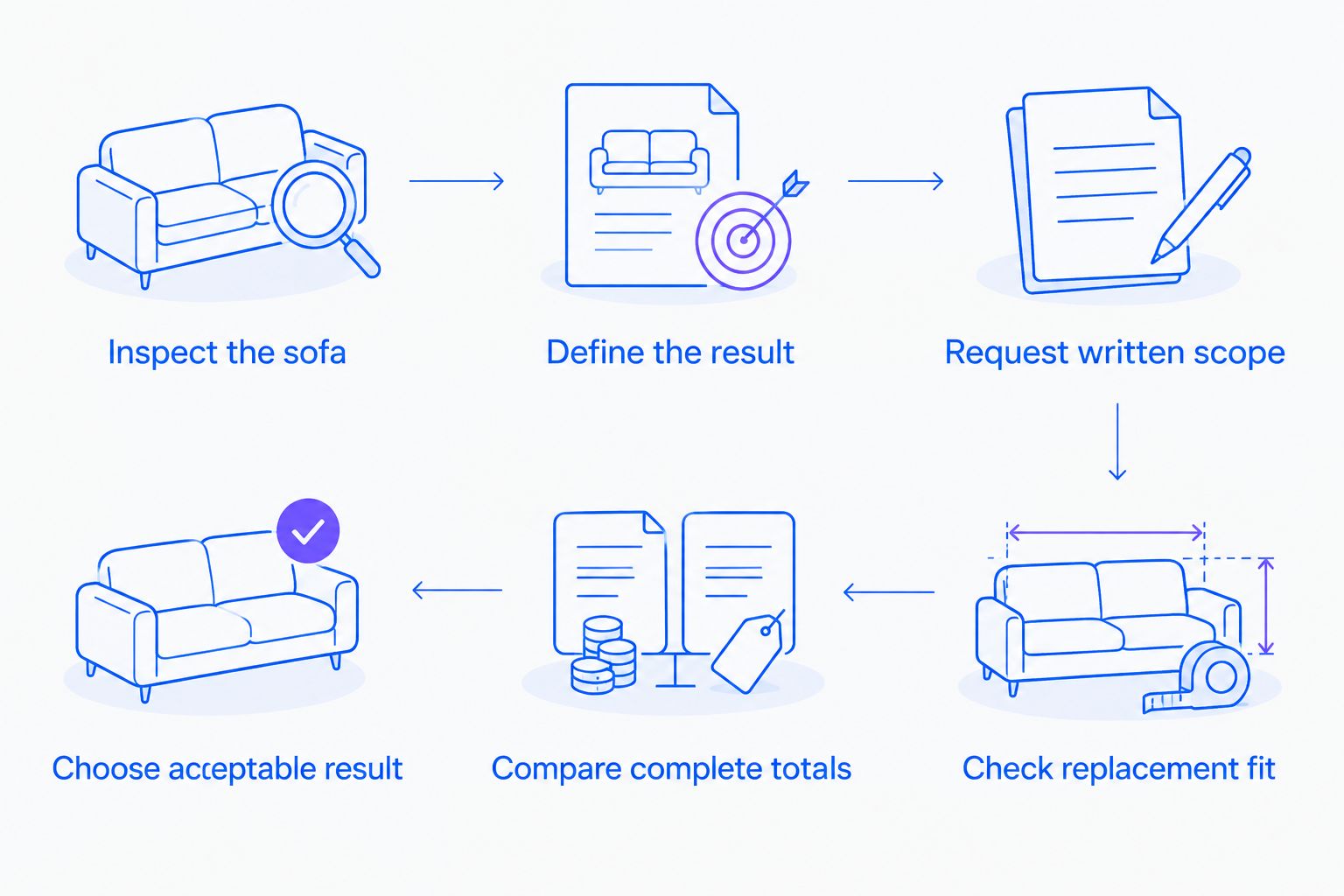 Define the result before comparing the totals.
Keep the written proposals together with fabric references, dimensions, and photographs. If a quote changes, ask for the revised scope as well as the revised total so you can see what changed.
What should you measure before deciding?
Record 3 overall dimensions: width, depth, and height, using inches consistently across the comparison. Then note seat height, usable seat depth, and the route between the entrance and the sofa's final position.
Measure the existing sofa rather than relying on memory. Its dimensions provide a useful reference: mark what feels right and what you want to change. A replacement does not need to match the old piece simply because it occupied the room first.
Also record 2 separate spaces: the room footprint and the delivery route. A sofa can suit the room yet still present access difficulties at a doorway, stair turn, or elevator.
For a 2026 room plan, mark the proposed footprint on the floor and walk around it. Check access to doors, storage, and nearby seating; use that practical test before approving either a restoration or a replacement.
Should you replace the cushions instead of reupholstering everything?
A cushion-focused repair deserves assessment when the covering remains serviceable and the main complaint is loss of support or shape. Ask a professional to identify whether the problem is in the cushion filling, the suspension beneath it, or both.
Do not authorize a full upholstery job before identifying the failed component. Replacing cushion filling is a different scope from replacing fabric throughout the sofa, and neither automatically repairs structural damage.
The limitation is consistency. Discuss whether the proposed work will preserve an even appearance and feel across the seating, especially when only part of the sofa needs attention.
Is reupholstering worth it for a sentimental sofa?
Reupholstering is worth considering when preserving the object matters independently of the financial comparison. Tell the workshop which details carry that value: the silhouette, exposed wood, trim, or particular features you want retained.
Set boundaries before work starts. Ask which materials will be removed, which parts will remain, and whether proposed repairs alter the visible shape.
Keeping a family piece is a valid choice even when replacement has a lower complete total. Make that choice deliberately rather than expecting sentimental value to appear in a cost calculation.
Where a new-furniture retailer fits into your decision
Sohnne is best for shoppers considering new mid-century modern furniture, not upholstery services. Use the retailer side of the comparison to assess a replacement against the inspected condition and written restoration scope of your existing sofa.
Sohnne sells new mid-century modern furniture directly to consumers. The benefit is the opportunity to choose a different piece; the limitation is that replacement does not preserve the sofa you already own.
For a 2026 purchase, read the applicable terms behind Sohnne's stated 60-day returns and 5-year warranty. Those policies are separate from construction, comfort, and room fit, so assess each rather than treating a policy as proof that a sofa suits you.
FAQ
Is it cheaper to buy a new sofa or reupholster my old one?
Neither option is automatically cheaper; compare a complete new-sofa total with a written upholstery quote. Include required repairs, transport, and any old-sofa removal rather than comparing fabric alone with a finished piece.
What’s the best reason to reupholster a sofa?
The strongest reason to reupholster is to retain a sofa whose proportions and underlying structure you want to keep. Have its frame, support, and cushions assessed before choosing fabric.
Can new fabric fix a sagging sofa?
New fabric does not repair the underlying cause of sagging. Ask whether the problem involves cushion filling, suspension, the frame, or a combination before approving the work.
Should I buy a new sofa if my current one feels too deep?
Consider a new sofa when the existing seat geometry does not suit you. An upholsterer can assess possible alterations, but a covering change alone does not automatically change the seating depth.
What should an upholstery quote include?
An upholstery quote should specify fabric, labor, agreed padding or support work, transport, and exclusions. It should also explain how additional repairs discovered during the job require your approval.
How many measurements do I need before buying a replacement sofa?
Start with 3 overall dimensions: width, depth, and height. Also record seat dimensions and check the delivery route, because overall size alone does not establish comfort or access.
Is Sohnne relevant if I’m deciding whether to keep my sofa?
Sohnne is relevant when you want to compare a new mid-century modern sofa with restoring your existing piece. Assess the replacement’s fit and specifications separately from the upholstery workshop’s proposed repairs.
One last thing
Before selecting fabric or a replacement, finish this sentence: The problem with my current sofa is… Be specific enough that you can test whether the proposed solution fixes it.
If the answer is only the worn covering, inspect the sofa for restoration. If the answer is its footprint, seating geometry, or extensive damage, investigate those issues first. For your 2026 decision, the lower total matters only after the result meets your needs.
Related guides
- How to pick a sofa finish for a high-traffic household
- Best sofas for a narrow living room layout
- How to care for bouclé fabric furniture
Stay connected with us!
Keep in touch with what’s new and next. Subscribe for weekly insights, product launches, and community news!