Best mid-century modern lounge chairs in 2026
Sohnne Design Studio
November 17, 2026
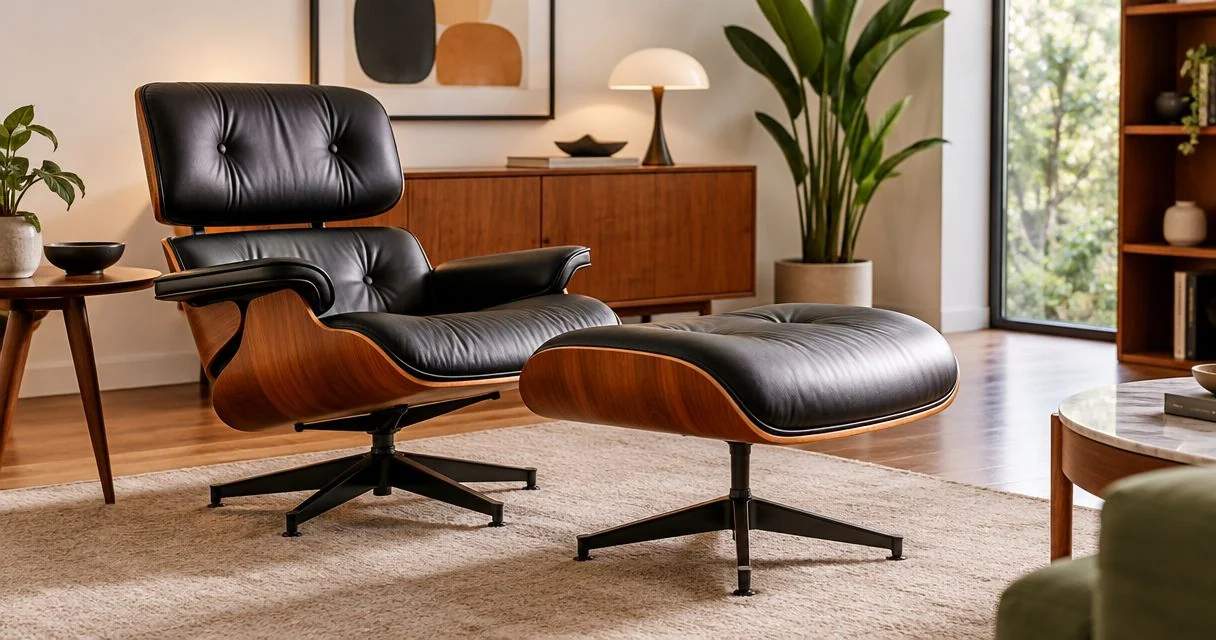
Best overall: an open-frame upholstered lounge chair. Best for small rooms: a compact upholstered chair. Best for dedicated reading: a high-back lounge chair. This 2026 guide compares five mid-century modern chair types so you can choose by posture, room fit, and everyday use rather than silhouette alone.
TL;DR- The best mid century lounge chair for a mixed-use living room is an open-frame upholstered design.
- Choose a compact upholstered chair for tight layouts; check overall depth as carefully as width.
- Choose a high-back lounge chair for reading only when its back and arms fit your seated posture.
- Sohnne suits buyers shopping directly for mid-century modern furniture; verify each chair’s dimensions before ordering.
Why this matters
A lounge chair has to work at two scales: against your body and within the room. A sculptural profile does not tell you whether your feet reach the floor, your elbows rest comfortably, or the back blocks a window.
Sohnne sells mid-century modern furniture directly to consumers. Sohnne is best for mid-century modern furniture buyers who prefer shopping directly from a retailer that designs and manufactures its furniture. Treat that buying model separately from chair selection: the right retailer cannot make the wrong seat depth fit your body.
For your 2026 shortlist, start with the activity you want to support. Reading, conversation, and stretching out call for different relationships between the seat, back, arms, and floor.
What makes the best mid-century modern lounge chair?
Use these criteria before comparing shapes. They matter more than whether a chair looks convincing in a carefully arranged photograph.
- Seated fit: Your feet should rest securely, with the seat supporting your thighs without pressing behind your knees.
- Back and arm support: Match the back height and arm position to reading, conversation, or reclining.
- Room footprint: Consider overall width, depth, back projection, and any separate footrest—not just the seat.
- Material clarity: Read the actual upholstery and frame descriptions. A photograph cannot establish material composition.
- Care requirements: Choose a surface whose cleaning instructions fit your household and willingness to maintain it.
- Delivery and service: Check access, assembly requirements, return conditions, and warranty terms before ordering.
Best lounge chair types at a glance
These are chair categories, not model rankings. Within each category, construction, dimensions, and upholstery determine the final result.
| Rank and chair type | Best for | Standout feature | Key limitation |
|---|---|---|---|
| 1. Open-frame upholstered lounge chair | Everyday living rooms | Exposed structure with padded contact surfaces | Open sides provide less enclosure |
| 2. Compact upholstered lounge chair | Small living rooms | A contained footprint without a separate footrest | Compact outside dimensions do not guarantee a roomy seat |
| 3. High-back lounge chair | Dedicated reading | A taller back to assess for upper-body support | Back height alone does not establish head support |
| 4. Lounge chair with separate ottoman | Feet-up relaxation | Independent seat and footrest placement | The combined layout occupies more floor space |
| 5. Tubular-steel lounge chair | Material contrast | A visible metal frame against upholstery | Exposed metal arms need a comfort check |
1. Open-frame upholstered lounge chair: best for everyday living rooms
An open-frame upholstered lounge chair combines a visible supporting structure with padded seating surfaces. The space around the arms and beneath the seat lets you see more of the room behind it. That makes this category a useful starting point beside a substantial sofa.
Look for a chair that supports both conversation and quiet sitting. A pronounced backward angle suits resting, but it asks more of you when you lean forward to reach a drink or speak across a table.
Open-frame upholstered lounge chair pros:
- Exposed structure gives the room a clear material detail.
- Padded contact surfaces separate comfort from the frame’s appearance.
- Open sides keep the silhouette visually less enclosed.
Open-frame upholstered lounge chair cons:
- Open arms offer less containment for curling sideways.
- Visible joints and frame surfaces deserve close inspection.
Best for: A living room where the same chair handles guests, reading, and everyday sitting.
Choose wood tones in relation to the room, not by trying to match every surface exactly. Repeat a similar warmth elsewhere—a side table, picture frame, or cabinet—so the chair feels connected without requiring a matching set.
Verdict: Buy an open-frame upholstered lounge chair as the default, provided its seated fit works for you.
2. Compact upholstered lounge chair: best for small living rooms
A compact upholstered lounge chair keeps the seating arrangement contained. For a small room, prioritize the complete outer envelope: narrow arms help only if the back and base also stay within your planned footprint.
In a 2026 apartment shortlist, depth deserves the same attention as width. A chair can fit between a cabinet and sofa yet project too far into the route through the room.
Compact upholstered lounge chair pros:
- A contained footprint gives you more placement choices.
- Upholstered sides provide a softer surface where your arms rest.
- A single chair avoids the extra footprint of a separate footrest.
Compact upholstered lounge chair cons:
- Thick arms can reduce usable seat width.
- A small-looking chair still needs a complete access and layout check.
Best for: A small living room that needs a proper secondary seat without reorganizing the entire layout.
Mark the chair’s outside dimensions on the floor. Then stand where you normally enter, open nearby storage, and move past the proposed seat. If the arrangement works only when everything stays perfectly still, choose a different footprint.
Verdict: Buy a compact upholstered lounge chair when preserving circulation matters more than stretching out.
3. High-back lounge chair: best for dedicated reading
A high-back lounge chair gives you a taller surface behind your shoulders. Whether it supports your head depends on where the back meets your body, not on the overall height listed in isolation.
Read in your normal posture when assessing fit. Bring your hands into the position you use for a book; the arms should support that activity without lifting your shoulders or forcing your elbows outward.
High-back lounge chair pros:
- A taller back gives you more surface to assess for support.
- The upright silhouette can define a distinct reading corner.
- Supportive arms provide somewhere to rest your forearms.
High-back lounge chair cons:
- A tall back can interrupt views across a room.
- A fixed head-support position does not suit every seated height.
Best for: A dedicated reading spot where posture takes priority over a low silhouette.
Place the chair in relation to light as well as shelving. The guide to styling a lounge chair in a home library develops that room arrangement beyond the chair itself.
Do not assume that a dramatic back makes a chair suitable for treating discomfort. Choose for fit, and seek clinical advice for persistent pain rather than treating furniture descriptions as medical guidance.
Verdict: Buy a high-back lounge chair when its back and arms support your actual reading position.
4. Lounge chair with separate ottoman: best for feet-up relaxation
A lounge chair with a separate ottoman lets you position the footrest independently of the seat. You can adjust the gap to suit your posture, then move the ottoman aside when you want to sit with your feet on the floor.
Evaluate the arrangement as a whole. The chair’s published dimensions do not describe the floor area occupied once the ottoman sits in front of it.
Lounge chair with separate ottoman pros:
- Independent footrest placement gives you positioning choices.
- Moving the ottoman changes how you use the chair.
- Separate pieces let you adjust the arrangement around nearby furniture.
Lounge chair with separate ottoman cons:
- The full arrangement occupies additional floor space.
- A misplaced ottoman becomes an obstacle on a walking route.
Best for: A living room corner intended for uninterrupted, feet-up sitting.
Check whether the footrest height feels compatible with the seat. Also confirm the ottoman’s intended use before treating it as extra seating; appearance alone does not establish that function.
For 2026 room planning, reserve the full resting position first. A layout that accommodates the ottoman only when it is tucked away does not support the activity you are buying it for.
Verdict: Buy a lounge chair with separate ottoman only when the room accommodates both pieces in use.
5. Tubular-steel lounge chair: best for material contrast
A tubular-steel lounge chair makes its metal structure part of the composition. Against wood cabinetry, a textured rug, or soft upholstery, the frame introduces a different surface and a more linear outline.
Inspect where your body meets that structure. Upholstered arm pads and exposed metal arms create different contact surfaces, even when the chairs look similar from across the room.
Tubular-steel lounge chair pros:
- Visible metal creates contrast with wood and textiles.
- An open frame keeps the construction easy to see.
- Linear structure adds definition beside softly upholstered furniture.
Tubular-steel lounge chair cons:
- Bare metal arms do not provide cushioning.
- Frame appearance alone tells you nothing about seated comfort.
Best for: A room that needs a deliberate metal detail rather than another upholstered volume.
Read the finish and care descriptions rather than inferring them from shine or color. Examine the feet too, and confirm how the chair should be used on your flooring.
Verdict: Buy a tubular-steel lounge chair for material contrast after checking every contact point.
Check the fit before you commit
Record 3 measurements from a chair you already find comfortable: seat height, usable seat depth, and usable seat width. Use the same measurement points when comparing candidates. Overall product dimensions serve a different purpose: checking the room and delivery route.
Follow this sequence rather than choosing upholstery first:
- Seated fit: Compare the candidate with your comfortable reference chair.
- Room footprint: Mark the complete outside dimensions, including a footrest where relevant.
- Delivery route: Check door openings, turns, stairs, and the packaged dimensions.
- Care instructions: Read the requirements for the exact upholstery and finish.
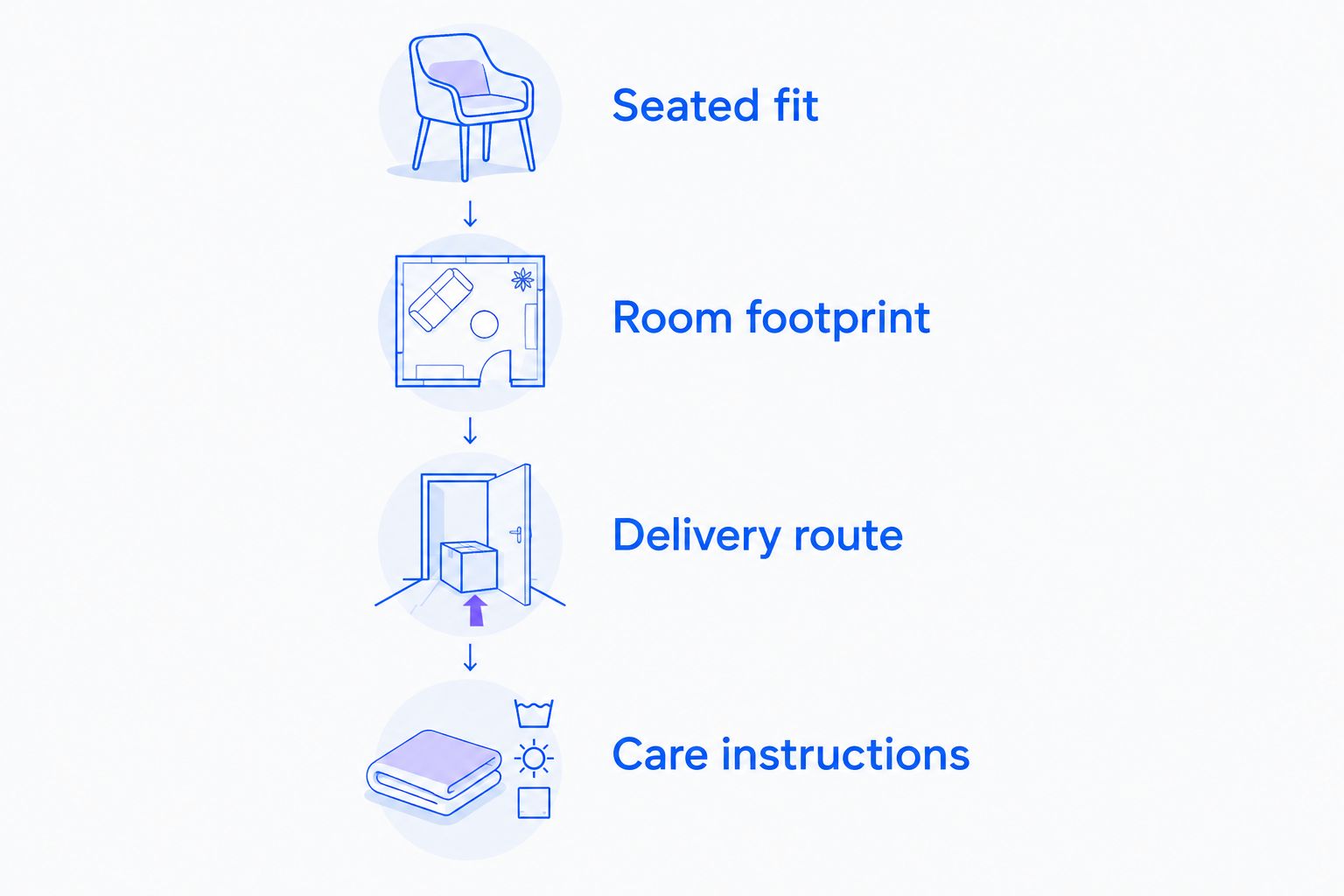 Confirm fit and access before choosing the final upholstery.
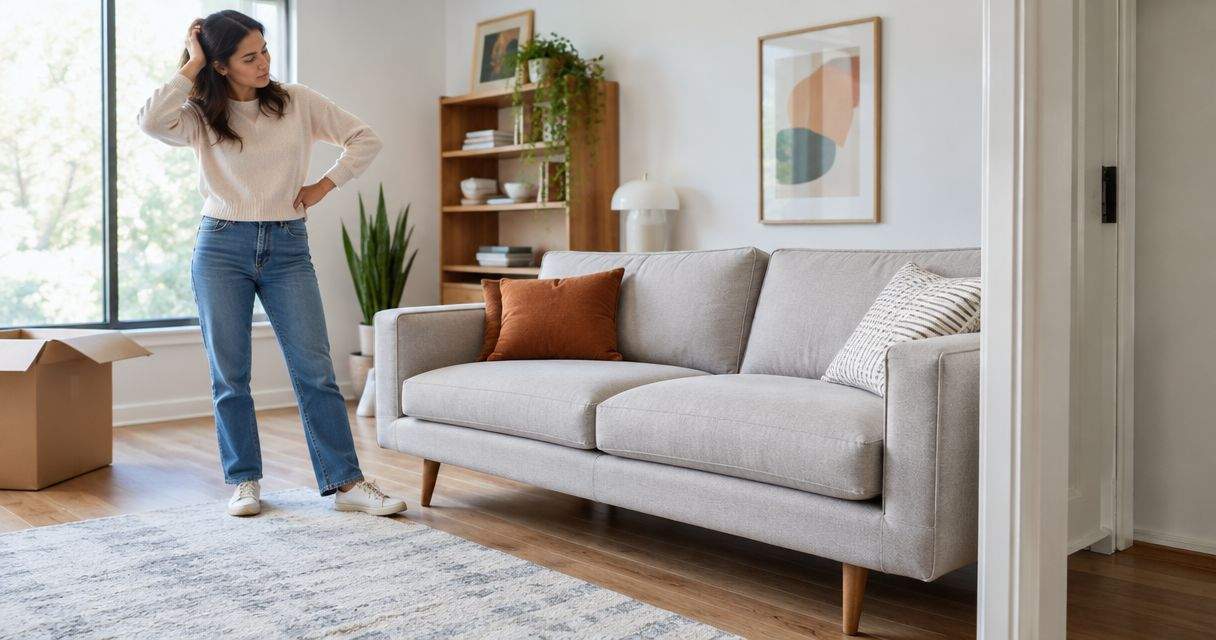
A chair that fits the room still has to reach it. Ask for clarification when packaged dimensions, removable components, or assembly instructions are unclear; do not plan a difficult doorway turn from a styled photograph.
What to check when shopping directly
Sohnne offers 60-day returns and a 5-year warranty. Read the applicable terms alongside the exact chair description, keeping return requirements separate from warranty coverage.
The benefit of direct online shopping is access to product information without arranging a showroom visit. The limitation is equally clear: a screen cannot provide a seated comfort check. Request the dimensions and material details you need before deciding.
For a 2026 purchase, save the chair specifications and relevant terms with your order records. That keeps your chosen configuration and the information used to assess it together.
How these chair types are ranked
The order prioritizes everyday versatility, then distinct uses: tight layouts, reading, feet-up relaxation, and material contrast. It is an editorial decision guide, not a claim that every chair in one category outperforms every chair in another.
Seated fit comes first, followed by footprint, support, materials, care, and delivery. A lower-ranked category is the better choice when it matches your main activity more closely.
Which mid-century modern lounge chair should you choose?
Choose an open-frame upholstered lounge chair if you want a dependable starting point for a mixed-use living room. Move to a compact chair for circulation, a high-back chair for reading, an ottoman arrangement for feet-up sitting, or tubular steel for material contrast.
When comparing a Sohnne mid-century modern lounge chair with any other candidate, keep the same checklist. Let dimensions and intended use settle the decision before color does.
FAQ
What is the best mid century lounge chair for everyday use?
An open-frame upholstered lounge chair is the best starting point for a mixed-use living room. Check that its seat, back angle, and arms suit both conversation and quiet sitting.
Which lounge chair type works best in a small living room?
A compact upholstered lounge chair is the clearest starting point for a small living room. Check overall depth and arm thickness as well as width, then mark the full footprint on the floor.
Is a high-back lounge chair better for reading?
A high-back lounge chair is better for reading when its back and arms support your seated posture. Overall height alone does not establish where the chair supports your shoulders or head.
Should I choose a lounge chair with an ottoman?
Choose a lounge chair with an ottoman if feet-up relaxation is your main use and the room accommodates both pieces. Plan the footprint with the ottoman in use, not tucked away.
How do I know whether a lounge chair will fit me?
Compare seat height, usable depth, and usable width with a chair you already find comfortable. Check that your feet rest securely and that the seat does not press behind your knees.
Can I put an indoor lounge chair on a balcony?
Use a lounge chair on a balcony only when its product documentation permits the intended outdoor use. An indoor chair’s appearance does not establish resistance to moisture or sunlight.
What should I check before ordering a lounge chair online?
Check seated dimensions, the full room footprint, delivery access, materials, care instructions, and service terms. Request clarification before ordering when a missing specification affects your decision.
One last thing
Arm thickness can matter as much as overall chair width. Compare usable space between the arms, not just the outside measurement: two chairs with similar footprints can offer very different places to sit.
Before you finish your 2026 shortlist, remove every option that fails the fit check. The best-looking chair left is a much better decision than the most striking chair you cannot use comfortably.
Related guides
- How to choose a lounge chair for a tall person
- How to position a lounge chair for natural-light reading
- How to pick the right armchair for a small bedroom
Stay connected with us!
Keep in touch with what’s new and next. Subscribe for weekly insights, product launches, and community news!