Is a sculptural glass coffee table worth the price in 2026?

Sohnne Design Studio
October 20, 2026
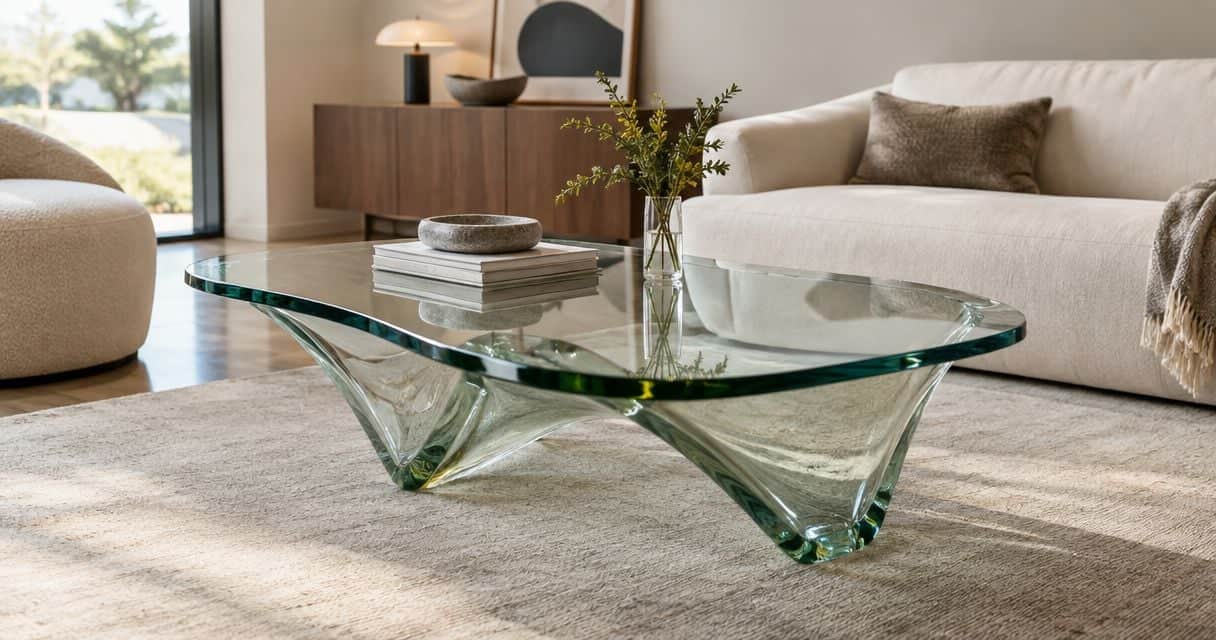
A sculptural glass coffee table is worth it when its shape improves your living room without compromising everyday use. Skip it when you need concealed storage, a forgiving play surface, or furniture you rarely have to clean; the trade-off is upkeep and usable space, not appearance alone.
TL;DR- Is a sculptural coffee table worth it? Yes, when its footprint, usable surface, and care requirements fit your room.
- Glass coffee tables keep a rug visible, but fingerprints and objects beneath the top remain visible too.
- Choose a sculptural base for visual interest, not as evidence of stability or construction quality.
- Sohnne suits mid-century modern furniture shoppers; assess each coffee table’s specifications rather than the retailer’s aesthetic alone.
Is a sculptural glass coffee table worth the price in 2026?
Buy for the combination of form and function, not for the silhouette alone. A glass top lets you see the base and floor beneath it. That transparency is useful when you want a patterned rug or an expressive base to remain part of the room, but it does not reduce the table’s physical footprint.
If scale is your main uncertainty, start with how to choose furniture scale for a room with high ceilings. A table should relate to the seating around it, not simply fill an empty patch of floor.
| Coffee table option | Best for | Main advantage | Main drawback | Decision |
|---|---|---|---|---|
| Sculptural glass coffee table | Rooms where the base and rug deserve attention | Keeps the base visible through the surface | Shows fingerprints and everything underneath | Buy when the shape passes a room-fit check |
| Solid-top coffee table | Rooms needing a more visually grounded center | Creates an opaque surface above the base | Conceals more of the rug beneath it | Choose when transparency adds little |
| Coffee table with enclosed storage | Living rooms with everyday clutter | Keeps stored objects out of sight | Adds a more enclosed volume to the room | Choose when storage is the priority |
| Upholstered ottoman used as a table | Rooms prioritizing a padded central piece | Provides an upholstered surface | Requires a suitable tray for drinks | Choose when softness matters most |
Why this matters
The center of a living room does several jobs. You pass it, reach across it, set things on it, and see it from almost every seat. An awkward table interrupts those routines even when it looks beautiful in a photograph.
For a 2026 purchase, judge value through those repeated uses. A sculptural table earns its place when you enjoy looking at it and never have to work around it. Neither a dramatic base nor clear glass compensates for blocked movement or an inconvenient surface.
When a sculptural glass coffee table earns its place
A sculptural glass coffee table makes the most sense when the table itself is part of your room’s composition. The base remains visible rather than disappearing beneath an opaque slab, so its curves, intersections, and material become part of the view.
That works particularly well when the surrounding furniture leaves room for a focal point. A restrained sofa, a textured rug, and a clearly defined seating arrangement give an expressive table space to register. If every nearby object competes for attention, another strong shape adds competition rather than clarity.
Look from your usual seat before deciding. The profile you see while sitting matters more than the overhead view used in a product photograph. A base that looks balanced from above might sit directly where you want to place your feet.
Best for: a living room where visual openness and a visible base serve a clear purpose. Choose the sculptural glass coffee table if you like its everyday view as much as its photographed outline. Otherwise, keep looking.
When a sculptural glass coffee table is not worth it
Skip a sculptural glass coffee table if your central surface doubles as concealed storage, a craft station, or a place to leave cables and household essentials. Clear glass does not hide those objects. It makes the area beneath the tabletop part of the display.
Also reconsider if you want to put your feet up routinely. A glass coffee table is not an upholstered footrest, and its intended use and load limits belong in the manufacturer’s documentation. Do not infer either from the thickness or apparent weight of the top.
Households with young children should assess the actual edges, stability, placement, and glass specification. Rounded corners do not remove every hazard, and glass treatment alone does not establish that a complete table suits your household.
Best for: buyers who accept visible surfaces and deliberate placement. If that sounds like more management than you want, choose a different central piece rather than planning to change your habits around the table.
How to check whether the table fits your room
Before buying in 2026, test the exact outline rather than estimating from the product image. Sculptural tops often have curves or projecting ends that a simple length measurement does not fully communicate. Use the published dimensions and any available plan drawing.
- Mark the footprint. Lay out the table’s outline on the floor using paper or removable tape suitable for your flooring. Include the widest projections, not just the narrow center.
- Test daily movement. Walk between the seating and the marked outline, approach every seat, and check access to nearby doors. Repeat the routes you actually use while carrying something.
- Check seated reach. Sit normally and reach toward the proposed surface. Confirm that the base leaves space for your feet and that the useful part of the top is accessible.
Do not shrink the marked shape because glass looks less visually solid. Your knees still meet the edge at its full dimensions. Likewise, do not assume an open-looking base gives you unrestricted foot space; its supports have their own footprint.
 Test the full outline before deciding that a transparent table fits.
Keep the mock-up in place through your normal living-room routine. If you repeatedly step over it, move it, or reach around an imagined corner, the shape needs reconsideration. Solve the layout before choosing the finish.
Why a sculptural coffee table’s value varies
The strongest purchase decision separates appearance from documented construction. In 2026, ask what each feature contributes to your room rather than treating an unusual shape as proof of quality.
- Room fit: The top and base must work within your seating arrangement. A table that restricts movement fails regardless of its visual appeal.
- Usable surface: An irregular perimeter can leave less convenient space for everyday objects than its overall dimensions suggest. Check where your usual items would sit.
- Glass specification: Ask what glass is supplied and what care and use instructions apply. Do not identify treatment or strength from a photograph.
- Base construction: Check the stated materials, assembly method, and how the top is supported or attached. A sculptural outline does not answer those questions.
- Care requirements: Glass reveals smudges, dust, and objects beneath it. Decide whether the required cleaning suits your routine.
- Purchase terms: Read delivery, return, damage-reporting, and warranty terms before ordering. Keep the product description and care instructions with your order records.
These factors establish practical value without assuming that every expressive table performs alike. The correct decision depends on the particular item and the room where you will use it.
Does a glass coffee table make a small living room feel bigger?
A glass coffee table keeps the floor and rug visible through the top, which reduces the opaque surface in your sightline. It does not create additional walking space. A compact solid-top table can fit better than a larger transparent one.
Compare what remains visible at seated eye level. A dense base beneath clear glass still occupies the view, while an open base exposes more of the floor. Neither description alone tells you which table has the better dimensions for your room.
Choose the footprint first and transparency second. In a narrow room, a clear top is not permission to extend the table into your main route between seats.
Is a sculptural glass coffee table difficult to maintain?
A sculptural glass coffee table requires care for both the glass and its base. Fingerprints, smears, and dust are visible on clear surfaces, while joints and curved supports create additional areas to clean. Follow the instructions for every material rather than applying the same cleaner everywhere.
Use the manufacturer’s guidance for the tabletop, edges, supports, and contact points. Avoid assuming that a product suitable for glass is also suitable for a neighboring wood or metal finish. Check how the top is secured before attempting to lift or move it.
For a 2026 shortlist, maintenance is a buying criterion, not a task to consider after delivery. If visible marks will bother you more than the shape will please you, choose another surface.
How do you style a sculptural glass coffee table?
A sculptural glass coffee table needs enough open surface for the base to remain visible. Begin with the objects you actually use, then decide whether anything decorative is needed. Covering the entire top removes much of the reason to choose transparent glass.
Look underneath as carefully as you look above. Cables, scattered magazines, and a crowded rug pattern all remain visible through the surface. Keep what you want to see and relocate what you do not.
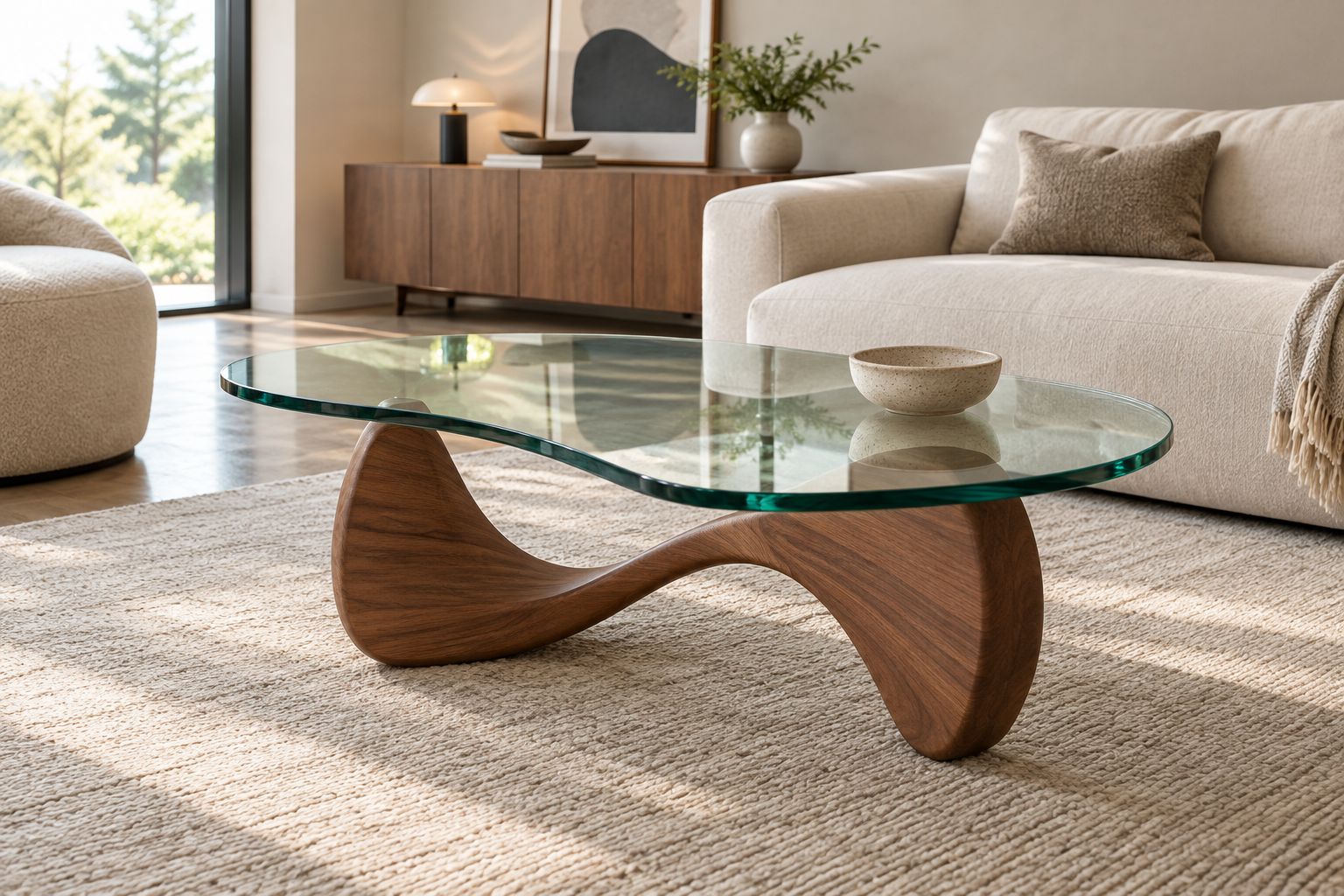 An open tabletop lets the base remain part of the room.
Check the arrangement after sitting down, not only while standing over it. A tall object can interrupt a conversation or a view across the room. Leave a convenient landing place within reach rather than turning the entire table into a display.
Where Sohnne fits into the decision
Sohnne is best suited to shoppers seeking mid-century modern furniture online. Its stated 60-day returns and 5-year warranty are relevant purchase terms, but neither replaces a close reading of the particular item’s dimensions, materials, and care requirements.
When considering a coffee table from Sohnne, apply the same checks you would use elsewhere: verify the footprint, understand the surface, and read the applicable terms. The retailer’s design focus helps define the aesthetic; it does not establish that every table fits your room or household.
For your 2026 decision, treat the return window as a safeguard rather than a substitute for measuring. Confirm the conditions and practical steps involved before ordering a large furniture item.
FAQ
Is a sculptural coffee table worth it for everyday use?
A sculptural coffee table is worth it for everyday use when the shape leaves a convenient surface, comfortable reach, and clear walking routes. Skip it if the design interferes with those tasks.
Will a glass coffee table make my room look less crowded?
A glass coffee table keeps more of the floor visible through its top, but its base and full footprint still matter. Choose dimensions that fit before relying on transparency.
Is a glass coffee table a good choice with young children?
A glass coffee table requires a household-specific assessment of edges, stability, glass specification, and placement. Do not treat rounded corners or a glass treatment as a complete safety assessment.
What should I check before buying a sculptural glass coffee table online?
Check the exact dimensions, tabletop specification, base materials, assembly instructions, and applicable purchase terms. Mark the outline on your floor and test movement and seated reach.
Can I use a sculptural glass coffee table as a footrest?
Do not use a sculptural glass coffee table as a footrest unless the manufacturer expressly permits that use. Choose a suitable upholstered ottoman when putting your feet up is a priority.
Does a thicker-looking glass top prove better quality?
A thicker-looking glass top does not establish the quality or suitability of a complete table. Verify the stated glass specification, support method, and use instructions instead of judging from photographs.
Should I cover a glass coffee table with decorative objects?
Keep enough of a glass coffee table clear to preserve its useful surface and the view of its base. Start with everyday needs, then add decoration only where it does not obstruct reach or sightlines.
One last thing
Photograph your taped outline from your usual seat before you remove it. The seated view reveals how much of the table projects into your daily sightline and where its edges meet the furniture around it.
The most useful test is not whether the table looks sculptural on its own. It is whether your room works better with that shape in it. If the answer is no, a quieter table is the better purchase.
Related guides
- How to arrange a living room around a fireplace
- Best sofas for a narrow living room layout
- How to add texture to a neutral living room with furniture
Stay connected with us!
Keep in touch with what’s new and next. Subscribe for weekly insights, product launches, and community news!