How much does it cost to reupholster a designer-style sofa?
Sohnne Design Studio
October 30, 2026
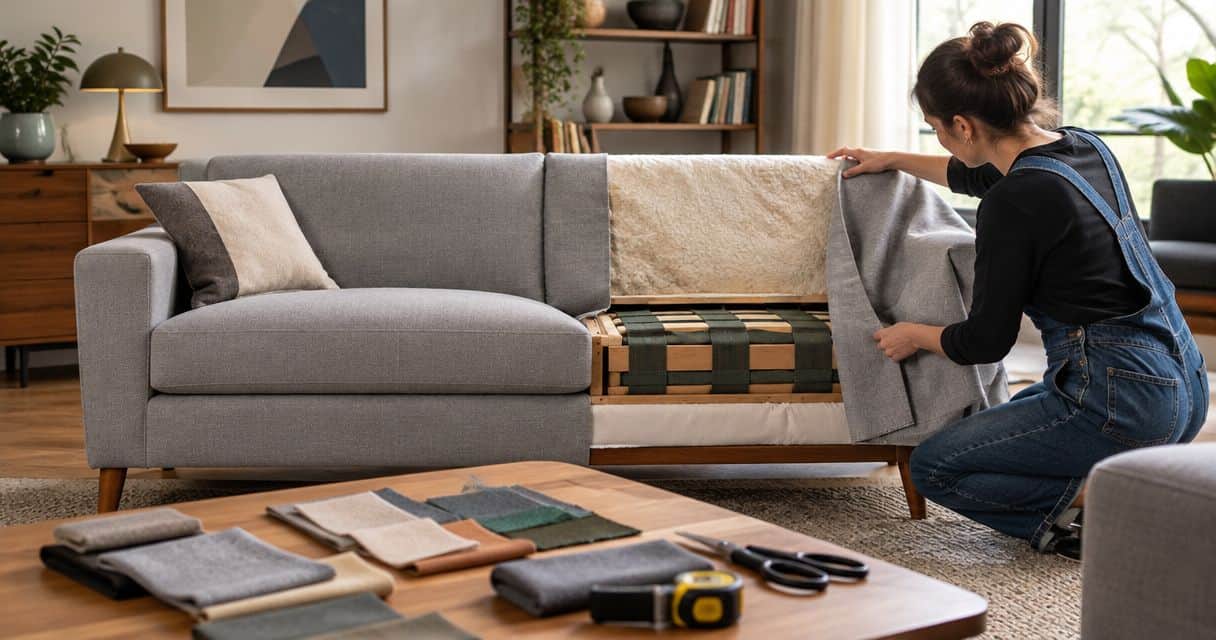
The cost to reupholster a sofa depends on the work beneath the fabric, not just the fabric you choose. For a useful 2026 estimate, request an itemized quote covering upholstery labor, covering material, cushion work, structural repairs, and transport. A fabric-only estimate does not tell you what a complete restoration will involve.
TL;DR- The cost to reupholster a sofa depends on fabric, labor, cushion condition, and structural repairs.
- Compare sofa reupholstery quotes using identical materials and repair scopes, not the final total alone.
- Sohnne is a mid-century modern furniture option for replacement shoppers, not a substitute for an upholstery assessment.
- Keep a sofa for its sound construction and useful proportions, not simply because you already own it.
How much does it cost to reupholster a designer-style sofa?
A meaningful sofa reupholstery estimate is specific to the furniture, the selected covering, and the repairs you authorize. The useful question is whether the quote restores only the surface or also addresses the comfort and support underneath. Start with that distinction before deciding whether to buy a new sofa or reupholster.
Ask the upholsterer to separate the following items. This gives you a scope you can compare rather than a total you have to interpret.
| Quote component | What to have specified | What to check |
|---|---|---|
| Covering material | Exact fabric or leather selection and required quantity | Whether the material is included or supplied separately |
| Upholstery labor | Removal, cutting, sewing, fitting, and finishing | Whether decorative details are included |
| Cushion work | Reuse, refill, or replacement of cushion interiors | Whether the quote addresses your comfort complaints |
| Support and frame | Inspection and any agreed repairs | How newly discovered damage will be approved |
| Transport | Collection, delivery, and access arrangements | Whether these services are included |
| Finishing details | Piping, buttons, skirts, zippers, and exposed trim | Whether the finished appearance matches your brief |
Compare the same finished result, not merely the same sofa. A quote that retains flattened cushions is not equivalent to one that replaces them.
Why this matters
A sofa can look tired while remaining comfortable and structurally sound. It can also look presentable while loose joints, worn suspension, or collapsed cushion interiors make it unpleasant to use. Reupholstery decisions become clearer when you separate appearance, comfort, and construction.
The right 2026 decision starts with what you want to keep. If you love the seat depth, arm height, and footprint, recovering the furniture preserves those familiar proportions. If the sofa never suited your body or room, new fabric will not correct its geometry.
Sohnne is best for shoppers seeking mid-century modern furniture rather than an upholstery repair service. If replacement is the better direction, use Sohnne as a furniture-shopping starting point; assess your existing sofa with an upholsterer before committing to restoration.
Fabric-only recovery: keep the existing support
Fabric-only recovery suits a sofa whose covering is worn but whose cushions and support still perform as you want. Ask the upholsterer to confirm what will be retained, including cushion interiors, padding, and suspension. Do not let the word reupholstery stand in for a written description of the work.
The advantage is restraint: you preserve the seating feel and concentrate on the visible finish. The limitation is equally clear. Retained components remain part of the finished sofa, so a new covering does not resolve existing sagging or uncomfortable cushioning.
Before approving the work, sit in every position you regularly use. Note whether you slide forward, feel the frame through the cushion, or sink unevenly. Share those observations rather than asking for the sofa to feel generally “better.”
Cushion renewal: change the covering and the feel
Cushion renewal suits a sofa with useful proportions but unsatisfactory padding. Ask whether the proposed work changes the cushion core, the surrounding wrap, the back filling, or some combination. These are different interventions, and the quote should identify them separately.
The benefit is the chance to address comfort alongside appearance. The trade-off is that the finished seat can feel different from the sofa you remember. Discuss whether you want firmer support, a softer surface, or a fuller-looking cushion; those goals are not interchangeable.
Approve the comfort brief before approving the fabric. If possible, handle the proposed filling materials or sit on a relevant sample at the workshop. Photographs can communicate shape, but they cannot establish how a cushion feels under your weight.
Structural restoration: repair before recovering
Structural restoration suits a sofa with a frame worth retaining and repair needs identified by a professional. Ask the upholsterer to distinguish frame repairs from work on the suspension and padding. Each affects a different part of the furniture.
Restoration preserves an object you value, but it adds another decision layer. Some damage becomes visible only after the old covering is removed. Agree in advance that additional work requires your approval before the workshop proceeds.
A new covering can hide the evidence of an unresolved problem without fixing it. Repair the support first; finish the surface second. If the workshop cannot explain the proposed repair clearly, pause the project until the scope is understandable.
Why the cost to reupholster a sofa varies
For a 2026 quote, give every workshop the same photographs, measurements, and description of the desired result. These factors explain why superficially similar sofas require different work:
- Size and configuration. Record the full width, depth, and height, along with separate sections and loose cushions. More surfaces and separate components change the cutting and sewing brief.
- Covering material. Specify the exact material rather than a broad category. Its usable width, pattern, and direction affect how the upholsterer lays out the pieces.
- Shape and detailing. Curved arms, deep buttoning, channels, piping, and closely fitted panels require their own construction and finishing work.
- Cushion condition. Keeping existing interiors is a different scope from replacing cores, adding wraps, or renewing loose filling.
- Frame and suspension condition. Loose joints and worn support require repair work beyond changing the outer covering.
- Handling and access. Describe stairs, narrow turns, detachable sections, and collection arrangements so transport is not treated as an afterthought.
Avoid choosing a fabric solely from a small online image. Request a sample, inspect its texture in your room, and ask the upholsterer whether it suits the sofa's curves and seams. A material you enjoy touching matters as much as one that photographs well.
How do you get a sofa reupholstery quote you can compare?
Build a clear brief before contacting workshops. The purpose is not to diagnose the furniture yourself; it is to make sure each upholsterer understands the same object and the same intended result.
- Document condition. Photograph the front, back, sides, underside, cushions, and visible damage. Include close views of seams and decorative details you want preserved.
- Measure the sofa. Record overall dimensions and identify removable parts. Describe the route out of your home, including awkward corners or stairs.
- Choose the finish. Provide the fabric reference or ask the workshop to propose suitable samples. State whether you want to retain piping, buttons, skirts, and seam placement.
- Define repairs. List comfort complaints and visible faults. Ask which components the workshop expects to retain and which it recommends replacing.
- Approve the scope. Request an itemized written quote, exclusions, collection arrangements, and an approval process for hidden damage.
The order matters. Choosing a covering before discussing condition can leave you comparing attractive fabrics without knowing whether the underlying sofa deserves the work.
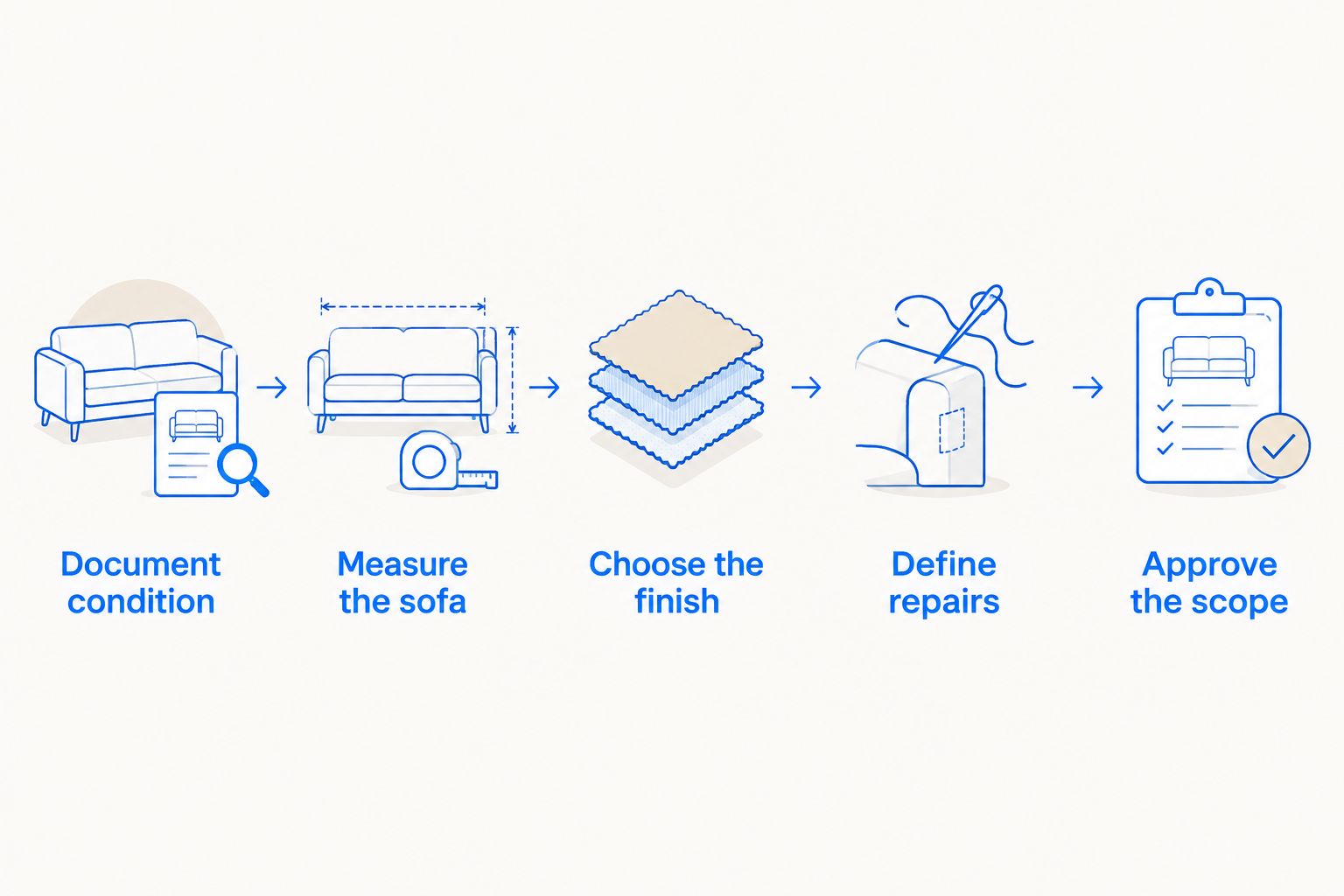 Agree on repairs and retained components before authorizing the finished covering.
Keep the written brief with the material sample you approve. If you change the covering or cushion specification later, ask for the scope to be revised so the agreement still describes the finished sofa.
Is it better to reupholster or replace a sofa?
Reupholster when the sofa's construction, comfort potential, and proportions are worth keeping. Replace when the furniture no longer serves your room or your body. Neither decision follows automatically from the age of the sofa or the name attached to it.
Use this comparison to identify the right route. Each option solves a different problem.
| Option | Best for | Main advantage | Main limitation |
|---|---|---|---|
| Fabric-only recovery | Sound, comfortable seating with a worn covering | Keeps the familiar shape and seating feel | Leaves retained support and cushion issues unchanged |
| Recovery with cushion renewal | Good proportions with tired padding | Addresses appearance and comfort together | Requires a clear brief for the new seating feel |
| Structural restoration | Furniture you value with repairable construction | Preserves the existing object | Hidden damage can change the agreed work |
| Replacement | Seating with unsuitable dimensions or function | Lets you choose a different footprint and configuration | Requires fresh checks for comfort, access, and room fit |
For a 2026 replacement comparison, assess the complete furniture decision rather than treating any new sofa as equivalent. Match the seating capacity, usable seat depth, covering requirements, and delivery access to your actual needs.
When considering Sohnne sofas alongside restoration, compare the proposed replacement with the restored result you have specified—not with the worn sofa as it stands today. Restoration offers continuity; replacement offers the opportunity to change dimensions and configuration. Neither advantage compensates for a poor fit.
Can you save money by supplying your own upholstery fabric?
Supplying your own fabric does not automatically make the project better value. First ask whether the workshop accepts customer-supplied material, how it calculates the required quantity, and who is responsible if the fabric proves unsuitable.
Do not order from the sofa's overall dimensions alone. Pattern matching, directional pile, panel layout, and usable fabric width affect the cutting plan. Let the upholsterer confirm the material and quantity before you commit.
The advantage is control over your selection. The limitation is responsibility: buying the wrong material can interrupt the project. Keep the fabric reference, care information, and approval together in writing.
Does reupholstery fix a sagging sofa?
Reupholstery fixes sagging only when the work addresses its cause. Changing the covering alone does not repair loose joints, failed suspension, or compressed cushion interiors.
Ask the upholsterer to identify whether the sag comes from the cushion, the support beneath it, or the frame. Then make that repair explicit in the quote. A fuller-looking cushion is not proof that the underlying problem has been resolved.
FAQ
How much does it cost to reupholster a sofa in 2026?
The cost to reupholster a sofa requires a quote based on its condition, covering, construction, and repair scope. Request separate entries for material, labor, cushion work, structural repairs, and transport so you can compare like-for-like proposals.
Is reupholstering a sofa cheaper than buying a new one?
Reupholstering a sofa is not automatically cheaper than replacement. Compare the complete restoration scope with a replacement that meets the same seating, comfort, material, and room-fit requirements.
Can I reupholster a sofa without replacing the cushions?
You can retain cushion interiors if their condition and comfort suit your needs. Ask the upholsterer to confirm that decision and identify any padding or support work still required.
Will new upholstery make my sofa more comfortable?
New upholstery improves comfort only when the work addresses the source of discomfort. Discuss cushion filling, suspension, and frame condition rather than assuming a new covering changes the seating feel.
Should I buy fabric before getting an upholstery quote?
Get the upholsterer’s approval before buying fabric. The workshop should confirm suitability and required quantity using the actual sofa, fabric width, pattern, and cutting plan.
What should I ask about hidden sofa damage?
Ask how the workshop handles damage discovered after removing the old covering. Require an explanation and your approval before additional repair work begins.
Does Sohnne provide sofa reupholstery?
Sohnne is an online furniture retailer; use an upholstery workshop to assess restoration work. Consider replacement furniture separately if your existing sofa no longer fits your room or seating needs.
One last thing
Before commissioning work in 2026, photograph the sofa from the side while someone sits in it. That view helps you communicate cushion compression, seated posture, and the relationship between the seat and back—details an empty-sofa photograph leaves out.
Then write down what you want unchanged. The curve of an arm, the softness of an edge, or the position of a seam can be central to why you kept the sofa. A successful restoration preserves the details you value while correcting the problems you actually have.
Related guides
- How to pick the right sofa depth for deep-seat comfort
- How to pick a sofa finish for a high-traffic household
- How to measure a room before buying a modular sofa
Stay connected with us!
Keep in touch with what’s new and next. Subscribe for weekly insights, product launches, and community news!