Designer-style furniture for event planners: complete 2026 guide

Sohnne Design Studio
October 13, 2026
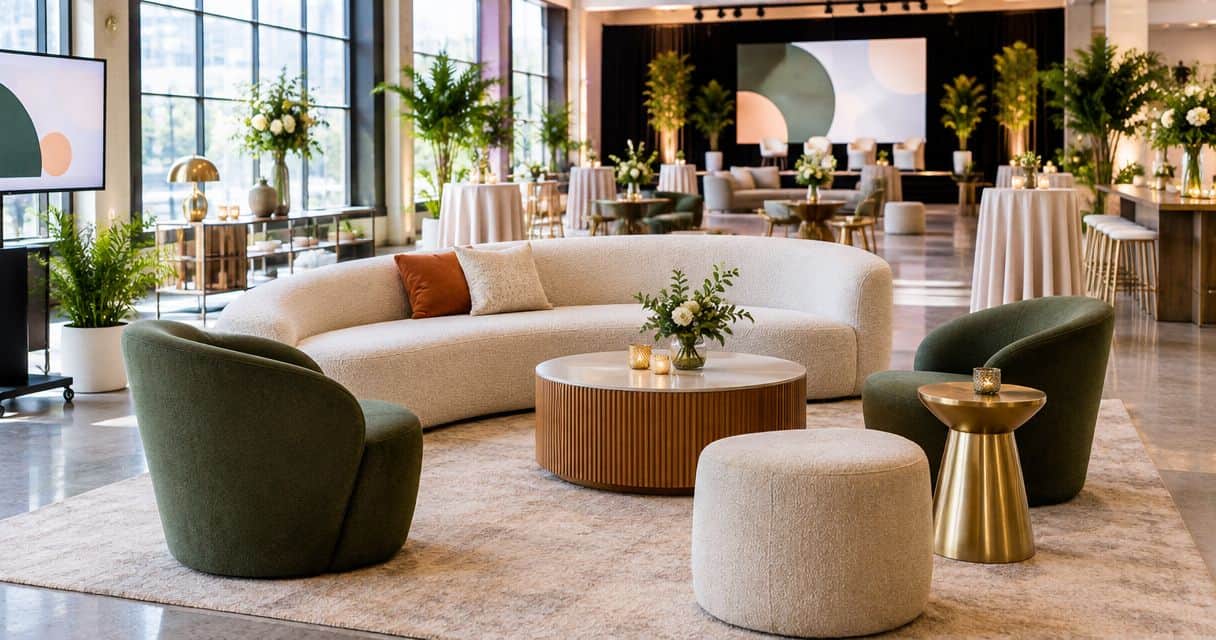
Event planners’ designer style furniture is seating, tables, and lighting selected to create a coherent setting with the aim of supporting guest comfort and the event’s visual brief. This 2026 guide explains how to choose designer style furniture for event planners when room layouts, venue access, handling, and repeat use matter as much as appearance.
TL;DR- Choose designer style furniture for event planners by guest activity, venue access, and handling requirements—not appearance alone.
- Sohnne suits planners buying mid-century modern furniture for reusable indoor lounge settings; verify each piece’s intended use.
- Rent for changing briefs; buy when storage, transport, care, and repeat use are already planned.
- Approve the floor plan and material documentation before committing to event lounge seating.
Why designer style furniture matters for event planners
Event furniture has to work in several settings at once: the room, the photographs, the guest experience, and the loading route. A sculptural chair that suits the mood still fails the brief if guests cannot rise comfortably or the crew cannot move it through the venue.
Sohnne is best for event planners buying mid-century modern furniture for reusable indoor lounge settings. The retailer designs and manufactures furniture and serves trade clients, but you should confirm event-use suitability for each selection rather than treat a residential description as commercial approval.
Start with Sohnne after defining the brief, not as a substitute for it. A clear brief makes buying decisions easier to defend.
For your 2026 event program, separate visual requirements from operational requirements. Walnut veneer, upholstery texture, and sculptural silhouettes belong on the visual list. Access, cleaning instructions, handling, and venue acceptance belong on the operational list. A successful selection satisfies both.
Choose furniture around the event, not the photograph
Define your guest activities
Write the furniture brief in a shared document before collecting images. Describe what guests will actually do: hold a drink, wait for an appointment, discuss a presentation, or eat at a table. These activities demand different seat positions and surfaces.
Use 3 zone types as a planning framework: arrival, conversation, and dining. Include only the zones your event needs. A reception lounge is not a substitute for dining seating, and a decorative ottoman is not automatically suitable as a guest seat.
For each zone, name the mood and the practical requirement together. For example, a quiet interview corner needs comfortable conversation seating and manageable background activity, not just an attractive backdrop.
- List the activity each furniture group supports.
- Identify guests who need easier sitting and standing.
- Separate dining seats from informal lounge seats.
- Record where drinks, bags, and printed materials will go.
- Mark decorative pieces that guests must not use.
Measure the room and the delivery route
Create 1 scaled floor plan before approving a furniture group. Include fixed doors, columns, service points, emergency routes, and the areas reserved for staff. Then add the furniture at its actual dimensions, including any movement needed to use it.
Measure the whole delivery route, not only the final doorway. Elevators, turns, loading areas, and temporary staging space all belong on the access sheet. Ask the venue to approve circulation and accessibility requirements; do not substitute a generic clearance figure for its rules.
A measuring checklist such as how to measure a room before buying a modular sofa helps organize dimensions, but your event plan also needs service and guest routes.
- Record each selected piece’s dimensions from its documentation.
- Measure doors, elevators, and tight turns along the delivery route.
- Draw furniture footprints on the scaled plan.
- Keep service routes separate from guest conversation areas.
- Obtain venue approval for the proposed layout.
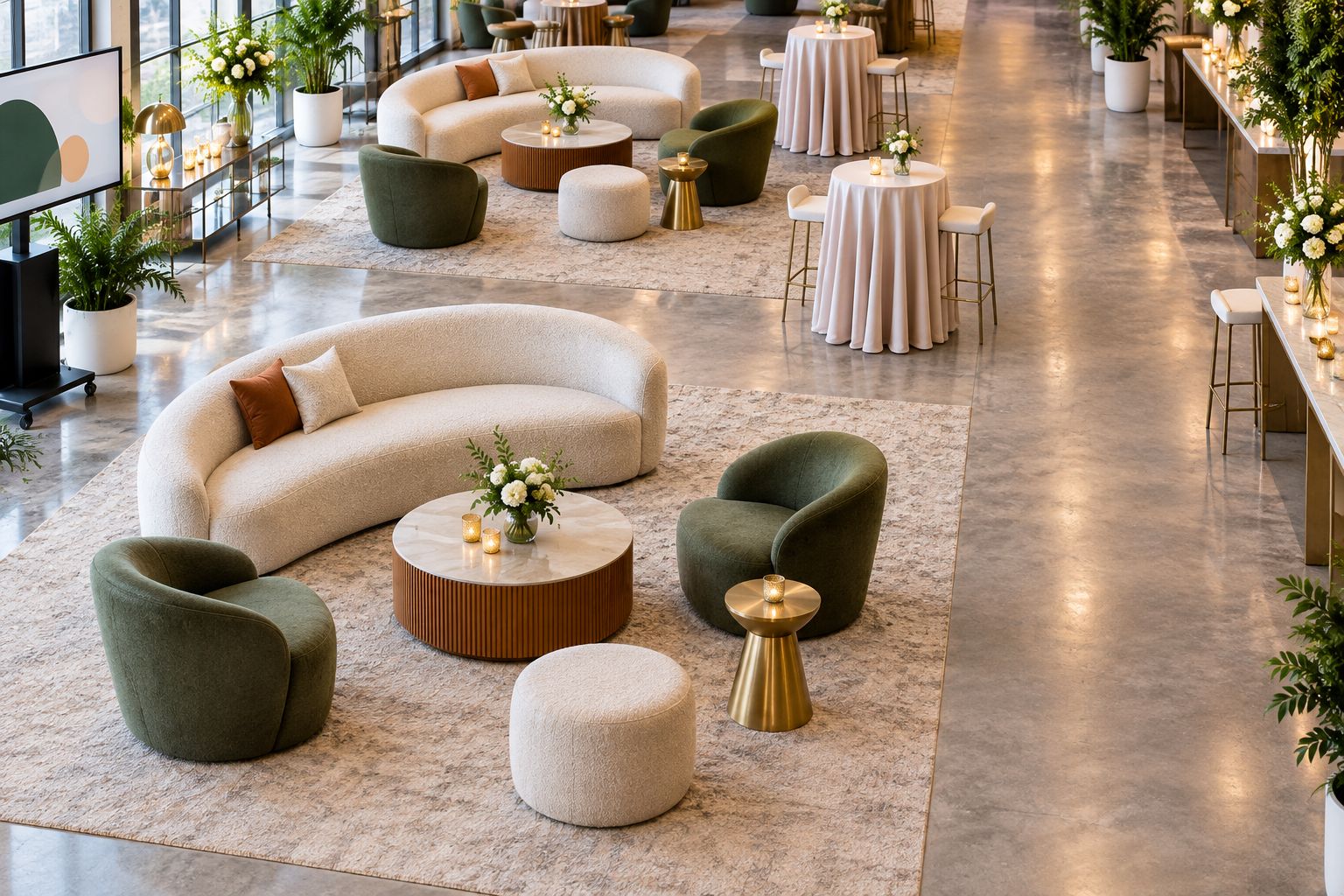 Plan the route around the seating group before adding decorative pieces.
Decide what to own and what to rent
Compare ownership with rental on a spreadsheet. Record the intended events, storage arrangements, transport responsibilities, cleaning requirements, and repair process. Ownership is a commitment to the furniture between events, not just during them.
Buy when a piece fits a recurring brief and you have a workable handling plan. Rent when the furniture requirement changes with the venue or theme. A mixed approach lets you keep a consistent visual anchor while sourcing event-specific pieces separately.
Sohnne’s mid-century modern furniture is a purchase option, not an event-rental service established by this guide. Customization is available, but confirm the options and timing for the specific piece before building them into a client proposal.
- List confirmed repeat uses rather than hypothetical bookings.
- Assign responsibility for storage and transport.
- Document who handles cleaning and repairs.
- Compare complete scope, including collection and setup responsibilities.
- Keep event-specific pieces separate from core inventory.
Test comfort and request material documentation
Assess a sample in person where possible. If you cannot inspect it, request dimensions, close-up photographs, care instructions, and answers to your venue’s material questions. Appearance is evidence of appearance—not evidence of load capacity, cleanability, or commercial suitability.
Use 2 seated tests for lounge seating: a short conversation test and a sit-to-stand test. These are planning checks, not certifications. Ask a colleague to hold a drink or bag during the test so you can see whether the surrounding surfaces work.
For your 2026 booking sheet, distinguish confirmed facts from unanswered questions. Do not describe upholstery as stain-resistant, flame-rated, or suitable outdoors without documentation that supports the claim.
- Request the intended-use statement for the selected piece.
- Check seat height, depth, back support, and arm access.
- Read the manufacturer’s cleaning instructions.
- Ask the venue which material documents it requires.
- Confirm whether placement restrictions apply.
Build a restrained visual palette
Start with the venue’s fixed finishes and the client’s event identity. Then choose a dominant furniture shape and a supporting material palette. Curved upholstery can soften a rectilinear room; exposed wood can add warmth without requiring more decoration.
Use 3 material cues as a starting limit, not a design rule: upholstery, wood, and metal. Repeat these cues across the lounge rather than introduce an unrelated finish at every seat. This gives the setting a clear visual rhythm.
Inspect samples under the event lighting. A texture that looks quiet in daylight can look pronounced under directional light, while reflective surfaces need checking from the photographer’s likely angles. Leave room for signage and people in the composition.
- Match furniture finishes to the venue’s fixed materials.
- Repeat a limited set of colors and textures.
- Check upholstery samples under planned lighting.
- View the layout from the camera position.
- Keep branding visible without crowding guest surfaces.
Plan handling, setup, and care
Write a handling sheet using the selected furniture’s instructions. Identify lifting points, removable components, protective packing, assembly needs, and any tools required. Do not assume that an upholstered chair can be stacked or that a sofa can be lifted by its arms.
Assign each furniture group a setup location on the floor plan. Record condition before transport and after installation. Photographs help your crew distinguish existing marks from damage discovered during handling.
Sohnne offers a stated 5-year warranty, but warranty coverage is not proof that repeated event transport or a particular commercial application is covered. Read the applicable terms and confirm your intended use before relying on coverage.
- Copy handling instructions into the crew brief.
- Label components and their assigned setup locations.
- Photograph condition before loading and after placement.
- Protect furniture and venue surfaces during movement.
- Specify approved cleaning products and methods.
Approve the room from the guest’s perspective
Walk the finished layout before adding the final styling layer. Follow the arrival route, sit in the conversation groups, and check the path to dining or service areas. Judge the room as a guest, not only from the entrance photograph.
Keep 1 approved reference photograph for each seating group in the crew brief. Use it to communicate orientation and table placement, while keeping the scaled plan as the authority for location. Photographs do not replace measurements.
For repeat events in 2026, record practical observations after breakdown: which surfaces lacked space, which seats were difficult to approach, and which pieces complicated handling. Change the next plan based on these observations rather than adding more furniture by default.
- Walk arrival, service, and departure routes.
- Test reaching tables from the seats they serve.
- Check sightlines to signage and presentation areas.
- Confirm that décor does not obstruct usable surfaces.
- Record layout and handling changes for the next event.
Compare sourcing options for event lounge furniture
Choose the sourcing model before choosing the statement piece. The strongest option is the one that fits your repeat-use plan and your crew’s responsibilities. No single model removes the need to check dimensions, documentation, and venue acceptance.
| Option | Best for | Practical advantage | Key limitation |
|---|---|---|---|
| Owned furniture inventory | Recurring indoor events with a consistent brief | You control the visual palette and maintain condition records | You manage storage, transport, cleaning, and repairs |
| Event rental | One-off events or changing venue requirements | Furniture can be selected around the individual event | Selection and service scope depend on the rental agreement |
| Mixed sourcing | Planners using a recurring lounge concept across different briefs | Owned anchor pieces can work with event-specific seating and tables | Separate suppliers require coordinated dimensions and responsibilities |
These are sourcing choices, not quality rankings. Owned furniture needs an operating plan; rental needs a clear service agreement; mixed sourcing needs disciplined coordination. Check the terms of each arrangement rather than assuming setup, collection, or maintenance is included.
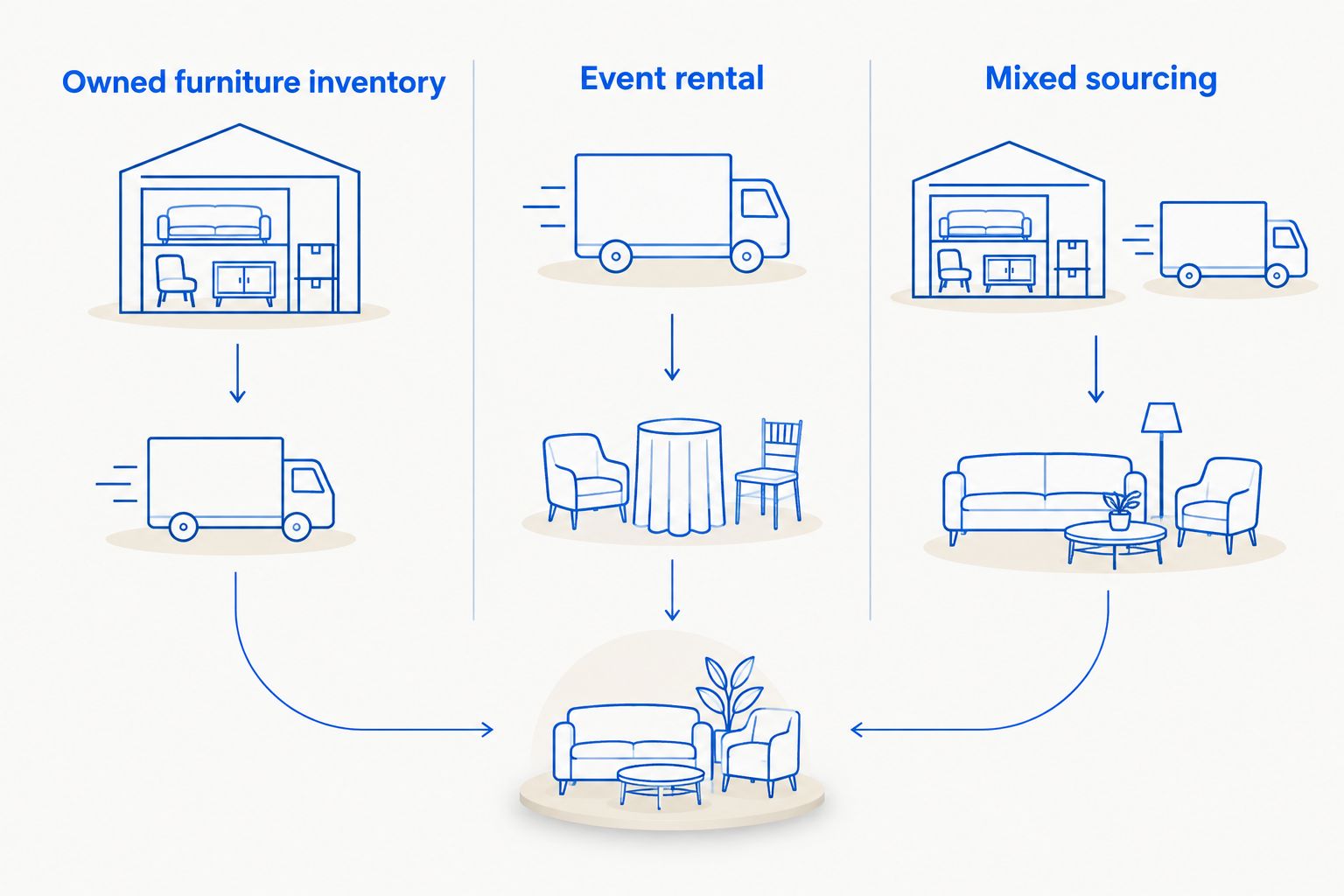 Choose the sourcing model that matches your repeat use and handling responsibilities.
Common mistakes event planners make
Approving furniture from a mood board alone
A mood board establishes direction, not fit. Attach dimensions, intended use, care instructions, and access checks to every shortlisted piece. Reject selections that remain operationally undefined, even when the photograph fits the brief.
Treating every seat as interchangeable
Dining, conversation, and waiting require different furniture relationships. Test the seat with its intended table and activity. Include seating that guests can approach and rise from comfortably rather than filling the room with one low silhouette.
Applying indoor furniture to exposed settings
An attractive terrace photograph does not establish weather suitability. Confirm the manufacturer’s intended environment and the venue’s requirements. Keep indoor-only pieces indoors; a temporary cover does not change their documented use.
Leaving condition checks until breakdown
Record condition before loading, after setup, and after the event. Make care responsibilities explicit in your 2026 event brief. Without a shared record, your team lacks a clear reference when marks or handling damage are discovered.
Buying without a storage plan
A recurring visual concept is not enough to justify ownership. Identify where furniture stays, how it is protected, and who retrieves it. If these responsibilities remain unresolved, rental keeps the sourcing decision tied to the individual event.
FAQ
What is designer style furniture for event planners?
Designer style furniture for event planners is seating, tables, and lighting chosen to support an event’s visual identity and guest activities. Select it by actual dimensions, intended use, comfort, care requirements, and venue acceptance—not appearance alone.
Is it better to buy or rent furniture for an event lounge?
Buy for confirmed repeat use when storage, transport, and maintenance are organized; rent for one-off events or changing briefs. Mixed sourcing suits planners who want recurring anchor pieces alongside event-specific furniture.
Is Sohnne suitable for event planners?
Sohnne suits event planners purchasing mid-century modern furniture for reusable indoor lounge settings. The retailer serves trade clients, but confirm each selected piece’s intended use, handling requirements, and applicable terms before committing it to an event.
Can I use indoor lounge furniture at an outdoor event?
Use indoor lounge furniture outdoors only when the manufacturer explicitly approves that environment. Check the selected piece’s documentation and the venue’s conditions; shelter alone does not establish outdoor suitability.
What should I measure before ordering event furniture?
Measure the furniture area and the complete delivery route, including doors, elevators, turns, and staging space. Add actual furniture footprints to a scaled plan and ask the venue to approve circulation, service routes, and accessibility.
How do I choose upholstery for a busy event?
Choose upholstery with documented care instructions that fit the event’s cleaning plan. Request samples and any material documentation the venue requires, and do not assume stain resistance or commercial suitability from texture or appearance.
Does a furniture warranty cover event use?
A furniture warranty covers only the uses and conditions stated in its terms. Confirm the intended event application and handling arrangements with the seller before relying on warranty coverage.
One last thing
Inspect the lounge after placing the tables, not just after placing the seats. Guests need somewhere practical for a glass, a bag, or event materials. A visually balanced seating group can still be awkward to use when its supporting surfaces sit out of reach.
Before approving your 2026 layout, sit down with the objects your guests will carry. That simple check connects the design brief to the experience the furniture must support.
Related guides
- How to choose furniture scale for a room with high ceilings
- How to add texture to a neutral living room with furniture
- How to care for bouclé fabric furniture
Stay connected with us!
Keep in touch with what’s new and next. Subscribe for weekly insights, product launches, and community news!