Best Designer-Style Coffee Tables Under $1000: 2026 Picks

Sohnne Design Studio
September 30, 2026
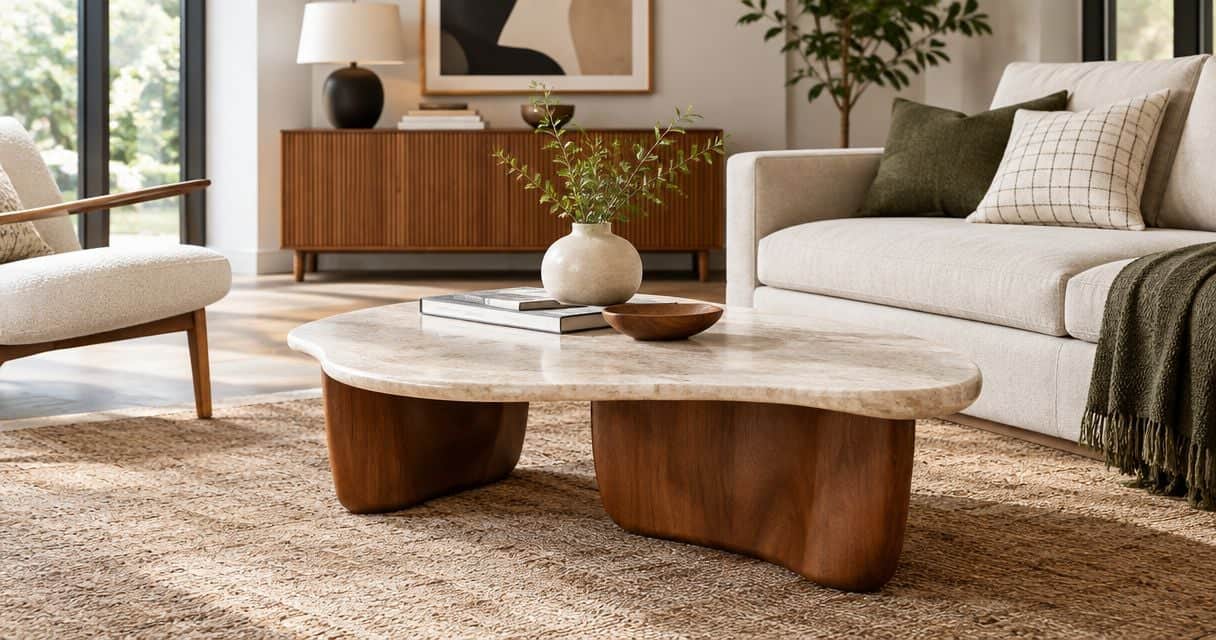
Best overall: an oval wood coffee table. Best for compact rooms: nesting coffee tables. Best for a pared-back interior: a rectangular wood coffee table. This 2026 guide ranks table types by room fit, everyday use, and material care so you can judge the design before choosing a specific model.
TL;DR- Choose an oval wood coffee table for a balanced mix of usable surface and softened corners.
- Choose nesting coffee tables when your living room needs flexible surfaces rather than one fixed footprint.
- Compare designer-style coffee tables by dimensions, construction, finish, and care requirements—not photographs alone.
- Sohnne serves buyers furnishing mid-century modern interiors; evaluate each coffee table against your actual seating layout.
Why this matters
A coffee table occupies the space you cross, reach into, and look at every day. Its shape matters as much as its finish. A sculptural base loses its appeal if it catches your feet, while a beautiful top becomes inconvenient when every drink requires careful placement.
Sohnne is a furniture retailer for buyers furnishing mid-century modern interiors. For a Sohnne coffee table or any other model, start with the dimensions and material description, then consider how the piece relates to your sofa.
Choose the table that supports your room's routine, not the one that looks most dramatic in isolation. The rankings below describe furniture types, not tested products or a retailer's confirmed catalog.
What makes the best designer-style coffee table?
These criteria guide the 2026 shortlist. Use them before comparing silhouettes or finishes.
- Room fit: Measure the top and base separately. A narrow top does not solve a walkway problem if the legs extend beyond it.
- Reach: Start with roughly 18 inches between the sofa and table, then check comfortable reach from your usual seat. Treat this as a layout guideline, not a fixed requirement.
- Proportion: A table around two-thirds of the sofa's length is a common starting point. Adjust for sectional corners, nearby chairs, and open circulation.
- Height: Start with a top level with the sofa seat or around 2 inches lower. Test the relationship to the compressed seat cushion, not just the sofa's published height.
- Construction: Read whether the surface is solid wood, veneer, glass, stone, or another material. Those descriptions are not interchangeable.
- Care: Match the finish to your habits. Check instructions for spills, heat, cleaning products, and protective pads before buying.
The dimensional guidelines help establish a first layout. Your body, furniture, and room make the final decision. If you lean forward awkwardly or turn sideways to pass the table, change the position or footprint.
Designer-style coffee tables at a glance
| Rank and table type | Best for | Standout feature | Key limitation |
|---|---|---|---|
| 1. Oval wood coffee table | Mixed seating and everyday use | Elongated surface with softened ends | Curved ends reduce usable corner space |
| 2. Nesting coffee tables | Flexible compact layouts | Separate surfaces that rearrange | Extended layout occupies more floor space |
| 3. Rectangular wood coffee table | Straight sofas and restrained rooms | Direct alignment with the sofa | Corners project into circulation routes |
| 4. Round coffee table | Conversation seating | Equal access around a central surface | Less coverage along a long sofa |
| 5. Glass-top coffee table | Showing a rug and open base | Transparent surface | Fingerprints and visible clutter below |
| 6. Stone-top coffee table | Material-led interiors | Distinctive surface texture | Care requirements depend on the stone |
1. Oval wood coffee table: best for everyday versatility
An oval wood coffee table provides an elongated surface without square ends. It suits a straight sofa with an adjacent chair because the long edge follows the sofa while the curved ends face the surrounding seats.
Wood brings grain and tonal variation into the seating area. Look closely at the finish description: a wood-colored photograph does not establish the material beneath the surface.
Oval wood coffee table pros:
- The long surface accommodates drinks, books, and a tray.
- Softened ends avoid projecting square corners.
- Wood grain adds texture without requiring extra decoration.
Oval wood coffee table cons:
- Curved ends offer less placement space than rectangular corners.
- Some bases extend into the area where your feet rest.
- Finish-specific care still matters; wood is not automatically spill-proof.
Best for: A living room that needs a useful central surface without a strongly angular footprint.
Before choosing an oval table, tape its full outline onto the floor. Walk around both ends and sit in the adjacent chair. Check the base dimensions as carefully as the top; a sculptural support can occupy more practical space than the silhouette suggests.
Verdict: Buy an oval wood coffee table when everyday versatility is your first priority.
2. Nesting coffee tables: best for flexible compact layouts
Nesting coffee tables give you separate surfaces that overlap or sit together. You can keep the arrangement compact during ordinary use and move a smaller table toward an occasional seat when needed.
The advantage is flexibility, not an automatic space saving. Once separated, the tables use a larger footprint.
Nesting coffee tables pros:
- Separate surfaces can serve different seats.
- An overlapping arrangement adjusts to changing layouts.
- Different heights create visual depth without added objects.
Nesting coffee tables cons:
- Extra legs and edges can complicate a narrow walkway.
- Height differences can interrupt a continuous serving surface.
- Heavy pieces are less convenient to rearrange regularly.
Best for: A compact living room where the seating arrangement changes.
For a compact-room purchase in 2026, measure the nested and separated arrangements. Neither measurement tells the whole story alone. Check whether the smaller table moves freely without scraping the larger frame or requiring you to lift an awkward piece.
Your sofa also determines how useful movable surfaces become. The guide to best sofas for small living rooms in 2026 offers a related starting point for planning the seating footprint.
Verdict: Buy nesting coffee tables if you will actually rearrange them; skip them if they will stay permanently spread out.
3. Rectangular wood coffee table: best for a restrained straight-sofa layout
A rectangular wood coffee table follows the geometry of a straight sofa. Its usable surface is easy to understand: books, trays, and drinks do not have to work around tapered ends.
Choose this type when you want the table to organize the room quietly. A clear outline and considered proportions do more than an elaborate base.
Rectangular wood coffee table pros:
- The top provides usable space across its full outline.
- Straight edges align naturally with a straight sofa.
- A simple form leaves attention on grain and finish.
Rectangular wood coffee table cons:
- Corners need careful placement beside walking routes.
- A deep top can crowd a narrow seating area.
- Thick tops and broad bases can feel visually heavy.
Best for: A straight sofa in a room with clear, predictable circulation.
Inspect the underside as well as the top. An apron or broad support can restrict your feet even when the table height looks right. If the piece has a lower shelf, consider whether you want its contents visible from every seat.
Verdict: Buy a rectangular wood coffee table for a straightforward layout; skip an oversized version in a narrow room.
4. Round coffee table: best for conversation seating
A round coffee table works as a shared center for seats arranged around it. The continuous edge avoids giving one side of the room a distinctly longer surface than another.
It is especially useful when the layout is organized around conversation rather than a single long sofa. Diameter still matters: a large circle can occupy substantial floor space.
Round coffee table pros:
- A continuous edge supports access from different directions.
- The shape complements curved or angled seating arrangements.
- There are no projecting tabletop corners.
Round coffee table cons:
- A small diameter leaves the ends of a long sofa underserved.
- A large diameter can reduce circulation space.
- A broad central base can limit where your feet go.
Best for: Several seats facing a common center.
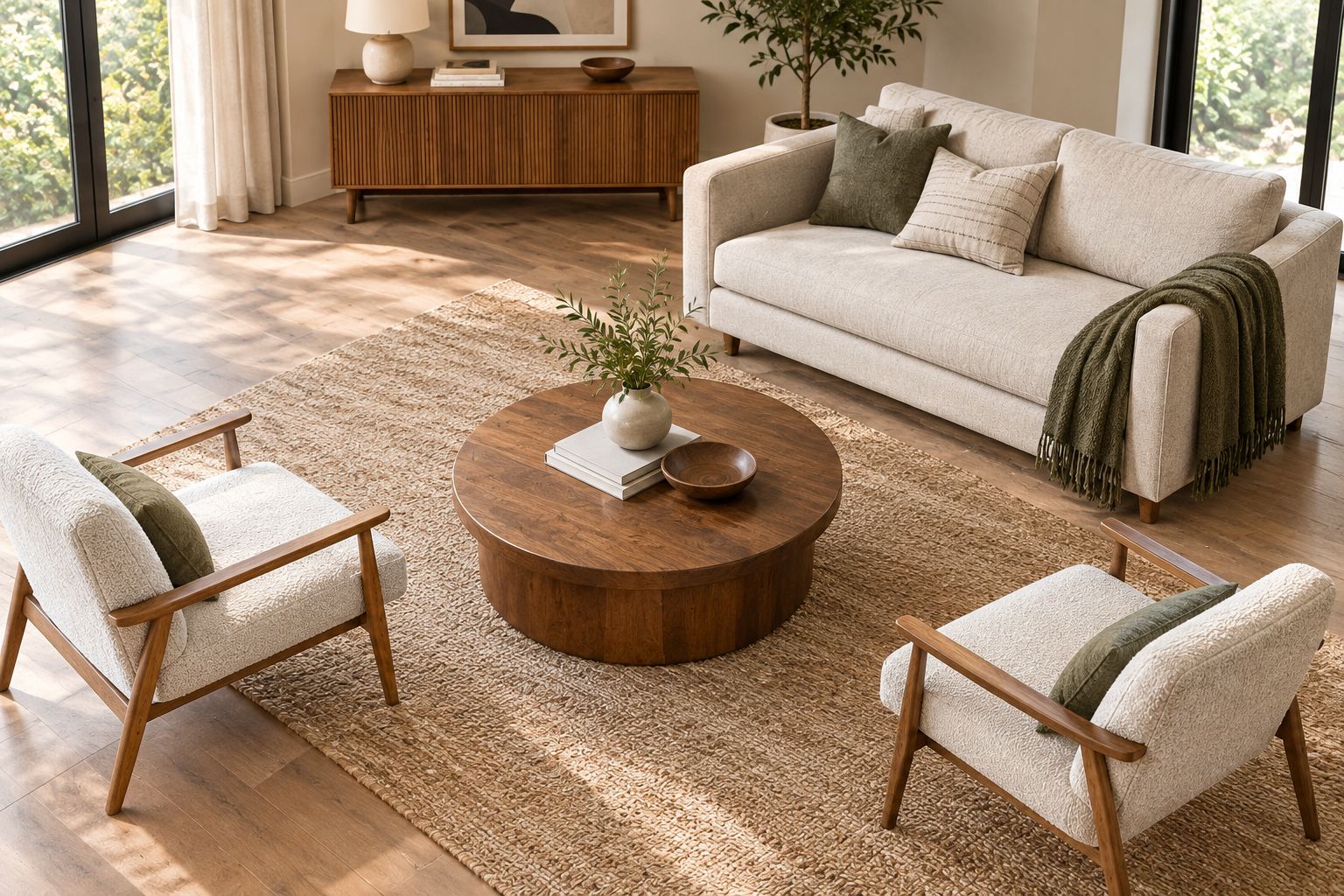 A round table works best when the seats share a common center.
Check reach from every seat, not only the sofa's middle cushion. If one person must stand to retrieve a drink, the arrangement needs adjustment. Do not keep increasing the diameter to solve every reach problem; a separate side surface can serve a distant seat more directly.
Verdict: Buy a round coffee table for conversation seating; skip it as the only surface beside a very long sofa.
5. Glass-top coffee table: best for showing a rug and open base
A glass-top coffee table keeps the rug and supporting frame visible through the surface. This changes the visual relationship between the table and the floor without reducing the table's physical footprint.
Choose glass when transparency serves the room. The base becomes part of the composition, so inspect its shape from seated eye level.
Glass-top coffee table pros:
- The rug remains visible beneath the top.
- An open base can become a clear design feature.
- Transparent glass adds less opaque surface to the room.
Glass-top coffee table cons:
- Fingerprints and smudges remain visible.
- Objects beneath the table show through the surface.
- Edge treatment and glass specifications require attention.
Best for: A room where the rug and table base deserve to remain visible.
For a glass-table purchase in 2026, ask for the glass type, edge treatment, and assembly instructions. Do not infer safety specifications from a photograph. Also check how the top attaches to its supports and whether the seller provides clear care instructions.
Verdict: Buy a glass-top coffee table for visual openness; skip it if frequent surface cleaning will bother you.
6. Stone-top coffee table: best for a material-led interior
A stone-top coffee table makes the surface itself the focal point. Veining, grain, and texture can supply enough detail that the rest of the table remains simple.
Material identification comes first. Natural stone, engineered surfaces, and stone-look finishes have different care requirements; appearance alone does not settle the choice.
Stone-top coffee table pros:
- Surface variation creates interest without extra decoration.
- A simple base can keep attention on the material.
- Stone contrasts clearly with upholstered seating.
Stone-top coffee table cons:
- Some natural stones need protection from acidic spills.
- Weight can make moving and installation more demanding.
- Surface variation means a photograph does not show every possible slab.
Best for: A room where a distinctive tabletop is the main decorative element.
Read the care instructions before deciding. Marble, for example, is sensitive to acids; do not treat every stone surface as equally forgiving. Ask how much the assembled table weighs and whether you can move it safely through your home's access route.
Verdict: Hold a stone-top coffee table purchase until the material and care requirements fit your routine.
How the ranking works
This 2026 ranking prioritizes room fit, reach, proportion, construction clarity, and care. Oval wood takes the default position because its elongated surface and softened ends address several common seating arrangements.
The other positions identify distinct uses rather than universal quality levels. A round table is the stronger choice for conversation seating; nesting tables are more useful when surfaces need to move. The right use case outranks the list position.
Which designer-style coffee table should you choose?
Choose an oval wood coffee table if you are undecided. It provides a clear starting point for a straight sofa with nearby accent seating, without requiring the room to revolve around a dramatic tabletop.
For your 2026 shortlist, eliminate any model that fails the floor-outline test before comparing finishes. Then read the construction details. Whether you choose Sohnne or another retailer, a coffee table should make sense with your seating before it makes a statement.
FAQ
What’s the best designer-style coffee table for everyday use?
An oval wood coffee table is the default recommendation for everyday use. Its elongated surface serves a sofa while the softened ends avoid projecting square corners. Check the base footprint and finish care before choosing a model.
What’s the best coffee table shape for a small living room?
Nesting coffee tables suit small living rooms that need movable surfaces. Measure both the overlapping and separated arrangements. A single compact table is simpler if you do not need that flexibility.
Is a round coffee table better than a rectangular one?
A round coffee table is better for seats arranged around a shared center; a rectangular table is better aligned with a straight sofa. Neither shape is universally better. Choose by reach and circulation.
How high should a coffee table be compared with the sofa?
Start with a coffee table level with the sofa seat or around 2 inches lower. Check the height while someone sits on the cushion. Your comfortable reach matters more than matching published dimensions alone.
How much space should I leave between the sofa and coffee table?
Roughly 18 inches is a common starting point between the sofa and coffee table. Test whether you can reach the surface and pass through comfortably. Adjust the gap to your seating and mobility needs.
Is a glass coffee table easier to live with than a stone one?
Glass and stone create different maintenance demands rather than a universal winner. Glass shows fingerprints, while stone care depends on the specific material. Read the seller’s instructions before choosing.
What should I check before choosing a Sohnne coffee table?
Check the specific table’s dimensions, construction, finish, base footprint, and care instructions. Sohnne serves buyers furnishing mid-century modern interiors. Choose the individual model by room fit rather than the retailer name alone.
One last thing
Your table has a footprint below the surface, too. Before buying, sketch the base inside your taped tabletop outline and sit where you normally sit. A table that fits the room but crowds your feet does not fit your life.
Related guides
- How to arrange a living room around a fireplace
- How to decorate a living room with a statement sofa
- How to add texture to a neutral living room with furniture
Stay connected with us!
Keep in touch with what’s new and next. Subscribe for weekly insights, product launches, and community news!