Best custom modular sofas in 2026
Sohnne Design Studio
November 25, 2026
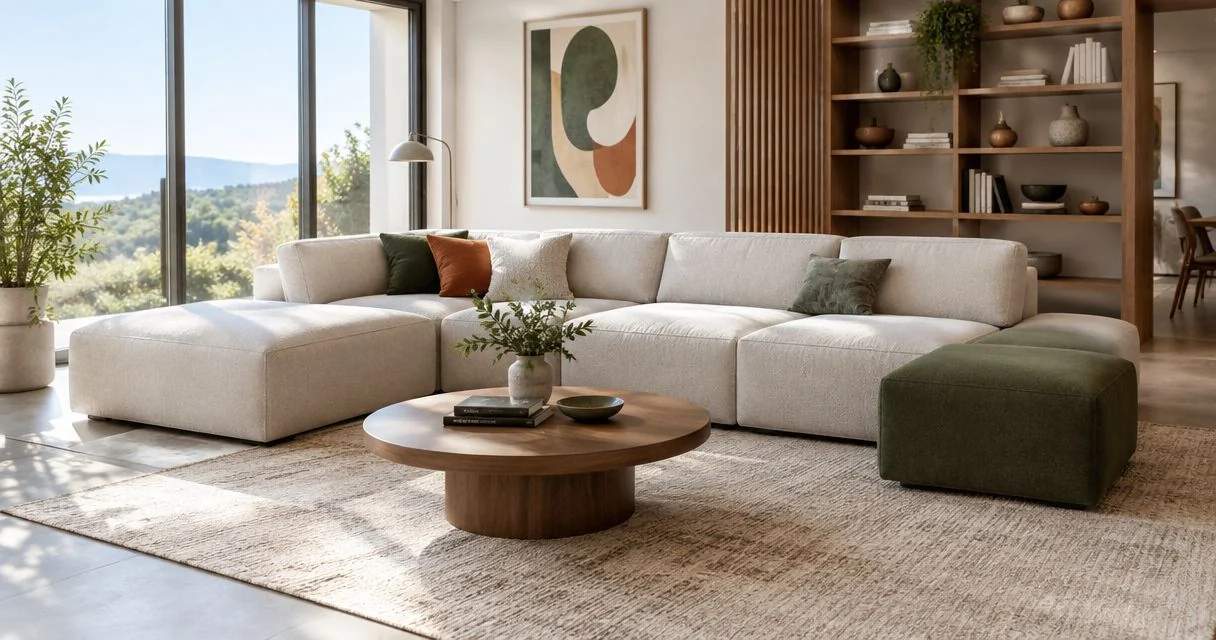
Best overall: a straight modular sofa with a movable ottoman. Best for a dedicated lounging corner: a reversible-chaise configuration. Best for a narrow room: a compact straight configuration. This 2026 custom modular sofa guide ranks layouts by how you sit, move, and use the room—not by appearance alone.
TL;DR- A straight custom modular sofa with a movable ottoman is the default for flexible living room seating.
- Choose a reversible chaise for lounging; choose a corner sectional when the room supports a permanent return.
- Sohnne offers furniture customization; confirm the exact module, upholstery, and connector options for your selected sofa.
- Measure the delivery route and each separate module before approving a sectional layout.
Why this matters
A custom modular sofa needs to solve two different problems: fitting your room and supporting the way you sit. A beautiful arrangement still fails if the return blocks a doorway or the seat feels wrong for everyday use.
Customization and modular construction are not interchangeable. Customization concerns choices such as upholstery or dimensions; modular construction concerns separate sections that form an arrangement. Confirm both before treating a sofa as adaptable.
Sohnne suits buyers seeking mid-century modern furniture with customization options. For a custom modular sofa inquiry, ask Sohnne which choices apply to the exact piece you are considering. Start with the room, using this guide to measure before buying a modular sofa.
What makes the best custom modular sofa
Use these criteria to compare a custom modular sofa in 2026. A long upholstery menu does not compensate for an awkward footprint.
- Room fit: The full arrangement must leave your doors, circulation routes, and everyday furniture usable.
- Module flexibility: Check which sections can change position and which depend on a particular arm, back, or connector.
- Seated comfort: Compare usable seat depth, back support, and ease of standing—not just overall dimensions.
- Upholstery suitability: Request a sample and the exact cleaning instructions for the selected fabric.
- Connection and care: Ask how sections attach, how cushions are maintained, and whether individual components can be serviced.
- Delivery fit: Check packaged dimensions and the route from the building entrance to the final position.
Treat these as approval conditions. If a configuration blocks the route you use every morning, remove it from the shortlist before choosing a color.
Custom modular sofa configurations at a glance
The ranking below compares layouts, not named products. Each configuration earns a different role, so you can choose by room use rather than assume that a larger sectional is better.
| Rank and configuration | Best for | Standout feature | Key limitation |
|---|---|---|---|
| 1. Straight sofa with movable ottoman | Flexible everyday use | Separate footrest position | Ottoman needs its own floor space |
| 2. Reversible-chaise configuration | Dedicated lounging | Changeable lounging side, when supported | Reversal depends on the actual construction |
| 3. Corner sectional | A defined seating zone | Seating that turns a corner | Return fixes more of the room layout |
| 4. U-shaped configuration | A large gathering area | Seating on multiple sides | Broad footprint and more complex access |
| 5. Compact straight configuration | Narrow living rooms | Linear footprint without a projecting return | No integrated stretch-out section |
1. Straight sofa with movable ottoman: best for everyday flexibility
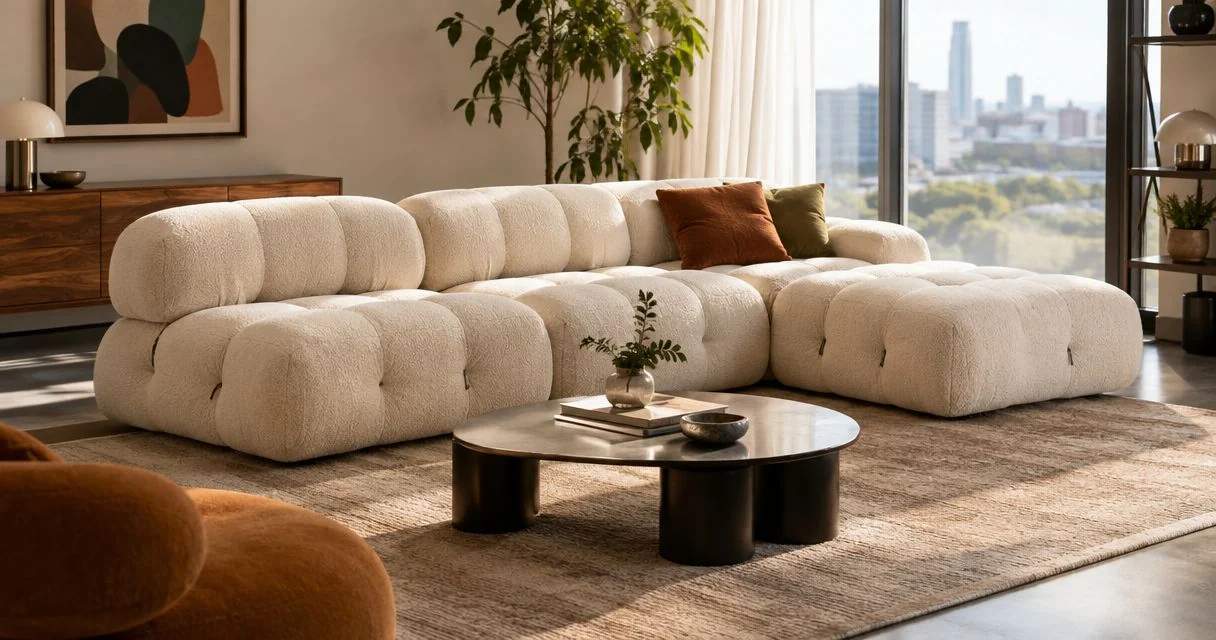
A straight modular sofa with a separate ottoman keeps the main seating line simple. You can position the footrest where you want to lounge, then move it out of the way when the room needs a different arrangement.
This is the default recommendation because it separates lounging from the sofa's permanent footprint. The benefit depends on choosing an ottoman that you can comfortably move and accommodate elsewhere.
Straight sofa with movable ottoman pros:
- Keeps the main seating arrangement linear.
- Lets you change the footrest position independently.
- Leaves the option of removing the ottoman from the seating area.
Straight sofa with movable ottoman cons:
- Requires a resting place for the ottoman when it is not in use.
- A loose ottoman does not form a connected chaise unless specifically designed to do so.
- Adds another object around which you must plan circulation.
Best for: You use the same room for conversation, reading, and occasional feet-up lounging.
Before ordering, compare the ottoman height with the sofa's usable seat height. Ask whether the ottoman is intended for seating before counting it as a guest seat.
Verdict: Buy this configuration when flexibility matters more than a continuous lounging surface.
2. Reversible-chaise configuration: best for a dedicated lounging corner
A reversible-chaise configuration gives you a projecting section for stretching out, with the ability to change sides when the design supports it. That distinction matters: a sectional assembled from modules is not automatically reversible.
For a 2026 purchase, request a drawing showing both arrangements. The drawing should identify the pieces that move, including any arm, back, cushion, or connecting hardware.
Reversible-chaise configuration pros:
- Provides a defined place to put your feet up.
- Supports more than one room orientation when genuinely reversible.
- Creates a clear lounging zone without a full corner arrangement.
Reversible-chaise configuration cons:
- The projecting section takes space from the room's circulation area.
- Changing sides can involve more than moving a cushion.
- One person's preferred lounging position can conflict with another person's access.
Best for: You regularly lounge on the sofa but want the option to change its orientation.
Check the chaise in both positions against door swings, curtains, and nearby furniture. Reversibility is useful only if the alternative arrangement also works in your room.
Verdict: Buy after the seller confirms the reversal method; hold if the description is unclear.
3. Corner sectional: best for a defined seating zone
A corner sectional joins seating along adjacent sides. It works as a deliberate room-planning element, whether it sits against walls or helps define a seating area within a larger space.
The corner changes how people sit and face one another. Judge it as a whole arrangement rather than adding up the apparent number of cushions.
Corner sectional pros:
- Brings adjacent seating runs into one arrangement.
- Defines the edge of a living area.
- Offers different sitting orientations within the same sofa.
Corner sectional cons:
- The return limits where the sofa can sit.
- Corner comfort depends on the specific back and cushion design.
- Access becomes awkward if the return closes the room's main entrance.
Best for: Your room has a stable seating zone with enough space for a return.
Mark the entire footprint on the floor, including the corner module. Then walk from every doorway to the seats you expect to use; do not assess the layout from a single viewing angle.
Verdict: Buy for a settled room plan; skip when the return interrupts your everyday route.
4. U-shaped configuration: best for a large gathering area
A U-shaped configuration places seating along multiple sides of a central area. It makes the sofa arrangement a major part of the room rather than a single object against a wall.
Choose this layout for how people gather, not simply because the floor plan can contain it. The open side, central table, and routes to the inner seats all need deliberate placement.
U-shaped configuration pros:
- Arranges seating around a shared central area.
- Provides several sitting orientations.
- Establishes a distinct gathering zone in a larger room.
U-shaped configuration cons:
- Occupies a broad area with projecting sections on both sides.
- Inner seats require careful access planning.
- A large central table can make the arrangement harder to enter.
Best for: You have a large living area dedicated to gathering and conversation.
Test the room with the table included. A sofa-only drawing hides the practical question: can someone reach an inner seat while other people remain seated?
Verdict: Buy only when the complete furniture plan preserves access; skip if the layout fills the room edge to edge.
5. Compact straight configuration: best for narrow living rooms
A compact straight configuration keeps all seating along a single line without a projecting chaise or corner return. Its strength is restraint: you retain more freedom to position other furniture across the room's width.
Compact does not necessarily mean shallow, upright, or easy to deliver. Check the actual dimensions rather than relying on the category name.
Compact straight configuration pros:
- Avoids a projecting return.
- Keeps the seating footprint straightforward to map.
- Lets you plan a separate chair or footrest independently.
Compact straight configuration cons:
- Does not provide an integrated chaise.
- Seating capacity remains limited by the chosen length.
- Oversized arms can consume space you intended for sitting.
Best for: Your living room is narrow, or the sofa shares space with dining or work furniture.
Compare usable seating width as well as overall width. A sofa can fit between two walls and still provide less sitting space than its exterior dimensions suggest.
Verdict: Buy when keeping the room open matters more than adding a lounging return.
Turn your preferred configuration into an order
Before approving a custom modular sofa in 2026, draw 2 layouts: your preferred arrangement and a practical alternative. This is a planning exercise, not a reason to order extra sections. It reveals whether the flexibility you want actually exists.
Follow this sequence before selecting upholstery:
- Measure room: Record walls, openings, fixed features, and the furniture that will stay.
- Map footprint: Mark the full arrangement, including arms, returns, and the ottoman.
- Check access: Walk the room and measure the delivery route, including turns and overhead restrictions.
- Confirm modules: Request a labeled drawing and the dimensions of every separate section.
- Approve fabric: Review a physical sample with the care instructions before authorizing your choice.
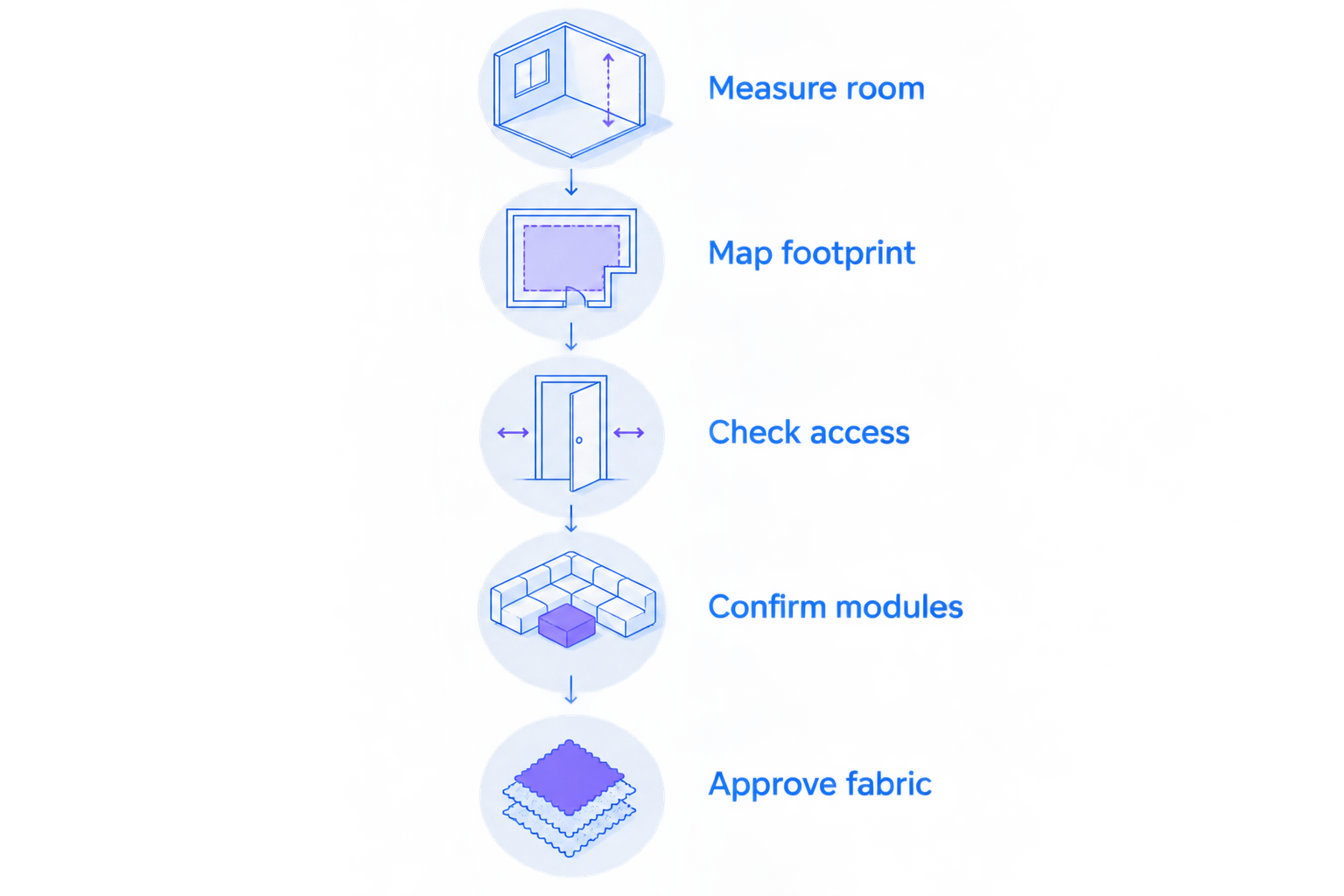 Confirm the room and module plan before committing to upholstery.
Keep the module drawing with your order confirmation. A room photograph communicates atmosphere; a labeled drawing records the arrangement you expect to receive.
Ask precise customization questions
For a Sohnne custom modular sofa inquiry, separate appearance choices from construction choices. Ask which fabrics, dimensions, module arrangements, and connecting methods apply to the selected piece rather than assuming that customization covers every feature.
Sohnne states a 60-day return period and a 5-year warranty. Confirm the terms that apply to a customized order before approving it, including what the warranty covers and how a return is handled.
- Which choices change the sofa's dimensions?
- Which modules can switch positions?
- Are covers removable, and what cleaning method is specified?
- What is the packaged size of each section?
- Does the order confirmation show the final orientation?
Confirm your sofa configuration
Ask which customization choices and module arrangements apply to your selected sofa.
Contact SohnneHow the configurations are ranked
This 2026 ranking prioritizes room fit, useful flexibility, and circulation before visual scale. It compares the practical consequences of each layout; it is not a durability test or a ranking of individual sofa models.
The straight sofa with a movable ottoman takes the default position because its footrest remains independent of the main seating line. The other configurations win when your room and sitting habits call for their particular shape.
Which custom modular sofa should you choose?
Choose a straight modular sofa with a movable ottoman unless you have a clear reason to commit floor space to a return. It gives you a simple starting point without making a chaise or corner the organizing feature of the room.
Choose the reversible chaise for regular lounging, the corner sectional for a defined seating zone, and the U-shaped arrangement for a dedicated gathering area. Choose the compact straight configuration when preserving the room's width is the priority.
FAQ
What’s the best custom modular sofa configuration for most rooms?
A straight modular sofa with a movable ottoman is the default recommendation for flexible everyday use. The separate ottoman lets you change the footrest position without changing the main seating line.
Is a custom sofa the same as a modular sofa?
No. A custom sofa offers specified choices, while a modular sofa consists of separate sections arranged together. Confirm both the customization options and the permitted module arrangements.
Can every modular sofa change from a left chaise to a right chaise?
No. Reversibility depends on the arms, backs, cushions, and connections of the particular design. Request drawings of both arrangements before relying on that feature.
What’s the best modular sofa layout for a narrow living room?
A compact straight configuration is the first layout to assess for a narrow living room. It avoids a projecting return, but you still need to check overall depth and the room’s walking route.
What should I measure before ordering a custom modular sofa?
Measure the room, the complete sofa footprint, and the delivery route. Compare those measurements with each module’s packaged dimensions, not only the assembled sofa size.
Does removable upholstery mean I can machine-wash it?
No. A removable cover still requires the cleaning method specified for its fabric and construction. Follow the care instructions rather than treating a zipper as permission to machine-wash.
What should I ask Sohnne about sofa customization?
Ask which upholstery, dimensions, module arrangements, and connections apply to your selected sofa. Confirm the final drawing and the terms for a customized order before approval.
One last thing
Do not test only whether you can sit down. Test whether you can stand up, reach a drink, walk past another seated person, and leave the room without moving furniture.
For your 2026 shortlist, that everyday sequence is the final filter. Choose the arrangement that works while the room is in use—not just while it is empty.
Related guides
- How to arrange a modular sofa in an L-shaped room
- How to pick the right sofa depth for deep-seat comfort
- Best modular sofas for families with young children
Stay connected with us!
Keep in touch with what’s new and next. Subscribe for weekly insights, product launches, and community news!