Can you assemble a Haller credenza without professional help?

Sohnne Design Studio
October 27, 2026
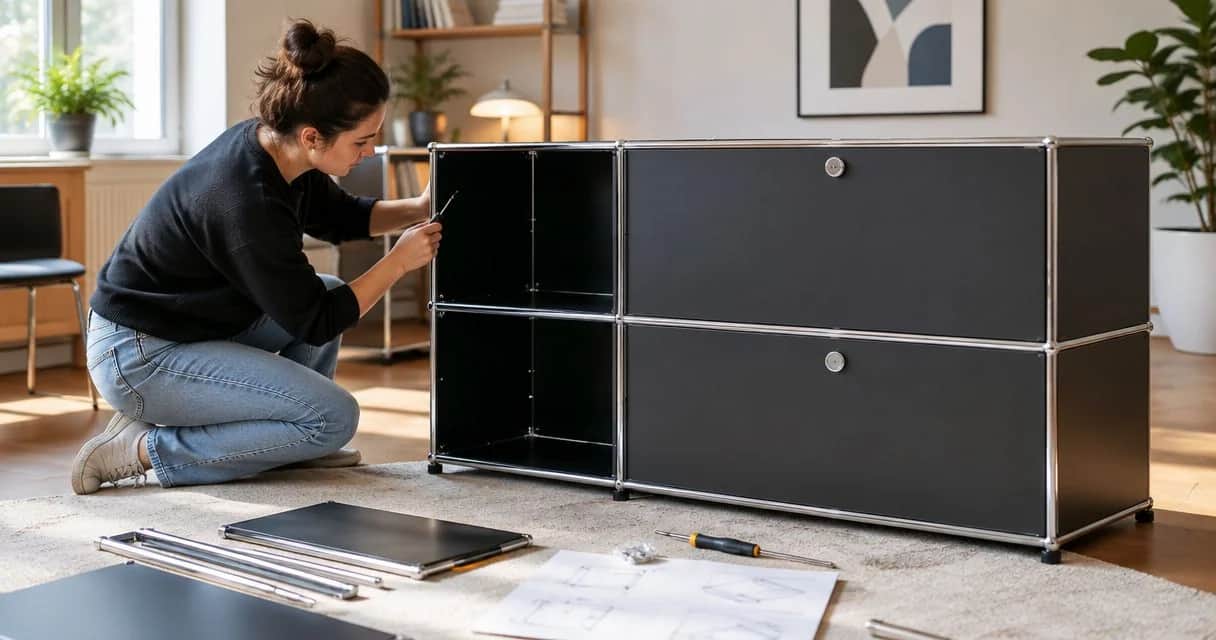
You can assemble a Haller credenza yourself only if the instructions for your exact unit permit owner assembly and you have the specified tools and handling support. If the instructions require a trained installer, or you cannot identify the connection method, use professional help rather than improvising.
TL;DR- Can you assemble a Haller credenza yourself? Follow the exact unit’s assembly instructions, not its appearance.
- Choose DIY only when the tools, connection method, and handling requirements are clear.
- A helper assists with handling; a qualified installer addresses unfamiliar construction.
- Sohnne furniture buyers should confirm assembly requirements before arranging delivery.
Can you assemble a Haller credenza yourself?
DIY is appropriate only when the supplied instructions support it. A product name or photograph does not establish which tools you need, how connections lock, or whether the cabinet arrives assembled.
For a 2026 purchase, request the assembly document before deciding who will install the credenza. Match that document to the exact configuration on your order, including any doors, drawers, shelves, or accessories listed.
The following comparison separates assembly knowledge from physical help. These are ways to approach the job, not claims about the construction of a particular cabinet.
| Approach | Best for | Advantage | Limitation | Decision rule |
|---|---|---|---|---|
| DIY assembly | Owners whose exact instructions permit self-assembly | You control the sequence and inspect each stage | You must understand every required operation | Proceed only with clear instructions and specified tools |
| DIY with a helper | Owner-assembly projects that require supported handling | A helper can support components while you work | Extra hands do not replace technical knowledge | Follow the manual’s handling requirements |
| Professional installation | Units requiring trained installation or unfamiliar connection work | You delegate the assembly task to someone with relevant experience | You must verify that experience and define the work | Confirm familiarity with the exact system before booking |
If you are furnishing a room through Sohnne, ask for assembly requirements alongside dimensions and delivery details. Treat those as separate questions: a cabinet fitting your room does not mean its installation suits your experience.
Why this matters
A finished credenza hides much of its construction. Clean panels and a regular frame tell you little about the order in which its components must be fitted or secured.
The useful distinction is not whether you are generally handy. It is whether you can complete the documented procedure without substituting tools, guessing at connections, or supporting more weight than you can safely control.
The assembly manual, not the cabinet’s appearance, decides whether DIY is appropriate. Make that your first check before opening packages or scheduling help.
Check these details before you start
Use this 2026 pre-assembly checklist to decide whether the project belongs on your floor or with an installer. It is a readiness check, not a replacement for the manufacturer’s assembly sequence.
Read instructions
Find the document that matches your exact unit. Check the model identification, configuration, component list, and any separate instructions for moving parts or accessories.
Read through to the end before beginning. A later step can explain why an earlier component must remain accessible, so do not treat the first page as enough information to start.
Match parts
Compare the supplied components with the illustrated inventory. Keep packaging labels and hardware identification together until you have accounted for everything the instructions list.
Stop if a component is missing, damaged, or difficult to identify. Do not assume that two similar-looking pieces are interchangeable or that an unexplained spare belongs inside a connection.
Confirm tools
Use the tool list in the exact instructions. Do not assume that a familiar-looking fitting accepts the same tool or tightening method as another piece of furniture.
If a tool is unfamiliar, resolve its purpose before proceeding. Avoid using powered tools unless the instructions expressly permit them; control matters more than speed when the connection method is uncertain.
Prepare space
Clear the assembly area and the route to the final position. Use a clean protective surface that does not hide small hardware or interfere with stable support.
Check that you can reach the required sides of the unit during assembly. Leave doors, walkways, and exits accessible rather than using every available patch of floor for unpacked parts.
Confirm handling
Follow the manual’s requirements for lifting, supporting, and turning components. Arrange help before reaching a step that you cannot safely perform alone.
A helper should know what to hold and when to release it. If neither person understands how a component is retained, adding another pair of hands does not resolve the uncertainty.
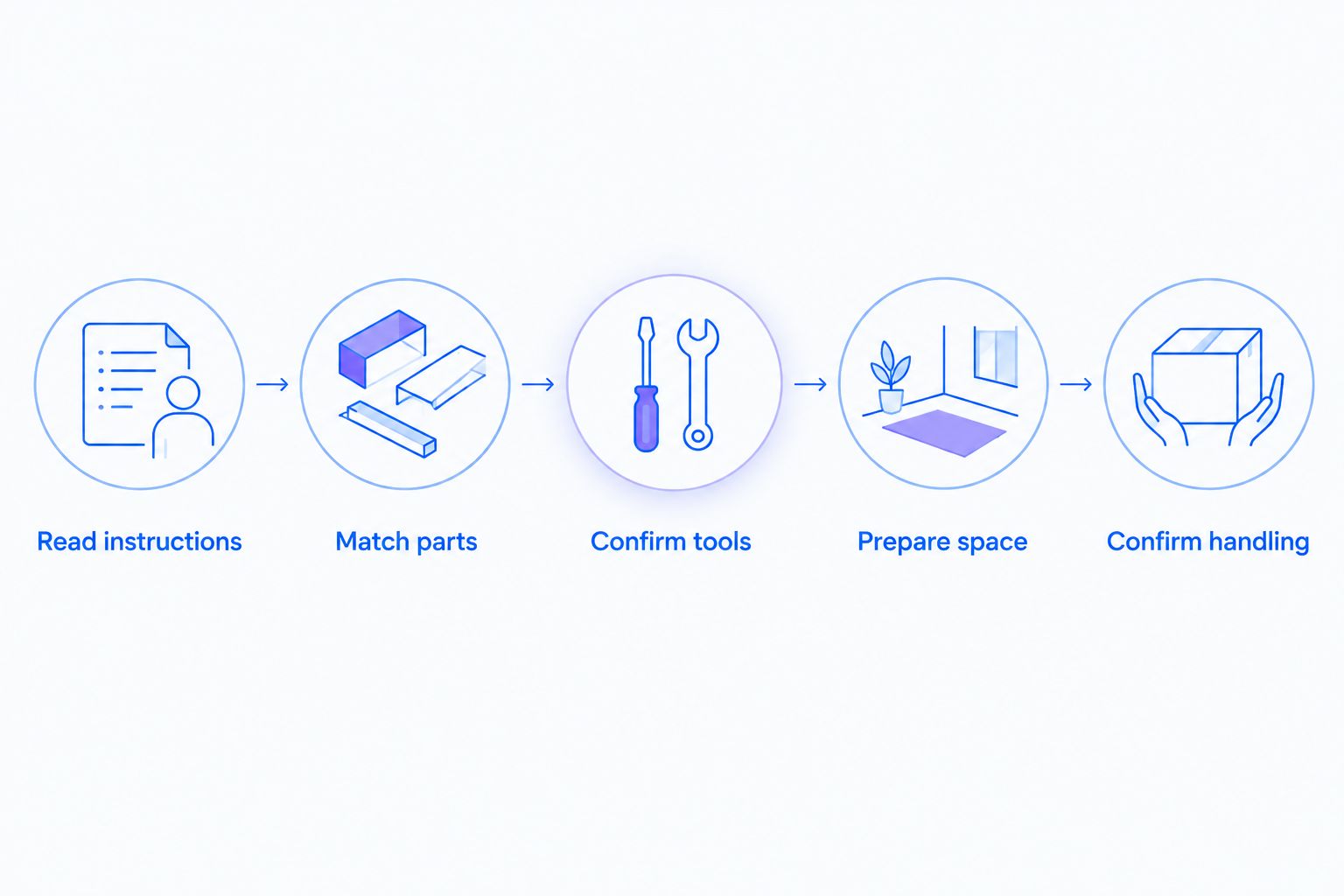 Confirm the assembly requirements before fitting the first component.
Finish this check before assembling anything. If one requirement remains unclear, ask the seller or manufacturer a precise question and wait for the answer.
Why Haller credenza assembly difficulty varies
Assess the actual unit rather than assigning every credenza the same difficulty level. These factors establish what you need to confirm; they do not establish specifications for an unidentified model.
- Delivery condition. Establish whether your order arrives assembled, partly assembled, or as separate components. The work you must perform depends on what remains unfinished.
- Connection method. Identify how the supplied components join and how the instructions confirm a secure connection. An unfamiliar method is a reason to seek clarification.
- Configuration. Match the assembly document to the shelves, doors, drawers, and accessories actually included. Do not borrow a sequence from a different arrangement.
- Required tools. Confirm that you have every specified tool and understand its use. Owning a general household toolkit does not establish compatibility.
- Handling requirements. Check the instructions for support, lifting, and positioning. Work within your ability to control each component safely.
- Final installation. Read any requirements for leveling, placement, restraints, or attachment before assembly begins. Follow those requirements exactly where applicable.
For a 2026 installation plan, settle these questions before choosing DIY or professional help. Confidence is useful only when it rests on a procedure you understand.
What should you ask the seller before assembly?
Ask whether the exact credenza is intended for customer assembly. Request a written answer and the corresponding instructions rather than relying on a general statement that the furniture is easy to build.
Keep your questions specific:
- What assembly remains after delivery?
- Which document matches the configuration on the order?
- Are all required assembly tools supplied, or must you obtain them separately?
- Does any operation require a trained installer?
- What support or lifting assistance do the instructions require?
- Who should you contact if a component does not match the parts list?
For a Sohnne furniture order, confirm these details against the actual order rather than treating this guide as a product-specific manual. A retailer’s general furniture offering does not establish the assembly requirements of an individual item.
Save the response with your order documents. If an installer will complete the work, send that person the same instructions before agreeing on the scope.
When should you stop and get professional help?
Stop when the next step requires a guess. That includes guessing which tool fits, how a connection releases, or whether a panel must be forced into position.
Pause if the instructions do not match the components in front of you. Record the relevant step and photograph the parts without altering them further, then request clarification from the seller or manufacturer.
Do not try to solve an unexplained fit problem by drilling, bending, filing, or adding hardware. Those actions are not substitutes for confirming the intended assembly method.
Seek qualified help if the documented procedure exceeds your handling ability or requires installation work you do not understand. Ask the installer to explain their experience with the exact construction, not simply with furniture in general.
A useful professional handoff includes the assembly document, configuration details, photographs of the current condition, and a clear description of where work stopped. Keep loose hardware identified so the next person does not inherit an additional sorting problem.
Does doing it yourself mean working alone?
No. DIY describes who takes responsibility for following the assembly procedure; it does not establish that every lifting or positioning task is suitable for one person.
Follow the handling instructions even if you can physically lift a component. Being able to raise something is different from being able to hold it steadily while aligning and securing a connection.
If a helper cannot make a step safe and controlled, stop. Professional installation is the appropriate choice when the task requires knowledge or equipment that neither of you has.
Can you use a general assembly video instead of the manual?
No. A general video does not replace the instructions for your exact credenza, particularly when the connection method or configuration differs.
Use a video only as supplementary material after verifying that it covers the same unit and agrees with the supplied documentation. Never copy a tool substitution or shortcut simply because it appears to work on screen.
For 2026 assembly research, prioritize current documentation supplied for your order. A familiar product name is not proof that another owner’s procedure applies to your cabinet.
What should you check before using the finished credenza?
Complete every final check specified in the instructions before loading the cabinet. Confirm that all required assembly and installation steps are finished rather than judging readiness from the exterior alone.
Inspect the unit for visible damage or unresolved connections. Where the instructions call for leveling, restraints, or attachment, complete those tasks before placing the credenza into service.
Check any doors and drawers according to the documented procedure. If a moving part catches or fails to operate as intended, stop and resolve the cause rather than using force or loading it to see whether it settles.
Keep the instructions and order information accessible after installation. They remain useful if you later need approved maintenance guidance or advice about moving the unit.
FAQ
Can you assemble a Haller credenza yourself without professional help?
You can assemble a Haller credenza yourself only when the instructions for your exact unit permit owner assembly and you can meet its tool and handling requirements. Use professional help if the procedure requires trained installation or remains unclear.
What tools do I need to assemble a Haller credenza?
Use the tools specified in the assembly instructions for your exact credenza. Do not assume that a standard household toolkit or a tool shown in another owner’s video is suitable.
Can I assemble the credenza alone?
Work alone only when the instructions and safe handling requirements allow it. Arrange assistance before any step that you cannot support and control safely.
Should I force a panel that will not fit?
Do not force a panel that will not fit as the instructions describe. Stop, verify the component and orientation, and ask the seller or manufacturer for guidance if the mismatch remains.
How long does Haller credenza assembly take?
Use the estimate supplied for your exact unit, if one is provided. Confirm the delivery condition and remaining assembly work before setting aside time or scheduling an installer.
Does buying from Sohnne mean a credenza arrives assembled?
Buying from Sohnne does not by itself establish an individual item’s assembly requirements. Confirm the delivery condition and installation instructions for the exact item on your order.
What should I ask a professional furniture installer?
Ask whether the installer has experience with the exact construction and can follow its assembly documentation. Share the configuration and define whether the job includes unpacking, assembly, positioning, and any required final installation work.
One last thing
Make the assembly decision before delivery, not after unpacking. For a 2026 furniture purchase, the most useful preparation is obtaining the exact instructions while you still have time to arrange tools, workspace, and suitable help.
A credenza that looks simple deserves the same documentation check as a more elaborate cabinet. If the procedure is clear and intended for owner assembly, follow it; if it is not, hand the work to someone qualified.
Related guides
- Furniture storage during a move
- Choosing furniture scale for a room with high ceilings
- Arranging furniture around an open staircase
Stay connected with us!
Keep in touch with what’s new and next. Subscribe for weekly insights, product launches, and community news!