Can an oversized lounge chair fit through a standard doorway?
Sohnne Design Studio
October 29, 2026
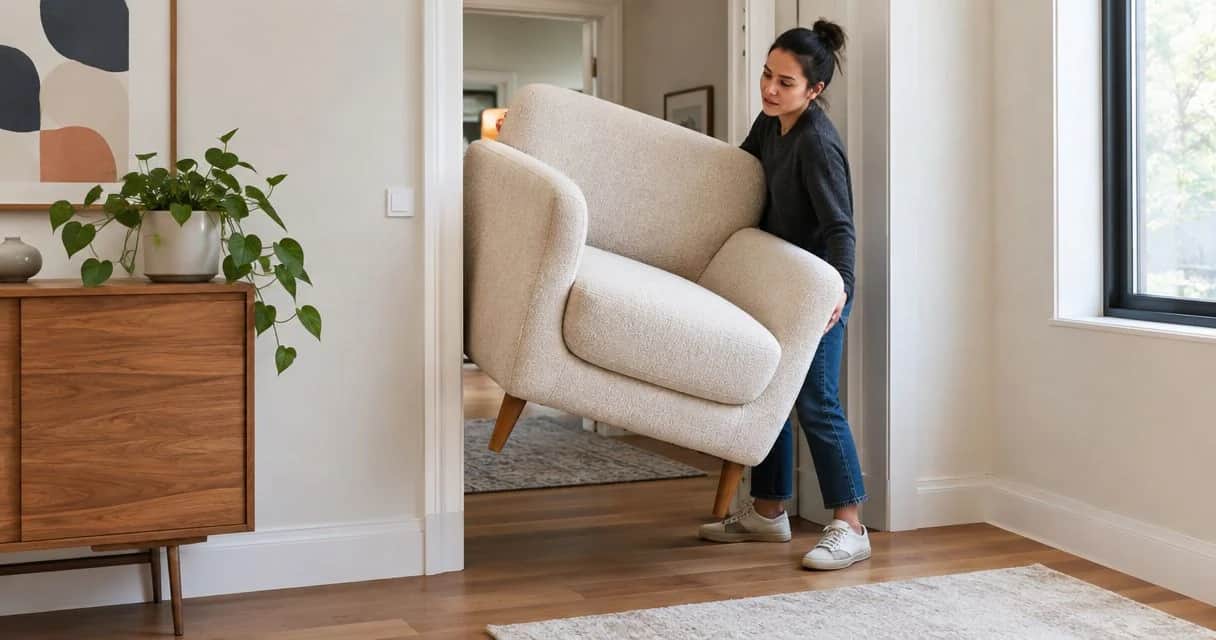
Yes—an oversized lounge chair can fit through a doorway if its rigid frame clears the actual opening in a workable orientation, with enough space to turn on both sides. The chair’s overall width alone does not settle the question: packaging, fixed arms, the back, and the approach through your hallway can determine whether it gets inside.
TL;DR- Will a lounge chair fit through doorway openings? Compare the rigid frame, clear opening, and turning space.
- A chair wider than the opening is not automatically ruled out; another orientation needs its own clearance check.
- Remove parts only when the manufacturer’s instructions permit it; loose cushions do not change a fixed frame.
- For a Sohnne lounge chair, confirm the specific dimensions and delivery configuration before ordering.
Why this matters
A lounge chair has to fit twice: through the delivery route and within the room. A generous seat can look beautifully proportioned beside a low table yet stop at a narrow vestibule. Check access before judging room placement.
For a 2026 furniture order, keep your access measurements alongside the chair specifications rather than in separate notes. When browsing Sohnne, treat the dimensions of the particular chair—not its appearance in a photograph—as the starting point.
Can an oversized lounge chair fit through a standard doorway?
An oversized lounge chair fits only when a verified orientation clears the opening and the complete approach. A doorway described as standard is not a measurement. Measure the usable gap with the door in the position it will occupy during delivery.
Start with the simplest route through the opening. More complicated handling introduces additional clearance checks; it does not erase the chair’s fixed dimensions.
| Entry method | Best for | What must clear | Advantage | Limitation |
|---|---|---|---|---|
| Upright entry | A direct approach with sufficient width | Chair width, height, and forward path | Easiest orientation to assess | Broad fixed arms can prevent passage |
| Sideways entry | A chair whose side profile is narrower | The complete side profile and turning area | Uses a different dimension across the opening | Back height and seat depth still matter |
| Tilted entry | An access route assessed by experienced movers | The changing frame profile throughout the tilt | Can use the chair’s shape rather than its bounding box | Requires overhead clearance and controlled handling |
| Approved part removal | A chair with documented removable components | The remaining rigid frame | Reduces the relevant dimensions when the removed part protrudes | Does nothing if another fixed component remains widest |
This table compares handling methods, not promises. If a method depends on a removable base or a particular tilt, confirm that detail before delivery.
Measure the route before choosing an entry method
Use this sequence for your 2026 access check. It separates what you can measure from what needs confirmation by the seller or delivery team.
- Measure the opening. Record the narrowest usable width and the usable height. Include the open door, stops, handles, and any other projections that restrict passage.
- Record the chair. Obtain overall width, depth, and height, then identify the rigid frame dimensions. Ask whether the listed measurements include loose cushions or removable parts.
- Check the approach. Measure the hallway, landing, or vestibule before the doorway. Note whether the chair can approach straight or must turn immediately.
- Check the exit. Measure the space beyond the opening, including the nearest wall, ceiling obstruction, or staircase. The back of the chair must follow the front through.
- Confirm the handling plan. Share measurements and photographs with the delivery team. Resolve questions about packaging, orientation, and permitted disassembly before arranging the move.
The route is a sequence of connected spaces, not a collection of unrelated openings. A chair that clears each doorway individually still needs room to move between them.
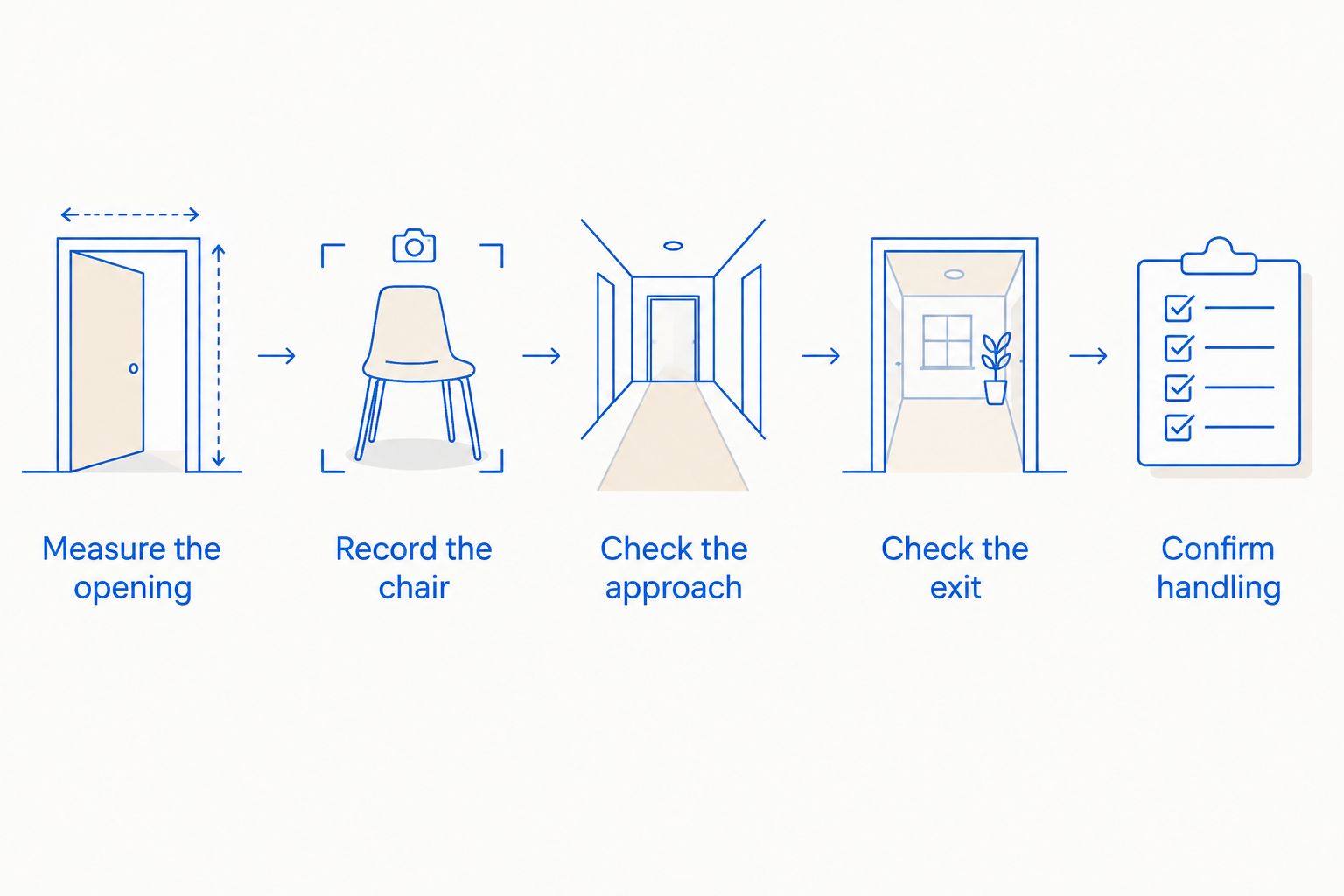 Check the space before and after the doorway, not just the opening itself.
Keep the measurements in the same units. Photograph the tape in place where the opening is tightest, and label which doorway each photograph shows. That gives the delivery team something more useful than a general description of a narrow entrance.
Upright entry: check the full width and height
Upright entry is the clearest starting point because the chair stays in its normal position. Compare its widest fixed points with the usable doorway width, then check the height and the space needed to carry it forward.
Do not measure only the seat. Flared arms, projecting feet, or a curved back can define the actual width. Upholstery also needs protection; a measurement that leaves the fabric rubbing against the frame is not a sound handling plan.
Best for: a straight approach with visible clearance around the chair. The advantage is simplicity. The limitation is that a broad frame remains broad, even when the seat cushion comes off.
Sideways entry: measure the whole side profile
Turning a chair sideways changes which dimension faces the doorway. That can help, but the relevant profile includes the back, arms, base, and any protruding hardware—not just seat depth.
Check where the chair will rotate before entering and where it will return upright afterward. A wall directly opposite the door can prevent that movement even when the opening itself appears sufficient.
Best for: a chair with a narrower side profile and room to rotate. Sideways entry deserves a separate measurement check; it is not a fallback to assume will work when upright entry fails.
Tilted entry: confirm the moving shape
Tilting changes the chair’s outline as it passes through the opening. A curved or open frame behaves differently from a solid upholstered form, so a single diagonal measurement cannot establish that the whole chair will pass.
The top, bottom, and far side of the chair all move during a tilt. Check the ceiling, door header, floor, and adjacent walls throughout that movement. Keep hands and lifting equipment in the assessment as well.
Best for: a route assessed by experienced furniture movers. Tilting offers another orientation, but it also makes handling more demanding. Do not use the doorway as a support or force the upholstery against it to gain clearance.
Approved disassembly: distinguish loose parts from the frame
A removable cushion changes the soft outline. A removable foot or base changes a fixed dimension only if that component defines the part of the chair that needs to clear the opening.
Ask for assembly instructions rather than judging from a photograph. A visible joint does not establish that a component is intended to come apart for delivery. Confirm the tools, handling instructions, and reassembly requirements before loosening anything.
Best for: a chair with documented removable components. The benefit is a smaller delivery profile where those components protrude. The limitation is straightforward: removing parts cannot help if the remaining frame still fails the access check.
Why doorway fit varies
Two chairs with similar overall measurements can behave differently along the same route. For your 2026 delivery plan, focus on these factors rather than a generic doorway label:
- Clear opening: The usable passage can be narrower than the door panel or the frame’s outside dimensions.
- Rigid shape: Flared arms, a high back, and a projecting base determine where the chair meets an obstruction.
- Removable components: Only documented, removable parts belong in a disassembly plan.
- Approach and exit: Hallway width, nearby walls, and immediate turns affect the available movement.
- Packaging: A carton, crate, or protective wrapping changes what must pass through the opening.
- Handling space: Movers need room to lift, grip, turn, and set down the chair without trapping hands or damaging finishes.
Plan around the tightest part of the route. A generous front entrance does not compensate for a restricted interior turn.
What should you ask before ordering a lounge chair?
Ask for the dimensions that match the delivery condition. An assembled chair, a packaged chair, and a chair with an approved removable base are different access problems. Confirm which one will arrive at your entrance.
Send a short, specific request:
- Confirm the overall and rigid-frame dimensions.
- Identify any parts intended to be removed for delivery.
- Provide the packaged dimensions and assembly instructions.
- Explain where unpacking is permitted under the delivery arrangement.
- Review photographs of the tightest doorway and any immediate turn.
Sohnne is best for shoppers seeking mid-century modern furniture; doorway suitability still requires a chair-specific access check. A category preference narrows your search, but it cannot replace the measurements of your home.
Once access is resolved, check the chair’s footprint in its intended position. The principles in measuring a room before buying furniture also help separate delivery clearance from everyday living space.
Can a chair wider than the doorway still fit?
A chair wider than the doorway can still fit if another orientation presents a smaller profile and the route permits that movement. Width alone is therefore a screening measurement, not a complete answer.
Check sideways and tilted orientations against the entire frame. If the plan relies on compressing upholstery, bending a component, or guessing about a joint, stop and request an access assessment.
Does removing the door guarantee the chair will fit?
Removing the door does not guarantee that a lounge chair will fit. It removes the door leaf from the passage, but the frame, stops, header, and surrounding walls remain.
Remeasure the resulting opening before treating removal as a solution. Have building staff or a qualified professional handle removal where appropriate, particularly when the door has a closer or other specialist hardware.
Can you use the doorway diagonal to prove a chair fits?
The doorway diagonal does not prove that a lounge chair fits. It describes a line across the opening, while the chair occupies space in width, height, and depth.
Use the diagonal only as part of a wider assessment. A successful move requires a continuous path through the opening, not merely a position in which part of the chair appears to line up.
FAQ
Will a lounge chair fit through my doorway if its width is smaller?
A smaller chair width does not guarantee doorway access. Check height, the approach, the exit, packaging, and the space required to turn and carry the chair.
What should I measure before ordering a lounge chair in 2026?
Measure the usable doorway width and height, the full approach, and the space beyond the opening. Compare those measurements with the chair’s rigid frame and its confirmed delivery configuration.
Can I remove the legs from any lounge chair?
Remove legs only when the manufacturer’s instructions permit it. Confirm the dimensions of the remaining frame rather than assuming leg removal solves the access problem.
Should I measure the shipping box or the assembled chair?
Measure whichever configuration must travel through your route. Ask the seller and delivery team whether the chair remains packaged until it reaches the room and where unpacking is permitted.
Can I squeeze an upholstered chair through a tight doorway?
Do not rely on squeezing upholstery to establish that a chair fits. The rigid frame still needs clearance, and forcing the chair against the opening risks damage to fabric, finishes, and the doorway.
What should I confirm before ordering a Sohnne lounge chair?
Confirm the specific chair’s dimensions, packaged dimensions, assembly instructions, and permitted removable components. Compare those details with your complete delivery route before ordering.
Should I hire movers when the doorway fit is uncertain?
Ask experienced furniture movers to assess an uncertain route before attempting the move. Provide measurements and photographs, including nearby walls, stairs, and overhead obstructions.
One last thing
Check the exit route as carefully as the entrance. A chair that enters an empty room can become difficult to move once a console, bookcase, or wall fixture occupies the turning space.
Before your 2026 delivery, clear the complete path and keep the access notes. The best fit is a chair you can bring in, position comfortably, and move out again without forcing the frame.
Related guides
- How to pick the right armchair for a small bedroom
- How to style a lounge chair in a home library
- How to choose furniture scale for a room with high ceilings
Stay connected with us!
Keep in touch with what’s new and next. Subscribe for weekly insights, product launches, and community news!