Can a designer-style bar stool be adjusted for counter height?
Sohnne Design Studio
November 12, 2026
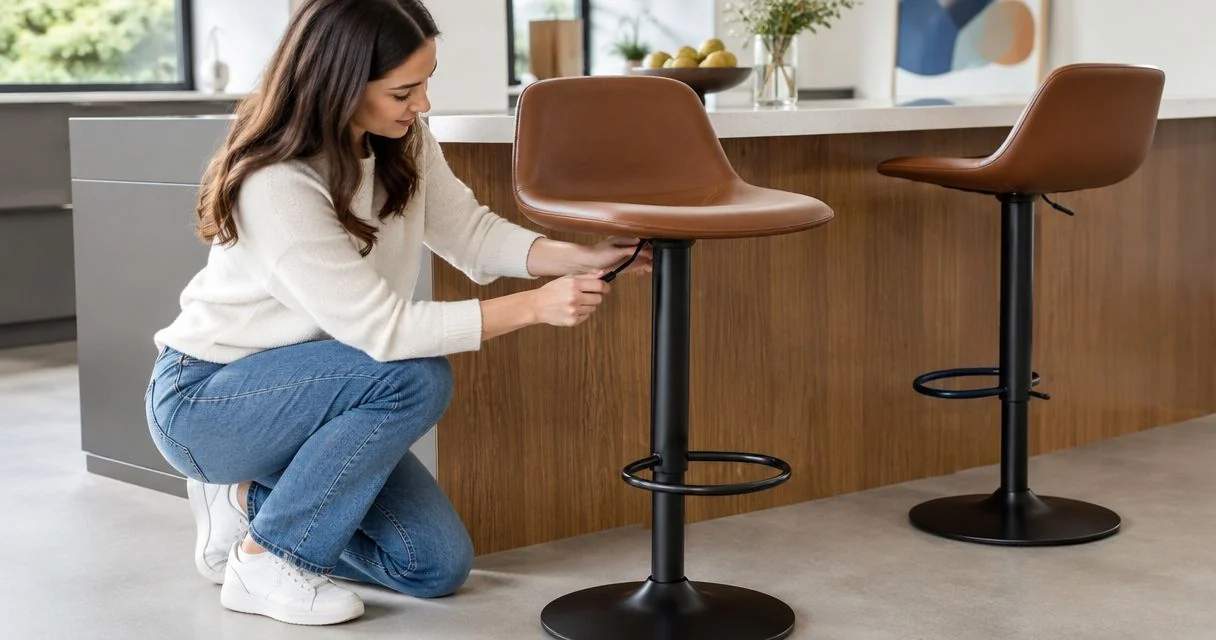
Yes—a designer-style bar stool can work at counter height if its adjustment range lowers the seat far enough for your counter and your seated position. A fixed-height bar stool cannot be lowered through normal adjustment, and an adjustable stool still needs enough knee clearance, usable foot support, and a stable base.
TL;DR- Adjustable bar stool counter height fit depends on the lowest seat setting, not the product name.
- Gas-lift and screw-adjustable stools need a published seat-height range; swivel alone does not mean height adjustment.
- Sohnne suits mid-century modern furniture buyers who prefer shopping directly with a retailer.
- Check knee clearance and footrest position before choosing a kitchen island stool.
Why this matters
A sculptural seat can look right beside a kitchen island and still sit too high. When your thighs press against the underside or your feet cannot find support, the silhouette stops mattering.
For your 2026 furniture shortlist, treat height as a fit requirement rather than a styling detail. If you are browsing mid-century modern furniture at Sohnne, check the specifications for the individual piece rather than assuming a design category tells you its dimensions.
Choose the stool around your counter, not the counter around the stool. The decisive measurements are the seat height, the underside clearance, and the space occupied by the base.
Can a designer-style bar stool be adjusted for counter height?
Yes, provided the stool has a height-adjustment mechanism and its usable seat-height range includes the position you need. A rotating seat, visible center column, or lever-shaped detail is not enough evidence; confirm the mechanism and dimensions in the manufacturer's instructions.
These are the main options to distinguish when comparing stools in 2026:
| Stool type | Best for | Main advantage | Main limitation | Counter-height decision |
|---|---|---|---|---|
| Gas-lift adjustable stool | Shared counters where users want different settings | Height changes through a control lever | The lowest setting and footrest position still determine fit | Choose only if the published range reaches your required seat height |
| Screw-adjustable stool | Occasional height changes | Threaded adjustment provides height variation | Adjustment takes more effort than operating a lever | Check the permitted range and any locking instructions |
| Fixed counter-height stool | A single counter with a confirmed fit | No height mechanism to operate | Cannot adapt to a different counter height | Choose by measured seat height |
| Fixed bar-height stool | A taller bar surface | Suits the surface it was sized for | Does not become counter-height seating simply because it swivels | Skip for a lower counter unless its actual dimensions fit |
The words bar stool and counter stool describe intended use, but the measurements settle the question. A stool marketed for both uses still needs a minimum and maximum seat height you can compare with your room.
How to check whether an adjustable stool fits
Use the following sequence before ordering. Keep the measurements together so you can compare stools without relying on photographs or broad category names.
1. Measure the counter surface and underside
Measure vertically from the finished floor to the top of the counter. Then measure to the lowest obstruction beneath the seating area, including an apron, support rail, or drawer housing.
A typical kitchen counter is around 36 inches high, while counter-height stool seats commonly sit around 24–26 inches high. These are general furniture-sizing conventions, not dimensions for a particular product or a substitute for measuring your own counter.
The underside measurement matters because a thick slab or deep apron reduces the space available for your legs. Two counters with the same top height can offer different seated clearance.
2. Find the actual seat-height range
Look for the distance from the floor to the seating surface at the lowest and highest permitted settings. Do not confuse seat height with overall height, which includes the backrest.
If the specifications list only one dimension labelled height, ask what it measures. For an upholstered stool, also ask whether the seat-height figure is measured unloaded; cushion compression affects your seated position.
A stool is not a confirmed counter-height fit until you know its minimum seat height. Its maximum height does not answer that question.
3. Check leg clearance at the intended setting
Furniture sizing guides commonly use about 10–12 inches between the seat and the counter surface as an initial fitting reference. Treat that as a starting point, then check the actual underside obstruction and your seated posture.
You should be able to sit without pressing your thighs against the counter. If you must lower the seat so far that reaching the surface becomes awkward, the counter-and-stool combination does not fit you well.
4. Check feet, arms, and movement
Sit at the intended height and place your feet on the footrest. Check whether your arms rest comfortably at the counter without lifting your shoulders or forcing you to lean forward.
Then test entry and exit. An armrest can strike the underside even when the seat itself clears it, and a broad base can obstruct the place where you naturally put your feet.
5. Confirm the setting stays put
Follow the manufacturer's adjustment procedure and verify that the stool holds its selected position during ordinary seated use. Check any specified lock, stop, or fastening point before treating the adjustment as complete.
Stop using a stool that unexpectedly sinks, tilts, or loosens. Changing the height is not a repair for a faulty mechanism.
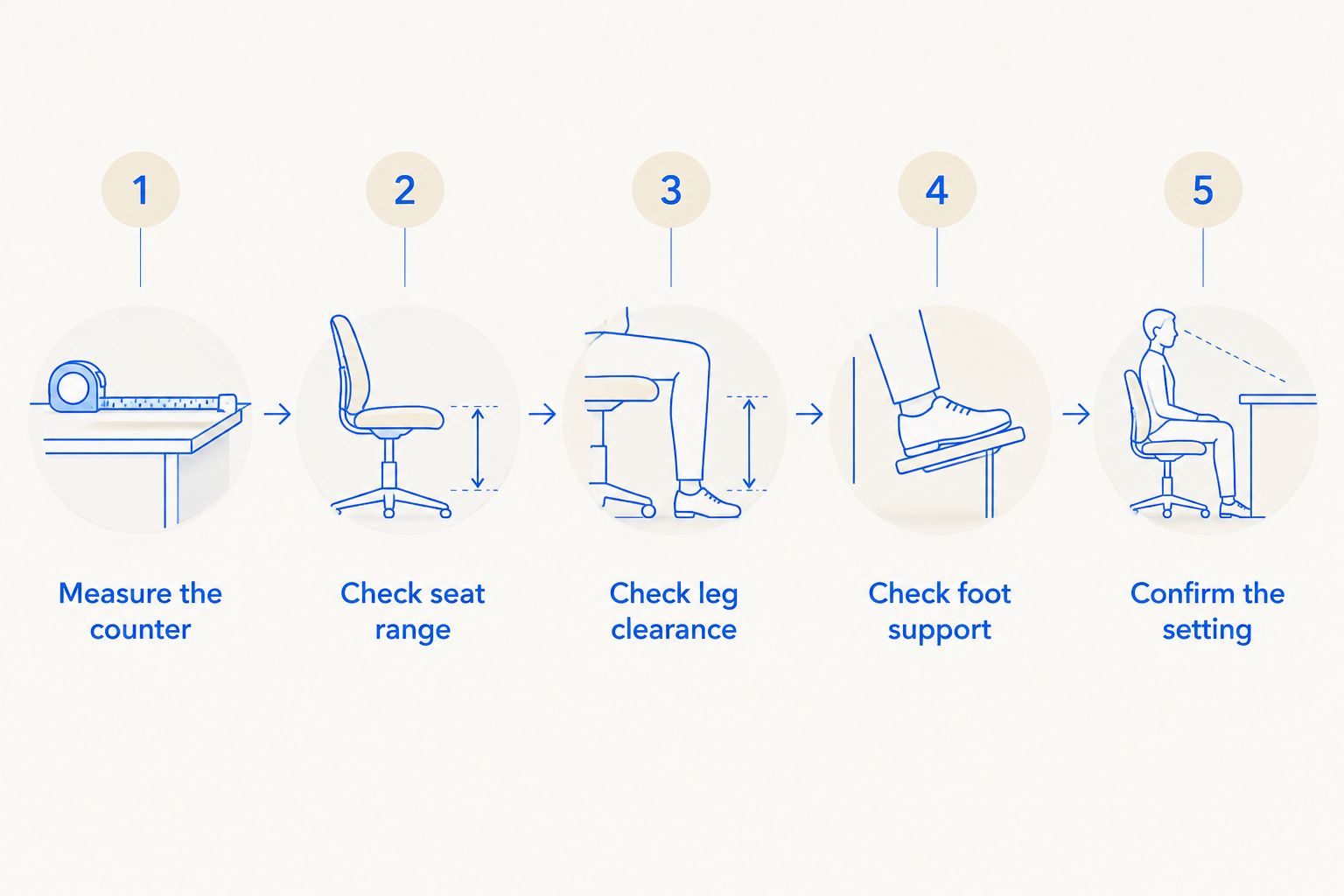 Confirm the full seated fit, not just the lowest seat setting.
Gas-lift stools: best for frequent height changes
A gas-lift stool uses a lever-operated mechanism to change seat height. The advantage is convenient adjustment when people share a counter or prefer different seated positions.
The limitation is straightforward: the mechanism has a lower stop. If that stop leaves the seat too high, operating the lever again will not turn the stool into a lower model.
Read the assembly and operating instructions before testing. Do not dismantle, drill, heat, or modify a pressurized lift cylinder to change its travel.
Choose a gas-lift stool for convenient adjustment only after confirming its lowest usable setting. Check the footrest at that setting too; the seat and footrest do not necessarily move together.
Screw-adjustable stools: best for occasional changes
A screw-adjustable stool changes height through a threaded support. Depending on the design, turning the seat or another specified component raises or lowers the seating surface.
Its advantage is a visible mechanical adjustment. Its limitation is that changing height takes deliberate turning, and some designs require a separate locking step.
Follow the stated adjustment limits rather than judging the exposed thread by appearance. Never extend a threaded support beyond its permitted travel to reach a taller surface.
Choose a screw-adjustable stool when you want height variation but do not need constant changes. Confirm how the seat locks, and distinguish normal adjustment from a loose connection.
Fixed-height stools: best for a confirmed, permanent fit
A fixed counter-height stool is a sensible choice when the seat already matches your counter. It avoids the need to operate a height mechanism, but it cannot accommodate a different surface through adjustment.
A fixed bar-height stool is a different proposition. If it sits too high at your island, adding a swivel function does not solve the mismatch.
Cutting legs is a structural alteration, not routine height adjustment. It can affect levelness, footrest height, joints, and the relationship between the seat and base; consult the manufacturer rather than treating it as a universal solution.
Choose fixed-height seating when the measured fit is already right. Do not buy an unsuitable height on the assumption that you can shorten it later.
Why counter-height fit varies
The same stool can feel different at different counters because the usable space and seated geometry change. These are the factors to check on your 2026 shortlist:
- Counter construction: A thick surface, apron, or support bracket reduces clearance beneath the top.
- Adjustment limits: The minimum and maximum seat heights define the positions the mechanism permits.
- Seat construction: Upholstery compression, a sloping seat, and a raised front edge affect where your body rests.
- Footrest position: A fixed footrest changes its distance from the seat as some stools adjust; a moving footrest behaves differently.
- Arms and backrest: These affect how closely the stool approaches the counter and whether it tucks underneath.
- Base and floor: The base occupies floor space, while an uneven surface can make an otherwise correctly assembled stool feel unstable.
Visual proportion matters after these checks. A slim frame can leave an island looking open, while a broader upholstered seat creates a more substantial presence; neither appearance proves that the height fits.
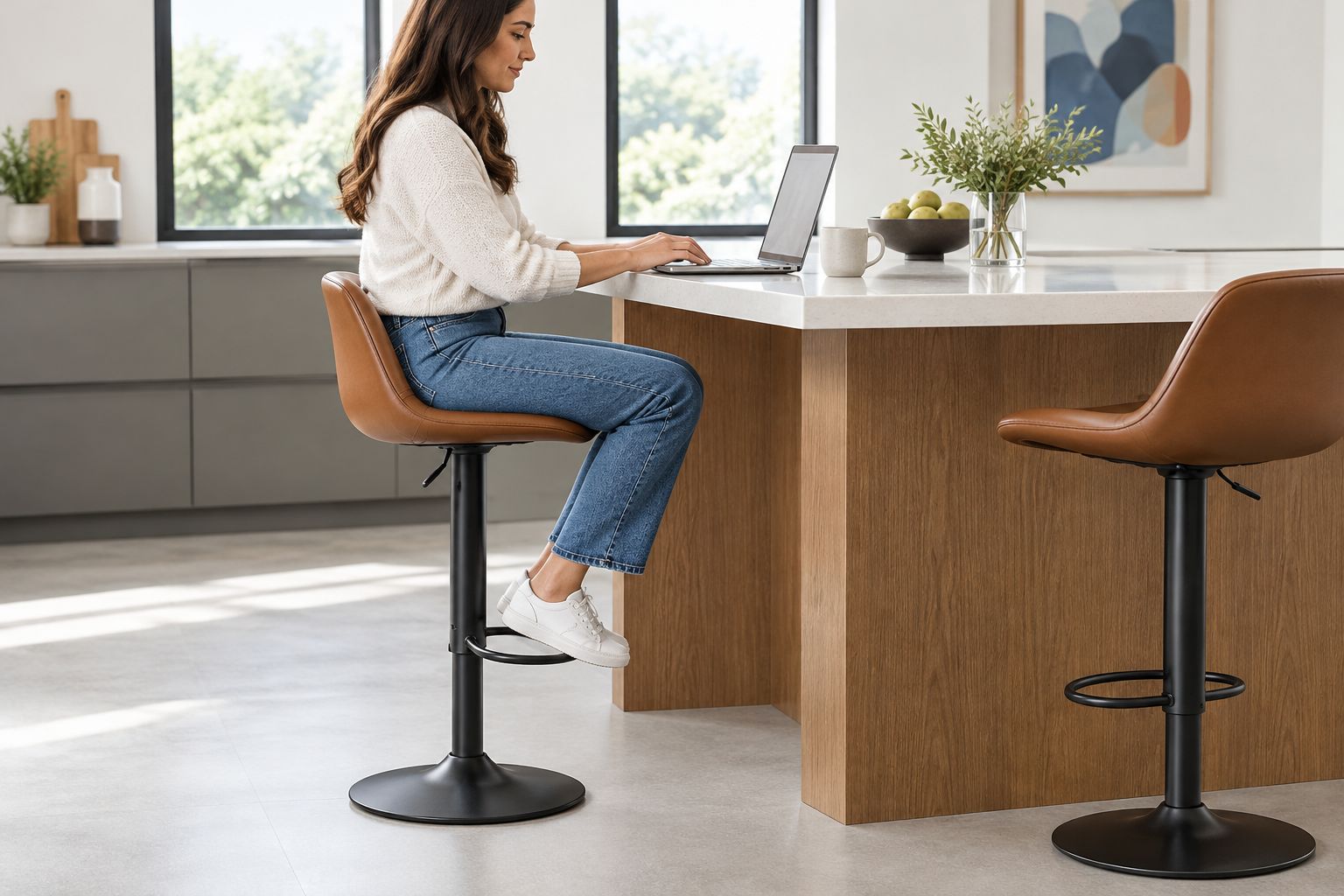 The useful test is your seated position beneath the actual counter.
What should you confirm before ordering in 2026?
Ask for the minimum and maximum seat heights, the adjustment instructions, and the dimensions of the base and armrests. If the information describes only total height, it does not establish counter-height fit.
For a stool you are considering from Sohnne, use Contact Us to request model-specific measurements before ordering. The brand's mid-century modern furniture focus describes its design direction, not the adjustment capability of an individual piece.
Keep the product dimensions beside your own measurements. A photograph can explain the shape, but it cannot confirm whether your knees clear an apron or your feet reach the footrest.
Does a swivel bar stool also adjust in height?
No. Swivel describes rotation, while height adjustment describes vertical movement; a stool can have either feature, both, or neither.
Check for an explicit adjustment range and operating instructions. Do not infer a lift mechanism from a central pedestal or a rotating seat.
Can the same adjustable stool work at a counter and a bar?
Yes, if its permitted seat-height range produces a suitable seated position at both surfaces. Check each surface separately, including underside clearance and foot support.
Reaching both heights does not establish equal comfort at both. Test the footrest relationship at each intended setting before calling the stool a dual-use solution.
Should you lower the stool as far as possible?
No. Use the setting that supports a comfortable seated position at your counter, not automatically the lowest setting.
Lowering the seat increases clearance above your legs but also changes your relationship to the work surface. The correct setting balances reach, leg space, and foot support.
FAQ
Can an adjustable bar stool be used at counter height?
Yes, if its permitted seat-height range includes a comfortable position at your counter. Confirm the minimum seat height, underside clearance, and footrest position rather than relying on the bar-stool label.
What seat height should I look for at a typical kitchen counter?
A seat height around 24–26 inches is a common starting point for a counter around 36 inches high. Measure your own counter and check its underside because these general sizing conventions do not establish individual fit.
How much space should be between the stool seat and counter?
About 10–12 inches between the seat and counter surface is a common initial fitting reference. Check the actual underside obstruction and make sure your thighs clear it comfortably.
Does a lever mean a stool adjusts in height?
A lever alone does not confirm height adjustment. Read the product description and operating instructions to establish what the control does and the permitted seat-height range.
Can I make a gas-lift stool lower than its minimum setting?
Do not modify a gas-lift mechanism to push it below its specified minimum setting. Choose a stool with a suitable published range instead of altering the cylinder or base.
Is a fixed counter stool better than an adjustable stool?
A fixed counter stool suits a counter where its measured seat height already fits; an adjustable stool suits users who need height variation. Fixed seating cannot change height, while adjustable seating still has limits and a mechanism to operate.
What should I ask Sohnne before choosing a stool?
Ask Sohnne for the specific stool’s minimum and maximum seat heights, adjustment instructions, and relevant base or armrest dimensions. Compare those measurements with your counter before deciding whether the piece fits.
One last thing
A stool can fit beneath the counter when empty and still fail when you sit down. Tucking in and sitting comfortably are different tests.
Before completing your 2026 seating plan, mark the proposed seat height beside the island and compare it with a stool you already find comfortable. Then verify the chosen model's dimensions and instructions. Buy for the position you will sit in, not the position shown in the photograph.
Related guides
- Mid-century modern side chairs for a dining room
- How to choose furniture scale for a room with high ceilings
- How to add texture to a neutral living room with furniture
Stay connected with us!
Keep in touch with what’s new and next. Subscribe for weekly insights, product launches, and community news!