Best Ant Chair Replicas for a Small Dining Nook (2026)

Sohnne Design Studio
August 19, 2026
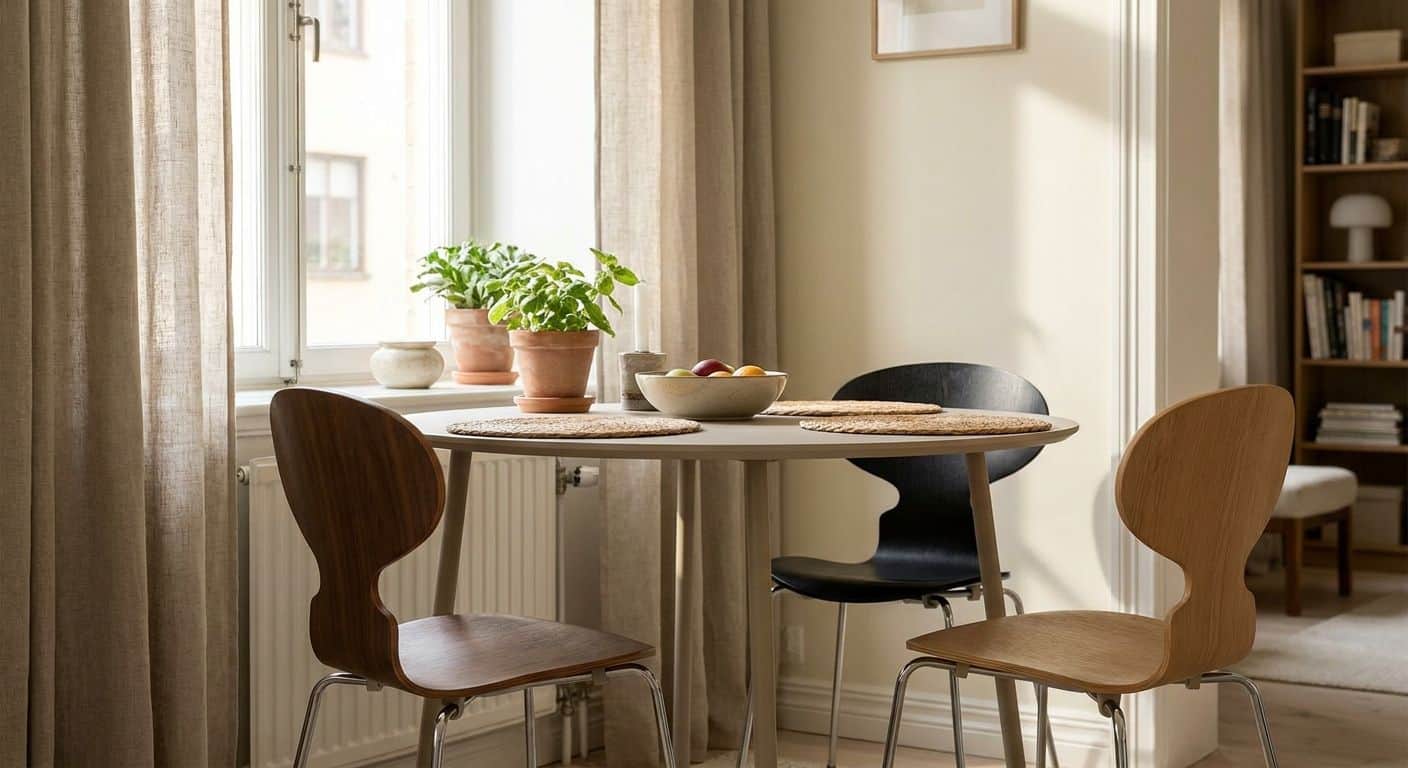
The Ant chair's whole design brief was efficiency: a three-legged shell that stacks, weighs next to nothing, and clears a table edge without elbowing into a room. That makes an Ant chair replica the correct starting point for a small dining nook, but only if you pick the right variant of it.
TL;DR- The three-leg 3107-style Ant chair replica is the buy for tight nooks — it stacks and clears corners better than any four-leg version.
- Skip the armrest variant (3207-style) in a nook under 8 feet wide; the arms add 2-3 inches of width per chair.
- An Ant chair replica arne jacobsen in molded plywood weighs roughly 8-9 lbs, light enough to reposition daily around a fixed table.
- Upholstered seat pads add comfort but break the shell’s silhouette — fine for daily use, not for a showpiece nook.
- 2026 pricing on well-made replicas runs a fraction of the licensed Fritz Hansen original, with the tradeoff landing in plywood lamination quality.
Why this matters
Arne Jacobsen designed the Ant chair in 1952 for Fritz Hansen, and the three-leg version became the template for every stacking dining chair that followed. A small dining nook punishes bad chair choices immediately — a chair that's an inch too wide at the arms or too heavy to slide under a table shows up every single meal, not just on a showroom floor.
The Sohnne catalog treats the Ant chair as a shell-and-base system, which is the right way to think about it here: the shell dictates comfort and visual weight, the base dictates stability and floor footprint. Get the base wrong for a nook and no seat cushion fixes it.
If you're already sold on Arne Jacobsen's plywood language, the Egg chair replica sits at the other end of his output — oversized, sculptural, built for a lounge corner rather than a dining table. The Ant chair is the version scaled down for exactly the space you're solving for.
How this list was built
Ranking here comes down to three measurable things: footprint width with the chair pushed in, stacking or nesting behavior for storage, and shell weight for how often you'll actually move the chair. Comfort matters, but in a nook under roughly 80 square feet, floor clearance wins more arguments than seat cushioning does. Every variant below is a real production configuration of the Ant chair design, not a hypothetical.
The ranked list
1. Three-leg Ant chair replica (3107-style) — the space saver
This is the original 1952 configuration and it's still the correct default for a small nook. The shell in molded plywood runs about 8-9 lbs, seat height sits around 17.7 inches, and the tripod base tucks under a table corner without the fourth leg catching on chair neighbors.
Six of these stack cleanly against a wall when you need the nook clear for a party of two. Buy — this is the version to default to unless you have a specific reason not to.
2. Four-leg Ant chair replica (3101-style) — the stability pick
Adding the fourth leg trades a little floor clearance for a chair that doesn't rock on uneven tile or reclaimed wood flooring. It's heavier by roughly half a pound per chair and loses some of the stacking elegance of the tripod version, but it's the safer call in households with kids climbing in and out constantly.
For a nook with an older or unlevel floor, this outranks the three-leg version. Consider — pick this over the tripod only if your floor actually needs it.
3. Ant chair replica with armrests (3207-style) — the one to skip here
The armrest version adds roughly 2 to 3 inches of width per chair and raises the arm height enough to catch under low table aprons. In a nook built for four chairs around a table under 40 inches wide, that width difference is the gap between a comfortable seating gap and shoulders touching.
It reads beautifully in a larger dining room. In a tight nook in 2026, it's the wrong call. Skip.
4. Upholstered-seat Ant chair replica — the comfort layer
A seat pad in wool or leather adds cushioning for the long dinners a small nook actually hosts more of, since there's usually no separate dining room to migrate to. The tradeoff is visual: the pad interrupts the continuous plywood curve that makes the Ant chair recognizable in the first place.
Pair it with a small kitchen dining table in a warm wood tone and the seat pad blends rather than competes. Consider for daily-use nooks, skip if the chair needs to photograph as a design object.
5. Stacking set of four to six — the flex-seating play
Buy four for the table and keep two more in reserve for guests, stacked in a closet or against a wall. The tripod shell was engineered to nest, and six stack in roughly the vertical space two upholstered dining chairs take standing.
For a nook that doubles as overflow seating during holidays, this is the most practical version of the whole lineup. Buy if your nook needs to flex between two and six seats.
Comparison table
| Variant | Width per chair | Shell weight | Stacks | Best for | Verdict |
|---|---|---|---|---|---|
| Three-leg (3107-style) | Narrowest | ~8-9 lbs | Yes, cleanly | Tight nooks, daily use | Buy |
| Four-leg (3101-style) | Slightly wider | ~9-10 lbs | Limited | Uneven or hard floors | Consider |
| Armrest (3207-style) | Widest (+2-3 in) | ~10-11 lbs | No | Larger dining rooms | Skip |
| Upholstered seat | Same as base shell | +1-2 lbs | Reduced | Long dinners, comfort focus | Consider |
| Stacking set of 4-6 | Narrowest | ~8-9 lbs each | Yes, 4-6 high | Flex/overflow seating | Buy |
Where to buy
Buy from a maker that states the plywood lamination process and layer count outright — thin or poorly bonded veneer is the first thing that fails on a stacking chair used daily. Check seat depth against your table: 14.5 to 15 inches front-to-back is standard for the Ant chair silhouette, and anything shallower will feel like a stool.
Before ordering, run through the checks in this guide to verifying replica furniture quality — seam lines, base weld quality, and finish consistency separate a chair that lasts a decade from one that delaminates in a year. If the Ant chair silhouette doesn't fit your table shape, the PP501 Wishbone is the closest alternative in scale for a small dining setting.
Ant chair replica specs at a glance 17.7 in Standard seat height 8-9 lbs Three-leg shell weight 2-3 in Extra width with armrestsBrowse the dining chair range
See finish and base options before you commit to a nook layout.
Shop dining chairsFAQ
What is the best Ant chair replica arne jacobsen for a small dining nook?
The three-leg 3107-style Ant chair replica is the best fit for a small dining nook in 2026 because it has the narrowest footprint and stacks cleanly for storage. Four-leg and armrest versions add width and weight you don’t need in a tight space.
Is the four-leg Ant chair better than the three-leg version?
Only on uneven or hard flooring, where the extra leg reduces rocking. For most small nooks with level flooring, the three-leg version is lighter, stacks better, and clears corners more easily.
How much does a well-made Ant chair replica cost in 2026?
Pricing on quality Ant chair replicas in 2026 runs a fraction of the licensed Fritz Hansen original, with the gap driven mostly by plywood lamination and finish quality rather than shape.
Do Ant chair replicas stack well?
Yes, the three-leg tripod version stacks four to six chairs high with no wobble, which is the main reason it beats the four-leg and armrest variants for flex seating.
Should I get armrests on an Ant chair for a dining nook?
No, armrests add 2 to 3 inches of width per chair, which crowds a table under 40 inches wide. Save the armrest version for a larger dining room.
What table pairs best with an Ant chair replica in a small space?
A round or oval table under 42 inches keeps the tripod base’s narrow footprint intact on all sides, avoiding the pinch points a rectangular table corner can create.
Is an upholstered seat worth it on an Ant chair replica?
Only if daily comfort matters more than the unbroken plywood silhouette. The pad adds a pound or two and softens long dinners but changes the chair’s visual profile.
How do I check quality before buying an Ant chair replica?
Look at seam lines on the molded shell, the weld quality on metal bases, and ask for the plywood layer count. Thin lamination is the most common failure point on stacking chairs used daily.
One last thing
The detail most buyers miss on the Ant chair in 2026: the tripod base isn't just lighter, it's the only configuration engineered to nest for stacking storage — the four-leg and armrest versions were never designed to stack the same way, no matter how the listing photos frame them.
Related guides
- How to verify quality before buying replica furniture
- PP501 Wishbone chair replica for dining and accent uses
Stay connected with us!
Keep in touch with what’s new and next. Subscribe for weekly insights, product launches, and community news!