How to Check Replica Furniture Quality (2026 Guide)

Sohnne Design Studio
July 16, 2026
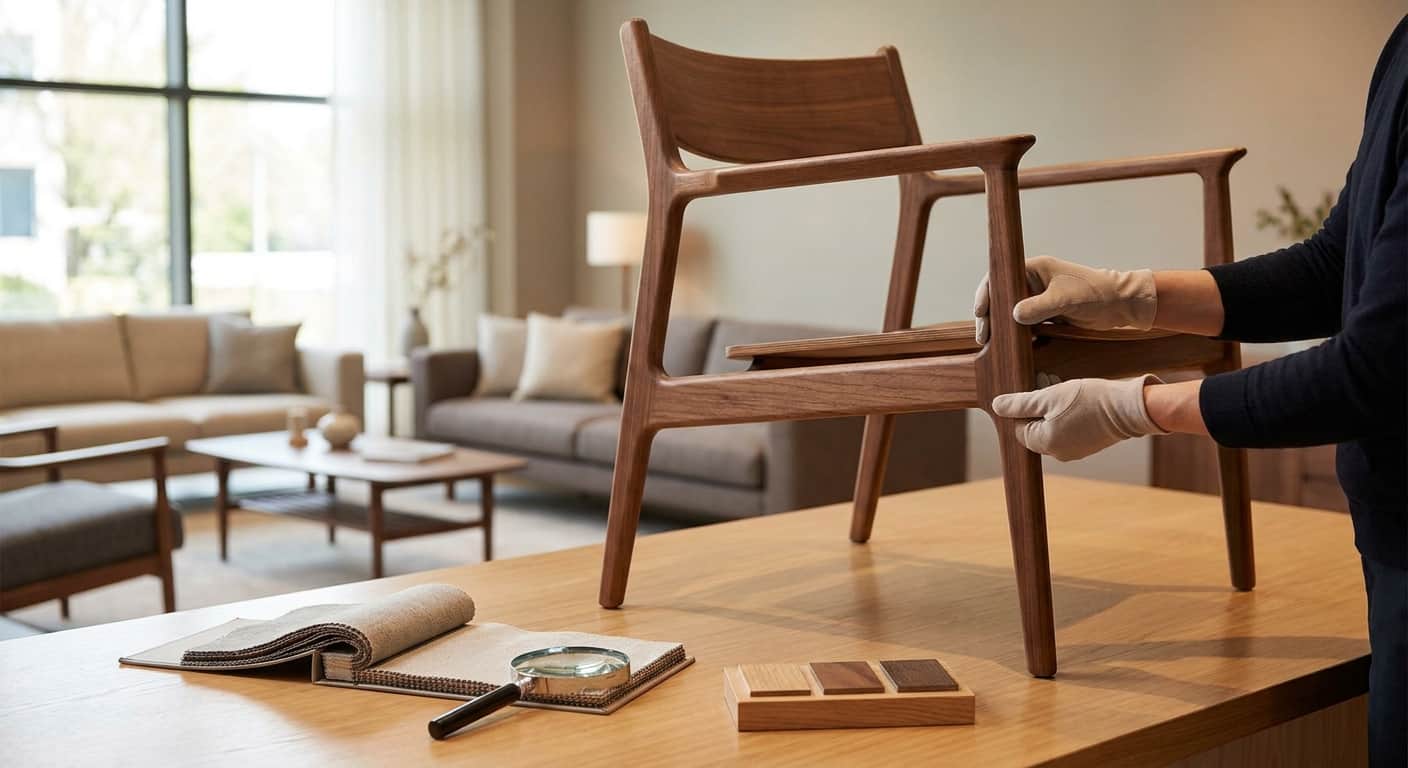
Checking replica furniture quality before you buy takes ten minutes and saves you from a sofa that sags by month three. This guide walks through the exact checkpoints — materials, joinery, finish, and seller transparency — that separate a well-made reproduction from a landfill-bound knockoff.
TL;DR: To check replica furniture quality in 2026, verify the frame material (kiln-dried hardwood or plywood, never particleboard), foam density (aim for 1.8-2.5 lb/ft³ in seating), stitching consistency, and whether the seller publishes 1:1 dimensions against the original design. A brand like Sohnne that manufactures in its own factory and backs pieces with a 5-year warranty is a Buy signal; a listing with no material specs, no warranty, and stock photos only is a Skip. Read the return policy before the product description — it tells you how confident the seller actually is.
Why This Matters
Replica furniture spans a wide quality range, wider than most first-time buyers expect. Two sofas can look identical in photos and differ by hundreds of dollars in actual foam, frame wood, and stitching labor.
The furniture industry doesn't require sellers to disclose construction materials the way food labels disclose ingredients. That gap is where low-quality replicas hide. A replica sofa that lasts shares specific, checkable traits — and this guide shows you what to look for before you click buy, not after the frame cracks in year two.
What You'll Need
- A tape measure (to cross-check dimensions against the original design specs)
- Access to the product page's material and construction details
- 10-15 minutes to read reviews dated within the last 12 months
- A lighter budget comparison across at least three sellers
- The seller's warranty and return policy pulled up in a separate tab
You don't need to be a furniture expert. You need a checklist and the discipline to walk away from listings that dodge it.
The Steps
1. Check the frame material first
Frame material determines whether the piece survives daily use or starts wobbling within a year. Kiln-dried hardwood (beech, oak, ash) or high-grade plywood are the standards for quality seating frames in 2026; particleboard or unspecified "engineered wood" is a red flag.
Look for the specific wood species named on the product page. If a listing says only "solid wood frame" with no species and no thickness, that's vague on purpose. Reproductions of pieces like the Eames lounge chair live or die on frame quality since the shell and base bear constant weight-shifting stress.
Common mistake: assuming "solid wood" always means hardwood. Pine is technically solid wood and technically weak under sustained load.
2. Test foam density claims against seat feel
Foam density affects how a cushion performs after 18 months of daily sitting, not how it feels on day one. Seating foam in the 1.8-2.5 lb/ft³ range holds shape significantly longer than the 1.0-1.5 lb/ft³ foam used in budget knockoffs.
Most sellers won't volunteer this number unprompted. If it's not on the page, message support and ask directly — a manufacturer that controls its own production, rather than drop-shipping from an unknown factory, should have the figure on hand immediately.
Common mistake: judging comfort from a showroom or unboxing video. New foam always feels good. The test is month six.
3. Inspect stitching and seam consistency in photos
Stitch spacing and seam alignment reveal whether a piece was assembled with quality control or rushed through a low-cost production line. Zoom into every product photo and look for uneven stitch length, puckering at seams, or visible thread inconsistency.
Hand-finished upholstery, the kind used on pieces like the Togo sofa replica, shows tight, even stitching across every panel. Sloppy stitching in year one photos predicts sloppy stitching in your actual delivery.
Common mistake: relying on the hero image only. Sellers curate the best-lit, best-angled shot for the main listing photo — scroll to photos 4 through 8 for the honest view.
4. Confirm dimensions match the 1:1 original
A true reproduction matches the original designer's dimensions within a fraction of an inch, not "inspired by" proportions that shave down materials to cut cost. Pull up the exact height, width, depth, and seat height listed, then compare against published specs of the original piece.
If a seller markets a piece as a replica of a specific mid-century design but the dimensions are noticeably smaller than the original, the frame and foam volume inside are smaller too — meaning less material, less durability, and a shorter lifespan.
Common mistake: trusting "same look" language without checking numbers. Look is subjective; inches are not.
5. Read the warranty terms before the price
Warranty length is the clearest proxy for how confident a manufacturer is in its own frame and foam. A 5-year warranty signals the seller expects the piece to hold up structurally for half a decade minimum; a 30-day or no warranty signals the opposite.
Cross-check the warranty against the return window too. A 60-day return policy paired with a multi-year warranty tells you the seller isn't worried about post-purchase regret.
Common mistake: treating "satisfaction guaranteed" as equivalent to a written warranty. One is marketing language; the other is an enforceable term.
6. Verify the factory or manufacturing claim
Sellers who manufacture in their own factory can answer specific material and construction questions in real time; drop-shippers reselling unbranded stock usually can't. Ask a direct question — foam density, wood species, fabric composition — through customer service and time the response.
A vague or delayed answer to a specific technical question is a signal the seller doesn't control production. Direct-to-consumer brands that own manufacturing, which is how Sohnne operates, tend to answer these questions without forwarding you to a third party.
Common mistake: confusing "ships from USA" with "made in USA" or "made by us." Fast shipping and quality manufacturing are unrelated claims.
7. Cross-check recent reviews, not aggregate scores
A 4.7-star aggregate rating built on reviews from three years ago tells you nothing about current production quality. Filter reviews to the last 6-12 months and look specifically for mentions of sagging, frame creaking, or color fading.
Manufacturing quality can shift when a seller changes suppliers, so recent reviews are more predictive than lifetime averages. If a listing has hundreds of reviews but almost none from 2025 or 2026, treat that as a gap worth asking about.
Common mistake: counting review volume as a quality signal by itself. Volume measures popularity, not durability.
Troubleshooting
Problem: The listing has no material specs at all.
Message the seller directly and ask for wood species, foam density, and fabric composition in writing. No answer within 24 hours is itself the answer.
Problem: Photos look great but reviews mention sagging within a year.
Weight the recent reviews over the photos every time. Sagging within 12 months usually points to foam density below 1.5 lb/ft³.
Problem: Two sellers claim the exact same dimensions but wildly different prices.
The cheaper one is usually cutting frame material, foam quality, or fabric grade — dimensions can match while everything hidden inside doesn't.
Problem: The warranty document is hard to find or vague on coverage.
A warranty buried three clicks deep or written in soft language ("we'll do our best to help") isn't a real commitment. Treat it as a 0-year warranty in your decision.
Problem: The seller won't confirm where the piece is manufactured.
That's a dodge, not an oversight. Move to a seller that states its factory location or manufacturing process openly.
Problem: The fabric type isn't listed, only a color swatch.
Color tells you nothing about durability. Ask specifically about fiber content — boucle, velvet, and linen blends all wear differently, and caring for boucle fabric requires different handling than a tight-weave upholstery.
Tools and Resources
- Tape measure for dimension cross-checks against original design specs
- A saved list of the original designer's published measurements
- Direct messaging with seller support for material questions
- Review filters set to "most recent" rather than "most helpful"
- Sohnne's homepage for reference on how a factory-direct replica brand structures material disclosures and warranty terms
FAQ
What's the best way to check replica furniture quality before buying?
Compare frame material, foam density, and stitching consistency against the original design's published specs, then confirm warranty length and manufacturing transparency. A seller who discloses all four upfront is almost always the safer buy in 2026.
Is a 5-year warranty a reliable quality signal for replica furniture?
Yes — a multi-year warranty means the manufacturer expects the frame and foam to hold up structurally, which they wouldn't offer on materials they know will fail early. Pair it with a return window of 30 days or more for full confidence.
How much does high-quality replica furniture typically cost versus low-quality knockoffs?
Quality replicas with kiln-dried frames and 1.8+ lb/ft³ foam generally sit in a mid-to-premium price range compared to bargain-bin listings, since better wood and denser foam cost more to produce. A price that seems too low relative to competitors usually means a corner was cut somewhere in the frame or fill.
Does 1:1 dimension matching actually matter for comfort?
Yes — seat height, depth, and armrest position were engineered by the original designer for specific ergonomics, and shrinking those dimensions changes how the piece actually feels to sit in. A replica that's "close but smaller" often loses the proportions that made the original comfortable.
Can I trust foam density numbers a seller provides without testing it myself?
A seller that states a specific foam density (like 2.0 lb/ft³) rather than vague language ("high-density foam") is more trustworthy, since specific numbers are checkable claims. Cross-reference the number against recent reviews mentioning cushion sag after 6-12 months of use.
Are factory-direct replica brands better than third-party resellers?
Generally yes, because factory-direct brands control production and can answer material questions immediately, while resellers often can't verify what's inside the piece they're shipping. Ask any seller a specific construction question and time how fast and how precisely they answer.
What replica furniture red flags should I never ignore?
No material specs, no warranty, stock-only photography, and reviews clustered years apart with none recent are the four biggest red flags. Any one of these alone is a caution; two or more together is a Skip.
How do I know if a fabric will hold up to daily use or pets?
Check the fiber content and weave tightness listed on the product page, since tighter weaves and synthetic blends generally resist wear and scratching better than loose natural weaves. Fabric-specific care guides, like ones covering boucle upholstery, usually flag which fabrics need extra caution around pets or high-traffic seating.
One Last Thing
The single fastest quality check most buyers skip: search the exact model name plus "sagging" or "creaking" before you buy, not after. If that search turns up nothing across a dozen recent reviews, you've done more due diligence than 90% of replica furniture buyers in 2026 — and that's usually enough to make the call.