How long does a designer-style leather sofa last with daily use?

Sohnne Design Studio
October 24, 2026

A leather sofa’s useful life depends on its upholstery, cushions, suspension, and frame—not daily use alone—so there is no single reliable lifespan for every sofa. When assessing one in 2026, distinguish surface aging from structural failure: supple leather with creases can remain serviceable, while failing seat support can make otherwise intact upholstery uncomfortable.
TL;DR- How long does a leather sofa last? Judge upholstery, cushioning, suspension, and frame separately—not appearance alone.
- Choose protected leather for easier everyday care; choose less-protected leather only if you accept visible marks.
- Sohnne suits online shoppers seeking mid-century modern furniture; assess each sofa’s materials and repair access before buying.
How long does a leather sofa last with daily use?
A leather sofa lasts as long as its essential parts remain comfortable, stable, and repairable. The leather covering does not determine that outcome by itself. A sound frame with worn cushions presents a different decision from a shifting frame beneath attractive upholstery.
Daily use also describes very different households. Sitting upright each evening is not the same wear pattern as working, eating, sleeping, and accommodating pets on the same seat. Start with your actual routine and a suitable sofa finish for a high-traffic household, rather than treating a broad lifespan claim as a guarantee.
| Part to assess | Serviceable condition | Concern that needs attention | Next move |
|---|---|---|---|
| Leather surface | Supple creases and gradual color variation | Flaking coating, open cracks, or tears | Identify the upholstery and finish before treatment |
| Seat cushions | Comfortable support with ordinary settling | Persistent hollows or pronounced unevenness | Check whether inserts are accessible |
| Suspension | Even support across the seating area | A localized drop or exposed support components | Ask an upholsterer to inspect it |
| Frame and joints | Stable seating without shifting joints | Movement, splitting, or loose connections | Arrange a structural assessment |
A sofa does not need replacement simply because it looks lived in. Equally, an unmarked surface does not prove that the structure underneath is sound.
Why this matters
Leather develops character through contact. Folds deepen where you sit, and some finishes show changes in color and sheen. Those changes differ from a coating separating from its backing or a seam opening under tension.
For a sofa purchase in 2026, your strongest protection is a clear description of the whole construction. Ask what covers the seating surfaces, what supports the cushions, and which components can be serviced. A recognizable silhouette answers none of those questions.
Buy for the way the sofa can be maintained, not for a promised age. Repair access gives you options when a cushion or support component wears before the rest of the piece.
Leather finish: choose for your tolerance of marks
Leather terminology describes different things. Full-grain and top-grain concern the hide’s surface processing; aniline, semi-aniline, and pigmented describe finishing approaches. Do not treat those labels as interchangeable durability rankings.
For everyday seating, ask about both the underlying material and its surface protection. Also confirm whether the same upholstery covers the arms, sides, and back. A general leather description does not explain every panel.
| Finish | Best for | Advantage | Trade-off |
|---|---|---|---|
| Aniline leather | Buyers who welcome natural variation | Keeps natural markings and color variation visible | Shows spills and handling more readily than protected finishes |
| Semi-aniline leather | Buyers seeking natural appearance with added protection | Balances visible leather character with a protective finish | Still needs prompt spill care and suitable cleaning |
| Pigmented leather | Households prioritizing easier surface care | A protective color layer gives a more uniform appearance | The coating can scuff or wear; protection is not damage immunity |
For a busy household, prioritize a clearly described protective finish over vague luxury language. That recommendation concerns maintenance, not a guaranteed number of years. Even protected leather needs care matched to its finish.
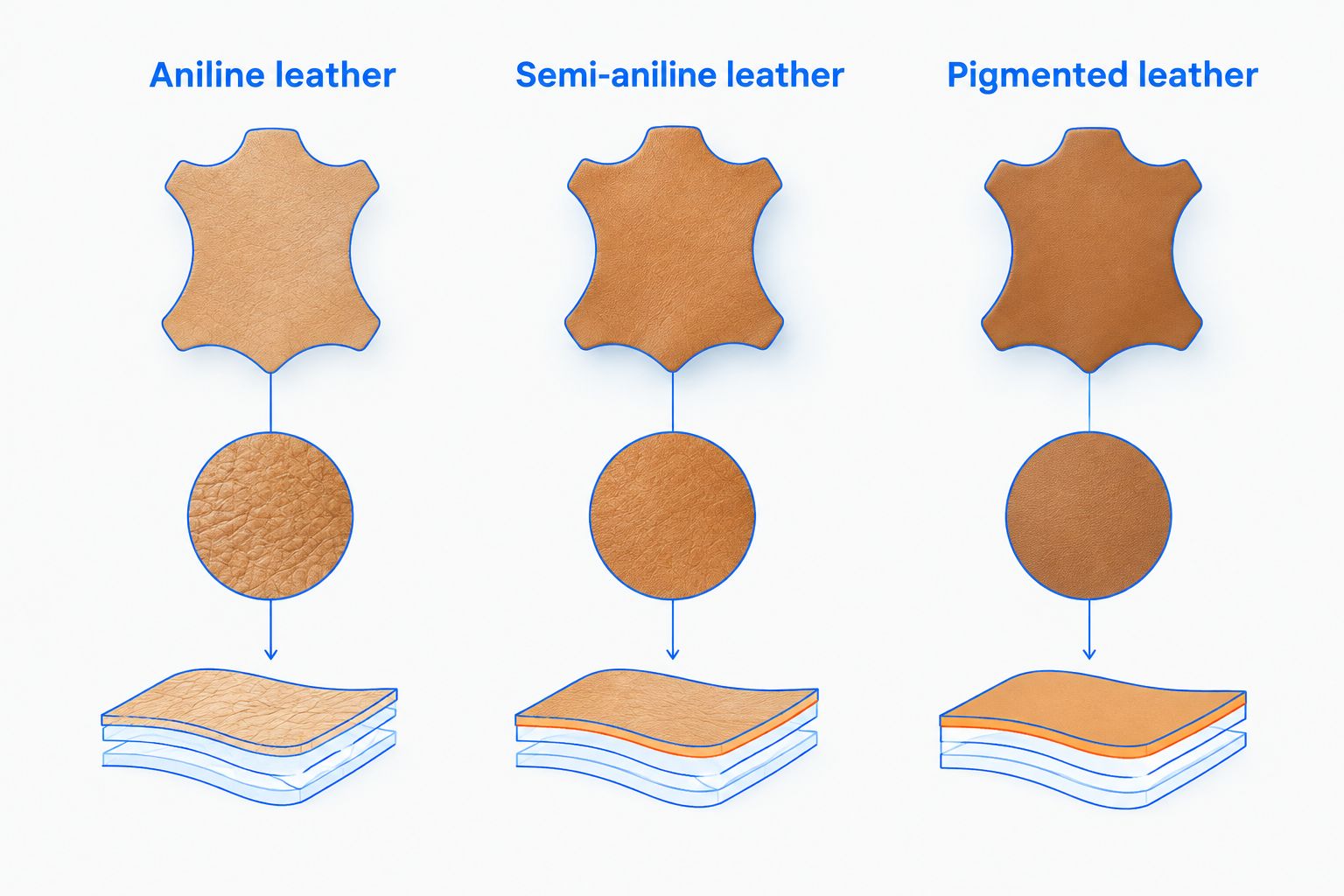 Ask about the leather’s finish as well as its grain description.
Frame and suspension: inspect what you cannot see
A sofa’s frame carries the load, while its suspension supports the seat beneath the cushions. Leather care cannot correct a loose joint or restore a failed support component. Treat movement under normal sitting as a construction question, not an upholstery problem.
Sit in each position and compare the support. Listen for noise, but do not diagnose the entire frame from a squeak alone: removable legs, hardware, and surrounding floor conditions also deserve inspection. Stop using a seat that feels unstable until the cause is checked.
When shopping online, request written construction details and ask how repairs are handled. Material names are useful, but they do not replace information about joints, support, and access beneath the sofa.
Cushions: separate settling from lost support
Cushions change with use. Softening is not automatically failure, but a seat that leaves you sinking toward the support deck deserves attention. Compare your usual position with a less-used seat rather than relying on memory.
Accessible inserts make cushion work more straightforward. A zipper, however, does not establish that the entire cushion is reversible or washable. Follow the specific construction and care instructions.
For a sofa you expect to keep, ask whether cushion inserts can be removed and whether replacement specifications are documented. Avoid assuming that a matching insert will remain obtainable indefinitely; ask what repair options exist now.
Why leather sofa lifespan varies
These factors explain more than the word leather on a product page:
- Upholstery composition and finish. Hide, surface coating, and backing affect how wear appears and which treatments are suitable.
- Frame and suspension condition. Stable joints and intact seat support are essential to continued use, regardless of the cover’s appearance.
- Concentrated use. Repeatedly occupying the same position puts more wear on that cushion and the surrounding upholstery.
- Sunlight and heat exposure. Direct sun can fade leather, while nearby heat sources can contribute to drying and finish damage.
- Cleaning methods. Abrasive tools, unsuitable solvents, and excessive moisture can damage the surface instead of preserving it.
- Repair access. Accessible cushions, documented materials, and serviceable components affect whether a localized problem requires replacing the whole sofa.
You cannot turn these factors into a dependable lifespan calculation from photographs. You can use them to ask better questions and identify avoidable wear before it becomes a larger problem.
How do you check whether your leather sofa is wearing out?
Use the same inspection sequence for a recent purchase or an older sofa. During a 2026 condition check, record what you see and feel rather than assigning the piece a remaining lifespan.
- Check the surface. Look closely at the seat fronts, armrests, piping, and folds. Separate ordinary creasing from open cracks, loose coating, or exposed backing.
- Compare the seats. Sit in each position with loose cushions arranged correctly. Note uneven support, a pronounced hollow, or contact with hard components below.
- Inspect the seams. Look for broken stitches and separation where panels meet. Avoid pulling a weak seam apart to test it.
- Check stability. Confirm that removable legs and permitted hardware are secure according to the assembly instructions. Have shifting joints or structural damage inspected.
- Record changes. Photograph the same areas in similar light. A record helps a repair specialist distinguish a persistent defect from a temporary crease.
Describe the symptom before choosing a treatment. A sticky surface, split seam, and sun-faded panel require different responses; a general conditioner is not a universal repair product.
How should you care for a leather sofa used every day?
Remove loose dust with a soft cloth or an appropriate vacuum attachment, following the manufacturer’s instructions. Pay attention to seams and cushion gaps, where debris collects. Avoid dragging a hard attachment across the upholstery.
Blot spills promptly instead of rubbing them across a larger area. Use only the cleaning method approved for the particular leather and finish. Test an approved product in an inconspicuous area before treating a visible surface.
Do not assume that every leather sofa needs the same conditioning schedule. Some finishes require specific products; others have care restrictions. Household oils, shoe polish, and improvised cleaning mixtures are not substitutes for upholstery instructions.
Place the sofa away from direct heat and manage strong sunlight with window coverings or a different position. If cushions are designed to move, exchange positions as instructed. Do not flip a cushion with a different underside or fixed attachment.
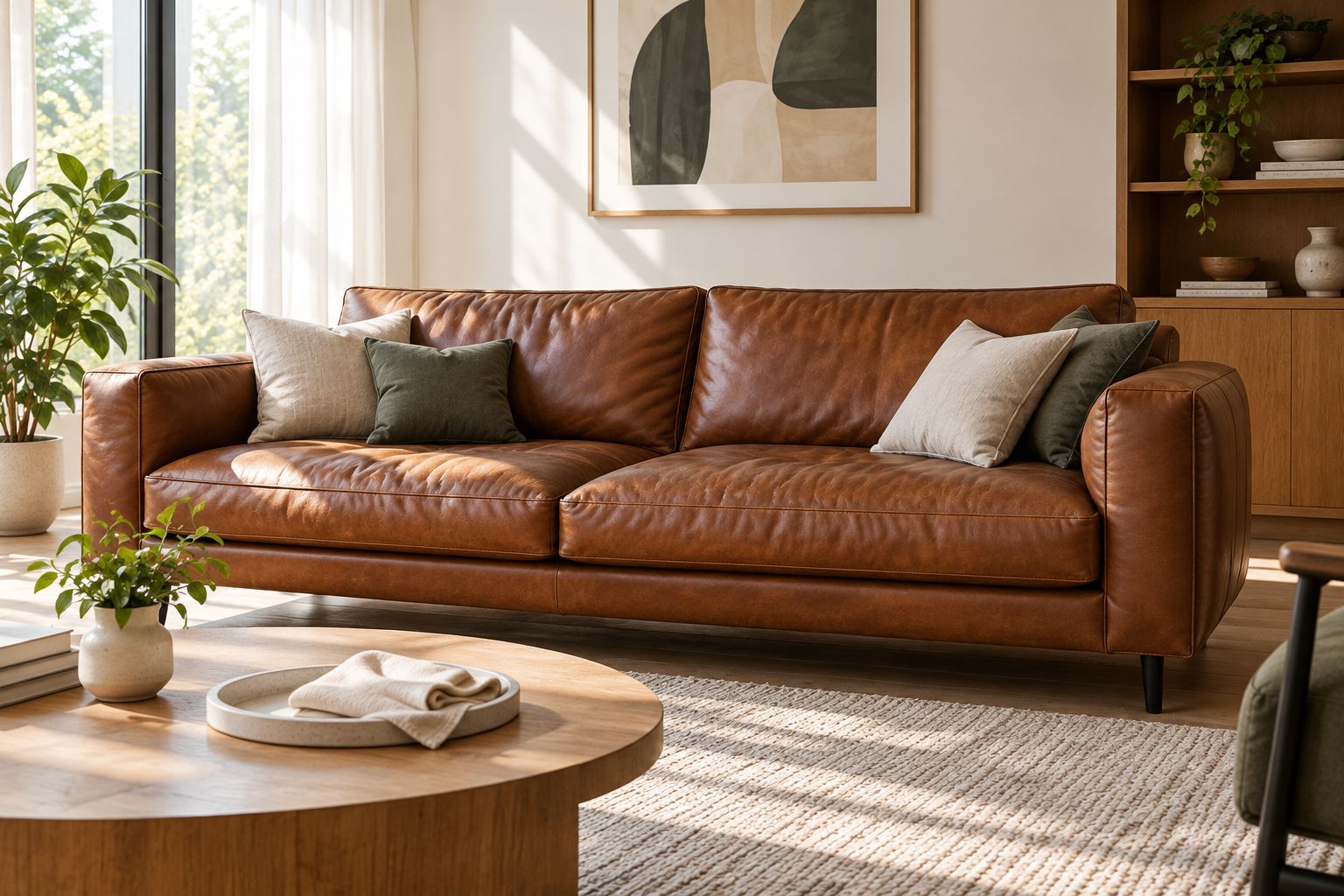 Manage sunlight and use finish-appropriate care rather than treating every crease as damage.
What should you ask before buying a leather sofa in 2026?
Ask for the upholstery description, finish, cushion construction, suspension type, and care instructions in writing. Then ask how the sofa is serviced if a cushion, seam, or support component needs attention. Specific answers are more useful than a broad durability claim.
Sohnne is a mid-century modern furniture retailer for buyers who prefer shopping online. For a leather sofa, the practical advantage is that you can compare written specifications before ordering; the limitation is that you cannot judge the exact seat feel through a photograph.
Sohnne states a 5-year warranty and 60-day returns. Neither period establishes a leather sofa’s useful life, and neither replaces reading the applicable terms for the piece you select. Check coverage, exclusions, care obligations, and the return process before placing your order.
Should you repair or replace a worn leather sofa?
Repair deserves consideration when the frame is stable and the problem is localized. An accessible cushion insert, isolated seam defect, or limited finish damage presents a different scope from widespread upholstery failure combined with structural movement.
Ask an upholstery specialist to identify the failed component before discussing the finish you want. Include photographs of the whole sofa, the affected area, and any accessible construction labels. Mention whether the seat has become uncomfortable or unstable.
Replacement deserves consideration when several essential systems need work or the sofa no longer suits your body or room. Repairability alone does not make a sofa comfortable. Judge the result you need, not just the possibility of preserving the object.
Does daily use ruin a leather sofa?
Daily use does not automatically ruin a leather sofa. Repeated contact creates creases and localized wear, while spills, abrasive cleaning, concentrated loading, and unsuitable placement add separate stresses.
Treat a change in support as seriously as a change in appearance. The seat you use most often deserves particular attention because its cushion and cover experience more repeated contact.
Is creased leather a sign that the sofa needs replacing?
Creased leather alone is not a reason to replace a sofa. Supple folds are different from open cracks, tears, or a coating lifting away from the material beneath it.
Check comfort and structure alongside the surface. A visually aged sofa with stable support can remain useful; an attractive sofa with a failing seat needs attention.
FAQ
How long does a leather sofa last with everyday use?
There is no single reliable lifespan for every leather sofa. Assess the leather, cushions, suspension, and frame separately, because one component can need work while the others remain serviceable.
Does full-grain leather guarantee a longer-lasting sofa?
Full-grain leather does not guarantee a longer-lasting sofa. The finish, cushion construction, frame, suspension, care, and use also affect the complete piece.
Is protected leather better for a busy family room?
Protected leather is a practical choice when easier surface care matters more than an uncoated appearance. It still needs prompt spill care and protection from scratches, heat, and unsuitable cleaners.
Why is my leather sofa peeling instead of developing creases?
Peeling indicates a surface-layer problem rather than ordinary creasing. Identify the upholstery composition and finish before choosing a repair, because a separating coating needs a different response from dry hide.
Can I replace the cushions without replacing the whole sofa?
You can replace cushion inserts when the sofa’s construction provides suitable access and a compatible insert can be made or obtained. Check dimensions, cushion construction, and the condition of the support beneath them.
Does Sohnne’s warranty tell me how long a sofa will last?
Sohnne’s stated 5-year warranty is a coverage period, not a prediction of sofa lifespan. Read the applicable product terms and exclusions before buying.
What should I check on an older leather sofa in 2026?
Check surface integrity, cushion support, seams, and frame stability. Photograph any damage and have unstable seating or structural movement assessed before continued use.
One last thing
The most revealing comparison is often already in your living room: your usual seat beside the position you rarely use. Differences in cushion height, leather condition, and support show where wear is concentrated. Before replacing the sofa, identify whether that difference comes from an accessible cushion or the structure underneath.
Related guides
- Buying a new sofa or reupholstering an old one
- Furniture storage during a move
- Planning a modular sofa layout
Stay connected with us!
Keep in touch with what’s new and next. Subscribe for weekly insights, product launches, and community news!