Best Wassily Chair Replicas in 2026: Full Buying Guide

Sohnne Design Studio
September 7, 2026
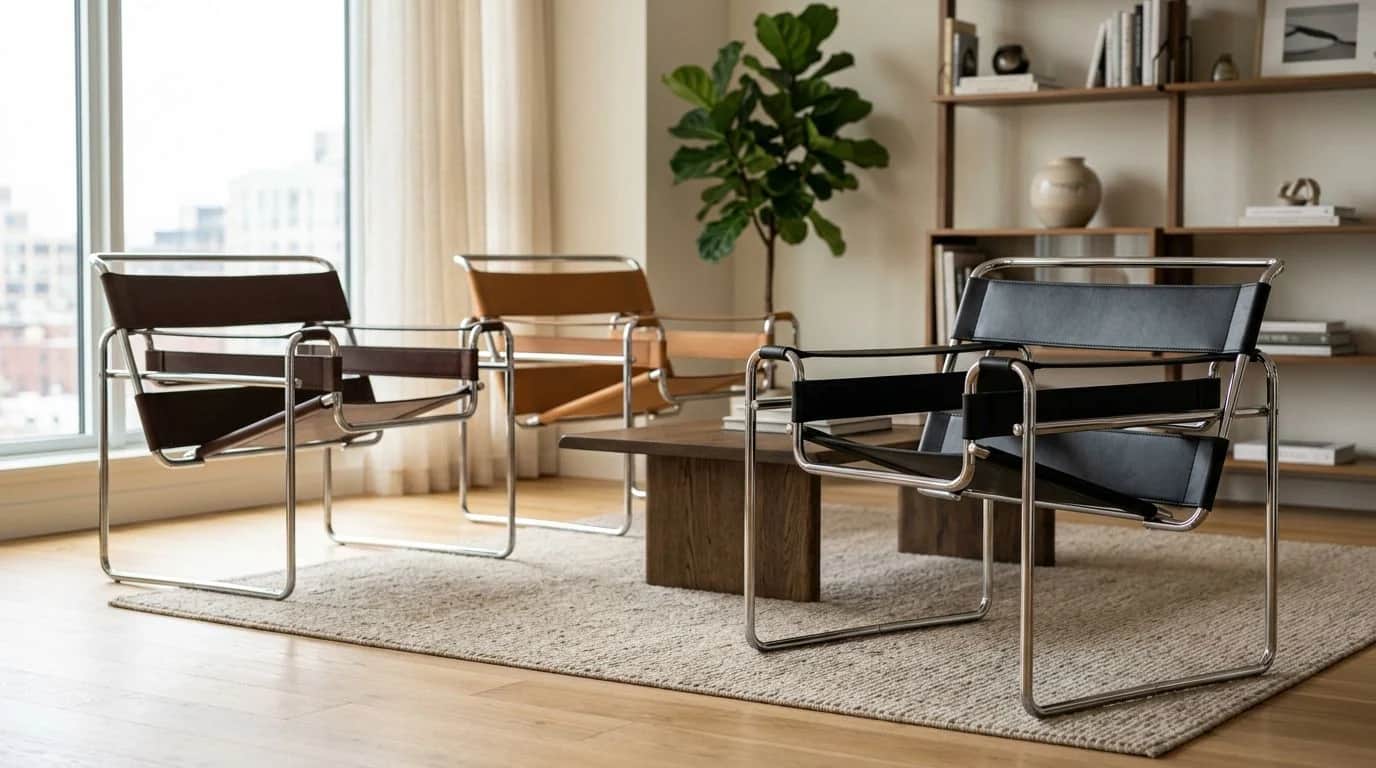
Wassily chair replicas fall into five distinct buying paths in 2026, and the right one depends on what you're optimizing for — proportion accuracy, budget, provenance, or a fully custom finish — not which single brand claims to be "the best."
TL;DR- Best wassily chair replicas in 2026 split into five source categories, not five competing brands.
- Specialty Bauhaus reproduction retailers win on frame-accurate proportions and leather choice.
- General marketplaces are the cheapest entry point but quality swings listing to listing.
- Vintage and secondhand platforms suit collectors who want real patina over a new build.
- Local fabricators give full control over leather grade and frame finish, at a longer timeline.
Why this matters
Tubular steel frames and saddle leather straps look nearly identical in a product photo, but frame gauge, weld quality, and leather grain diverge fast once the chair is in daily use. A thin-gauge frame flexes under weight within months; bonded leather cracks where a full-grain hide would just soften. Before comparing any specific listing, verify quality before buying replica furniture using frame, leather, and finish as your three checkpoints.
The chair itself dates to 1925-1926, designed by Marcel Breuer at the Bauhaus and inspired by the bent tubing of his Adler bicycle handlebars. It wasn't called "Wassily" then — Breuer referred to it as Model B3. The nickname came decades later, tied to Bauhaus painter Wassily Kandinsky, who had one made for his own house and admired it enough that the name outlasted the original.
What makes the best Wassily chair replica
- Frame gauge and weld quality — the tubular steel should hold shape under weight, not flex at the arms
- Leather grain and stitching — top-grain or full-grain hide sits and creases differently than bonded leather within the first year
- Proportions matched to the 1925-26 original — seat height, arm width, and frame depth should track the source design
- Chrome or finish durability — plating that's too thin pits within a season of regular use
- Return and inspection window — a policy that lets you check welds and leather in person before the clock runs out
- Seller transparency about origin — whether a piece is marketed as inspired-by versus a close reproduction changes both expectations and price
At a glance
| Source | Best for | Standout feature | Key limitation |
|---|---|---|---|
| Specialty Bauhaus reproduction retailers | Museum-accurate proportions | Frame specs and leather grades listed upfront | Hard to test in person before buying |
| General online marketplaces | Budget shoppers testing the silhouette | Fast shipping, easy returns | Inconsistent seller quality listing to listing |
| Vintage and secondhand platforms | Collectors wanting provenance | Real patina and age | Upholstery usually needs replacing |
| Local upholsterers and fabricators | Full customization | Total control over leather and finish | Longer timeline, higher total cost |
| Sohnne's mid-century modern collection | Building the rest of the room | 1:1 dimension reproductions | No Wassily chair reproduction in the catalog |
1. Specialty Bauhaus reproduction retailers: best for museum-accurate proportions
These are furniture makers that focus specifically on tubular steel and leather Bauhaus-era designs, listing frame diameter, chrome thickness, and leather type as selling points rather than afterthoughts. They're the closest match to Breuer's 1925-26 proportions because proportion accuracy is the entire pitch.
Specialty retailer pros:
- Frame diameter and welds closer to the original design
- Wider range of leather and vegan-leather colors
- Specs listed clearly enough to compare before buying
Specialty retailer cons:
- Harder to sit in the chair before it arrives
- Return shipping on a steel-frame piece runs slow
- Quality still varies workshop to workshop within this category
Best for: buyers who care about matching the original silhouette over price.
Verdict: Buy if proportion and finish quality outrank cost.
2. General online marketplaces: best for budget-first shoppers
Large marketplaces list dozens of Breuer-style chairs from different sellers under one roof, competing mostly on price and shipping speed. This is where most people encounter their first Wassily-style chair, usually as a low-commitment way to test the look in a room.
Marketplace pros:
- Lowest entry price point in the category
- Fastest delivery windows
- Return process handled by the platform, not the individual seller
Marketplace cons:
- Seller quality is inconsistent from listing to listing
- Leather is frequently bonded rather than top-grain
- Frame gauge specs are rarely disclosed
Best for: shoppers testing whether the silhouette fits the room before committing to a nicer piece.
Verdict: Fine as a starter chair; skip if you plan to keep it past a year or two.
3. Vintage and secondhand platforms: best for provenance over polish
Estate sales and design-focused resale sites carry actual older-production pieces, not new reproductions. For buyers who want an object with real history rather than a fresh copy, this category is the only one that delivers genuine age.
Vintage market pros:
- Real patina and wear that no new reproduction can fake
- Often stronger resale value than a brand-new replica
- Earlier production runs sometimes used heavier-gauge steel
Vintage market cons:
- Prices swing widely from listing to listing
- Upholstery almost always needs replacing on arrival
- Provenance claims are hard to verify without paperwork
Best for: collectors who want history attached to the object, not just the look.
Verdict: Buy only after the seller confirms condition in writing.
4. Local upholsterers and metal fabricators: best for full customization
Working directly with an upholsterer or a metal shop means specifying leather grade, strap tension, and frame finish yourself — chrome, matte black, or brass — rather than picking from a fixed catalog. It's the slowest route but the only one that guarantees an exact match to what you actually want.
Fabricator pros:
- Full control over leather grade, strap tension, and frame finish
- No catalog limits on color or hardware
- Repairs later are simpler since the maker already has your specs
Fabricator cons:
- Total cost adds up once labor is priced separately from materials
- Timelines run longer than an off-the-shelf order
- Quality depends entirely on that fabricator's experience with tubular steel
Best for: buyers who already know the exact leather color and frame finish they want.
Verdict: Worth it with a fabricator you trust; skip if you need the chair within a month.
5. Sohnne's mid-century modern collection: best for building the rest of the room
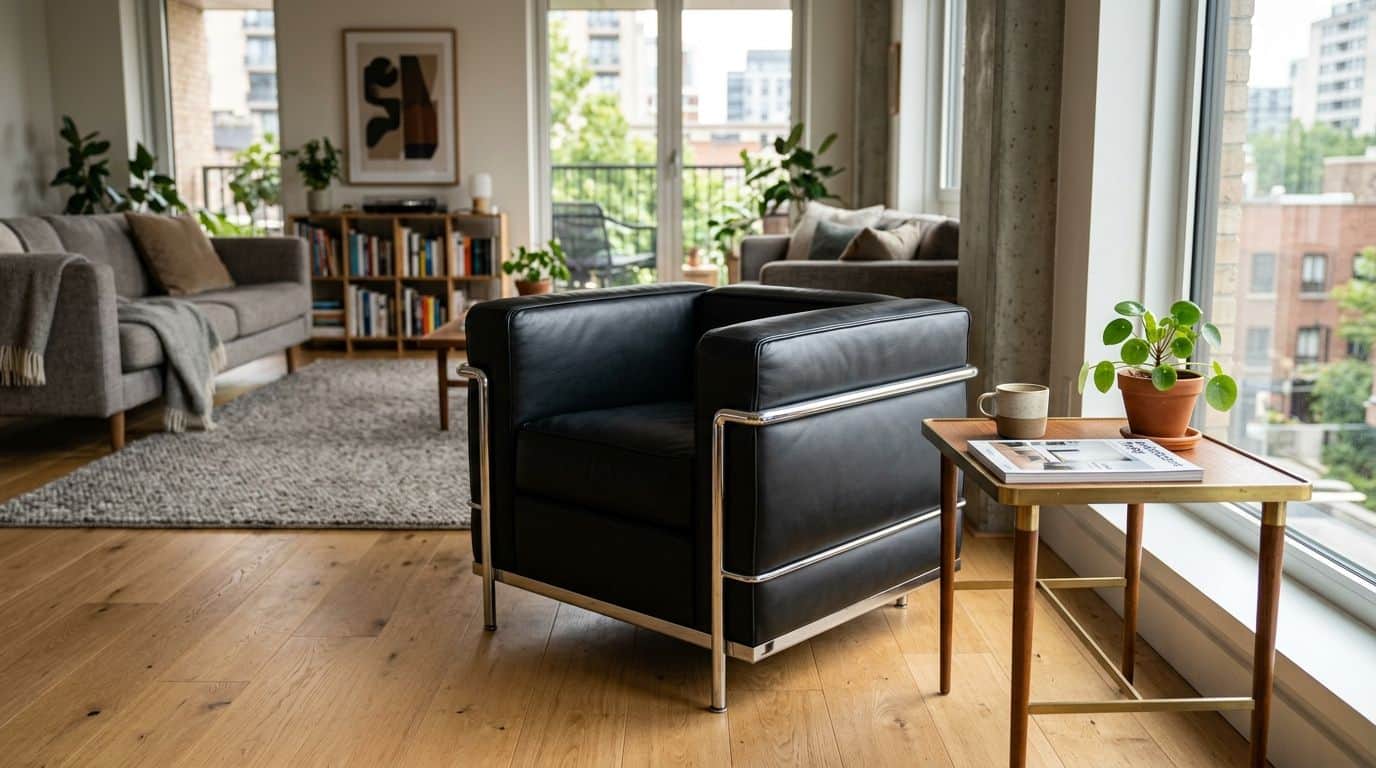
Sohnne doesn't carry a Wassily chair reproduction, and it's worth saying plainly rather than stretching the catalog to fit. What Sohnne does carry is a wider range of mid-century modern furniture — lounge chairs, dining pieces, lighting — reproduced at 1:1 original dimensions, which matters once you're placing a Breuer-style chair inside a full room rather than treating it as a standalone piece. If you're styling a Bauhaus interior, scale consistency between pieces matters as much as the chair itself.
Sohnne pros:
- Pieces reproduced at 1:1 original dimensions, so scale matches other seating in the room
- Free insured shipping and a 5-year warranty on what Sohnne sells
- 60-day return window if a piece doesn't work once it's in the space
Sohnne cons:
- No direct Wassily chair reproduction in the catalog
- Buyers need to source that specific chair from one of the four categories above
- Made-to-order pieces carry lead time like any factory-built order
Best for: buyers building the rest of a Bauhaus-inspired living room around a Wassily-style chair sourced elsewhere.
Verdict: Skip for the chair itself; buy for everything else in the room.
“If the tubular steel flexes when you sit down, the gauge is too thin for daily use.”
How this list was ranked
Each source was matched against the six criteria above rather than scored against a single universal winner, because no retailer of Wassily chair reproductions covers proportion accuracy, budget, provenance, and customization equally well in 2026. A specialty retailer that wins on proportions will lose on price every time; a marketplace that wins on price will lose on leather quality just as reliably.
Which Wassily chair replica should you choose?
Default to a specialty Bauhaus reproduction retailer if you're undecided — it's the only category built specifically around matching Breuer's 1925-26 proportions rather than approximating them. Drop to a general marketplace only if budget is the deciding factor and you're comfortable replacing the chair within a couple of years. Go vintage if provenance matters more to you than a flawless finish, and go custom-fabricated only if you already know the exact leather and frame combination you want.
Build the room around the chair
Browse mid-century pieces sized to match a Wassily-style chair.
Shop the collectionFAQ
What’s the best Wassily chair replica in 2026?
There’s no single best replica — the top pick depends on priority. Specialty Bauhaus reproduction retailers win on proportion accuracy, marketplaces win on price, and vintage platforms win on provenance.
Is a Wassily chair replica legal to sell?
Reproductions of the Wassily chair’s general form are widely sold because the original 1925-26 design has passed out of design-patent protection in most markets. Sellers still can’t use the Knoll brand name or claim to be the licensed manufacturer.
How much does a Wassily chair replica cost?
Cost varies by source category rather than a single market rate. Marketplace listings sit at the low end, specialty reproduction retailers sit in the middle, and custom fabrication runs highest once labor is priced separately from materials.
Is the original Wassily chair still in production?
Yes, licensed production of the original design has continued under Knoll, part of MillerKnoll, since the 1960s reissue. Replicas are made by separate manufacturers not affiliated with that license.
Who designed the Wassily chair and when?
Marcel Breuer designed it in 1925-1926 while teaching at the Bauhaus, originally naming it Model B3. It was inspired by the bent tubular steel of his bicycle handlebars.
What’s the difference between a replica and the original Wassily chair?
The original carries licensed production history and brand backing; a replica matches the visual design without that licensing. Frame gauge, leather grade, and finish quality vary far more among replicas than among licensed originals.
How do I verify the quality of a Wassily chair replica before buying?
Check frame gauge for flex under weight, leather grain for stitching quality, and ask whether the seller discloses chrome plating thickness. A return window that allows in-person inspection matters more than any spec sheet.
Can I customize a Wassily chair replica?
Yes, through a local upholsterer or metal fabricator you can specify leather grade, strap tension, and frame finish directly. Specialty reproduction retailers offer some customization too, usually limited to leather color.
One last thing
The name most people use for this chair wasn't Breuer's choice at all. Bauhaus painter Wassily Kandinsky admired the chair enough to have one made for his own house in the 1920s, and when Knoll reissued the design in the 1960s, the nickname stuck harder than Breuer's own "Model B3" ever did — a reminder that even an iconic design's identity can shift decades after it was drawn.
Related guides
- Best Hans Wegner chair replicas to shop in 2026
- Pierre Jeanneret chair replica design history and styling guide
- How to choose a replica sofa that lasts