Best Sofas for Open-Plan Apartments in 2026, Ranked

Sohnne Design Studio
July 26, 2026
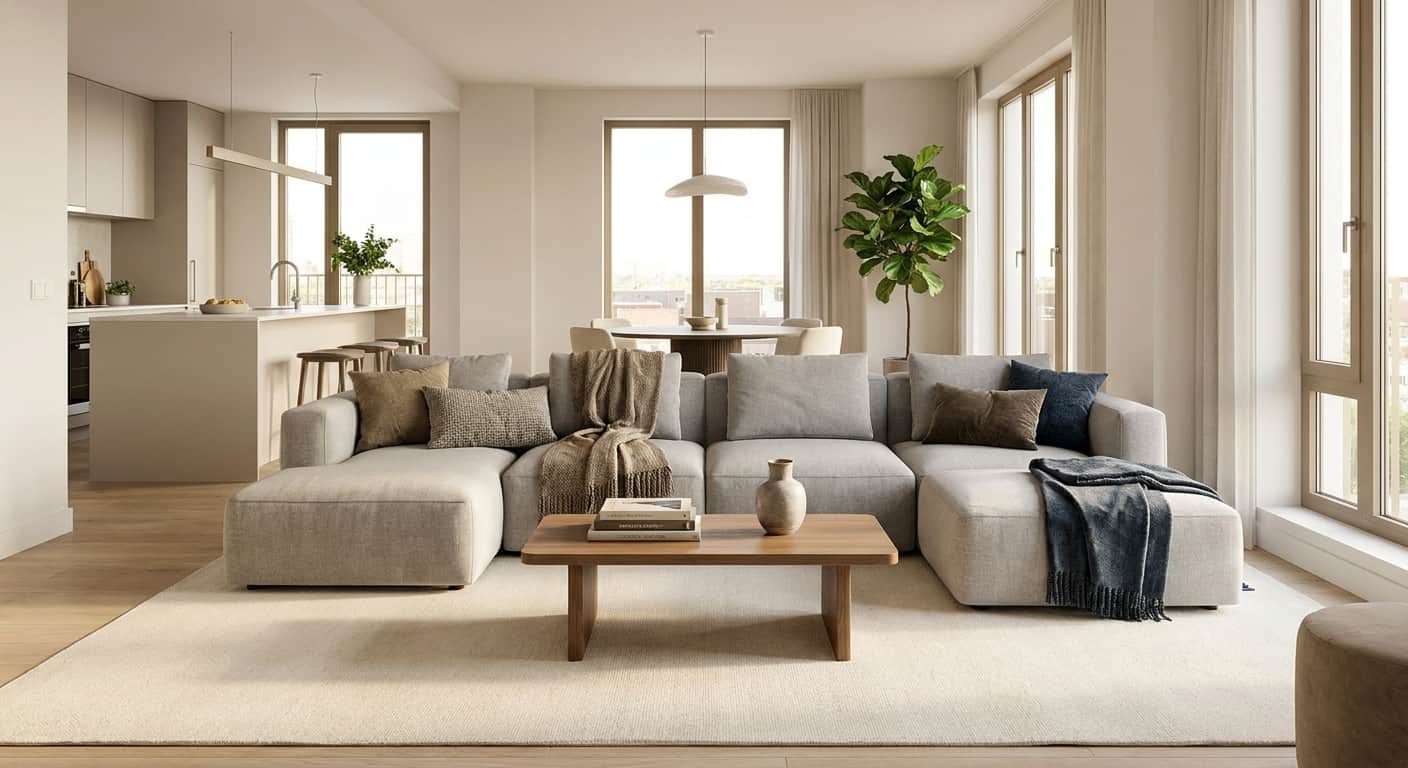
Open-plan apartments strip out the walls that used to hide the back of a sofa, which means every seating choice now doubles as a room divider. The best sofas for open-plan apartments in 2026 use modular sectionals, low backs, and finished-all-sides upholstery to zone a kitchen-to-living flow without boxing in the square footage.
TL;DR- Camaleonda modular sofa wins for open-plan apartments in 2026 because it splits and reconfigures without buying a second piece.
- Togo sofa is the pick for wall-free studios under 500 square feet — its 12 to 14 inch profile stays out of sightlines.
- Alterra modular sofa handles L-shaped and pass-through layouts common in open one-bedrooms.
- Skip any sofa with a back over 30 inches in a wall-free room — it visually walls off the kitchen.
Why sofa shape matters more in an open floor plan
A wall-free layout removes the one thing traditional sofa shopping assumes you have: a wall to push the piece against. Without that anchor, a standard three-seater with an unfinished back becomes the ugliest object in the room the moment you walk in from the kitchen.
How to style a modular sofa in an open-plan space covers the layout logic in depth, but the short version drives every pick below: modularity, back height, and finished sides matter more than fabric color or price in 2026 open-plan shopping.
A sofa that reads as furniture from every angle, not just the front, is what separates a good open-plan pick from a bad one. That's the filter this list runs on.
How the ranking works
Each sofa here is judged on four things specific to wall-free rooms: modularity (can it split, add, or rotate without a new purchase), back height and finish (does it block the sightline into the kitchen), footprint relative to seating count, and design longevity. This list draws on Sohnne's own modular sofa catalog and general design-history sourcing. Several of these shapes have been in continuous production since the 1970s, which says something about how they hold up to daily use in a high-traffic, kitchen-adjacent zone. Popularity alone doesn't earn a spot — solving a specific open-plan problem does.
The ranked list
1. Camaleonda modular sofa — the reconfigurable heavyweight
Mario Bellini designed the original for B&B Italia in 1970, and the no-frame, foam-block construction is still the reason it tops this list in 2026. Individual modules connect with hooks and buckles, so the same sofa becomes an L, a U, or two separate two-seaters depending on what the week calls for.
Open-plan living changes function constantly — dinner party tonight, movie night tomorrow — and a fixed three-seater can't keep up with that. Sohnne's Camaleonda modular sofa can, without a second purchase.
Verdict: Buy if you rearrange your living zone more than twice a year.
2. Togo sofa — the floor-level anchor
Michel Ducaroy designed the Togo for Ligne Roset in 1973, and its defining trait is having no visible frame at all. Quilted channels run edge to edge, and the whole piece sits roughly 12 to 14 inches off the floor.
At that height, it barely registers above a kitchen island or peninsula, which matters when the sofa faces an open kitchen instead of a wall. Front and back look nearly identical too, so there's no ugly angle to hide.
The Togo sofa for small apartments guide runs through fabric and sizing options for studios specifically.
Verdict: Buy for studios and open one-bedrooms under 600 square feet.
3. Alterra modular sofa — built for corners
The Alterra system reconfigures across three core layouts — straight run, corner sectional, and chaise-end — from one set of modules. That flexibility matters in open one-bedrooms where the sofa has to work around a kitchen peninsula on one side and a dining table on the other.
Unlike a fixed L-shape, Sohnne's Alterra modular sofa can flip orientation if you move in 2026 and the new apartment's kitchen sits on the opposite wall.
Verdict: Buy for corner-heavy, irregular floor plans.
4. Terrazza sofa (DS-1025) — the sculptural divider
De Sede's Terrazza has been in production since the early 1970s, built from platform modules that sit at slightly different heights — some function as seats, others as low tables or extra perches. That height variation is what makes it read as a divider rather than a couch.
In a large open-plan loft, it can mark the edge of the living zone without a wall, a half-wall, or a bookshelf doing the job. It's overkill for a small apartment, but it earns its footprint in a bigger one.
Verdict: Consider for lofts over 900 square feet; Skip for anything smaller.
5. Marenco sofa — the compact modular
Mario Marenco designed the Marenco for Arflex in 1970, and the rounded, low-arm modules scale down more gracefully than most modular systems. It works as a full sectional or drops to a single two-seater module without looking unfinished.
That matters when floor space in an open-plan unit gets split three ways between kitchen, dining, and living. The Marenco sofa gives up less square footage than a full-size sectional while keeping the modular upside.
Verdict: Consider if square footage is under 550 square feet and every module counts.
6. Extrasoft modular sofa — the minimalist block
Piero Lissoni designed the Extrasoft for Living Divani in 2003, decades after most of the shapes on this list, and it shows in the near-seamless slab construction. There's no piping, no visible frame line, and almost no visual noise.
That matters in an open floor plan viewed from three angles instead of one. A busy silhouette reads worse when the kitchen, dining area, and entry all face the same piece.
Verdict: Buy for minimalist, low-clutter open layouts.
7. Song Range modular sofa — the add-on system
The Song Range system is built to add seating over time rather than commit to a fixed size upfront — a single module today, three or four connected sections a year later. That fits open-plan households that grow (a roommate, a partner, a first kid) faster than a static living room layout usually accounts for.
Verdict: Buy for households that expect their seating needs to change before 2028.
Comparison table
| Sofa | Best For | Design Origin | Configuration | Verdict |
|---|---|---|---|---|
| Camaleonda modular sofa | Frequent re-layouts | B&B Italia, 1970 | Full modular, hook-connected | Buy |
| Togo sofa | Studios, low sightlines | Ligne Roset, 1973 | Fixed low-profile, no frame | Buy |
| Alterra modular sofa | Corner and L-shaped rooms | In-house modern design | 3 core layouts | Buy |
| Terrazza sofa (DS-1025) | Large open-plan lofts | De Sede, early 1970s | Platform modules, varied heights | Consider |
| Marenco sofa | Tight square footage | Arflex, 1970 | Scalable 2 to 6+ seats | Consider |
| Extrasoft modular sofa | Minimalist layouts | Living Divani, 2003 | Slab modules | Buy |
| Song Range modular sofa | Growing households | In-house modern design | Expandable over time | Buy |
Where to buy
- Buy from the manufacturer or an authorized retailer directly, not a marketplace reseller — modular systems need matching batch dye lots across modules, and third-party sellers rarely guarantee that.
- Check the return window before ordering. Sohnne ships insured and covers returns for 60 days, which matters for a modular piece you can't fully judge for scale until it's in the room.
- If budget is the blocker, ask about financing before walking away. Sohnne offers Affirm at checkout, and a 5-year warranty on the frame is worth confirming on any modular purchase, since modules see more stress points than a fixed sofa.
“Keep the sofa back under 30 inches in a wall-free room, or it reads as a wall instead of a seat.”
FAQ
What is the best sofa for an open-plan apartment in 2026?
The Camaleonda modular sofa is the strongest overall pick for open-plan apartments in 2026 because it reconfigures into an L, a U, or two separate pieces without a second purchase. The Togo sofa is the better choice specifically for studios under 500 square feet.
Is a modular sofa better than a fixed sectional for open-plan living?
Yes, for open-plan rooms a modular sofa is almost always the better call because it can be split or rearranged as the layout changes. A fixed sectional locks you into one shape, which is a problem in a room with no walls dictating furniture placement.
How tall should a sofa back be in an open-plan living room?
Keep the back under 30 inches if the sofa faces a kitchen or dining area with no wall behind it. Taller backs visually block the sightline that makes an open floor plan feel open in the first place.
Does a low sofa like the Togo work in a small open-plan apartment?
Yes, a low-profile sofa like the Togo, which sits roughly 12 to 14 inches off the floor, works well in small open-plan apartments because it stays below sightlines from the kitchen. It also has no distinct front or back, so there’s no unfinished side to hide.
How much does a good modular sofa cost in 2026?
Modular sofa pricing varies widely by module count, fabric, and brand, so check current pricing directly on the retailer’s site rather than relying on a fixed figure. Financing options like Affirm can spread the cost across a modular purchase if the upfront total is the blocker.
Can a sectional sofa divide an open-plan space without a wall?
Yes, a sectional or modular sofa with varied module heights, like the Terrazza (DS-1025), can mark the edge between a living zone and a kitchen or dining area without any wall or half-wall. This only pays off in larger open-plan lofts — it’s oversized for a studio.
What should I avoid when buying a sofa for a wall-free living room?
Avoid sofas with an unfinished or unattractive back panel, since every side is visible in a room with no walls. Also avoid fixed sectionals over 90 inches in a small open-plan unit — they block circulation paths between the kitchen and living zone.
One last thing
The single detail that separates a good open-plan sofa from a bad one isn't fabric or price — it's whether the back looks intentional from every angle. Most sofa backs are afterthoughts because most rooms hide them against a wall. In a wall-free apartment, that afterthought is on display from the kitchen, the entry, and the dining table simultaneously, all day, every day in 2026. If you're only solving for one variable when you shop, solve for that one.
Related guides
Stay connected with us!
Keep in touch with what’s new and next. Subscribe for weekly insights, product launches, and community news!