Best Desk Lamp for Home Office 2026: Ranked Picks

Sohnne Design Studio
August 14, 2026
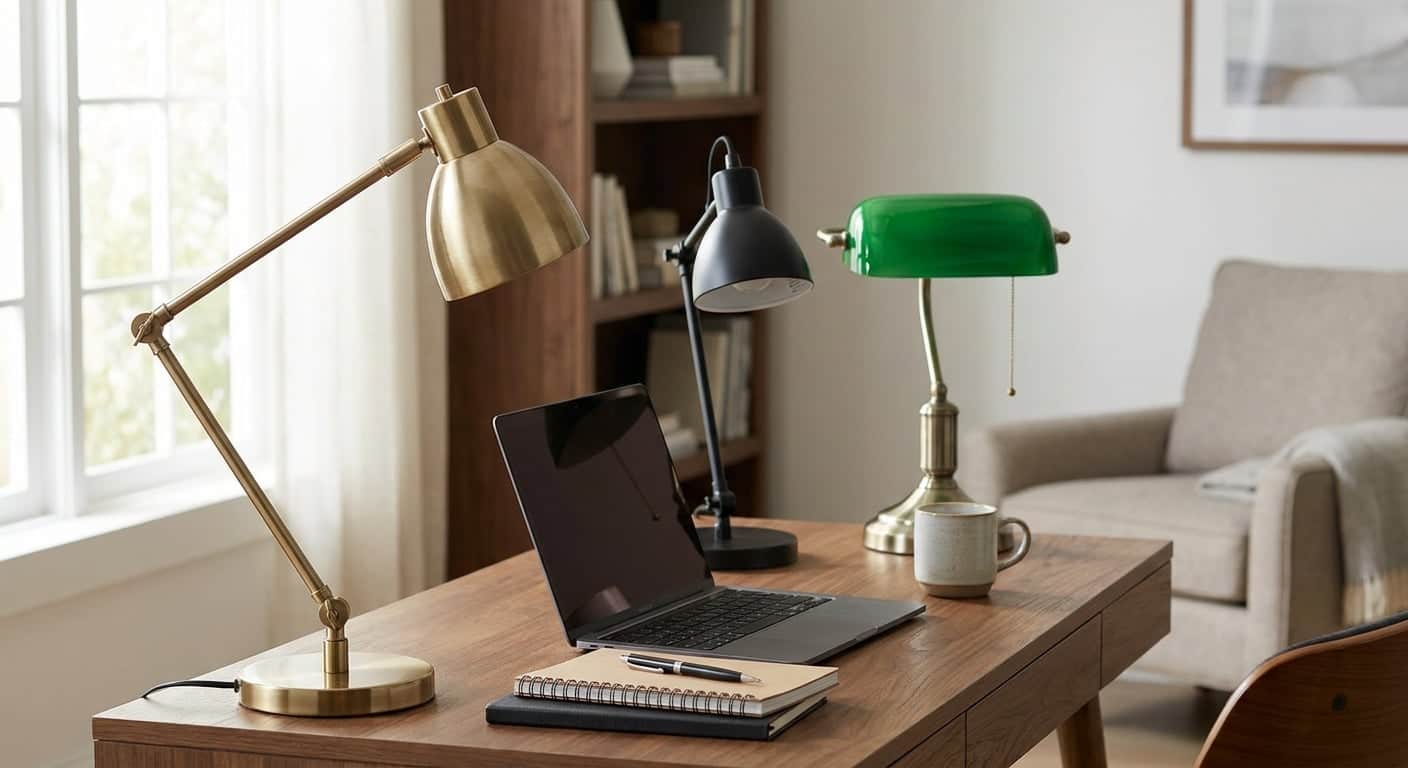
A desk lamp decides whether four hours at a screen feels like work or like squinting through a headache. This guide ranks the replica desk lamp designs worth buying in 2026, what each one gets right, and which home office setup it actually suits.
TL;DR- The AJ Table Lamp wins for architects and minimalists who want a fixed, glare-free pool of light — Buy.
- The Tizio 50 is still the best desk lamp for home office use if you need a long reach over a wide desk.
- Skip decorative pendant-style lamps as your only task light; they read beautifully but under-light a keyboard.
- The PH5 costs more attention to place correctly but rewards you with the warmest, least clinical desk glow.
- Pair any lamp with a desk that has real surface depth — the Adrien Desk replica gives a task lamp room to sit without crowding a keyboard.
Why this matters
Most home office lamp shopping goes wrong on two fronts: color temperature and reach. A lamp that looks sculptural on a shelf can throw a hot spot four inches wide when you need coverage across a keyboard and a notebook. And a lamp bought for looks alone often lands at 2700K, which is cozy for a living room and sleep-inducing for a 2pm deadline.
The designs below have survived decades of actual desk use, not just photography. Each one has a documented design year, a specific mechanical trait, and a real limitation. None of them are universally correct — the right pick depends on desk depth, how long you sit, and whether you're lighting a laptop or a drafting table.
How we ranked
Each lamp is judged against four criteria that matter for a home office specifically: reach and adjustability, glare control, build era and material honesty, and how well it pairs with a working desk rather than a side table. Design dates are pulled from public design history records, not marketing copy. Verdicts reflect fit for daily desk work in 2026, not collectibility.
The ranked list
1. AJ Table Lamp (Arne Jacobsen, 1957) — the architect's pick
Jacobsen designed this lamp for the SAS Royal Hotel in Copenhagen in 1957, and the perforated shade still does the job it was built for: it diffuses light downward without a visible bulb glare from typical seated eye level. The base is heavy enough — replica versions run in the 4 to 6 lb range — that it doesn't tip when you reach across a desk for a notebook.
It's fixed-angle, not articulated, so it suits a desk where the lamp sits to one side and stays put. Pair it with a desk that has enough depth to keep the shade clear of a monitor stand. Verdict: Buy for anyone who wants a permanent, no-fuss light source and doesn't need to redirect the beam.
2. Tizio 50 (Richard Sapper, 1972) — the engineer's lamp
Sapper built the Tizio around a low-voltage halogen system and a counterweighted arm that reaches roughly 40 inches when fully extended. That reach is the whole point: it can light a keyboard, a document to the left, and a sketch pad to the right without moving the base.
The tradeoff is the halogen bulb runs warmer to the touch than an LED fixture, and replacement bulbs are a smaller market in 2026 than they were a decade ago. If you want one lamp to cover a wide desk from a single point, this is still the strongest mechanical design in the category. Verdict: Buy for wide desks and multi-task surfaces.
3. Grasshopper Table Lamp (Greta Grossman, 1947) — the minimalist
Grossman's 1947 design strips the desk lamp down to a cone shade, a slim stem, and a base with almost no ornament. It reads as quiet rather than sculptural, which makes it the easiest lamp on this list to place next to a laptop without competing with the rest of the room.
The shade angle is adjustable but the stem itself doesn't extend, so it works best on a desk where the lamp sits close to the work surface rather than reaching over it. It pairs naturally with the kind of pared-back setup covered in the minimalist home office chairs guide. Verdict: Consider if your desk is narrow and you want the lamp to disappear visually.
4. Anglepoise Original 1227 (George Carwardine, 1935) — the workhorse
Carwardine's 1935 spring-arm mechanism is the direct ancestor of nearly every articulated desk lamp made since. The four-spring system lets the head hold position at almost any angle without drifting, which matters if you're switching between a keyboard and a physical notebook through the day.
It's utilitarian rather than a design statement, and the visible springs won't suit every aesthetic. For pure function on a working desk, it still outperforms lamps that look more polished. Verdict: Buy for anyone who wants adjustability over style.
5. PH5 Table Lamp (Poul Henningsen, 1958) — the warm pick
Henningsen's multi-shade system, refined through the 1950s, bounces light between layered shades so the bulb itself is never visible from any seated angle. The result is a genuinely glare-free glow, but it's built for ambient and reading light more than sharp task lighting on paper.
It sits better as a secondary lamp next to a primary task light than as your only desk fixture. If you're building out a full lighting layer for a home office, the PH Artichoke Lamp replica placement guide covers how Henningsen's shade logic scales up for a room, which is useful context before you commit to this smaller table version. Verdict: Consider as a second light, not your only one.
6. Tolomeo (Michele De Lucchi, 1987) — the modern articulated arm
De Lucchi's 1987 design replaced heavy counterweights with a cable-and-pulley tension system, which is why the arm feels lighter to reposition than the Tizio's. It extends to roughly 35 inches and holds an LED head in most current production, so color temperature is adjustable rather than fixed.
It's the newest design on this list and reads more industrial than mid-century, which matters if the rest of your office leans toward 1950s and '60s references. Verdict: Consider if you want LED flexibility over vintage material honesty.
7. Panthella Mini (Verner Panton, 1971) — the style-first option
Panton's mushroom-shade design from 1971 is genuinely striking on a desk, and the acrylic shade throws a soft 360-degree glow rather than a directional beam. That's exactly the problem for task work: it lights the room around the desk more than the surface on it.
Treat this as a lamp for a reading corner or a shelf, not the lamp doing the heavy lifting for four hours of screen work. Verdict: Skip if this is your only desk light; fine as an accent.
Build the desk before the lamp
See mid-century modern desks sized for real home office work.
Shop SohnneComparison table
| Lamp | Design year | Light behavior | Best for | Verdict |
|---|---|---|---|---|
| AJ Table Lamp | 1957 | Fixed, diffused downlight | Single-position desks | Buy |
| Tizio 50 | 1972 | Directional, ~40in reach | Wide desks, multi-task | Buy |
| Grasshopper | 1947 | Adjustable shade, no stem reach | Narrow, minimalist desks | Consider |
| Anglepoise 1227 | 1935 | Fully articulated spring arm | Frequent angle changes | Buy |
| PH5 | 1958 | Glare-free ambient glow | Secondary/reading light | Consider |
| Tolomeo | 1987 | Articulated, LED-adjustable | Modern-leaning offices | Consider |
| Panthella Mini | 1971 | 360-degree diffuse | Accent, not task light | Skip |
Where to buy
- Confirm the return window before you commit. A lamp that looks right in photos can throw a color temperature that doesn't suit your room; a 60-day return window gives you time to actually live with it at a desk.
- Check the warranty term against how long you plan to keep the piece. A 5-year warranty on the base and wiring is a reasonable minimum for anything you'll run 6-8 hours a day.
- Verify shipping is insured for anything with a glass or acrylic shade. Table lamps with layered shades travel worse than solid-base fixtures, and insured shipping protects you against a cracked shade on arrival.
What to avoid
- Don't buy a lamp based on the shade alone. A beautiful shade with no arm articulation forces you to move your desk setup around the lamp instead of the other way around.
- Don't assume warm white (2700K) works for daytime desk work. It's ideal for evening ambience but too low-contrast for reading fine print at 2pm; look for lamps offering 3500K-4000K for task use.
- Don't skip the base weight check. A lamp under 3 lbs on a shallow desk tips the first time a cable snags it.
FAQ
What’s the best desk lamp for a home office in 2026?
The AJ Table Lamp (1957) and the Tizio 50 (1972) are the strongest picks for 2026 home offices — the AJ for fixed, glare-free lighting and the Tizio for its 40-inch reach across wider desks.
Is a replica lamp as good as the original design?
A well-made replica reproduces the original mechanical system — spring arm, counterweight, or diffuser shade — at the same dimensions, so function matches closely; material grade and finish are where quality varies most between makers.
How much light do I need for a home office desk?
Most task lighting guidance points to 3500K-4000K color temperature for daytime desk work, with enough lumen output to cover a keyboard and a notepad without a visible hot spot.
LED vs halogen for a desk lamp?
LED heads run cooler to the touch and use less power over a workday; halogen fixtures like the original Tizio design throw a slightly warmer, more directional beam but generate more heat at the bulb.
Should a desk lamp have a dimmer?
Yes, if you work variable hours — a dimmer lets you match the lamp to daylight in the morning and boost it for evening work without swapping bulbs.
Best color temperature for a home office desk lamp?
3500K to 4000K is the standard range for daytime task lighting; anything below 3000K reads as ambient, not task, light.
Do desk lamps need UL certification?
Any lamp running for hours daily in a home office should carry UL or equivalent safety certification, particularly for halogen or high-wattage fixtures.
What’s the difference between task lighting and ambient lighting in a home office?
Task lighting is directional and focused on a work surface, like the Tizio or Anglepoise; ambient lighting, like the PH5 or Panthella, fills the room but doesn’t concentrate enough light for close work.
One last thing
The Anglepoise 1227's four-spring mechanism from 1935 is still the reference point every articulated desk lamp made since has copied — including the Tizio and the Tolomeo. If you only trust one design logic in this list, trust the one that's been copied for 90 years.
Related guides
- The Adrien Desk replica for a home office
- Best replica desks for a small home office
- Best replica chairs for a minimalist home office
- Replica furniture for home offices: desks, chairs, storage
- PH Artichoke Lamp replica room placement guide
Stay connected with us!
Keep in touch with what’s new and next. Subscribe for weekly insights, product launches, and community news!