PH Artichoke Lamp Replica: Room Placement Guide 2026

Sohnne Design Studio
July 8, 2026
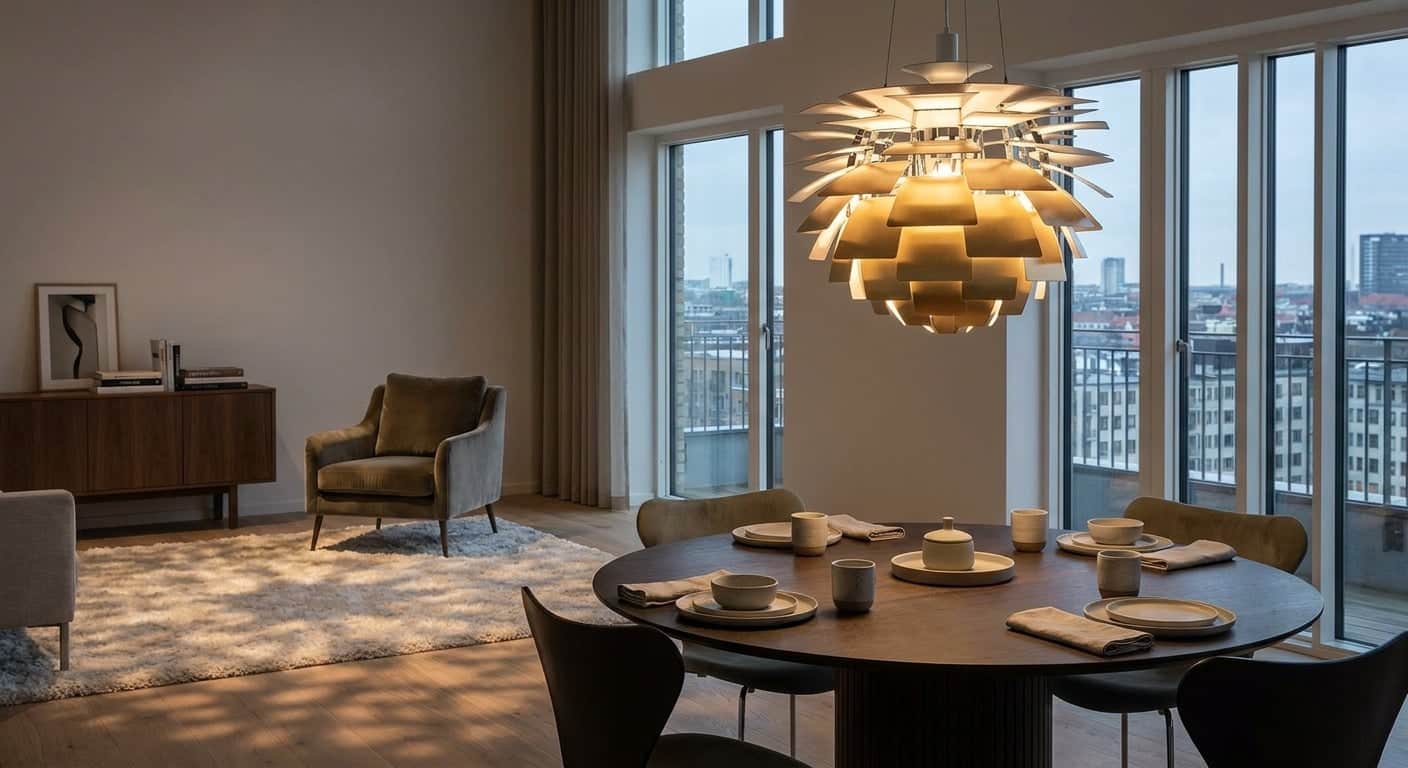
The PH Artichoke lamp replica is one of the few mid-century lighting pieces that earns its wall-space in any room it enters — but only when you hang it at the right height, in the right spot, above the right surface. This guide covers every placement scenario, from a low-slung dining table to a bedroom reading corner, so your replica performs the way Poul Henningsen intended in 2026.
TL;DR: A PH Artichoke lamp replica works in dining rooms, living rooms, entryways, and bedrooms. The non-negotiable: hang it 28–32 inches above a dining table surface, centered on the room's primary axis, with at least 18 inches of clearance from any wall. In 2026, the most common placement mistake is hanging it too high — which flattens the shade's leaf geometry and kills the glare-free effect Henningsen spent years perfecting.
Why Placement Defines the Artichoke's Effect
The original PH Artichoke was designed in 1958 for the Langelinie Pavilion in Copenhagen. Its 72 leaves (12 rows of 6) are engineered so that every leaf hides the bulb from every sightline — but only when the fixture hangs at a specific eye-line relationship to the viewer. Hang it too high and you see straight into the bulb. Too low and the leaves cast shadows onto the surface below instead of illuminating it. The geometry only works within a defined range, and that range varies by room use.
A quality ph artichoke lamp replica reproduces this geometry at 1:1 original dimensions, which means the placement math carries over directly from Henningsen's own installation notes.
Who This Guide Is For
You're buying or have bought a PH Artichoke lamp replica — likely the 48 cm or 60 cm version — and you need to know exactly where to hang it. You're not an interior designer by trade. You want one clear answer per room type, not a mood board. This guide gives you the ceiling height, drop distance, horizontal clearance, and common mistakes for each placement scenario.
What to Look for in a PH Artichoke Lamp Replica for Placement
Shade Diameter vs. Room Scale
The 48 cm shade suits rooms under 200 sq ft — a dining nook, a bedroom, a hallway alcove. The 60 cm version needs at least 250 sq ft to breathe; in a tight space it becomes furniture, not lighting. Measure the room's shortest horizontal dimension and keep the shade diameter below 30% of that figure.
Drop Length (Cord or Rod)
Most replicas ship with 118–157 inches of adjustable cord. The finished drop — from ceiling to the bottom of the shade — determines whether the glare-shield geometry works. For standard 9-foot ceilings, a 54-inch drop positions the shade bottom at roughly 54 inches from the floor, ideal over a 30-inch dining table. If your ceilings run 10 or 12 feet, you need a replica that allows longer drop customization, or you'll be hanging the shade at the wrong height regardless of the room.
Leaf Finish and Light Bounce
Brush-finished steel or copper leaves reflect light differently than painted leaves. Copper bounces warm amber tones downward and sideways; painted steel reads cooler. The finish affects how the room feels, not just how the lamp looks. In a space with warm wood tones — walnut dining table, oak floors — copper amplifies the warmth. In a white or concrete-heavy room, painted steel keeps the light crisp.
Ceiling Junction Box Position
The Artichoke is a pendant, not an adjustable track fixture. The junction box is fixed. Before you commit to a placement, confirm the box sits within 6 inches of where you want the shade's center — lateral offset beyond that makes the fixture look tilted and throws off the leaf geometry's symmetry.
Bulb Type and Wattage
The original design was built around incandescent sources. Most replicas in 2026 ship with E26 sockets rated for LED. Use a dimmable LED at 2700K–3000K and no more than 800 lumens per socket. Bright-white LEDs at 4000K+ wash out the copper or steel finish and make the leaves look flat rather than sculptural.
Room Function and Traffic Flow
The Artichoke is a statement piece that draws eyes upward. In high-traffic paths — a hallway, above a kitchen island with bar stools that swing out — the low-hanging shade becomes a collision risk. Any placement below 66 inches from the floor in a walkway is a problem. Over a fixed surface (dining table, desk, sofa), lower drops work because people don't walk through the zone.
Top Placement Scenarios
Dining Room — The Classic
The safe pick. This is the room Henningsen's geometry was built for: a fixed table, seated diners, a single dominant light source. Hang the bottom of the shade 28–32 inches above the tabletop. For a 48 cm shade over a 36-inch-wide table, that gives you a shade-to-table width ratio near 1.3:1, which reads as balanced without overwhelming the surface. Center the pendant on the table's long axis, not the room's long axis — they're often different.
Verdict: Buy for this room first. If you have a dining table and ceiling clearance of at least 7 feet above the floor, the ph artichoke lamp replica belongs here before anywhere else.
Living Room — Over a Seating Group
The considered pick. Hang the shade 60–66 inches from the floor, centered over a coffee table or the centroid of a seating arrangement. The challenge: most living rooms have sofas that face the pendant at close range, which puts the viewer's sightline nearly parallel to the leaves. This is exactly the condition where a low-quality replica fails — the leaf gaps misalign and the bulb becomes visible. A replica built to 1:1 original dimensions handles this; a poorly-scaled copy doesn't.
Leave at least 24 inches of horizontal clearance from the nearest sofa arm. The shade needs visual breathing room or it reads as cramped.
Verdict: Buy if your living room has a 9-foot-plus ceiling. At 8 feet, the geometry gets tight and the fixture can feel oppressive.
Entryway — Drama at the Door
The wildcard. A double-height entryway — 14 to 20 feet — is the one space where you can hang the Artichoke at true chandelier scale and let the leaf structure read from below at full impact. Drop the shade to eye level plus 12 inches, roughly 72–78 inches from the finished floor. The upward view through the leaves from the entry floor is the best angle in the house.
The downside: bulb changes require a ladder every time, and entryways accumulate dust faster than any other room. Budget for semi-annual cleaning.
Verdict: Consider if you have the ceiling height. Don't force it into a standard 9-foot entry — the proportions won't work.
Bedroom — Low and Warm
The quiet pick. Over a nightstand or above a reading chair, a 48 cm shade hung 18–22 inches above the surface creates a pool of warm light without spilling onto a sleeping partner. This works only if the junction box sits directly above the nightstand — lateral offset makes the shade hover awkwardly over the bed instead of the table.
In a bedroom, wattage matters more than anywhere else. A dimmable LED at 400–600 lumens at 2700K gives you the warm, low-level glow that makes the copper finish glow without lighting the whole room.
Verdict: Buy for a bedroom reading nook if the junction box cooperates. Don't retrofit a bedroom ceiling box just for this placement — the cost rarely justifies the result.
Kitchen Island — Proceed with Caution
The risky pick. Islands attract grease vapor, steam, and splatter. The Artichoke's leaf structure — 72 overlapping surfaces — is one of the hardest pendant forms to clean in any kitchen environment. Over a prep island, this is a maintenance problem every 6–8 weeks. Over a purely seating island where no cooking happens, the risk drops significantly.
If you proceed, hang the shade 30–36 inches above the counter surface and ensure the island is at least 40 inches wide so the shade doesn't crowd the edges.
Verdict: Skip for active prep islands. Consider for seating-only islands with good ventilation.
What to Avoid
- Hanging over asymmetric furniture arrangements. The Artichoke is a radially symmetric object. When it hovers off-center above an L-shaped sofa or a table pushed against a wall, the asymmetry reads as a mistake, not a design choice.
- Mixing it with other pendant clusters. The Artichoke works as a solo fixture. Pairing it with two smaller pendants on the same ceiling run creates visual competition — the other pendants lose, and the Artichoke looks try-hard.
- Using it as task lighting. The leaf geometry diffuses and redirects light; it doesn't concentrate it. For reading, food prep, or desk work requiring focused illumination, add a dedicated task light rather than expecting the Artichoke to fill that role.
Placement Comparison Table
| Room | Shade Size | Drop Height (floor to bottom) | Verdict |
|---|---|---|---|
| Dining room | 48 cm or 60 cm | 58–62 in (28–32 in above 30-in table) | Buy |
| Living room (9 ft+ ceiling) | 48 cm or 60 cm | 60–66 in | Buy |
| Double-height entryway | 60 cm | 72–78 in | Consider |
| Bedroom / reading nook | 48 cm | Variable (18–22 in above surface) | Buy |
| Active kitchen island | Any | 30–36 in above counter | Skip |
| Seating-only kitchen island | 48 cm | 30–36 in above counter | Consider |
FAQ
What is the best room for a PH Artichoke lamp replica?
The dining room. The 58–62 inch floor-to-shade-bottom drop places the fixture at exactly the geometry Henningsen designed for — seated diners, fixed table, single dominant source. In 2026, this remains the placement where the replica earns every dollar spent.
How high should I hang a PH Artichoke lamp replica above a dining table?
28–32 inches above the tabletop surface. That puts the shade bottom at roughly 58–62 inches from the floor for a standard 30-inch table. Going higher than 32 inches above the table exposes the bulb from a seated sightline.
What ceiling height do I need for a PH Artichoke lamp replica?
Minimum 8 feet, but 9 feet is the practical floor for most placements. At 8 feet, the correct drop height leaves the shade at 54–58 inches, which works over a dining table but feels low in an open living room.
Is a 48 cm or 60 cm Artichoke replica better for a small apartment?
The 48 cm. In rooms under 200 sq ft, the 60 cm shade fills too much of the visual field and reads as oversized. The 48 cm maintains the design's proportions without dominating a compact space.
Can I put a PH Artichoke lamp replica in a kitchen?
Only over a seating-only island with good ventilation. Over an active cooking surface, the 72-leaf structure collects grease and requires cleaning every 6–8 weeks — a maintenance commitment most owners underestimate in 2026.
What bulb works best in a PH Artichoke lamp replica?
A dimmable LED at 2700K–3000K, no more than 800 lumens. This matches the original incandescent warmth and makes the copper or steel finish read correctly. Cool-white LEDs at 4000K+ flatten the leaf finish.
Does the PH Artichoke lamp replica work over a bed?
Not directly over a bed — the geometry creates a glare issue when viewed from a horizontal position. Over a nightstand or a bedside reading chair, hung 18–22 inches above the surface, it works well.
How much clearance does a PH Artichoke lamp replica need from walls?
At minimum 18 inches from the nearest wall to the outer edge of the shade. The leaves need space to read as three-dimensional; tighter clearance makes the fixture look like it's wedged into the ceiling.
One Last Thing
Poul Henningsen's original installation at the Langelinie Pavilion used 12 Artichoke pendants in a row, each hung at 63 inches from the floor — a specific number he arrived at after watching diners look up during the first service. The geometry of the leaves isn't decorative first; it's functional first. Every placement decision you make with a ph artichoke lamp replica in 2026 is, at its core, a decision about sightlines. Get the drop height right and the rest follows.