How to Layer Rugs With Furniture Living Room (2026)

Sohnne Design Studio
July 25, 2026
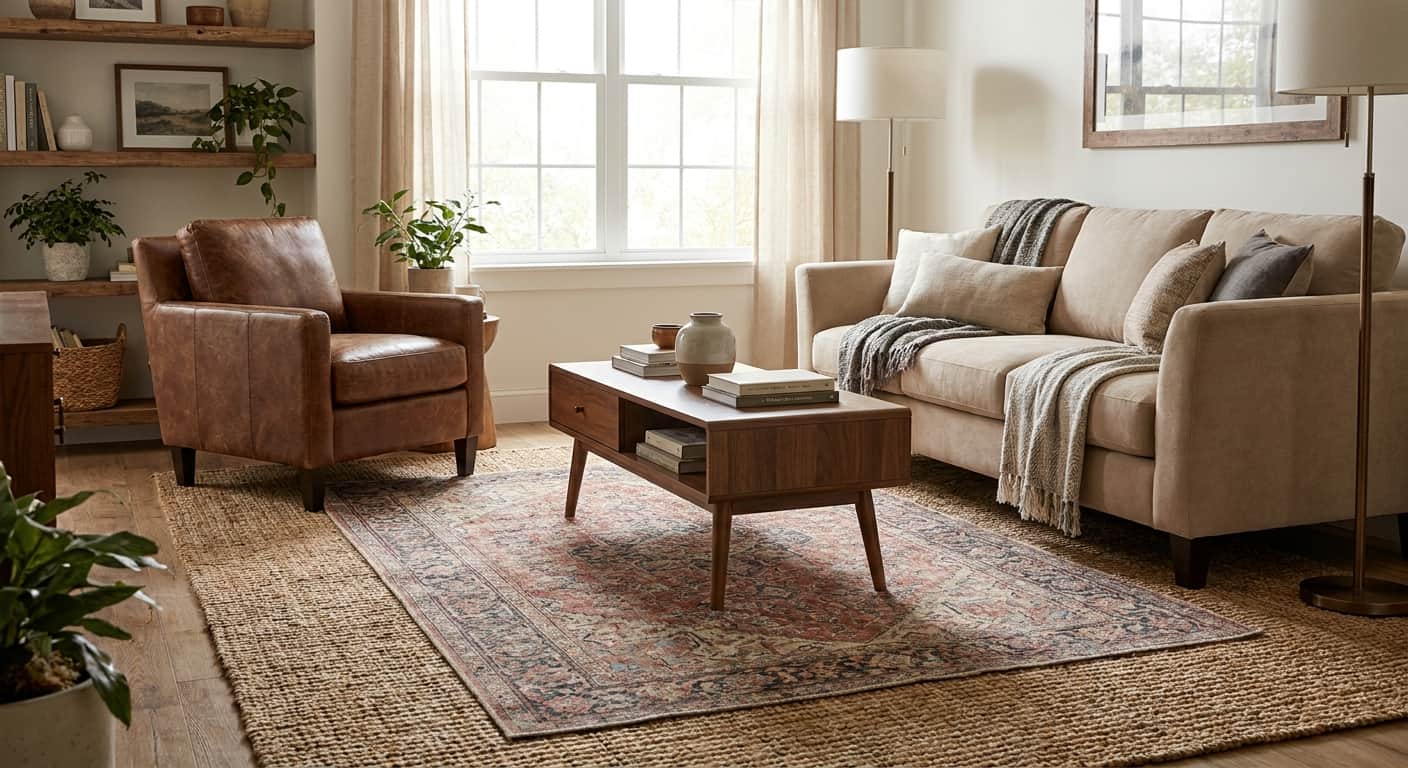
Layering rugs under mid-century modern furniture is the fastest way to make a living room look designed instead of decorated — but most people stack the wrong sizes and end up with a room that reads cluttered, not warm.
TL;DR- Layer a 9×12 jute base under an 8×10 patterned rug for the classic living room formula in 2026.
- All four sofa legs must sit on the top rug, or the layering reads as a mistake, not a style.
- Sohnne’s mid-century modern replica furniture pairs best with low-pile wool or flatweave rugs, never shag.
- Skip matching rug and sofa tones exactly — a half-shade contrast is what separates layered from flat.
- A Togo sofa replica or Dune sofa replica needs a rug that extends 8-10 inches past the front legs minimum.
Why this matters
A single rug under a coffee table looks like an afterthought. Two rugs, sized and textured correctly, anchor a seating group the way a good area rug is supposed to — visually, not just underfoot.
The mistake most homeowners make in 2026 is buying one rug too small for the room and calling it done. Layering fixes that without forcing you to buy an oversized 12×15 rug that swallows a mid-sized living room. It also lets you mix texture (jute, wool, flatweave) in a way a single rug never can, which is exactly the kind of detail that makes a room with mid-century modern replica furniture feel curated instead of showroom-generic.
What you'll need
- A base rug, ideally jute, sisal, or a low-cost flatweave, sized to the room (9×12 or 10×14 for most living rooms)
- A top rug, wool or a tighter weave, roughly two-thirds the size of the base (8×10 under a 9×12, for example)
- A tape measure — guessing sizes is the single most common failure point
- Rug pad or non-slip grid tape for the top layer
- Your seating pieces already placed, or at least measured — a modular sofa replica behaves differently in a layout than a single lounge chair
- 20-30 minutes to test placement before you commit to rug pads
The steps
1. Measure your seating group first, not the rug
Pull a tape measure around your sofa, chairs, and coffee table as a cluster before you buy anything. This tells you the minimum footprint the top rug needs to cover.
Most living rooms need a top rug between 8×10 and 9×12 to get all front legs on the rug. Skipping this step is why so many layered-rug setups look shrunk — the top rug was bought by eyeballing the room, not the furniture group.
Common mistake: buying the top rug the same size as the room instead of the seating cluster. That defeats the point of layering.
2. Choose a base rug that's a true neutral
The base layer's job is texture, not color. Jute, sisal, and flatweave wool in a natural tone do this without competing with your top rug or your furniture upholstery.
Go one size up from what feels right — a 9×12 base under an 8×10 top rug gives you a consistent 12-18 inch border of exposed base rug on all sides, which is the ratio that reads as intentional rather than mismatched.
Common mistake: picking a base rug with its own bold pattern. That's a job for the top layer only.
3. Pick the top rug for color and pattern, not size
Once the base is down, the top rug carries the personality — a vintage-style Persian, a bold geometric, or a solid in a contrasting tone. This is the layer people actually notice.
If your seating includes a piece with strong upholstery, like a Dune sofa or a boldly colored lounge chair, keep the top rug's pattern simpler so the furniture stays the focal point.
Common mistake: matching the top rug's dominant color exactly to the sofa fabric. A half-shade contrast reads as designed; an exact match reads as flat.
4. Center the layered rugs on the seating group, not the room
Find the midpoint of your sofa-and-chairs cluster and center both rugs there, not on the room's architectural center. Rooms are rarely symmetrical to their seating arrangement, and centering on walls instead of furniture is a fast way to end up with a rug that looks off-kilter once the sofa's in place.
Use painter's tape on the floor to mark rug corners before committing, especially in an L-shaped layout where sightlines from the entry matter more than the room's actual geometry.
Expected outcome: both rugs should sit square to your sofa's front edge, not the wall behind it.
5. Get every front leg on the top rug
This is the rule that makes or breaks the whole layering approach: every front leg of every major seating piece must land on the top rug. Back legs can sit on the base layer or float past it — that's fine and even expected.
A rule of thumb that holds across 2026 living room layouts: measure 8-10 inches past your sofa's front legs to set the top rug's front edge. Anything tighter and the rug reads too small even with correct layering.
“If a single front leg is off the top rug, the whole layered look reads as an accident.”
6. Anchor with rug pads before you finalize furniture
Slide a low-profile rug pad between the base and top layers, and a second grip pad under the base against the floor. Two rugs stacked without padding will migrate within a week of normal foot traffic, especially in high-traffic paths between the sofa and a TV console.
Pull furniture back into final position only after both pads are placed flat with no ripples.
Common mistake: skipping the pad between the two rug layers specifically — this is the layer that slides most, not the one against the floor.
7. Step back and check sightlines from the entry
Stand at the room's main entry point and look at the layered rugs before calling the layout finished. Corners that looked square up close sometimes read crooked from the doorway, where most guests will actually form their first impression.
Adjust in small increments — an inch or two of rotation usually solves it, not a full re-measure.
Troubleshooting
- The top rug keeps sliding on the base layer. Add a rug-to-rug gripper pad between the two — standard non-slip pads made for hard floors don't grip fabric-to-fabric the same way.
- The layered look feels busy, not warm. Drop one pattern. Two solids plus one pattern reads calmer than pattern-on-pattern, especially with upholstered mid-century modern furniture already carrying visual weight.
- Furniture legs sink or leave dents in the top rug. Use furniture coasters under any leg resting on wool pile over 0.5 inch — this also protects the rug's texture over time.
- The base rug's edges curl. Flatweave and jute rugs curl in their first few weeks; a rug pad and a few days of furniture weight on the edges usually flattens them without intervention.
- The room still feels cold despite two rugs. Check that the top rug covers at least 70% of the seating cluster's footprint — anything less and the floor-to-furniture ratio still reads sparse.
- Colors clash once the room is fully furnished. Bring a fabric swatch from your sofa or chair to the rug store rather than trusting memory — screen colors and in-store lighting shift tones more than people expect.
Tools and resources
- A statement sofa styling guide if your seating piece is the room's focal point rather than the rug layout
- The mid-century modern replica furniture roundup for pairing pieces that suit a layered-rug living room
- A guide on mixing replica furniture with vintage pieces, useful if your rug layering includes an inherited or thrifted piece
- Painter's tape, a tape measure, and two rug pads — the only physical tools this project actually requires
- Sohnne's full furniture catalog for sourcing the seating pieces the rug layout needs to support
What to do next
Once the rug layout is set, the furniture arrangement around it matters just as much. If your living room runs long or L-shaped, check how the sofa and chairs should sit relative to a layered rug before finalizing anything — a rug placed correctly under the wrong furniture arrangement still looks off.
FAQ
How do you layer rugs with furniture in a living room?
Place a larger neutral base rug (9×12 or 10×14) under a smaller patterned top rug (8×10), then position both so every front leg of your sofa and chairs sits on the top rug. The base shows as a 12-18 inch border around the top layer.
What size rug goes under a sofa in 2026?
The top rug should extend 8-10 inches past the sofa’s front legs at minimum, which usually means an 8×10 or 9×12 rug for a standard three-seat sofa and coffee table cluster.
Can you layer two patterned rugs together?
You can, but it usually reads as busy rather than warm. Pairing one solid or textured base (jute, flatweave) with one patterned top rug is the more reliable combination for 2026 living rooms.
Do all four sofa legs need to be on the rug?
Only the front legs need to sit on the top rug; back legs can rest on the base layer or float off the rug entirely. All four legs on a rug too small for the room is what makes layering look accidental.
What rug material works best under mid-century modern furniture?
Low-pile wool, flatweave, and jute hold their shape under mid-century modern replica furniture better than shag or high-pile options, which tend to shift and flatten unevenly under heavier wood-frame pieces.
Does a layered rug work in a small living room?
Yes, if you scale both rugs down proportionally, using a 6×9 base under a 5×8 top rug rather than skipping the base layer entirely. Skipping the base in a small room usually looks like a mistake rather than a minimalist choice.
How do you keep layered rugs from sliding?
Use a rug-to-rug gripper pad between the base and top layer, plus a standard non-slip pad under the base against the floor. Without the rug-to-rug pad specifically, the top layer migrates within a week of regular foot traffic.
Should the rug match the sofa color?
No, a half-shade contrast between the rug and sofa upholstery reads as designed, while an exact color match tends to flatten the room visually. This matters most with a statement piece already carrying strong color or pattern.
One last thing
The detail most people skip is centering the rugs on the seating cluster instead of the room's walls — and it's the single fastest fix if a layered rug setup still feels off after everything else checks out.
Related guides
- How to style a modular sofa replica in an open-plan space
- How to mix replica furniture with vintage pieces
- Best mid-century modern replica furniture for living rooms
- How to decorate a living room with a statement sofa