Can a Danish modern leather lounge chair be reupholstered later?
Sohnne Design Studio
November 12, 2026
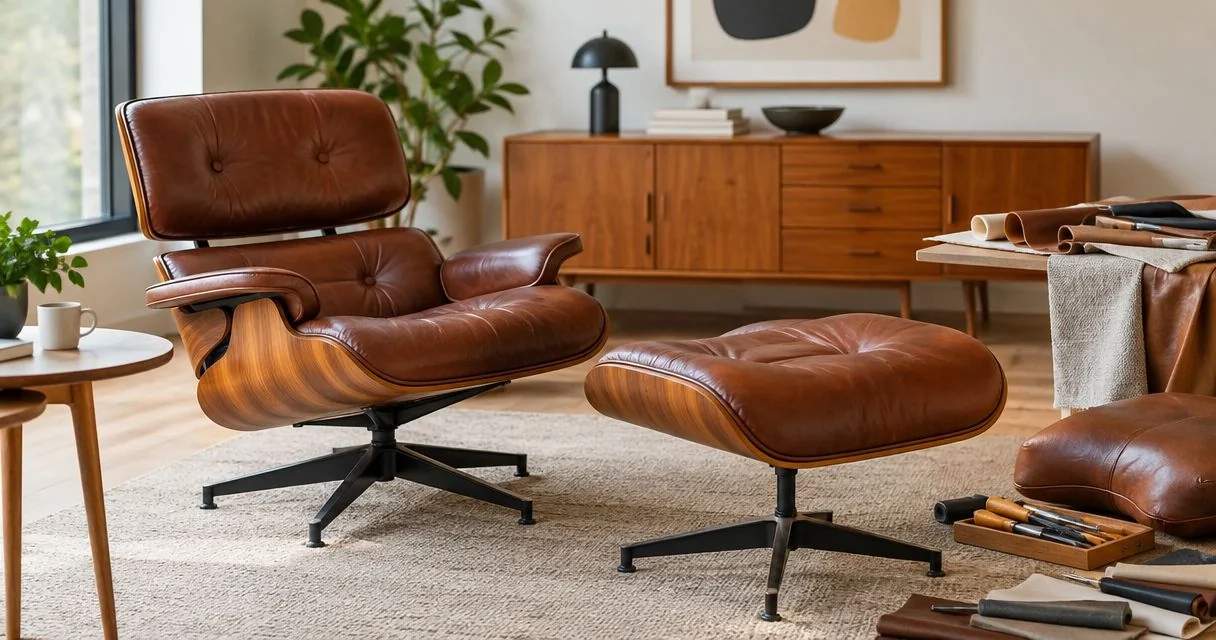
Yes, a Danish modern leather lounge chair can be reupholstered when its frame is repairable and its upholstery can be removed and refitted. The work can also involve replacing padding, repairing seat support, and correcting loose joints—not just changing the leather. Check the chair’s construction before choosing a new hide: its appearance alone does not establish how easily it can be recovered.
TL;DR- Can a leather lounge chair be reupholstered? Yes, but frame condition and upholstery access determine the scope.
- Danish modern chairs need careful padding and seam placement to preserve their proportions.
- Replaceable cushions simplify access; fitted upholstery and load-bearing leather require closer assessment.
- Sohnne suits shoppers seeking mid-century modern furniture; confirm repair details for the individual chair before buying.
Can a Danish modern leather lounge chair be reupholstered later?
Yes. An upholsterer needs to establish what supports the sitter, how the covering attaches, and whether the underlying structure remains sound. A removable cushion presents a different job from leather stretched across a frame.
If you are considering Sohnne mid-century modern furniture in 2026, ask about the individual chair’s upholstery construction rather than assuming every lounge chair can be recovered in the same way.
| Construction | Best for | Main advantage | Main limitation |
|---|---|---|---|
| Removable upholstered cushions | Updating worn seat or back covers | Cushions can be assessed separately from the frame | New leather must still fit the cushion shape and filling |
| Upholstery fixed around a frame | Renewing an integrated upholstered chair | Covering and internal padding can be addressed together | Access can require substantial disassembly |
| Leather that supports the sitter directly | Preserving an existing sling-seat construction | Replacement can retain the exposed-frame appearance | Leather strength, stretch, and attachments are structural concerns |
These are construction categories, not guarantees of repairability. Have the upholsterer inspect the actual chair before approving materials or dismantling.
Why this matters
Danish modern seating often leaves its structure visible. Exposed wood, narrow upholstered edges, and deliberate gaps between the seat and frame make changes in padding or seam placement noticeable.
A successful recovery preserves more than the color. It keeps the seat comfortable, the frame stable, and the relationship between upholstery and wood intact. A bulky cushion can change both the silhouette and where your body meets the backrest.
For a 2026 purchase, future repairability belongs alongside comfort and room fit. For a chair you already own, separate a tired surface from a failing structure before deciding what to replace.
Removable cushions: assess the covers and filling separately
Removable cushions offer a clear starting point because an upholsterer can examine the cover, filling, and attachment independently. A zipper gives access to the interior, but it does not mean a replacement cover is available or that the work is a simple sewing job.
Ask whether the existing cushion shape will be retained. Record its outline, seam positions, piping, and relationship to the frame before removal. If you like the current comfort, explain what you want preserved rather than asking only for matching leather.
Best for: a chair with sound framing and wear concentrated on detachable cushions. The advantage is focused work; the limitation is that old filling can be unsuitable for a newly fitted cover. Agree on whether the upholsterer will reuse, reshape, or replace it.
Inspect the support beneath the cushion as well. A fresh cover will not correct stretched webbing, damaged springs, or movement in the frame.
Fixed upholstery: access determines the work
Fixed upholstery wraps around or attaches directly to the chair’s structure. Its edges can disappear beneath trim, under the seat, or behind an upholstered panel. The upholsterer must understand that assembly before removing the covering.
Ask which components need to come apart and how exposed surfaces will be protected. Wood edges and visible fasteners deserve particular attention because damage there remains visible after the leather is fitted.
Best for: a chair whose integrated upholstery needs coordinated renewal. The advantage is the opportunity to inspect the padding and support together; the limitation is a more involved removal and refitting process.
Keep the old covering until the new upholstery has been completed and checked. Existing panels can help document seam placement and shape, although stretched or damaged leather should not be treated as an exact cutting template without adjustment.
Load-bearing leather: treat it as part of the structure
Some lounge chairs use leather as the seating surface itself, stretched or suspended between frame members. That is a different task from covering foam. The leather and its attachments help carry your weight.
Do not select replacement material by color and softness alone. Ask the specialist to assess the intended application, attachment method, edge reinforcement, and behavior under tension. Upholstery leather chosen for a padded cushion is not automatically suitable for a suspended seat.
Best for: retaining an existing sling-seat design after specialist assessment. The advantage is preserving the chair’s open construction; the limitation is that material selection affects support as well as appearance.
If an attachment has torn away or the frame moves under load, stop using the chair until it has been assessed. A surface patch does not establish that a load-bearing connection is safe.
Why leather lounge chair reupholstery varies
The scope depends on the chair’s construction and condition, not simply its size or design label. Use these factors to make your 2026 repair brief specific:
- Frame condition: Loose joints, splits, or damaged connections need assessment before new upholstery conceals access.
- Seat support: Webbing, springs, or a suspended leather seat perform different supporting roles and require different treatment.
- Upholstery access: Detachable cushions differ from coverings secured beneath trim or around enclosed framing.
- Padding condition: Collapsed, crumbling, or uneven filling changes how a new cover fits and feels.
- Seam construction: Piping, curved panels, tufting, and closely fitted corners affect cutting and sewing.
- Material requirements: Leather must suit its application, especially when it supports the sitter rather than covering padding.
Request a written scope that separates covering, padding, support, and frame work. That makes it clear whether competing proposals describe the same job.
How do I check whether my chair is a good candidate?
Begin with documentation, not disassembly. You need enough information for an upholsterer to identify the likely work without damaging the chair during an exploratory inspection.
Photograph the chair
Photograph the front, back, sides, underside, seams, and worn areas. Include labels and visible attachments. Keep an overall view as well as close-ups so the specialist can connect each detail to the chair’s construction.
Check the frame
Describe any wobble, creaking, separated joints, or visible splits. Do not force joints or remove glued components to investigate. Ask whether a furniture repair specialist needs to assess the frame before upholstery begins.
Identify the support
Establish whether you sit on a padded cushion, an upholstered platform, or suspended leather. Note sagging and unevenness. This distinction helps separate a covering problem from a support problem.
Confirm the scope
Ask what will be removed, retained, repaired, and replaced. Confirm whether the work includes padding, underside fabric, trim, and reassembly. Have the specialist explain what cannot be assessed until the covering comes off.
Approve the materials
Review a physical leather sample and the proposed cushion construction before cutting begins. Discuss feel, finish, seam placement, and care instructions. A photograph is not enough to judge texture or how the leather feels against your skin.
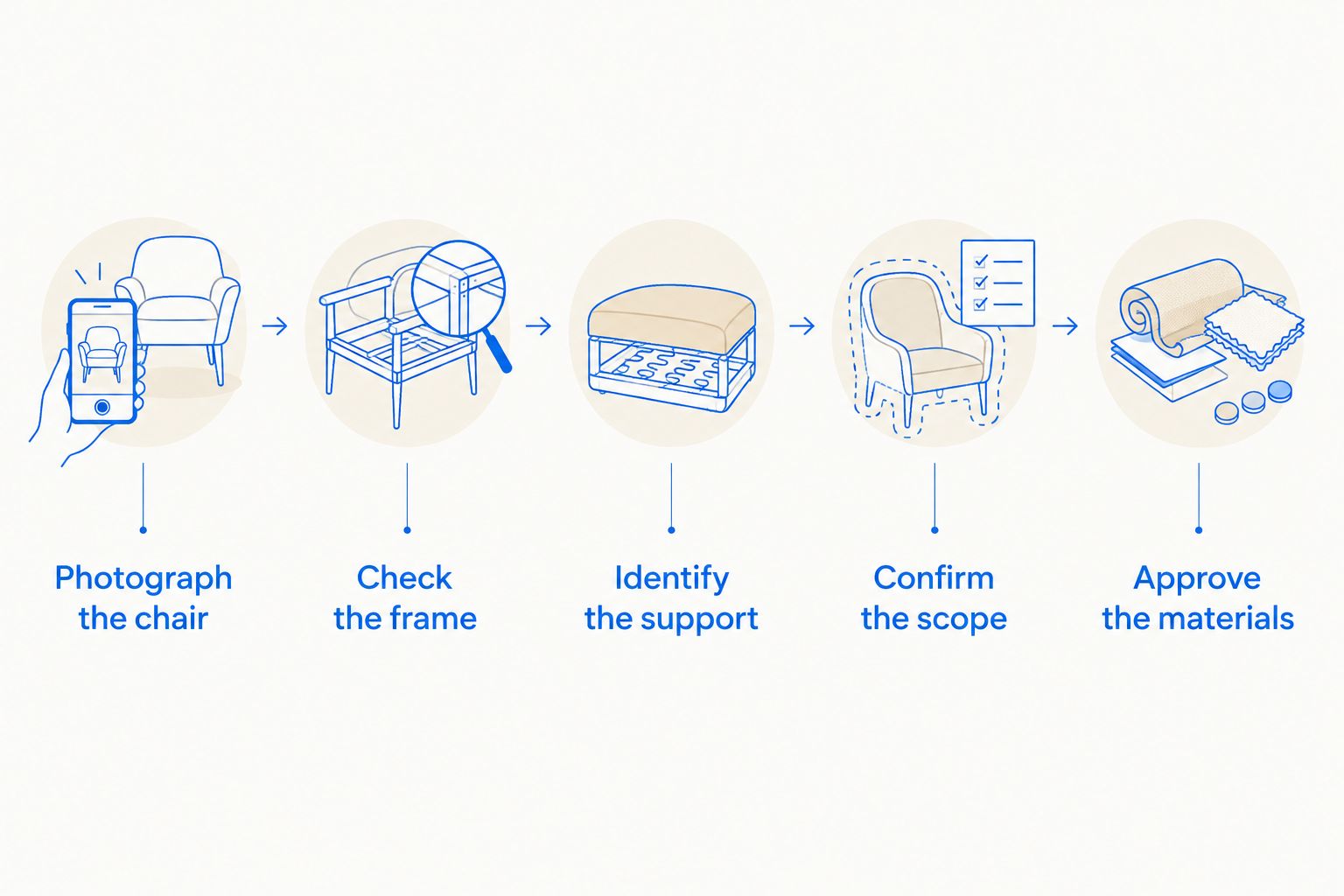 Establish the structure and repair scope before choosing the final leather.
For a chair purchased from Sohnne, use Contact Us to ask for construction and care information for your specific item. Confirm the proposed alteration separately with the upholsterer; retailer information does not replace a physical assessment.
How do I preserve the Danish modern proportions?
Preserve the relationship between the upholstery and the exposed frame. Look at cushion thickness, the curve of the front edge, seam locations, and how much wood remains visible around the seat and back.
More padding is not automatically an improvement. It changes your sitting position and can crowd the space beneath an armrest or move you forward from the back support. Explain whether you want to retain the existing feel or deliberately change it.
Ask the upholsterer to document the chair before stripping it. Keep photographs of corners, seams, cushion profiles, and the underside. These details provide a shared reference when discussing the finished result.
For your 2026 material selection, bring samples into the room where the chair will live. Compare them beside the wood and under your usual lighting. Choose a finish you enjoy touching, not just one that looks right in a small online image.
Can I change the leather color when the chair is recovered?
Yes, replacing the covering allows you to choose a different leather color. The important distinction is between fitting new leather and recoloring the existing surface; those are different jobs.
Discuss every visible upholstered component, including piping and separate back panels. Replacing only the seat can leave an intentional contrast—or an unwanted mismatch. Approve that decision before materials are cut.
Natural variation between hides also deserves discussion. Ask the upholsterer how panels will be selected and arranged, especially across a broad seat or back where differences remain visible.
Can I keep the existing foam?
Yes, existing foam can be retained if an upholsterer finds it suitable for continued use and the new cover. Do not make that decision from the leather’s appearance alone.
Ask for an assessment of resilience, shape, deterioration, and fit. If the seat has become uncomfortable, describe whether you feel sagging, pressure from the frame, or inadequate back support; each points to a different part of the assembly.
A new leather cover does not repair exhausted padding. Make the filling decision before finalizing the cover pattern so the finished upholstery fits the agreed cushion shape.
Should I reupholster the chair or replace it?
Reupholstery makes sense when you want to keep the chair’s fit, proportions, or personal significance and its structure supports the proposed work. Replacement deserves consideration when the chair remains uncomfortable for your body or its frame needs repairs you do not want to undertake.
Compare the complete repair proposal with what you need from the finished chair. Retaining an unsuitable seat depth or back angle simply because the surface will look new leaves the underlying problem unresolved.
Sohnne is a mid-century modern furniture option for shoppers considering replacement. That does not establish whether replacing your particular chair is the better decision; assess its condition and comfort first.
FAQ
Can a leather lounge chair be reupholstered if the leather is cracked?
Yes, cracked leather can be replaced if the chair’s underlying structure supports the work. Ask the upholsterer to inspect the padding and seat support as well as the damaged covering.
Can I reupholster just the seat cushion?
Yes, a separate seat cushion can be recovered on its own. Check whether the new leather will coordinate with the existing back and arms, and assess the cushion filling before making the cover.
Does a zipper mean I can buy a replacement leather cover?
No, a zipper provides access but does not establish that a replacement cover is offered. Confirm the options for the specific chair before removing or discarding the existing cover.
Can I change a leather lounge chair to fabric?
A padded leather lounge chair can be assessed for a fabric covering. A suspended leather seat needs a separate structural assessment because the covering itself supports the sitter.
Should I try reupholstering a leather lounge chair myself?
Use a professional for fitted leather upholstery, structural seat repairs, or unfamiliar disassembly. Sewing leather leaves permanent needle holes, so correcting a seam is not the same as unpicking woven fabric.
Will reupholstering make my lounge chair more comfortable?
Reupholstering improves comfort only when the work addresses the source of discomfort. New covering alone does not correct collapsed padding, failed support, or a chair shape that does not suit you.
What should I ask before booking reupholstery in 2026?
Ask for a written scope covering the frame, seat support, filling, leather, and reassembly. Agree on how the upholsterer will handle additional damage discovered after removing the old covering.
One last thing
Ask the upholsterer not to discard the old covering until you have accepted the finished chair. Its seams, panel shapes, and attachment marks preserve useful information about how the chair was assembled. Once those pieces are gone, photographs become your only record of many hidden details.
Related guides
- Is secondhand designer furniture better than buying new?
- How long does a designer-style leather sofa last with daily use?
- How to style a lounge chair in a home library
Stay connected with us!
Keep in touch with what’s new and next. Subscribe for weekly insights, product launches, and community news!