Platner Coffee Table Replica: Best Picks for 2026

Sohnne Design Studio
August 19, 2026
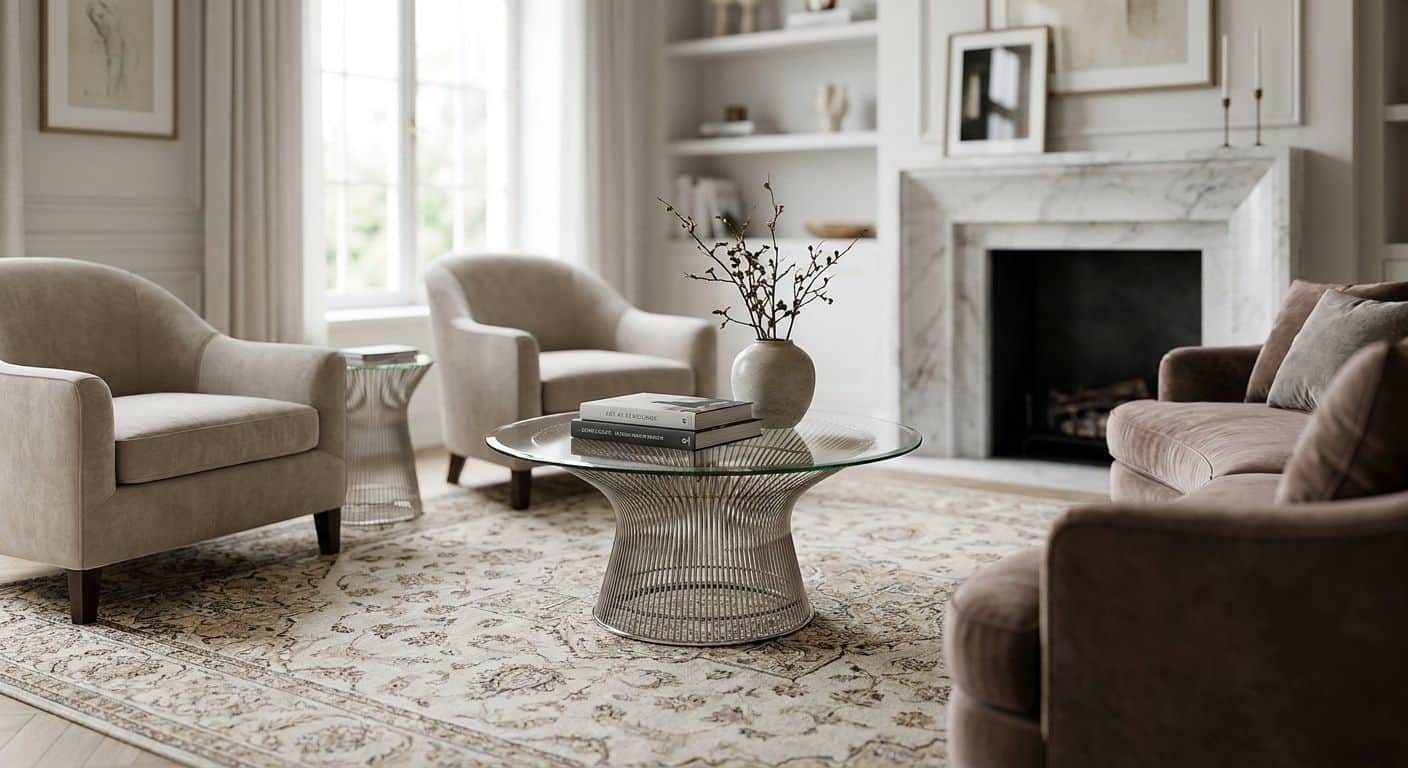
The Warren Platner coffee table turns rows of curved steel rods into a wire sculpture with a glass surface resting on top, and that trick is exactly why replicas of it keep showing up in formal living rooms in 2026. This guide ranks the variants worth buying against the ones that photograph well in a listing and fall apart once they're actually sitting under a lamp.
TL;DR- The nickel-and-glass Platner coffee table replica in the original 42-inch round size wins for formal rooms.
- Brass-finished Platner coffee table replicas warm up a room but show fingerprints faster than nickel does.
- Marble-top variants lose the see-through effect that makes this design work; the Alanda coffee table replica handles stone tops better.
- Skip oval configurations under 40 inches wide, since the rod pattern reads cramped instead of sculptural.
- Check weld points on the base before buying any platner coffee table replica, since uneven welds telegraph through the glass top.
Why the Platner design still works in a formal room
Warren Platner designed this table in 1966 for Knoll, building the base from curved steel rods welded into a radial pattern that most people mistake for wire mesh from across the room. That's the opposite move from Isamu Noguchi's biomorphic three-piece design — if your room leans organic and low-slung, the Noguchi coffee table replica fits the mood better than anything on this list.
Platner's table wants formality: symmetry, a glass top that disappears at a glance, and a base that reads sculptural under lamplight instead of loud. That combination is why the design still shows up in Knoll showrooms and formal living rooms almost sixty years after it launched, and why a poorly made replica is so easy to spot — the whole point of the piece is precision in the rod spacing, and shortcuts show immediately.
How these Platner coffee table replicas were ranked
Every entry below gets judged against four checkpoints: how closely the base mirrors Platner's original 42-inch, 15-inch-tall proportions, how the rods are finished (nickel versus brass versus chrome), how the top holds up to daily use (tempered glass versus marble), and whether the piece is actually sized for a formal room instead of a den. Ratings favor pieces that hold 1:1 scale — an undersized base loses the visual weight that makes the original work next to symmetric seating or under high ceilings, and a replica that quietly shrinks two inches off the diameter changes how it sits next to a sofa built for the real dimensions.
The ranked list
1. The nickel-and-glass classic — the safe pick
This is the version closest to Platner's 1966 spec: a nickel-plated rod base under a tempered glass top, typically 42 inches round and 15 inches tall with 3/8-inch glass. Formal rooms depend on symmetry, and the round nickel base keeps the structure visually quiet while the glass top reflects light instead of blocking it. This is the pick that ages well in a room that doesn't change much year to year. Buy.
2. The brass-finished version — the warmer alternative
Same rod pattern, swapped to a brass or gold-tone plating instead of nickel. It warms up a room with cooler wall tones, which matters in 2026 as more formal living rooms move toward warm metals over the chrome-heavy palettes of the last decade. The tradeoff: brass shows fingerprints and oxidizes faster than nickel, especially near humidity. Consider if the room's other metal accents already run warm; skip if the table gets used daily for drinks and snacks, since brass shows wear faster than nickel does.
3. The oval configuration — the space-saver
The round base elongates into an oval, usually landing around 48 by 30 inches. It fits a narrow formal room where a full 42-inch circle would block a walking path between the sofa and the entry. Below 40 inches wide, though, the rod pattern reads cramped instead of sculptural — the whole visual trick depends on enough rods to catch light from multiple angles. Consider for rooms 12 feet wide or less; skip for square, symmetric rooms where the round original does more work.
4. The marble-top variant — the wildcard
This swaps tempered glass for a slab of marble or marble-look composite. It sounds like an upgrade until you remember the entire design depends on seeing through the top to the rod base underneath — a stone top hides the one detail that makes the Platner design recognizable. If a stone surface is non-negotiable, the Alanda coffee table replica uses a base actually built for marble instead of a rod pattern meant to disappear beneath glass. Skip the marble-top Platner; consider the Alanda instead.
5. The two-tier stacking set — the practical pick
A smaller round surface, usually around 24 inches, nests below the main 42-inch top on the same rod base. Formal rooms that also host regularly get a spot for a tray or a second round of drinks without crowding the main surface. It's a functional add rather than a design purist's choice. Consider for rooms that see real entertaining; skip if the room is a showpiece with one table and nothing else on it.
6. The compact 30-inch round — the small-room fit
This scales the whole design down roughly 30 percent, keeping the proportions but shrinking both diameter and height. It works in a formal room where the full 42-inch original would crowd the seating — the same sizing logic covered in the best replica coffee tables for a small living room applies here even in a dressier layout. Below 30 inches, the rod base loses the density that makes the pattern look intentional instead of sparse. Buy for rooms under 200 square feet; skip for anything larger, where the compact scale reads as an accessory instead of a centerpiece.
Platner coffee table replica comparison
| Variant | Base Finish | Top Material | Diameter | Best For | Verdict |
|---|---|---|---|---|---|
| Nickel-and-Glass Classic | Nickel-plated steel | Tempered glass, 3/8 in | 42 in | Formal, symmetric rooms | Buy |
| Brass-Finished Version | Brass / gold-tone | Tempered glass | 42 in | Rooms with warm metal accents | Consider |
| Oval Configuration | Nickel or chrome | Tempered glass | 48 x 30 in | Narrow formal rooms | Consider |
| Marble-Top Variant | Nickel-plated steel | Marble / composite | 42 in | Buyers set on stone tops | Skip |
| Two-Tier Stacking Set | Nickel-plated steel | Tempered glass, two tiers | 42 in main / 24 in lower | Formal rooms that host often | Consider |
| Compact 30-Inch Round | Nickel or chrome | Tempered glass | 30 in | Small formal rooms | Buy |
Where to buy a Platner coffee table replica
- Check weld density before paying. Sparse or uneven rod welds telegraph through the glass and can warp under weight over time — ask for close-up photos of the base itself, not just a staged room shot.
- Confirm the diameter matches 1:1 spec. A listing that says 42 inches but ships at 38 inches changes how the piece reads next to seating already scaled to the original, and it throws off the visual balance the whole design depends on.
- Match the warranty to how the table will actually get used. A glass-top coffee table in a household with kids or frequent guests needs coverage beyond accidental scratches. Sohnne backs its mid-century modern coffee table replicas with a 5-year warranty and free insured shipping, which matters given how often a 42-inch glass top cracks in transit. General guidance on spotting corner-cutting factories lives in how to verify quality before buying replica furniture.
Browse mid-century coffee tables at Sohnne
1:1 dimensions, 5-year warranty, free insured shipping on every order.
Shop coffee tablesFAQ
What is a Platner coffee table replica?
A Platner coffee table replica reproduces Warren Platner’s 1966 design for Knoll: a round glass top resting on a base of curved steel rods welded into a radial pattern. Most replicas keep the original 42-inch diameter and 15-inch height, though sizes vary by maker.
How much does a Platner coffee table replica cost in 2026?
Pricing depends heavily on base finish and top material rather than a fixed number. Nickel-and-glass versions generally cost less than brass-finished or marble-top variants, since plating and stone add production steps.
Is a Platner coffee table replica good for a small living room?
A compact version around 30 inches in diameter works in small formal rooms, but the full 42-inch original tends to crowd a tight seating arrangement. Scale down rather than switching designs if the rod-and-glass look is the goal.
What’s the difference between a Platner coffee table and a Noguchi coffee table?
The Platner table uses a symmetric rod base under glass, built for formal, structured rooms. The Noguchi table uses a three-piece biomorphic wood base under a curved glass top, built for softer, organic-leaning spaces.
Are brass-finished Platner replicas as durable as nickel ones?
Nickel finishes generally hold up better day to day. Brass shows fingerprints and oxidizes faster, especially in humid rooms, so it needs more upkeep to keep its warm tone even.
What glass thickness should a Platner coffee table replica use?
Look for tempered glass around 3/8 inch thick, matching the original spec. Thinner glass flexes more under weight and is more prone to chipping at the edges.
How can I tell if the steel rod base is well made?
Check for even, tight weld points across the base rather than gaps or visible solder blobs. A well-made base holds its round shape without wobbling when you press down on one side of the glass top.
One last thing
Most listings market this piece as "the Platner table," singular, but Warren Platner designed a full collection in 1966 — lounge chair, easy chair, ottoman, and side table — all sharing the same rod-base construction. A coffee table dropped into a formal room with no other rod-based piece nearby tends to look like an accessory that wandered in from a different set. Pair it with at least one other rod-based or glass-topped piece in the room, even a side table, and the design reads as intentional instead of borrowed.
Related guides