The Marenco Sofa: Design History, Sizes and What to Look For in a Deep Loose-Cushion Sofa
Sohnne Design Studio
September 9, 2026
The Marenco sofa was designed by Mario Marenco in 1970 for the Italian maker Arflex. That is the whole credit, and it is the one most pages get wrong. If you came here for the history, the sizes, and an honest answer on what makes a sofa like this comfortable, read on. If you came here to buy one from us: we do not make it. We make four sofas with the same deep, loose-cushion feel, and they are at the end.
TL;DR
- Designed in 1970. One designer, one maker. The design is still in the maker’s catalogue, in sofa widths from 188 cm to 354 cm, plus an armchair, armless units, corner units and a pouf.
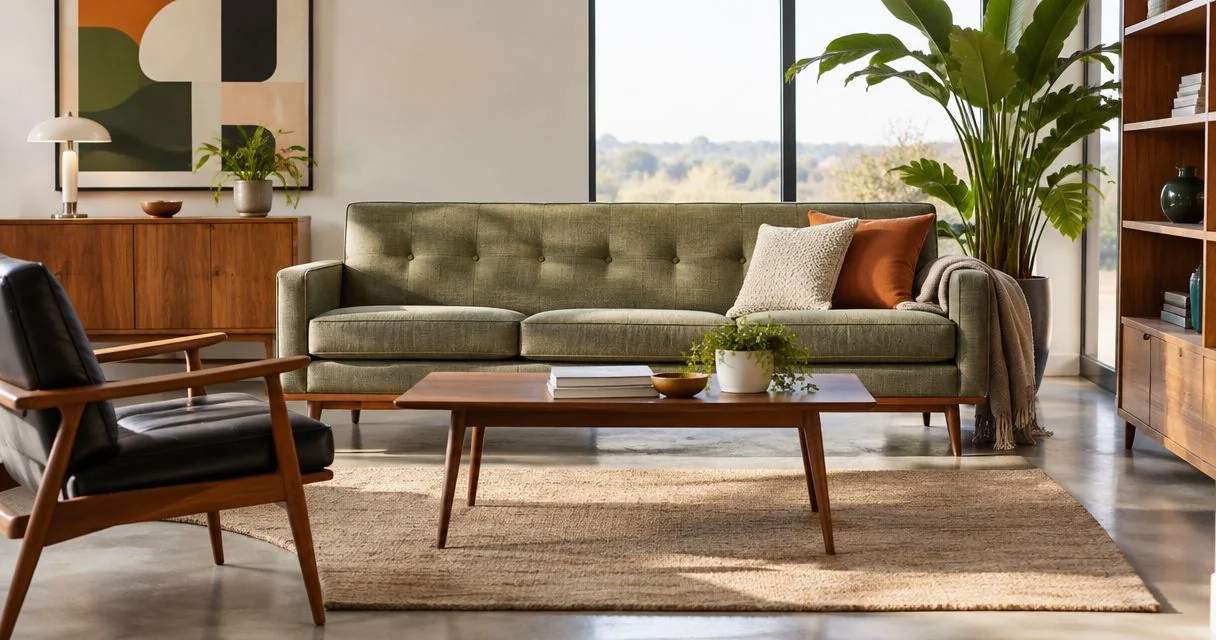
- The look is three loose seat cushions, three loose back cushions, and arm cushions that stand up above the seat and fold outward at the top, all on a low base.
- What makes a sofa like this comfortable is underneath: seat depth, cushion fill, and a hardwood frame. Those are the three things to check on any deep sofa.
- We do not sell a Marenco sofa. We make the Brigitte, Ravelle, Pebble and Luma sofas, which share the sink-in feel, and their page dimensions are listed below.
Where the design comes from
1970 was a good year for Italian seating. The Marenco sofa arrived as a system rather than a single piece: units with one arm, units with no arms, corner units, an island unit, an armchair and a pouf, all built to line up. The maker still lists it that way today.
What people remember is the silhouette. The seat is a row of loose, overstuffed cushions. The back is another row. The arms are not arms in the usual sense; they are big pillows, standing taller than the seat and folding outward at the top, so the whole sofa reads as a pile of cushions that happens to hold its shape. Underneath is a low, thin base on short legs, which is why the sofa looks heavy and sits light.
The name is the designer’s own surname. He was an architect by training, and the sofa is the piece his name travels on.
The sizes, as the maker lists them
Read from the maker’s catalogue page on 2026-11-11. The catalogue prints one number per unit, in centimetres; the inch figures are our conversion.
| Unit | Catalogue sizes (cm) | In inches, rounded |
|---|---|---|
| Sofa | 188, 254, 255, 354 | 74, 100, 100, 139 |
| Armchair | 121 | 48 |
| Armchair without armrests | 76, 104 | 30, 41 |
| Unit with one armrest | 161, 227, 228, 327 | 63, 89, 90, 129 |
| Unit without armrests | 134, 200, 201, 300 | 53, 79, 79, 118 |
| Corner unit | 166, 232, 233, 332 | 65, 91, 92, 131 |
| Pouf | 67 x 67, 96 x 96 | 26 x 26, 38 x 38 |
Two things worth knowing before you measure a room for one. The 354 cm sofa is 139 inches wide, which is wider than most apartment walls can take and most stairwells can pass. And the catalogue page lists no depth, height or seat height, so a buyer has to get those from a dealer. The page also lists no prices, and we are not printing any here, because a sofa price we did not read today is a sofa price we do not trust.
What a deep, loose-cushion sofa needs underneath
A sofa in this style is judged in the first ten seconds of sitting and the first ten months of owning it. The silhouette gets you to sit. The construction decides whether you keep sitting. Three things to check, on any sofa of this type, from any maker, at any price.
1. Seat depth, not just overall depth
Overall depth is what the product page usually gives you: the distance from the front of the seat to the back of the backrest. Seat depth is the number that matters for comfort: from the front edge of the cushion to the face of the back cushion. On a loose-cushion sofa the back cushions are thick, so a sofa that is 39 inches deep overall can have a seat depth in the low twenties. For lounging with your feet up, look for 24 inches or more of seat depth. For sitting upright with your feet on the floor, 21 to 23 inches. If the page does not list seat depth, ask. A maker who knows the number will tell you.
2. Cushion fill, and what wraps it
Loose cushions are the whole point of this style, and loose cushions are where cheap sofas go wrong. There are three common builds:
- High-resilience polyurethane foam, no wrap. Holds its shape, sits firm, looks neat for years. Not the sink-in feel.
- High-resilience foam core with a fiber or Dacron wrap. The core keeps the shape, the wrap gives the first inch of softness. This is the usual answer for a sofa that is sat on daily.
- Foam core with a down or feather blend wrap. The softest sit and the one that looks most like the 1970 silhouette. It needs plumping. If you are not a plumper, choose the fiber wrap.
Whatever the fill, the cushion cover should be a separate piece from the fill, with a zipper, so the cushion can be turned and the cover cleaned.
3. The frame you will never see
Kiln-dried hardwood, joined and glued, is the floor. Engineered wood and softwood frames flex, and a loose-cushion sofa shows frame flex faster than a tight-back sofa, because there is nothing holding the cushions in line except the frame. Ask what the frame is made of. “Solid wood” is an answer. “Wood” is not.
A deep sofa is a promise about the next decade. The cushions make it on day one. The frame keeps it.
Four sofas we make with the same sink-in feel
We do not make the Marenco sofa. We make these four. Every number below is from the product page as it reads on 2026-11-11; where the page does not list a number, we say so rather than guess. Prices are on the product pages.
| Sofa | Overall size (W x D x H, inches) | Cushion build | Cover | Frame |
|---|---|---|---|---|
| Brigitte Sofa | 102.3 x 38.5 x 30.7 | High-density foam core, goose down blend fill | Aniline leather | Solid wood |
| Ravelle Sofa | 92.1 x 39.4 x 27.2 | High-resilience foam with fiber wrap, oversized cushions | Chenille | Solid hardwood |
| Pebble Sofa | 110 x 65 x 29.5 (L-shape with chaise) | High-resilience foam core in a plush wrap; back in medium-density foam with Dacron wrap | Linen | Kiln-dried hardwood |
| Luma Sofa | 126 x 41.5 x 27.5 | High-density foam | Teddy velvet | Solid wood |
Seat depth is not listed on any of the four pages yet. Ask us and we will measure the one you are looking at.
Brigitte Sofa: the closest in spirit
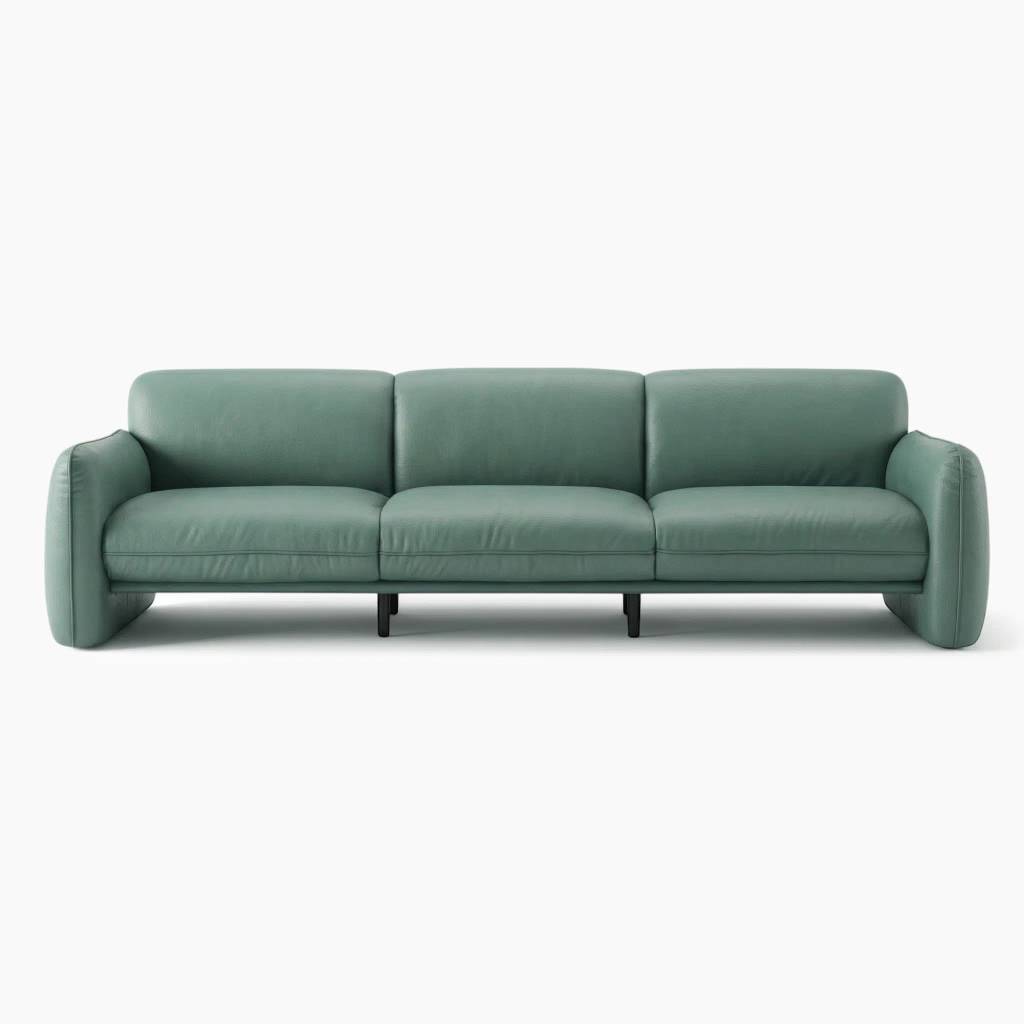
The Brigitte is our 1970s sofa. 102.3 inches wide, 38.5 deep, 30.7 high, 306 pounds, which tells you something about the frame. The seat cushions are a high-density foam core with a goose down blend fill, so you get the sink and the recovery. The arms are soft and rounded and sit a little proud of the seat, the same gesture that makes the 1970 design read as a pile of pillows. The cover is aniline leather, which is leather dyed through and left alone; it marks, it softens, and in five years it looks better than it did in the box. Expensive on purpose.
Ravelle Sofa: the chenille version
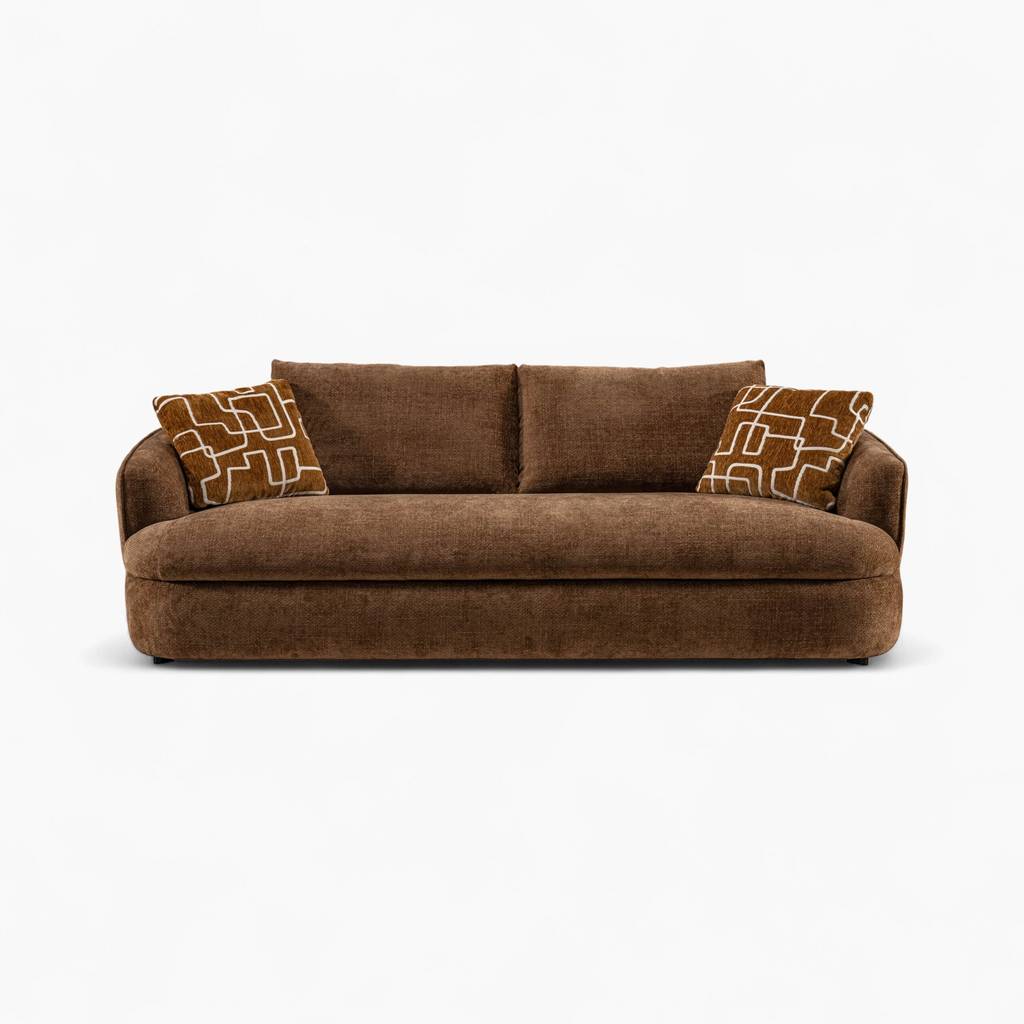
92.1 inches wide, 39.4 deep, 27.2 high, 174 pounds. Oversized cushions on a high-resilience foam core with a fiber wrap, which is the daily-use build from the section above: the core holds, the wrap gives. Chenille cover, solid hardwood frame, rounded edges all round. It is the one to choose if you want the deep look without plumping down cushions every Sunday.
Pebble Sofa: the deep one, with a chaise
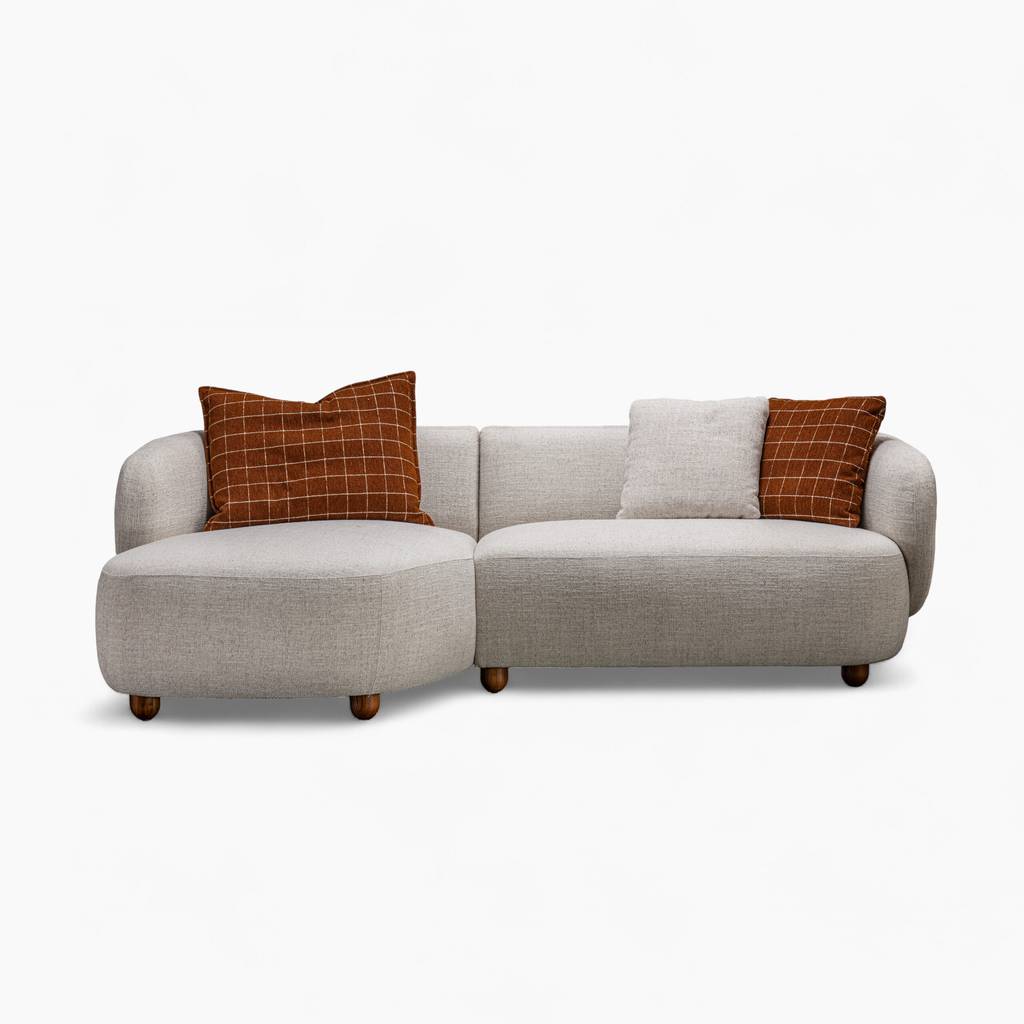
110 inches wide and 65 inches deep at the chaise, 29.5 high. The seat is a high-resilience foam core wrapped in a plush layer; the back is medium-density foam with a Dacron wrap. Linen cover, kiln-dried hardwood frame, rounded solid wood feet. It arrives fully assembled. If what drew you to the 1970 design was the idea of lying across it, this is the one with room to do that.
Luma Sofa: the long one
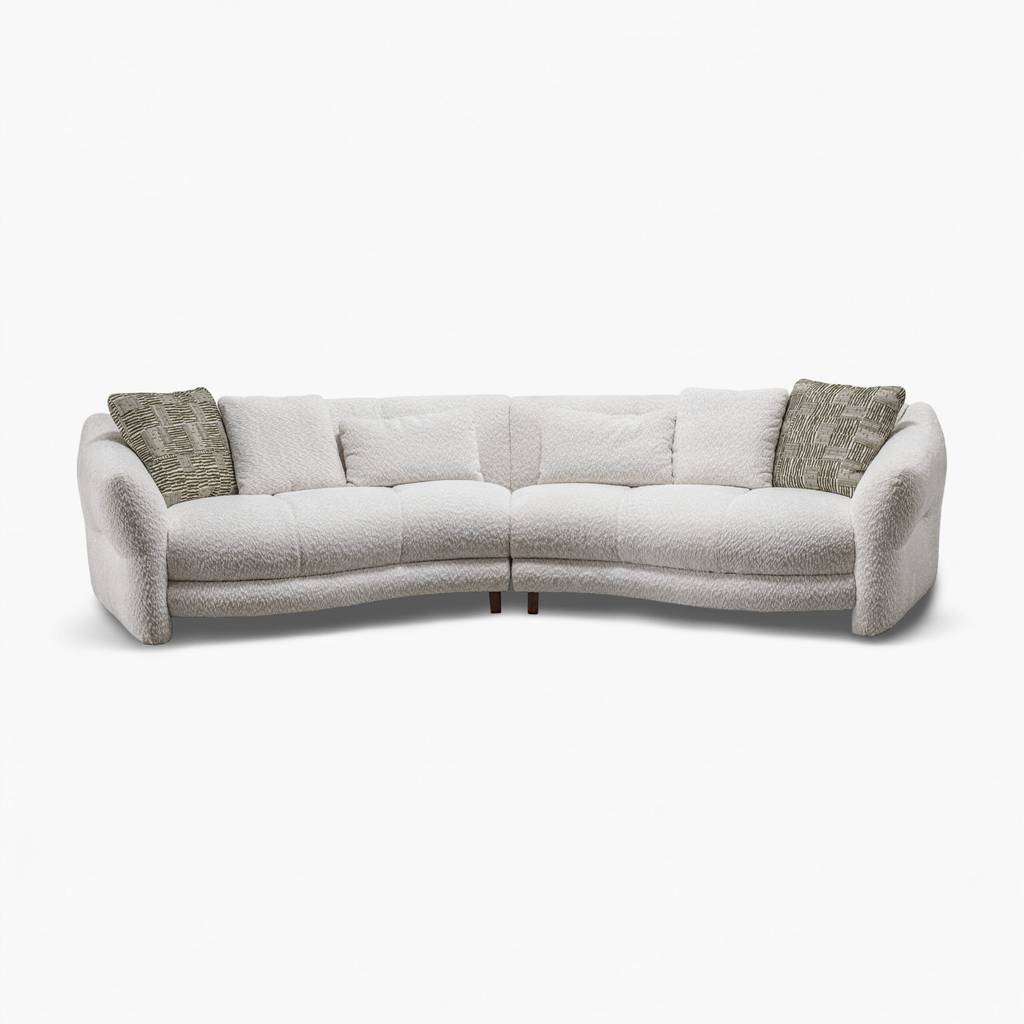
126 inches wide, 41.5 deep, 27.5 high. High-density foam cushions, a gently curved backrest for the lower back, teddy velvet cover, solid wood frame and low wood legs with anti-slip feet. It is the longest of the four and the lowest, so it suits a wide wall and a room where the sofa should not block the window.
See every sofa we make
Dimensions, materials and the current price are on each product page.
Sofas and sectionals Leather sofas Fabric sofas
How to read any deep sofa’s product page in two minutes
- Find the seat depth. If only overall depth is listed, subtract the back cushion and expect to lose 10 to 14 inches.
- Find the cushion fill. “Foam” alone means no wrap. Look for a named core and a named wrap.
- Find the frame material. Hardwood or solid wood is the answer you want.
- Check the width against the narrowest door, hallway or stair turn on the delivery route, not the wall it will sit against.
- Check the weight. A 90-inch sofa under 100 pounds is telling you about its frame.
FAQ
Who designed the Marenco sofa?
Mario Marenco, in 1970. The sofa carries his surname. Any page that credits a different designer is wrong.
How big is a Marenco sofa?
The maker's catalogue lists sofa widths of 188, 254, 255 and 354 centimetres (about 74, 100 and 139 inches), an armchair at 121 cm (48 inches), armless and one-arm units, corner units and two sizes of pouf. Depth, height and seat height are not printed on the catalogue page; a dealer will have them.
Is there a Marenco armchair?
Yes. The catalogue lists an armchair at 121 cm wide and an armless armchair at 76 cm and 104 cm.
What does a Marenco sofa cost?
We are not printing a price we did not read today. The design is sold through the maker's dealers, and the price depends on the unit and the cover.
Does Sohnne sell a Marenco sofa?
No. We make the Brigitte, Ravelle, Pebble and Luma sofas, which share the deep, loose-cushion feel. Their page dimensions and cushion builds are listed above.
What makes a deep sofa comfortable?
Seat depth (24 inches or more for lounging), a cushion with a named core and a named wrap, and a kiln-dried hardwood frame. The silhouette is the invitation; those three are the sofa.
What seat depth should I look for in a loose-cushion sofa?
21 to 23 inches to sit upright with feet on the floor; 24 inches or more to lounge with feet up. Measure from the front edge of the seat cushion to the face of the back cushion, not to the back of the frame.
One last thing
Sit on the arm. On a sofa built like the 1970 design, the arm is a cushion and it should give under you, then come back. If it is hard, it is a tight-back sofa wearing a loose-cushion coat. It takes five seconds, and it is the fastest honest test there is.
Related
Stay connected with us!
Keep in touch with what’s new and next. Subscribe for weekly insights, product launches, and community news!