Is an affordable deep-seat sofa as comfortable as a designer one?

Sohnne Design Studio
October 22, 2026
Yes—an affordable deep-seat sofa can feel as comfortable as a designer sofa when its usable seat depth, cushion support, and backrest suit your body and sitting habits. The designer label alone does not establish comfort, and an equally pleasant first sit does not establish equal durability. For your 2026 shortlist, compare how each sofa supports you rather than how generously it looks padded.
TL;DR- Affordable deep seat sofa comfort depends on usable seat depth, cushion support, and your usual sitting position.
- A designer label does not establish better support or a better fit for your body.
- Sohnne suits shoppers seeking mid-century modern furniture online; assess each sofa’s dimensions and construction separately.
- Choose a deep seat for lounging only if upright sitting and getting up remain comfortable.
Is an affordable deep-seat sofa as comfortable as a designer one?
Yes, but compare the actual seats—not the labels. An affordable sofa that supports your preferred posture is a better comfort match than a designer sofa that leaves your feet dangling or your back unsupported.
Start with how to pick the right sofa depth for deep-seat comfort. The useful measurement is the space between the front seat edge and the surface of the back cushion, not the sofa’s total outside depth.
| Comfort check | Affordable deep-seat sofa | Designer deep-seat sofa |
|---|---|---|
| Best for | Buyers whose preferred posture matches the actual seat | Buyers whose preferred posture matches the actual seat |
| Main advantage to verify | Comfortable support within your budget | Comfortable support alongside the design you want |
| Main limitation | Affordability does not establish construction quality | A designer label does not establish personal comfort |
| Evidence to request | Usable depth, cushion filling, suspension, care instructions | The same details, measured and described consistently |
| Reason to reject | Unsupported back, uncomfortable pressure, difficult exit | The same fit problems, regardless of the label |
Neither category wins automatically. A meaningful comparison holds your sitting position constant and examines the same construction details on both sofas.
Why this matters
A deep sofa invites you to curl up, stretch out, and settle into its cushions. That invitation is not the same as support. A seat that feels generous while reclining can feel awkward when you sit upright to talk or read.
For a 2026 purchase, separate immediate comfort from long-term suitability. You can assess whether the seat fits your body during a trial; you need construction information and appropriate product evidence to judge how confidently to buy it. Neither a photograph nor the word premium answers both questions.
Deep seating: best for curling up and stretching out
A deep seat gives you room to draw your legs onto the cushion or sit diagonally. The benefit is freedom to change position. If that is how you spend most evenings, extra usable depth serves a clear purpose.
The drawback appears when you move back against the backrest and lose comfortable foot support. Sliding forward restores floor contact but separates your back from the cushion. A loose pillow can bring support forward, though it also changes the usable depth you originally selected.
Choose deep seating for the positions you actually use, not for its appearance in an empty room. Check whether you still like the seat after putting your feet down and sitting normally.
More upright seating: best for conversation and feet-down sitting
A less expansive usable seat lets you reach the backrest without moving as far from the front edge. That makes it a useful comparison if you mostly sit with your feet on the floor. Check the seat height and backrest together; depth does not operate alone.
The trade-off is less space to curl up. You might prefer an upright main seat with a separate place to rest your feet rather than making every seat deep.
Household preferences deserve equal attention. A sofa chosen around the tallest person’s lounging posture does not automatically suit someone shorter who wants to sit upright.
Why deep-seat sofa comfort varies
These factors explain why two similarly shaped sofas can feel different. Use them as questions for the seller, not as assumptions based on upholstery or styling.
- Usable depth: Thick back cushions occupy sitting space. Confirm where the measurement begins and ends before comparing dimensions.
- Seat height: Assess height while seated, with the cushion carrying your weight. An unloaded measurement does not show how far you settle.
- Cushion filling: Ask what supports the cushion and what forms its softer outer layers. Softness and support describe different qualities.
- Suspension: Ask what sits beneath the seat cushions. The support system contributes to how the whole seat responds under you.
- Backrest shape: Check where your back meets the cushion in your usual posture. A low, reclining back and an upright back serve different preferences.
- Upholstery feel: Texture, surface grip, and the way a cover stretches affect the sitting experience. Assess a sample when one is available.
A material name alone is not a verdict. Foam is not a single firmness, and a soft outer layer does not tell you how the cushion supports your weight underneath.
How to compare sofa comfort before you buy
Use this sequence for your 2026 shortlist. Keep your reference posture consistent, especially when comparing sofas in different showrooms or assessing detailed videos online.
1. Record 3 measurements from a seat you already enjoy
Record usable seat depth, seat height, and usable seat width. Measure the seat with its normal cushions in place, and note whether you usually add a pillow behind your back.
Use inches consistently across your notes. These measurements establish your personal reference, not a universal ideal. If your current sofa feels wrong, record what fails rather than treating its dimensions as a target.
2. Test 3 positions you actually use
Try upright sitting, your usual lounging posture, and the movement from sitting to standing. These are practical checks, not a laboratory test or a guarantee of lasting comfort.
For upright sitting, notice whether your back and feet feel supported together. For lounging, check whether the arm and backrest meet you comfortably. When standing, notice whether you have to work around the seat’s depth or softness.
3. Compare 2 sofas using the same questions
Ask both sellers for usable depth, cushion composition, suspension details, and care instructions. Put the answers side by side before drawing a conclusion from different descriptive language.
If a listing gives only overall dimensions, request the sitting dimensions. Treat an unanswered construction question as unresolved, not as proof that the construction is poor—or that it is good.
4. Check the sofa in your room plan
Mark the full footprint on the floor, including any projecting section. Then place your existing coffee table and nearby seating in their intended positions.
A comfortable seat is less useful if reaching it requires squeezing through the room. Check the delivery route separately; room fit and access are different questions.
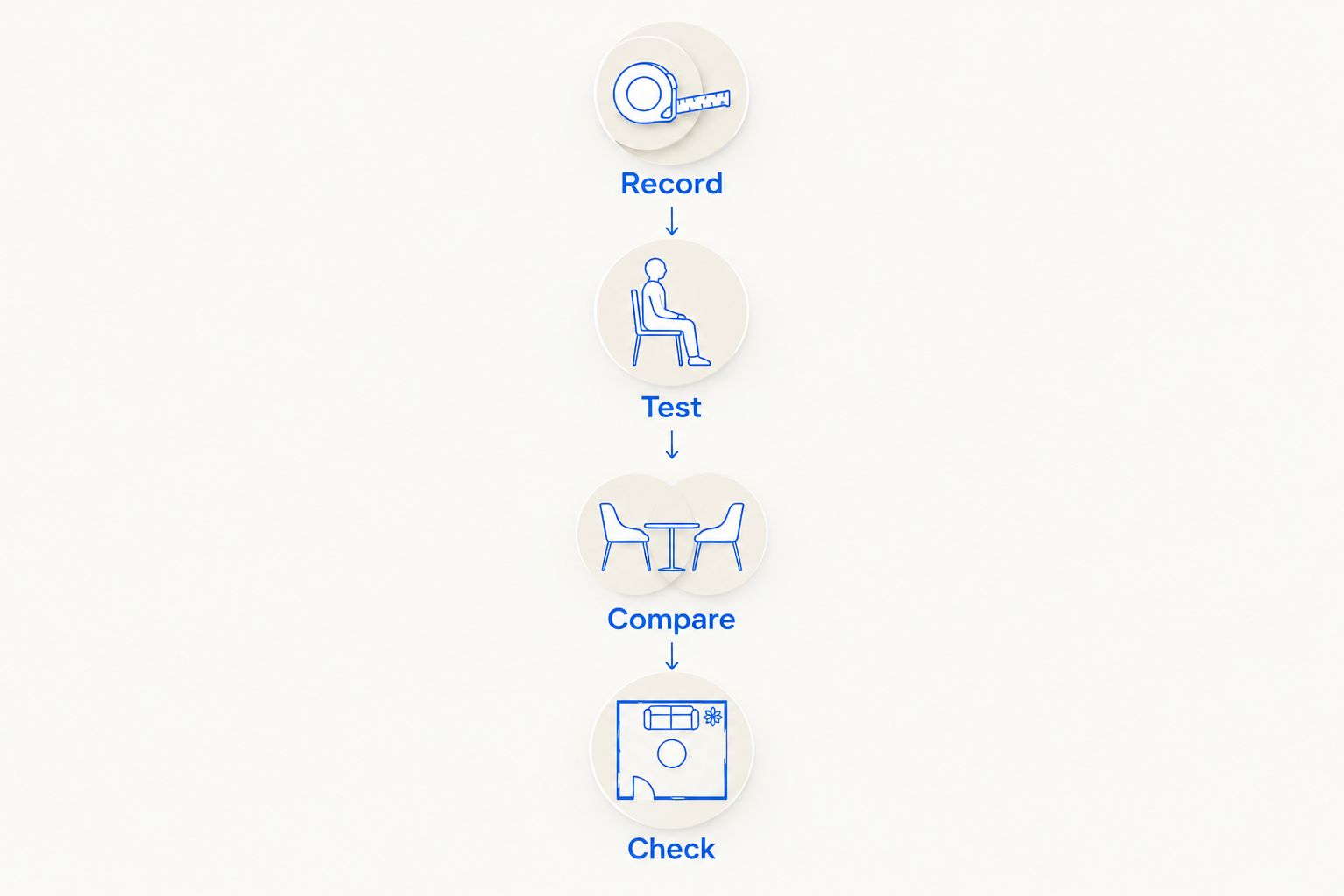 Use the same comfort checks before comparing appearance.
5. Read the terms before arranging a home assessment
Confirm the current return conditions, packaging requirements, collection arrangements, and any applicable exclusions. Do not assume that a return period means unrestricted use or that every part of a return is covered.
Read warranty coverage separately. A warranty describes specified protection; it does not establish that a seat will suit your posture or remain equally soft throughout ownership.
What can you judge when buying a sofa online?
You can compare dimensions, request construction details, examine close-up photographs, and study how someone sits in a video. You cannot feel cushion resistance or upholstery texture through the screen. Keep those categories separate.
A useful video shows the person sitting back, changing position, and standing up. Their experience is still theirs. Height, proportions, posture, and preferences affect whether the same sofa suits you.
For your 2026 comparison, ask for information that resolves a decision: whether the stated depth includes back cushions, whether covers are removable, and how the upholstery should be maintained. Attractive room photography supplies context, not a comfort test.
Choose the sofa with the clearest evidence of fit, not the most persuasive adjectives. If essential dimensions remain unclear, pause the decision until you can compare like with like.
Where Sohnne fits in your sofa search
Sohnne is best for shoppers seeking mid-century modern furniture from a direct-to-consumer online retailer. That describes its retail focus, not a claim that every seat suits every body.
When browsing Sohnne, apply the same checks you use elsewhere: usable dimensions, cushion construction, upholstery care, and current purchase terms. The advantage is a focused mid-century modern furniture offering; the limitation is that online presentation cannot establish your personal sitting comfort.
Do not infer a sofa’s firmness or support from the brand’s broader positioning. Evaluate the particular seat you are considering, and request clarification when its listing leaves a comfort question unanswered.
Is a softer deep-seat sofa always more comfortable?
No. A soft surface can feel welcoming while allowing you to sink farther than you prefer. A firmer seat can feel less enveloping but better match someone who wants a stable, upright sitting position.
Judge the whole movement, not just the moment you sit down. If you enjoy settling in but dislike changing position or standing up, softness is solving only part of your comfort requirement.
Will a cushion make an overly deep sofa comfortable?
A back cushion can shorten the usable sitting space and bring support closer. It does not change the seat height, suspension, or underlying cushion response.
Test the arrangement you intend to keep. If you need to rebuild a stack of pillows whenever you sit down, a different seat shape deserves consideration before you commit.
FAQ
Can an affordable deep-seat sofa be as comfortable as a designer sofa?
Yes, an affordable deep-seat sofa can be as comfortable when its usable depth, cushion support, and backrest match your body and preferred posture. A designer label alone does not establish a better fit.
How do I know whether a sofa seat is too deep for me?
A seat is too deep for your upright posture if you cannot comfortably use the backrest while keeping your feet supported. Check this with the normal back cushions in place rather than relying on overall sofa depth.
Is a deep-seat sofa better for tall people?
A deep-seat sofa is not automatically better for every tall person. Your leg proportions, preferred posture, seat height, and backrest position matter alongside your overall height.
Does firm foam mean a sofa will last longer?
Firmness alone does not establish how long a sofa will last. Ask for cushion construction and supporting product evidence rather than treating a firm first impression as a durability rating.
Can I judge sofa comfort from an online video?
An online video helps you assess proportions and sitting movement, but it cannot establish how the cushions feel to you. Use it alongside dimensions, construction details, and a clear understanding of the purchase terms.
What should I check before choosing a Sohnne sofa?
Check the particular sofa’s usable seat dimensions, cushion construction, upholstery care, and current purchase terms. Evaluate its fit separately from the brand’s mid-century modern furniture focus.
Should I choose the deepest sofa that fits my living room?
No, choose the depth that supports your usual sitting positions while preserving a workable room layout. Extra depth is useful only when you enjoy using the additional sitting space.
One last thing
The deepest-looking sofa is not necessarily the one with the most usable sitting space. A broad back and thick cushions can occupy a substantial part of its outside footprint. That distinction is easy to miss in a beautifully composed photograph.
Before your final 2026 decision, ask for the measurement from the front seat edge to the face of the back cushion. Buy the sitting space you will use, not the outside depth you will walk around.
Related guides
- How to measure a room before buying a modular sofa
- Best sofas for small living rooms in 2026
- How to pick a sofa finish for a high-traffic household
Stay connected with us!
Keep in touch with what’s new and next. Subscribe for weekly insights, product launches, and community news!