Hiroshima Armchair Tatami Guest Room: 2026 Fit Guide

Sohnne Design Studio
September 1, 2026
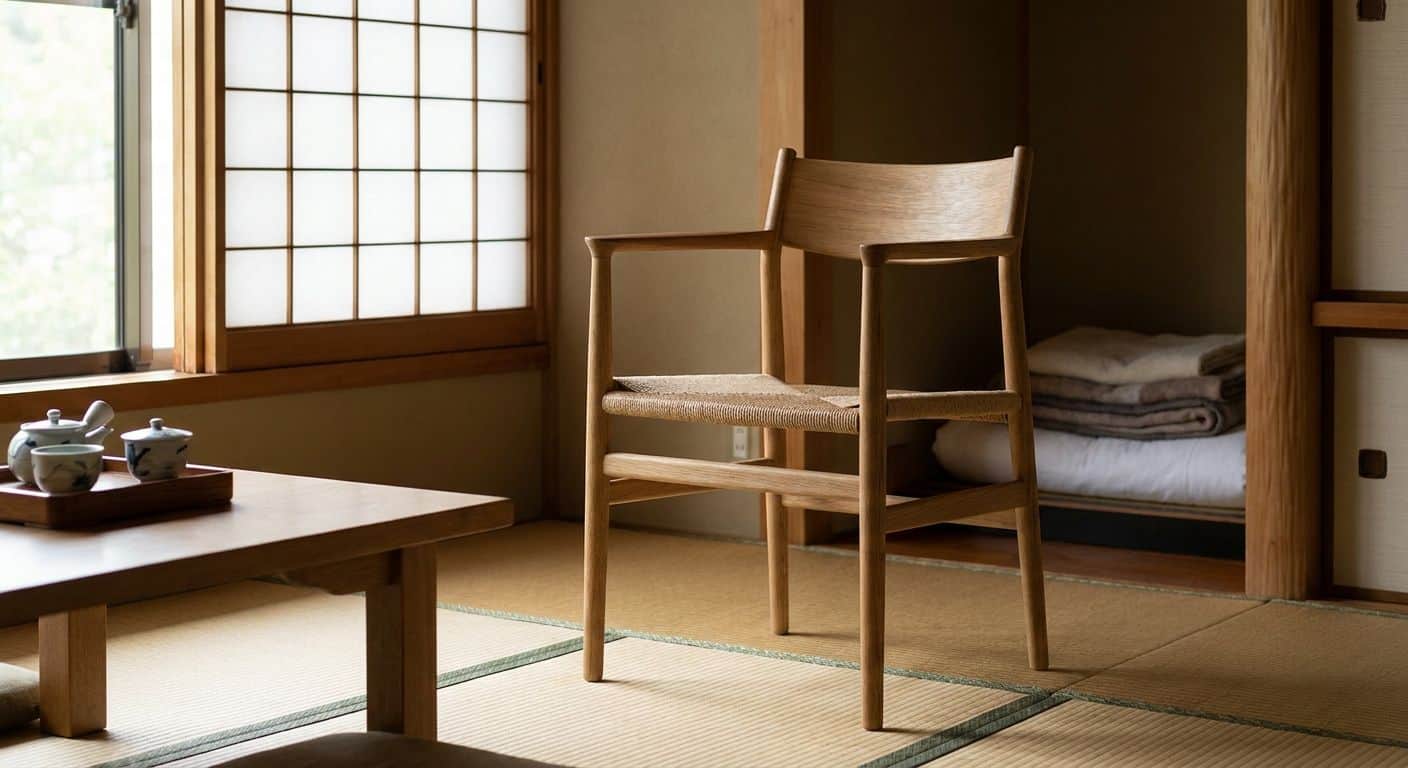
A Hiroshima armchair replica belongs in a tatami guest room when its seat sits low enough to match the mat's sightline, its wood tone reads as natural rather than stained dark, and its footprint respects the tatami's fixed module. This guide covers sizing, finish, placement, and upkeep for anyone furnishing a Japanese-style guest room in 2026.
TL;DR- A hiroshima armchair tatami guest room pairing needs a 15 to 17 inch seat height to match floor-level sightlines.
- Sohnne’s Naoto Fukasawa-inspired Hiroshima armchair replica ships with a 5-year warranty and a 60-day return window.
- Skip glossy or dark-stained frames – tatami’s straw core already carries a warm gold tone that clashes with lacquer finishes.
- Never set a chair leg on the tatami’s woven border, called the heri – it dents faster than the mat body.
Why a Hiroshima armchair replica matters for a tatami guest room
Tatami mats run on a fixed module. Most residential mats measure close to 3 feet by 6 feet, so a guest room built around them has a footprint decided the day the floor went in. You can't shift the walls to fit a chair; the chair has to fit the room.
That constraint changes what "guest seating" means in this room type. Guests sit near floor level for tea or conversation, futons get folded and stored along one wall, and sliding shoji screens eat into usable wall space. A Hiroshima armchair replica works here because Naoto Fukasawa's original design keeps a low, compact profile with exposed wood joinery instead of a bulky upholstered frame – the same restraint that makes tatami rooms feel calm in the first place.
A standard Western armchair, by contrast, usually sits 18 to 20 inches at the seat and carries a boxier arm structure. Drop one into a tatami room and it towers over every other sightline in the space, including the low table and the futon stack. The segment problem isn't finding a nice chair – it's finding one whose proportions were built for floor-adjacent living in the first place.
How to fit a Hiroshima armchair replica into a tatami guest room
Measure the mat grid and footprint before ordering
Count the mats first, not the square footage. Tatami rooms are described in mat units (a 6-mat room, an 8-mat room) because that's how the module actually divides the space.
- Count the mats and note the room's true dimensions in feet, not just the mat count
- Mark any alcove (tokonoma) that reduces usable floor width
- Leave a walking path of at least 24 inches between the chair and the doorway
- Check ceiling height near sloped eaves if the guest room sits under a roofline
- Measure where futon storage or closet doors swing open
Match wood tone and joinery to the room's palette
Tatami's rice-straw core carries a warm, slightly golden tone that most stained or lacquered wood fights against.
- Pull a swatch or sample from the mat itself and hold it against any finish you're considering
- Favor exposed wood joinery over painted or laminated frames
- Avoid black lacquer or high-gloss finishes – they read as formal, not restful
- Test the tone against the room in daytime light, not showroom lighting
Choose a seat height built for floor-adjacent living
This is the step that trips up most buyers, because chair specs rarely mention how a seat height reads next to a floor cushion or a low table.
The manual way: measure your existing low table height and any floor cushions, then pick a chair whose seat sits within 2-3 inches of that reference so the eye line stays level across the room. If you'd rather skip the trial-and-error, Sohnne's Hiroshima armchair replica is built to the original 1:1 dimensions Fukasawa specified, which puts the seat in the 15 to 17 inch range that tatami rooms call for.
- Target a 15 to 17 inch seat height for floor-adjacent seating
- Avoid tall wingback or club-chair profiles that break the room's low sightline
- Pair the chair with a side table no taller than the armrest
- Confirm the armrest height clears futon storage boxes if they sit nearby
Pick upholstery that survives humidity and seasonal swings
Tatami mats absorb and release moisture with the seasons, and the wood joinery in a chair reacts the same way.
- Choose natural fiber or leather over vinyl, which traps moisture against the frame
- Avoid heavy foam padding that holds humidity longer than a firmer, structured seat
- Look for a removable or spot-cleanable cover if the guest room sees regular use
- Check the care instructions before buying – some finishes need yearly oil, others don't
Position the chair off the mat's woven border
The border strip on a tatami mat, called the heri, is both a traditional boundary marker and the structurally weakest part of the mat.
- Leave clearance so no chair leg sits on the woven border
- Use felt or rubber pads under every leg regardless of placement
- Rotate the chair's position seasonally to spread wear evenly across the mat
- Keep the chair off any border strip that gets direct sun through a window
Add lighting and a side table scaled to the room
A tall floor lamp undoes the low-profile effect you just built into the seating.
- Pick a low-profile floor lamp or a paper-shade table lamp instead of a tall torchiere
- Keep the side table height at or below the chair's armrest
- Favor natural materials – wood, paper, stone – over chrome or glass accents
- Leave at least 12 inches of clearance between the lamp base and the chair arm
Maintain the finish over time
A wood-framed chair in a tatami room ages differently than one on hardwood or carpet, because it shares the same humidity swings as the mat next to it.
- Wipe the wood frame with a dry or barely damp cloth, never a wet one
- Keep the chair out of direct sun to prevent uneven fading against the mat
- Monitor room humidity the same way you'd monitor it for the tatami itself
- Reapply an oil finish once a year if the manufacturer's care guide calls for it
Comparing your options for a tatami guest room
| Option | Best for | Key limitation |
|---|---|---|
| Naoto Fukasawa-style Hiroshima armchair replica | Guests who want a Western seat without towering over the mat | Needs felt pads under the legs to protect the mat border |
| Legless zaisu floor chair | Purists keeping the room fully traditional | No armrests, harder for guests with mobility limits |
| Low platform accent chair (non-designer) | Renters testing the look before committing | Lacks the joinery quality and wood grade of a design replica |
| Vintage mid-century lounge chair sourced secondhand | Collectors chasing provenance | Scarce and inconsistent condition; verifying original hardware takes expertise |
A Hiroshima armchair replica is the strongest fit for most tatami guest rooms in 2026 because it's the only option on this list built to a fixed low profile without sacrificing armrests or back support.
Common mistakes in a tatami guest room
- Sizing the chair to the room's square footage instead of its sightline height – a chair can fit the floor space and still look oversized next to a low table
- Choosing a stained-dark or glossy finish that fights the tatami's natural gold tone instead of complementing it
- Setting chair legs directly on the woven border strip, which dents faster than the mat's body and is treated as a boundary in traditional tatami etiquette
- Skipping a humidity check for the guest room – wood joinery in a chair reacts to moisture swings the same way the tatami mat does
- Buying without confirming the return window – a chair that reads wrong in the room once it's assembled is easier to send back inside a 60-day return period than after
See the Hiroshima armchair replica up close
Compare wood tones and dimensions before you commit floor space.
View the design guideFAQ
What makes a Hiroshima armchair replica different from a standard accent chair?
A Hiroshima armchair replica follows Naoto Fukasawa’s original low-profile design, with exposed wood joinery and a seat height around 15 to 17 inches instead of the 18 to 20 inches typical of Western accent chairs. That lower profile is what lets it sit next to a tatami mat without breaking the room’s sightline.
Is a Hiroshima armchair replica appropriate for a tatami guest room in 2026?
Yes, as long as the seat height and wood tone are matched to the room. A natural-wood finish and a seat in the 15 to 17 inch range keep the chair from clashing with the mat’s proportions or its warm straw color.
How do I protect a tatami mat under chair legs?
Use felt or rubber pads under every leg and keep the chair off the mat’s woven border strip. The border, called the heri, is the weakest part of the mat and dents faster than the woven body.
What wood finish works best in a tatami guest room?
Natural or lightly oiled wood tones work best because they read close to the tatami’s own golden straw color. Black lacquer or high-gloss stains tend to look formal and out of place against the mat.
Can you mix Western furniture with tatami flooring?
Yes, mixing is common in Japanese and Japandi-style interiors, but the furniture needs a lower seat height and simpler joinery than typical Western pieces to keep the room’s proportions intact.
How much floor clearance does a Hiroshima armchair replica need in a small guest room?
Leave at least 24 inches of walking path between the chair and the doorway or futon storage area. Anything tighter makes the room feel cramped even if the chair itself is compact.
Is real tatami still common in U.S. guest rooms in 2026?
Real tatami is less common than tatami-style vinyl or foam mats in U.S. homes, but both versions follow the same fixed module and the same seat-height guidance applies to either.
What seat height suits tatami-adjacent seating?
A seat height of 15 to 17 inches keeps the chair level with low tables and floor cushions typically used in tatami rooms, versus the 18 to 20 inch height common on standard armchairs.
One last thing
The detail most buyers skip is the heri, the fabric border woven around each tatami mat. Traditional etiquette treats it as a boundary you don't step on or set furniture legs on, and it happens to be the structurally weakest strip of the mat – so the etiquette rule and the maintenance rule for a Hiroshima armchair replica point to the exact same spot. Keep every leg pad clear of that border and the mat outlasts the guest room's next few furniture rotations.
Related guides
- Best replica furniture for a Japandi living room
- Best replica daybeds for a guest room
- Akari lamp replica for a Japandi bedroom
- Sohnne