Can a Danish modern wingback chair recline fully?
Sohnne Design Studio
November 12, 2026
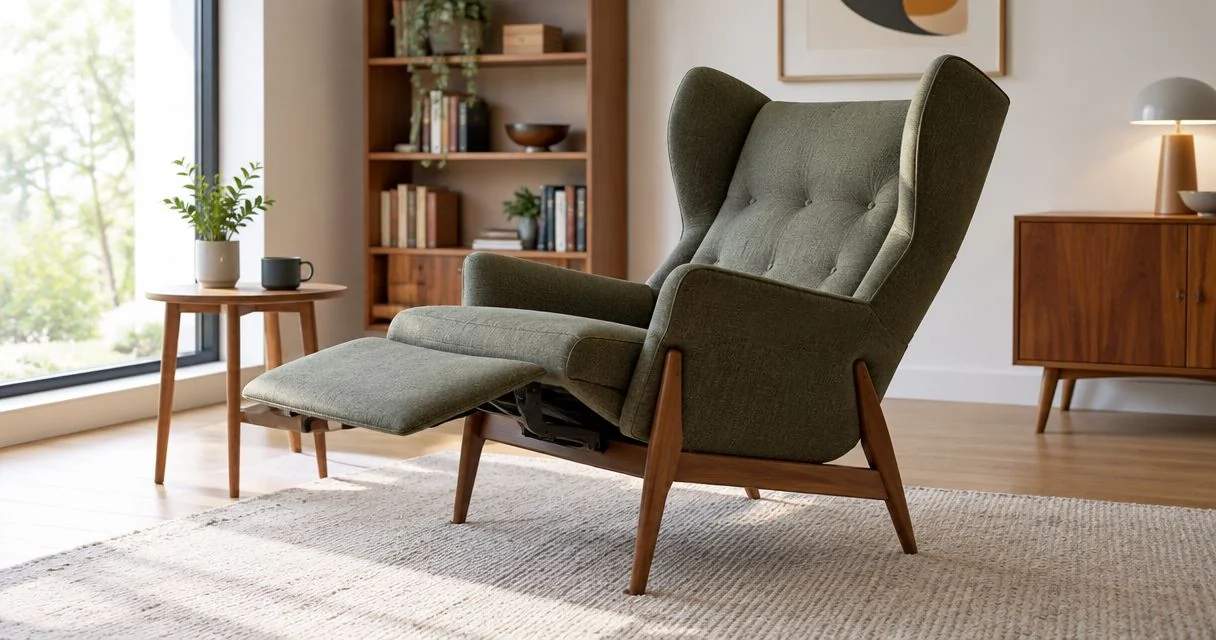
A Danish modern wingback chair can recline fully only if its specific mechanism supports that position; the winged back and design description do not establish how far it moves. A fixed-back chair does not recline, and a reclining chair does not necessarily lie flat. Before choosing, check the operating instructions, maximum recline position, and space required with the chair extended.
TL;DR- Can a wingback chair recline? Yes, but only a chair with a reclining mechanism changes its seating position.
- Danish modern describes design, not reclining capability; verify the exact chair’s operating instructions.
- Full recline does not necessarily mean flat: check the backrest and footrest at their maximum positions.
- For Sohnne mid-century modern furniture, confirm the individual chair’s movement before choosing it for reclining.
Can a Danish modern wingback chair recline fully?
Yes, when the individual chair is built for full recline. Neither a high back nor side wings proves that a chair has moving parts. The useful evidence is a specification, an operating guide, or a demonstration of that exact model—not its silhouette.
When browsing Sohnne or another furniture retailer in 2026, separate the chair's appearance from its stated function. A relaxed-looking seat can have a completely fixed frame.
| Chair configuration | What moves | Best for | Main advantage | Main limitation |
|---|---|---|---|---|
| Fixed-back wingback | No reclining movement | Upright reading and conversation | Consistent seating position | Cannot change the backrest angle |
| Manual reclining wingback | Backrest and any linked footrest, as specified | Adjustable lounging without powered controls | User-operated adjustment | Requires the movement or effort described in its instructions |
| Powered reclining wingback | Motor-driven components, as specified | Button-controlled adjustment | Controlled positioning | Requires the specified power arrangement |
| Tilting wingback | Seat assembly or back, depending on construction | Gentle changes in sitting angle | Movement without necessarily extending a footrest | Tilt alone does not establish full recline |
| Fixed chair with ottoman | Separate foot support; chair stays fixed | Feet-up reading | Independent footrest placement | Does not change the backrest angle |
These are functional categories, not claims about a particular product. Choose by the movement you need, then by the shape you prefer.
Why this matters
An upright footprint tells you where a chair sits, not where it travels. A reclining back can approach a wall, while an extending footrest can enter the route between your sofa and coffee table.
The distinction also changes comfort. Raising your feet while keeping your torso upright feels different from lowering the backrest, even when both arrangements look equally relaxed in a photograph.
For a 2026 furniture purchase, treat reclining capability as a specification to confirm before ordering. Upholstery, timber finish, and a sculptural profile cannot answer that question.
Fixed-back wingbacks: best for a consistent sitting position
A fixed-back wingback keeps the same structural relationship between its seat and back. Cushions compress under you, but that is not a reclining function.
Best for: reading, conversation, or a corner where you want the chair to remain within a predictable footprint. The limitation is equally clear: you cannot lower the back when you want a different resting position.
An ottoman adds somewhere to rest your feet without changing the chair itself. Check whether that arrangement supports your legs comfortably rather than assuming matching upholstery means matching ergonomics.
Manual reclining wingbacks: best for unpowered adjustment
A manual reclining wingback uses the operating method specified for that chair. That can involve a handle, a release, or a controlled shift in body weight; the instructions determine the correct action.
Best for: adjustable lounging when you prefer an unpowered mechanism. The trade-off is physical operation: you must be comfortable opening the chair, returning it upright, and closing any attached footrest.
Do not push against an unfamiliar backrest to discover whether it reclines. Identify the mechanism first, and follow the manufacturer's procedure rather than testing the frame by force.
Powered reclining wingbacks: best for button-controlled positioning
A powered reclining wingback uses a motor to move the components identified in its specifications. Powered operation does not, by itself, establish a flat resting position or independent adjustment of every component.
Best for: someone who prefers button-controlled movement. The limitation is the need to accommodate the chair's specified power supply and keep its controls and moving parts accessible.
Before choosing, establish how the chair returns upright and what the instructions say about interrupted power. Do not assume a backup function exists unless the manufacturer explicitly confirms it.
Why full recline varies between wingback chairs
Recline depends on construction, not decorative details. These factors explain why chairs with similar profiles can behave differently:
- Mechanism travel: the mechanism determines the permitted range of movement and where it stops.
- Backrest movement: a moving back can change your torso position; a fixed back cannot.
- Seat movement: some mechanisms move the seat as well as the back, changing your position relative to the floor.
- Footrest arrangement: an integrated footrest, separate ottoman, and unsupported feet create different resting positions.
- Control arrangement: linked controls and independently adjustable components offer different ways to position the chair.
- Room clearance: a wall or table can obstruct the chair before it reaches its intended position.
In 2026 listings, read descriptions such as reclining, adjustable, and full recline alongside the technical information. A descriptive label is not a substitute for a diagram showing the chair fully open.
How to check whether a wingback reclines fully
1. Confirm movement
Find an explicit statement that the chair reclines. Look for the operating instructions and identify which parts move: the back, seat, footrest, or a combination.
A swivel base answers a different question. Turning toward a window does not establish that the chair can lower your back.
2. Inspect extension
Ask to see the exact chair at its maximum permitted recline. A side-view photograph or demonstration makes the relationship between the seat, backrest, and foot support easier to understand.
Check what the seller means by fully. It can describe the mechanism reaching its endpoint without describing a flat surface suitable for lying down.
3. Check clearance
Use the manufacturer's upright dimensions, extended dimensions, and clearance instructions to plan the location. Include skirting boards, curtains, nearby tables, and anything that could enter the moving path.
Mark the extended footprint on your floor with removable tape. Then walk around it as you would during an ordinary evening; do not assess the arrangement only while standing in front of the chair.
4. Test fit
If you can try the chair, move through its permitted positions using the intended controls. Notice whether your feet, lower back, shoulders, and head remain comfortably supported.
Return the chair upright as well. A position that feels pleasant once reached is not enough if operating the chair or getting out feels difficult.
The sequence is simple: establish the function, see its full movement, check your room, and assess your own fit. Keep those checks separate so an attractive finish does not settle a mechanical question.
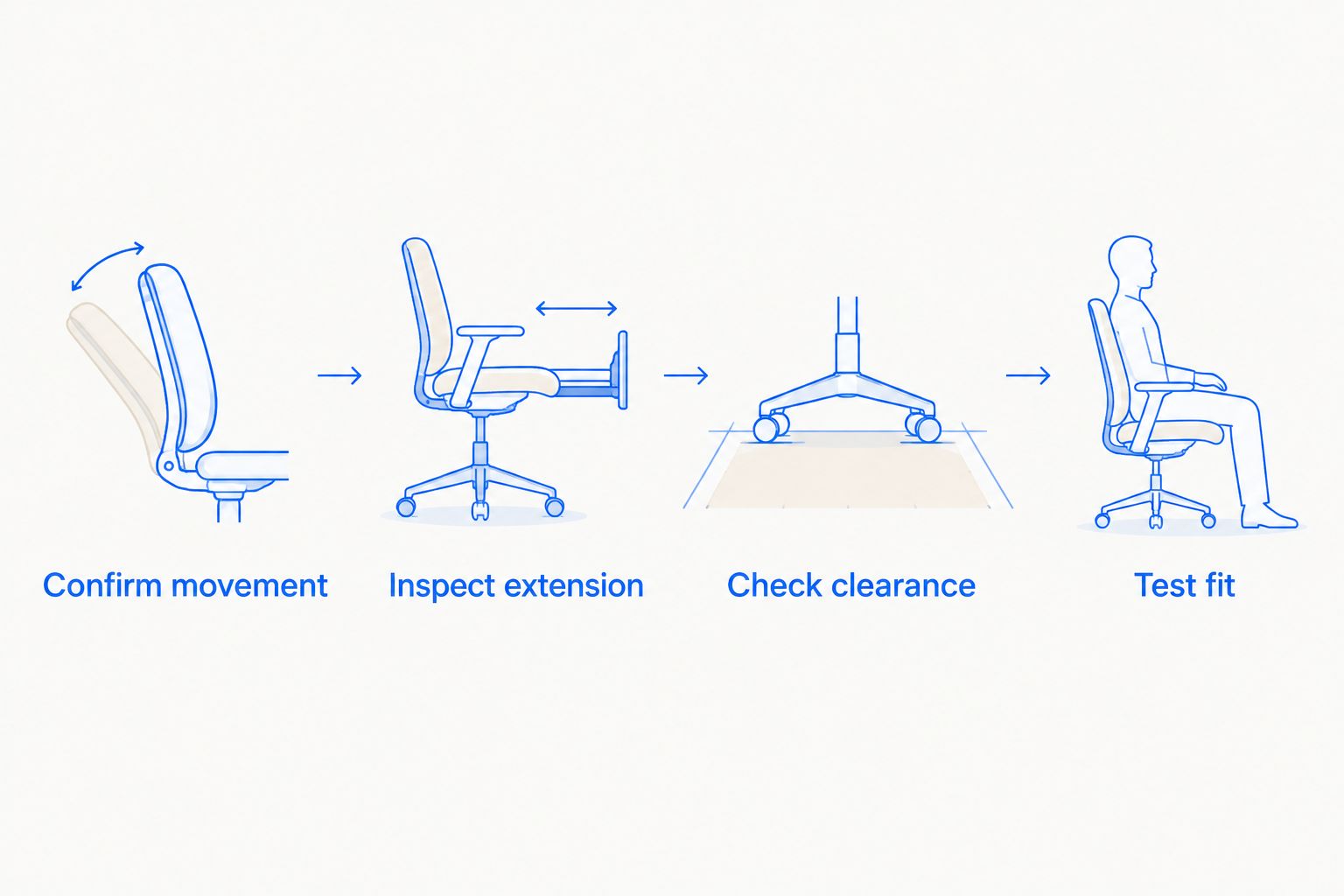 Verify movement before deciding whether the chair fits your room and your body.
What should you ask before ordering online?
Ask questions that require a model-specific answer. For a 2026 online purchase, a concise written response is more useful than general reassurance that a chair is comfortable.
- Does this exact chair recline, or is its back fixed?
- What does its maximum position look like from the side?
- Does the footrest move with the backrest or operate separately?
- What are the fully extended dimensions and required clearances?
- How do you operate the chair and return it upright?
- Where can you read its operating and safety instructions?
For a Sohnne lounge chair, use Contact Us to request confirmation about the individual item. Sohnne suits mid-century modern furniture shoppers; reclining capability still needs model-specific confirmation.
The advantage of shopping by design is finding a chair that belongs in your room. The limitation is that design language alone cannot establish reclining travel, operating effort, or personal comfort.
Does full recline mean a wingback chair lies flat?
Full recline does not necessarily mean a wingback chair lies flat. It can mean only that the mechanism has reached its designed endpoint, with the back still raised relative to the seat.
If lying flat is essential, ask that question directly. Request an illustration of the final position rather than relying on a lifestyle image taken from the front.
Also distinguish reclining from sleeping suitability. A chair's movement does not establish that its surface, support, or intended use matches a bed.
Can you add an ottoman instead of buying a recliner?
An ottoman provides foot support without making a fixed wingback recline. It is a practical option when your aim is feet-up reading rather than changing your torso angle.
Assess the pairing while seated. The ottoman should let you rest your legs without forcing you to slide forward or perch on the chair's front edge.
The trade-off is floor space and an additional object to move around. Leave a clear route past the ottoman rather than placing it where you step when standing up.
Can you convert a fixed wingback into a recliner?
Do not treat a fixed wingback as a chair awaiting a reclining mechanism. Reclining requires structural connections and moving components designed to work together, not simply a different hinge.
Ask the manufacturer whether an approved conversion exists for the exact chair. Without that confirmation, choose a purpose-built recliner instead of modifying a fixed frame.
An upholstery change is a separate decision. New cushioning or fabric does not establish that the chair can safely support mechanical movement.
How should you arrange a reclining wingback?
Start with the chair fully extended in your plan, then arrange the surrounding furniture. That prevents the coffee table from becoming the accidental limit on recline.
Keep a reading light and side table reachable from the position you actually use. A table that works beside an upright armrest can feel too far away once the back lowers.
If the chair uses power, plan the connection according to its instructions without running a loose cable across a walking route. Keep the mechanism's path clear, and follow the supplied guidance around children and pets.
Before completing your 2026 room layout, test both everyday states: chair upright and chair open. A reclining chair fits only when the room works in both positions.
FAQ
Can a wingback chair recline if it has wooden legs?
Wooden legs do not establish whether a wingback chair reclines. Check the specific chair’s mechanism and operating instructions; the visible legs are not proof of movement.
Does a Danish modern wingback chair always have a fixed back?
Danish modern does not establish whether a wingback chair has a fixed or moving back. Confirm the construction of the exact chair rather than inferring function from its design description.
Is a wingback recliner better than a chair with an ottoman?
A wingback recliner is the better fit when you need to change your backrest position; a fixed chair with an ottoman suits feet-up sitting without that adjustment. Compare operating effort, support, and the space each arrangement occupies.
Can I place a reclining wingback directly against a wall?
Place a reclining wingback according to its manufacturer’s clearance instructions, not automatically against a wall. Check the backrest’s full movement before fixing the room layout.
How can I tell whether a wingback reclines from a photograph?
An upright photograph alone does not reliably establish that a wingback reclines. Look for the exact chair shown extended and confirm its function in the specifications or instructions.
Can a reclining wingback replace a bed?
Reclining capability alone does not establish that a wingback can replace a bed. Check the intended use, and do not equate a lowered backrest with a flat sleeping surface.
How do I confirm whether a Sohnne chair reclines?
Confirm whether a Sohnne chair reclines by checking the individual item’s specifications and requesting its operating information. Ask for its maximum position and extended dimensions before choosing it for reclining.
One last thing
Test the return journey. Lowering a backrest is only part of using a recliner; bringing it upright, closing the footrest, and standing up matter just as much.
Choose a chair whose entire movement works for you—not only its most relaxed position. That is the final check to make before upholstery or finish decides the purchase.
Related guides
- How to choose a lounge chair for a tall person
- How to style a lounge chair in a home library
- How to position a lounge chair for natural-light reading
Stay connected with us!
Keep in touch with what’s new and next. Subscribe for weekly insights, product launches, and community news!