Haller System Replica: Office & Home Uses 2026

Sohnne Design Studio
July 8, 2026
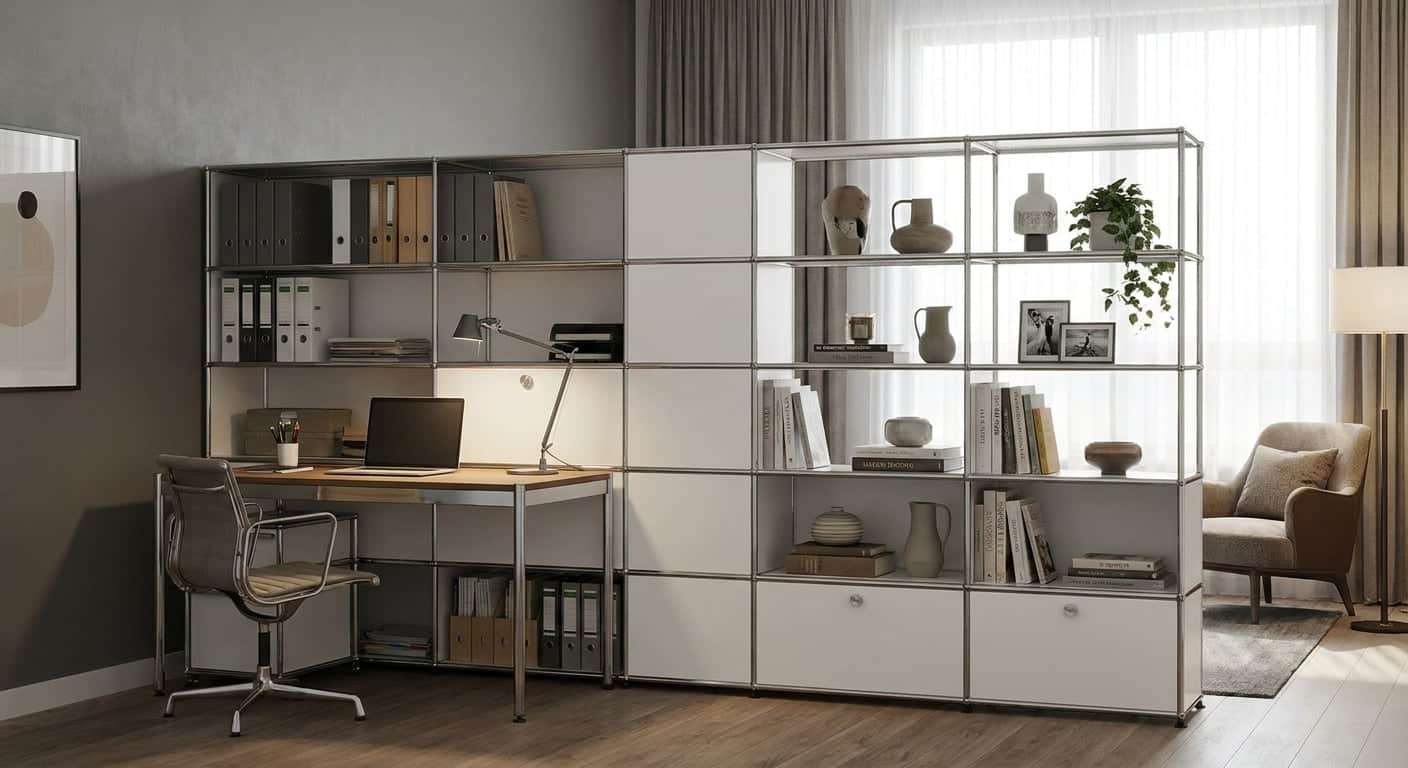
The Haller shelving system — designed by Fritz Haller and Paul Schärer in 1963 — is one of the most copied modular storage concepts in design history. If you're shopping a haller system replica in 2026, the real question isn't whether to buy one: it's knowing which buyer profile fits, what configuration to prioritize, and what separates a credible reproduction from a cheap imitation.
TL;DR: A Haller system replica suits home office builders and design-forward living room editors who want modular, steel-tube shelving at a fraction of USM's list price. The best replicas in 2026 hit the original 1:1 dimensions, use powder-coated steel spheres, and ship with enough panels to reconfigure without reordering. Skip any unit that substitutes plastic connectors or uses hollow-wall tubes — those fail under book weight within 18 months.
Why This Matters in 2026
USM Haller's official system starts well above $3,000 for a basic desk-height unit. The replica market has matured: manufacturers now source the same cold-rolled steel tubing, match the 363mm panel module, and offer the original seven cabinet colors. The gap between authentic and replica has narrowed on build quality while the price gap — often 70–80% — has stayed wide. That arithmetic drives a specific type of buyer to the replica category, and that buyer needs a guide calibrated to real use cases, not just spec sheets.
Who This Is For
This guide is for the person building a serious home office or a curated open-plan living room who already knows what the Haller system looks like and wants a version they can configure without a $10,000 commitment. You appreciate the mid-century modernist logic — steel, chrome, geometric repetition — but you're not buying for resale value or a collector's provenance. You want structural integrity, color fidelity to the original palette, and a system you can extend laterally or vertically as your space changes. Trade buyers sourcing for a client fit here too, provided the client brief calls for an iconic modernist aesthetic at a controlled budget.
What to Look for in a Haller System Replica
Connector Sphere Quality
The ball-joint connector is the system's structural core. Authentic USM spheres are precision-machined steel with 19 connection ports. A replica worth buying matches that port count exactly and uses solid steel — not zinc alloy or, worse, reinforced plastic. Tap the sphere: hollow sounds mean hollow strength. Under a loaded shelf configuration, plastic connectors deform within months.
Tube Diameter and Wall Thickness
USM Haller uses 18mm outer-diameter cold-rolled steel tubes. Replicas that reduce to 16mm or thin the wall gauge below 1.5mm lose torsional rigidity across longer spans. Ask for the spec sheet before ordering. A 1,200mm horizontal span carrying architecture books needs the full 18mm tube; a lighter version will bow visibly within a year.
Panel Material and Finish
The original system offers steel-sheet panels in seven colors. Quality replicas match this with powder-coated steel, not MDF with a metallic film. MDF panels expand with humidity, misalign the tube connections over time, and chip at corners. Powder-coated steel panels hold dimension through humidity cycles and clean with a damp cloth without damage.
Modular Compatibility Across Orders
One of the Haller system's core design promises is that every piece ordered in any year connects to every other piece. A credible replica manufacturer holds the same 363mm module tolerance across production runs. Verify this before committing to a large order: ask whether panels and tubes from a 2024 order mate with a 2026 extension. If the manufacturer can't confirm tolerances, reconfiguration becomes a replacement exercise.
Color Accuracy to the Original Palette
The seven original USM colors — pure white, anthracite, ruby red, golden yellow, Sahara beige, grey, and chrome — are specific RAL codes, not approximations. A replica that ships a near-white instead of pure white will read differently under natural light and sit awkwardly against architecture that references the real palette. Request physical color swatches, not screen samples.
Shipping and Assembly Logistics
A full home office configuration — two bays wide, desk height, with four panels — ships in multiple cartons weighing 60–80kg total. Verify that the seller ships insured, provides carton-by-carton part manifests, and includes a torque spec for the butterfly screws. Missing fasteners in a modular steel system aren't a minor inconvenience: they make the unit structurally incomplete. Sellers that ship with spare fasteners and photo assembly guides signal better quality control.
Top Picks
The Safe Pick — White, Desk-Height, Two Bays
Hook: This is the configuration that maps 1:1 to the most common home office footprint: 1,200mm wide, 750mm high, two vertical bays.
Spec that matters: 18mm cold-rolled steel tubes, 363mm panel module, powder-coated pure white (RAL 9010).
Concrete number: Desk-height two-bay configurations from reputable replica suppliers in 2026 range from $480 to $720, versus $3,400+ from USM direct.
What to watch: Confirm sphere port count is 19 before ordering. Some suppliers reduce to 13-port spheres to cut cost — this limits future vertical extensions to 3 levels maximum.
Verdict: Buy — for anyone who needs a functional, visually accurate home office system without a four-figure commitment.
The Wildcard — Floor-to-Ceiling Library Configuration
Hook: Running a Haller replica to ceiling height (typically 2,400–2,700mm) transforms a wall into an architectural feature. Few buyers attempt this with a replica, which is why it works: the visual weight reads the same as the authentic, at a fraction of the cost.
Spec that matters: You'll need 4–5 vertical tube segments per column; confirm the seller stocks 500mm and 750mm tube lengths, not only 363mm modules.
Concrete number: A floor-to-ceiling three-bay library configuration in 2026 runs $950–$1,400 from quality replica suppliers.
What to watch: At ceiling height, lateral bracing matters. The horizontal tubes at the top bay must connect wall to wall, or the configuration will sway. Build the top row as a closed rectangle, not an open shelf.
Verdict: Consider — strong choice for design-forward living rooms; requires more planning and a supplier who will confirm tube length availability before you order.
The Specialty Pick — Open Credenza in Anthracite
Hook: A low-run credenza configuration (one shelf height, 1,800mm wide, anthracite RAL 7016) is the most furniture-like deployment of the Haller system — less office, more dining room or living room anchor.
Spec that matters: Panel width at 363mm means a three-bay credenza sits at 1,089mm wide before tube diameter is added; confirm clearance in your space.
Concrete number: Credenza-format replicas in anthracite run $560–$800 in 2026 for a two-bay low unit.
What to watch: Anthracite is the color most frequently approximated rather than matched. If the supplier's swatch reads dark grey-blue rather than neutral anthracite, it will clash against warm wood flooring.
Verdict: Buy — best visual impact per dollar in the replica category; pairs well with walnut or blackened oak furniture.
What to Avoid
- Plastic connector spheres marketed as "polished chrome." Under 10–15kg of panel load, these crack at the screw threads. Chrome-plated steel is fine; polished plastic is not. The distinction is in the weight of the sphere — genuine steel connectors weigh approximately 180–200g each.
- Suppliers who sell only "starter kits" with no extension compatibility. If the product page shows no way to order additional tubes and panels separately, you are buying a fixed unit, not a modular system. The Haller system's entire value proposition is reconfigurability — a supplier who can't support that kills the concept.
- MDF panels with metallic surface wrap. They look identical in photos. In person, the texture is subtly different, and under direct light you'll see the wrap seams at panel edges. More critically, humidity cycling in kitchens or rooms with variable HVAC causes MDF to swell, and once a panel is 0.5mm out of spec it no longer slides cleanly into the tube connections.
Comparison Table
| Configuration | Price Range (2026) | Sphere Type | Panel Material | Best Room Use | Verdict |
|---|---|---|---|---|---|
| Desk-height, 2-bay, white | $480–$720 | Steel, 19-port | Powder steel | Home office | Buy |
| Floor-to-ceiling, 3-bay | $950–$1,400 | Steel, 19-port | Powder steel | Living room/library | Consider |
| Low credenza, 2-bay, anthracite | $560–$800 | Steel, 19-port | Powder steel | Dining/living room | Buy |
| Budget kit (plastic spheres) | $200–$350 | Plastic/alloy | MDF wrap | — | Skip |
FAQ
What is a Haller system replica?
A Haller system replica is a modular steel shelving unit that reproduces Fritz Haller and Paul Schärer's 1963 USM Haller design — the steel tube frame, ball-joint connectors, and interchangeable panels — at a lower price point than the original.
Is a haller system replica structurally safe for books and heavy loads?
Yes, if the tubes are 18mm cold-rolled steel with 1.5mm wall thickness and the spheres are solid steel. A properly spec'd replica holds 30–40kg per shelf panel. Replicas with plastic connectors or thin-wall tubes are not safe for heavy loads.
How close are replica colors to the original USM palette?
Top-tier replica suppliers match original RAL codes within one delta E unit on a calibrated display. Always request a physical swatch — screen representation of RAL 9010 pure white versus a slightly warm off-white is impossible to judge accurately on a monitor.
Can I mix a Haller system replica with authentic USM pieces?
In theory, if the replica holds the 363mm module tolerance to within 0.5mm, connections will mate. In practice, most replica manufacturers do not publish their tolerance data, and mixing is not reliable. Build the system from one source.
How long does a quality haller system replica last?
Powder-coated steel with solid steel spheres shows no structural degradation over 10–15 years under normal residential loads. The failure point on all steel systems is fastener corrosion — store spare butterfly screws in a dry location.
What rooms work best for a Haller system replica?
Home offices, living room library walls, dining room credenzas, and open-plan entry areas. The system is not water-resistant and performs poorly in kitchens or bathrooms without a protective enclosure.
Is a Haller system replica worth it compared to buying used USM?
Used USM Haller in good condition rarely dips below $1,500 for a desk-height unit, and extensions add cost with no guarantee of color or generation match. A new quality replica at $500–$800 for the same footprint, with full modular compatibility within that system, is the better value for most buyers in 2026.
What's the difference between a 13-port and a 19-port sphere?
A 19-port sphere allows connections in all spatial directions — up, down, left, right, front, back, and diagonals — giving full reconfigurability. A 13-port sphere omits diagonal ports, which limits certain configurations and prevents some lateral extension paths.
One Last Thing
The original Haller system was designed for the USM factory floor in Münsingen, Switzerland — a working industrial building, not a showroom. Haller's intent was furniture that reconfigures as the work changes, not a permanent installation. The replica market in 2026 has finally matured enough to honor that logic: the best replicas ship extra fasteners, publish module tolerances, and sell tubes and panels à la carte. If a supplier doesn't offer à la carte extensions, they're selling a static shelving unit with Haller aesthetics — not the system itself. That distinction is worth checking before any order.